Key Takeaways
- A $400,000 portfolio split evenly across Bristol Myers Squibb, HP and KeyCorp pays about $15,800 a year in dividends, or about $1,320 a month.
- None of the three dividends looks at risk today, but Bristol Myers Squibb’s is the one to watch.
- HP’s dividend took 28% of free cash flow over its last reported twelve months, while Bristol Myers Squibb’s took 55% and faces a $1.5 billion to $2 billion drop in Eliquis sales in 2027.
- If Bristol Myers Squibb halved its dividend, the income would fall to about $13,100 a year, and to about $10,300 if it stopped paying.
Bristol Myers Squibb (BMY), HP (HPQ) and KeyCorp (KEY) all yield more than 4% today. But a yield is only as good as the business paying it.
Let’s take a hypothetical $400,000 portfolio with a third in each. At today’s prices, that buys about 2,230 shares of Bristol Myers Squibb, about 4,610 of HP and about 6,730 of KeyCorp.
At each company’s current rate, those dividend checks add up to $15,806 a year, about $1,320 a month. That’s a 4.0% yield on this part of the portfolio. (Of course, no one should ever own just three stocks.)
| Stock | Shares | Cost | Income a year | Share of income | Coverage |
|---|---|---|---|---|---|
| Bristol Myers Squibb | 2,181 | $133,303 | $5,496 | 34% | 55% of free cash flow (TTM) |
| HP | 4,147 | $133,326 | $4,976 | 33% | 28% of free cash flow (TTM), 36% forward |
| KeyCorp | 6,504 | $133,332 | $5,333 | 33% | 55% of normalized EPS (fiscal 2025), 44% forward |
Source: TIKR and StockAnalysis, at today’s prices. Forward coverage is fiscal 2026 consensus.
6 safe dividend stocks paying retirees 6%+ yields
There are over 100 stocks paying 6%+ annual dividends today.
But after an extensive investment review leveraging TIKR’s proprietary data, we now believe only six of them are truly safe for retirees.
They’re all yours as part of our new investment report. Learn more about how to get access right here.
Bristol Myers Squibb is racing its own patent cliff
Bristol Myers Squibb’s check rests on its newer drugs outgrowing its older ones. Its Growth Portfolio brought in $7.7 billion in the third quarter of 2026, up 12% from a year before, while generics cut Revlimid’s sales 47% and Pomalyst’s 81%. Eliquis grew 26%, but on its Oct. 29 call, management said it expects a $1.5 billion to $2 billion step-down in Eliquis sales in 2027 as the drug loses exclusivity in Europe.
Dividends took 55% of free cash flow over the twelve months to Sept. 30, 2026. That’s more than in any fiscal year from 2021 to 2025, when they took 28.9% to 39.3%, after free cash flow fell to $9.29 billion from $15.3 billion over the twelve months before. It’s still well-covered, and free cash flow has paid for the dividend every year since fiscal 2017:
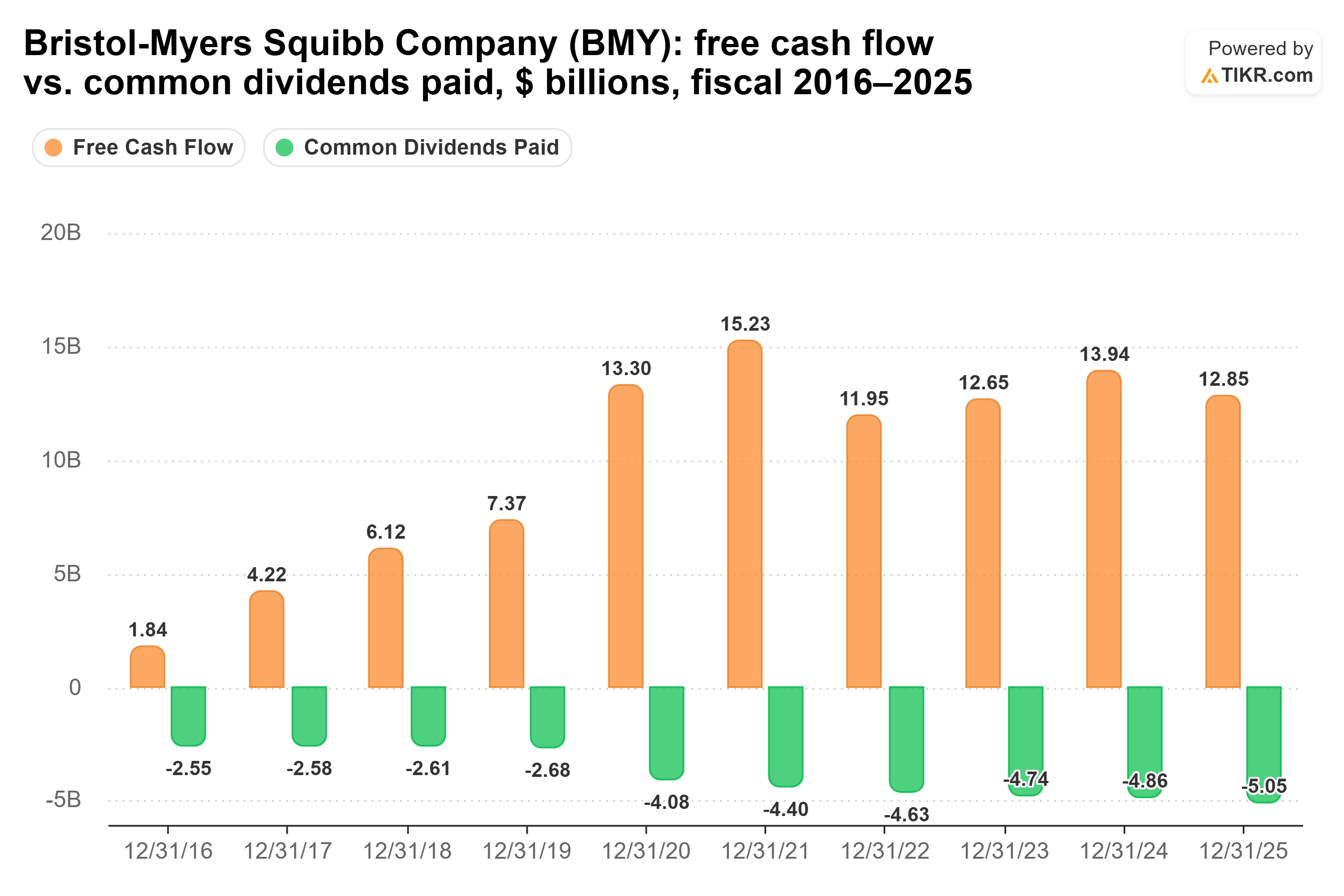
CFO David Elkins said on that call that business development “remains a priority,” alongside “our commitment to the dividend,” so a big deal would compete with the dividend for cash. On Nov. 23, the company said Elkins will leave on March 1, 2027, and reaffirmed its 2026 guidance.
HP pays out the least
HP’s PC business is doing the heavy lifting. Personal Systems revenue rose 18% from a year before to $11.8 billion in the quarter ended July 31, 2026, while Printing slipped 2% to $3.9 billion on competitive pricing and lower volumes.
Even so, its dividend has the most room of the three. It took 28% of free cash flow over the twelve months to July 31, 2026. Analysts’ $3.13 billion of fiscal 2026 free cash flow, inside HP’s raised guide of $3.0 billion to $3.2 billion, puts it at 36%. Free cash flow has covered the dividend every year on the chart:
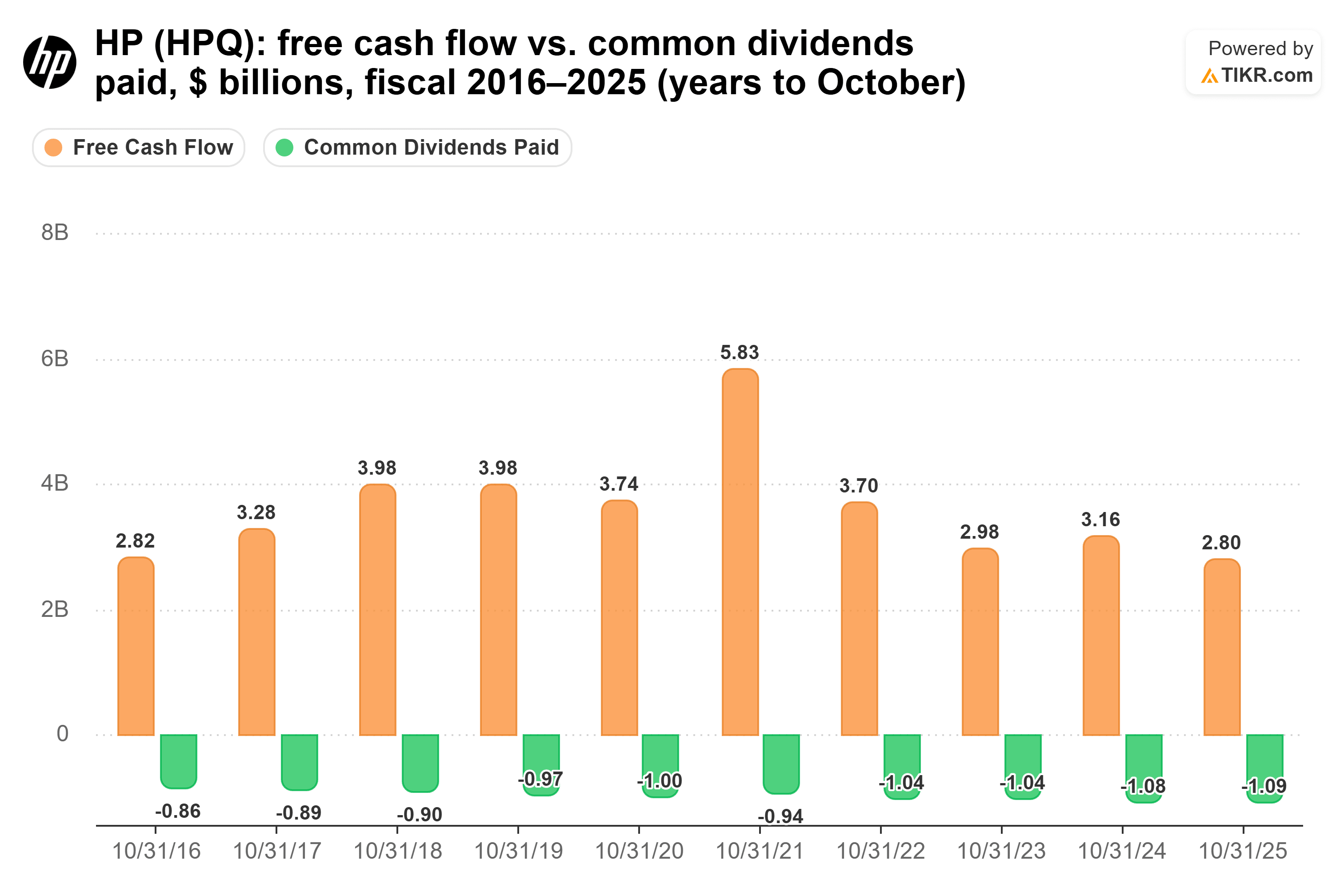
HP aims to return “approximately 100% of our free cash flow to shareholders over time” while gross leverage stays under 2x. So buybacks take whatever the dividend doesn’t, and I’d expect them to give first if cash got tight. On Nov. 4, HP named Emma Walmsley, GSK’s former CEO, to take over from interim CEO Bruce Broussard on Jan. 4, 2027.
KeyCorp held its dividend through a lean stretch
KeyCorp, judged on normalized EPS as a bank, kept paying $0.82 a share in fiscal 2023, 2024 and 2025, even as normalized EPS fell to $0.88 in fiscal 2023.
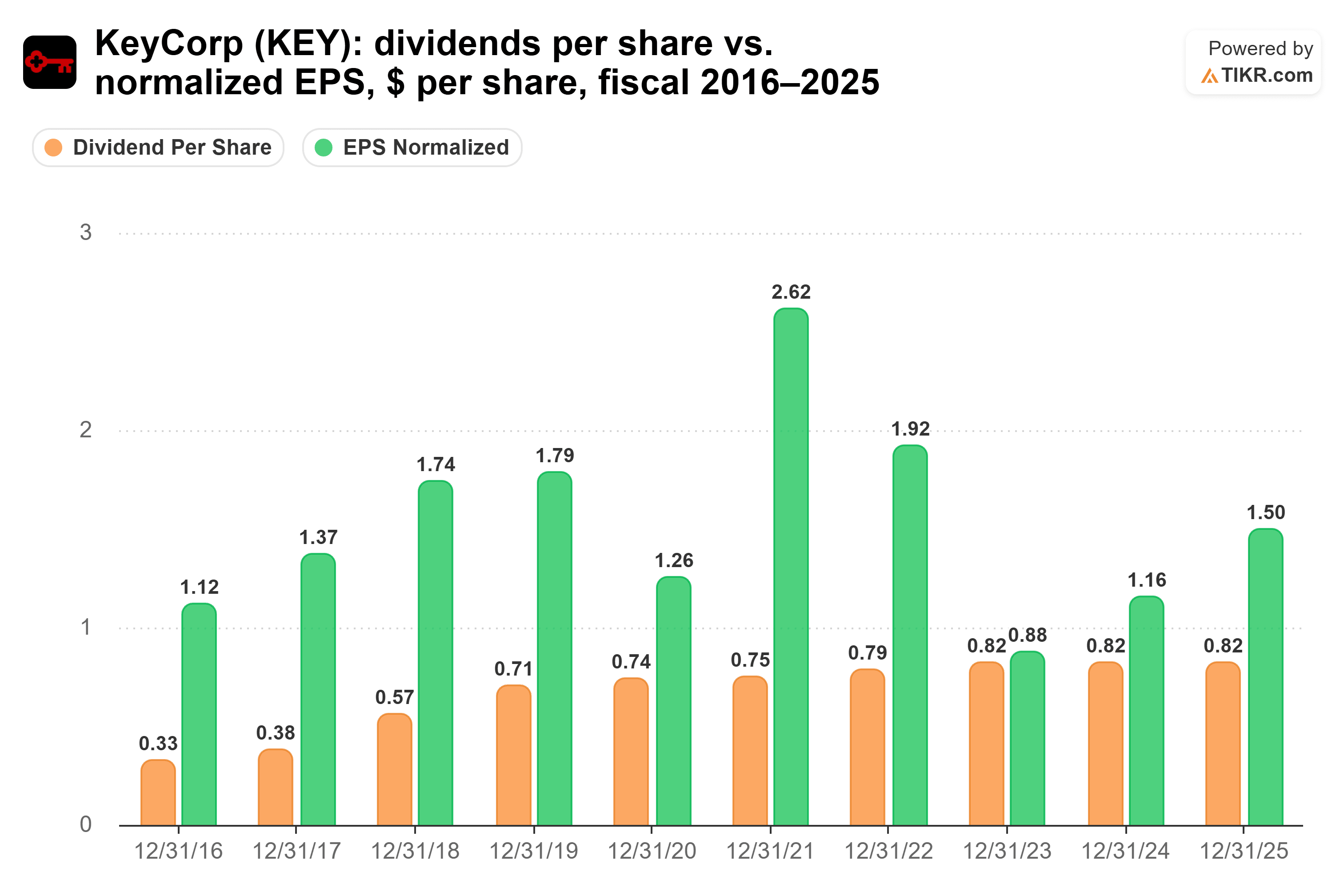
That year the dividend took a risky 93.2% of earnings. By fiscal 2025, with normalized EPS back to $1.50, it took 55%.
The recovery kept going in the third quarter of 2026. GAAP EPS from continuing operations rose to $0.51 a diluted share from $0.41 a year before, and net charge-offs fell to 0.32% of average loans from 0.42%. Management expects net interest income to grow about 10% in 2026. On analysts’ fiscal 2026 consensus of $1.89 of normalized EPS, the payout ratio would be a comfortable 44%.
KeyCorp’s promise is to maintain the dividend, which management ranks third among its uses of capital, ahead of buybacks. On Nov. 12, the board declared another $0.205 quarterly payment, the same $0.82 yearly rate as the last three fiscal years.
Bristol Myers Squibb is the check to watch
The way I see it, none of these three checks looks at risk today. HP’s has the most room, and KeyCorp’s looks safe but slow. Bristol Myers Squibb’s is the least covered on its own measure, so it’s the one to test.
If it halved its dividend, this portfolio’s income would fall from about $15,800 a year to about $13,100, and to about $10,300 if it stopped paying altogether. Being the most at risk of the three doesn’t make it risky, though: its free cash flow still left plenty over after the dividend in the last twelve months.
The real test comes in 2027, when the Eliquis step-down hits. Bristol Myers Squibb expects results in the first quarter of 2027 from its trial of milvexian in atrial fibrillation. As long as free cash flow stays well above the dividend through that stretch, I’m happy collecting all three checks.
Enjoy your retirement in style with these safe 6%+ dividend yields
Dividends can hold the key to enormous wealth. But only if you buy the right ones.
Picking the right high-yield dividend stock can be the difference between a dream retirement…and scraping by every month, waiting for the next Social Security check to clear.
We’ve identified six stocks yielding 6%+ that we believe every retiree should know about right now.
Disclaimer:
Please note that the articles on TIKR are not intended to serve as investment or financial advice from TIKR or our content team, nor are they recommendations to buy or sell any stocks. We create our content based on TIKR Terminal’s investment data and analysts’ estimates. Our analysis might not include recent company news or important updates. TIKR has no position in any of the stocks mentioned. Thank you for reading, and happy investing!