Key Takeaways
- The FAA certified the 737 MAX 10 on October 20, unlocking more than 1,555 orders that make up over 30% of Boeing’s 737 backlog.
- A dispute with supplier Vaero halted 777 freighter production for nearly two months, costing Boeing as much as $6.5 million per day.
- Boeing still posted a Q2 core loss of $0.76 per share despite 67% revenue growth and a record $715 billion backlog.
- The October 27 Q3 report will show whether September’s 57 deliveries and the 737 ramp can offset widebody and defense bottlenecks.
Boeing finally has its biggest 737. Now it needs the rest of its supply chain to keep up.
The FAA certified the 737 MAX 10 on October 20, closing out a program that originally targeted deliveries in 2020. Days later, Reuters reported that a parts dispute had idled 777 freighter production for nearly two months.
So Boeing (BA) walks into its October 27 Q3 report with one solved problem and one fresh one.
The stock barely reacted to either. Shares closed at $188 on October 23, up 0.4% on the day but down 19.6% over six months, just above the 52-week low of $177.
(Analysts still see plenty of room. The Street target is $267, about 42% above the current price.)
A certification and a stalled line
By dollars, the MAX 10 news matters more. Boeing holds more than 1,555 orders for the jet from over 30 customers, which is more than 30% of its 737 backlog. The MAX 10 seats up to 230 passengers, compared with 195 on the MAX 9.
Freighters are the more urgent story:
- Boeing alleged that Florida supplier Vaero stopped shipping trailing-edge rib kits, a critical wing part.
- The disruption cost as much as $6.5 million per day and also hit 767 output, including KC-46 tankers.
- The two sides settled in late September, yet 777 freighter production had not restarted as of October 23.
Meanwhile, the narrow-body side keeps moving. Boeing delivered 57 jets in September, and Allegiant Travel (ALGT) exercised options this week for six 737-8s worth over $720 million.
Here is how quarterly revenue rebuilt as deliveries recovered…
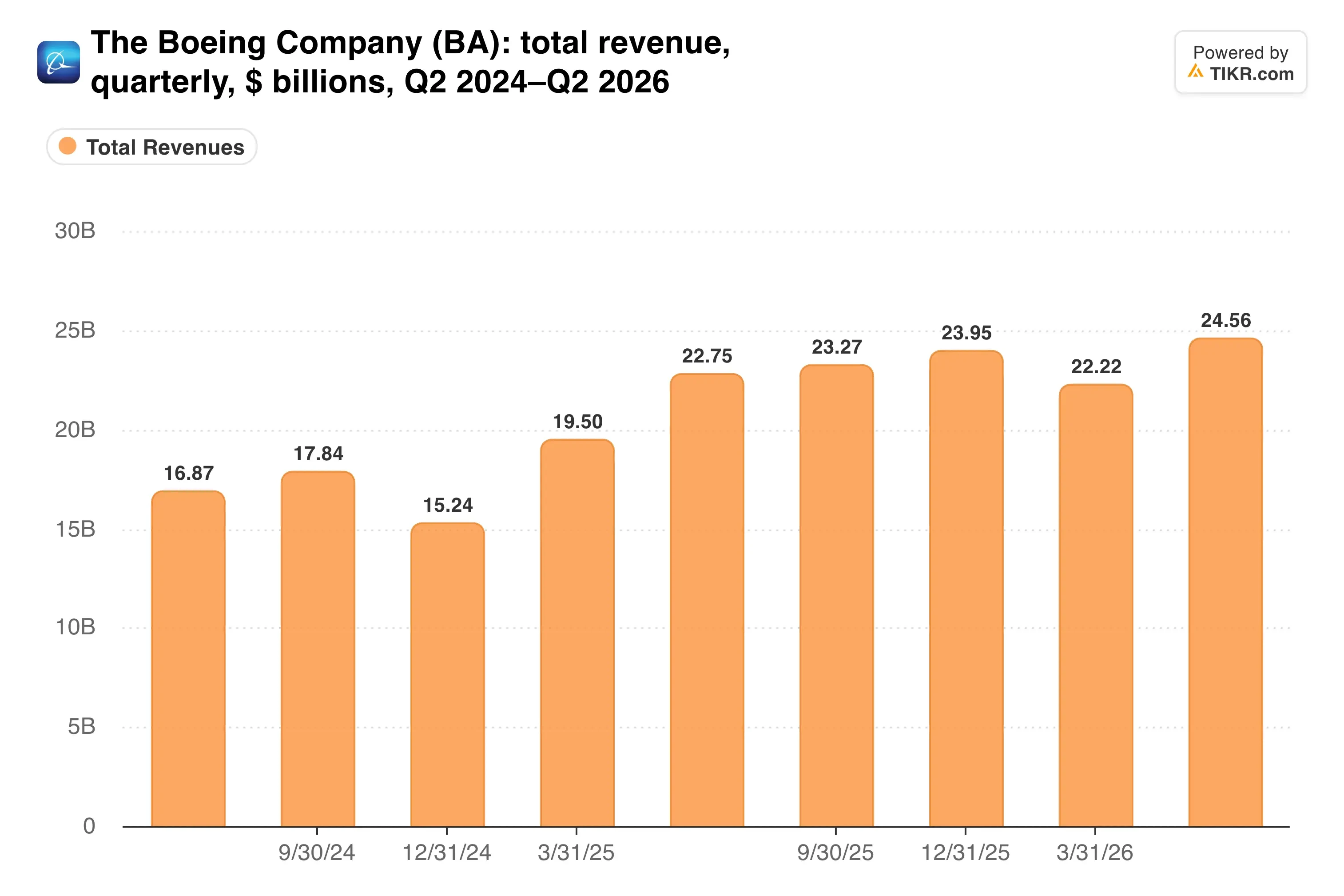
Q2 revenue reached $24.6 billion, up 67%, on 171 deliveries. The top line has stopped being the weak spot.
Why the MAX 10 matters for cash
Boeing has called the MAX 10 a major driver of cash flow, and the math supports it. A larger jet on the same line carries a higher price and spreads fixed costs across more seats.
The timing also lines up with the rate plan. Boeing began moving 737 output to 47 per month and opened low-rate production on its North Line in July. It is targeting 52 per month in 2027, the same year MAX 10 deliveries start.
That combination explains why Q2 looked better on cash than on earnings. Operating cash flow came in at $1.4 billion, and free cash flow was $600 million.
Demand looks secure. The backlog hit a record $715 billion, including more than 6,200 commercial aircraft, and Boeing booked 103 net orders in January against 49 at Airbus (AIR).
So what does the Street expect from free cash flow as the ramp continues?

The 2027 estimate is the one to watch, because that is when MAX 10 deliveries and the higher 737 rate should arrive together.
TIKR tracks 29 analysts on Boeing. How many say “Buy”?
See the full breakdown of Buy, Hold, and Sell ratings on Boeing, along with Wall Street’s revenue and earnings estimates, all in one place. More than 500,000 investors use TIKR to research stocks like this one. See Boeing’s Analyst Ratings
Losses and the multiple still bite
Revenue growth has not fixed the income statement yet. Boeing posted a Q2 core loss of $0.76 per share, wider than the $0.30 loss analysts expected, and its LTM EBIT margin sits at negative 5.4%.
The Vaero episode shows why progress keeps stalling. One supplier of one wing component froze a widebody line and disrupted a defense tanker program, and production still had not restarted weeks after a settlement.
Valuation leaves little cushion for more surprises. Boeing trades at 31.1x NTM EV/EBITDA and roughly 213x NTM earnings, because the profit base remains small.
Compare that margin profile with its only real rival:

Airbus has stayed profitable through the same industry supply squeeze, which shows how much ground Boeing still needs to recover.
My take: The MAX 10 approval removes the biggest program risk on the narrow-body side, and the backlog gives Boeing years of visibility. But I would not pay up for that yet. A $6.5 million daily hit from a single parts supplier tells me execution will decide this stock.
On October 27, watch for a restart date on 777 freighters, the Q3 cost of the Vaero dispute, and whether free cash flow stays positive. Clean answers on all three would make the $267 target look reachable.
So what is Boeing stock actually worth?
TIKR lets you forecast the future price of any stock in less than a minute. Just enter a few assumptions into TIKR’s valuation model and see what Boeing could be worth. Start from Wall Street consensus estimates, or adjust the inputs to reflect your own view of the business. It’s free to use.
Disclaimer:
Please note that the articles on TIKR are not intended to serve as investment or financial advice from TIKR or our content team, nor are they recommendations to buy or sell any stocks. We create our content based on TIKR Terminal’s investment data and analysts’ estimates. Our analysis might not include recent company news or important updates. TIKR has no position in any stocks mentioned. Thank you for reading, and happy investing!