Key Takeaways
- Third Point’s Dan Loeb says $5 trillion to $7 trillion of AI spending from 2025 to 2030 needs $2 trillion to $3 trillion of new AI revenue a year to pay back.
- That’s a third to half of today’s roughly $6 trillion of global IT spending.
- Third Point’s 13F shows it sold all its Amazon shares by Sept. 30 and opened new positions in Meta Platforms, Nvidia and Microsoft.
- Meta and Microsoft can fund a slow payback from cash flow, while Amazon and Oracle have pushed free cash flow below zero and have the most to prove.
Dan Loeb has put a price tag on the AI boom paying off, and it’s a big one.
In his latest letter to Third Point investors, an excerpt of which Zero Hedge posted on X, Loeb laid out what he called “the bear math”:
“Consensus has hyperscalers and frontier labs spending $5-7 trillion between 2025 and 2030. At a low-teens hurdle rate and sensible depreciation assumptions, that requires $2-3 trillion of incremental annual AI revenue, against roughly $6 trillion of total global IT spend today.”
Then there’s what his fund did. Third Point’s 13F for the quarter ended Sept. 30, filed Nov. 16, shows it sold all 1.75 million of its Amazon (AMZN) shares and opened new positions in Meta Platforms (META), Nvidia (NVDA) and Microsoft (MSFT), worth about $1.05 billion at quarter-end.
Meta and Microsoft are paying for their buildouts out of cash flow. Amazon and Oracle (ORCL) have pushed their free cash flow below zero to keep building.
A third to half of the world’s IT budget
Loeb’s range has to come in as new revenue every year. For scale, he notes that the two leading frontier labs generate “well over $100 billion in run-rate revenue combined.” So the target is more than 10x what the leaders bring in now.
Which, yikes.
And the bill keeps growing. Microsoft’s capital spending has nearly quintupled since fiscal 2022, reaching $116 billion in the year ended June 2026:

Microsoft can carry that. In its September quarter, Azure grew 48%, and the company kept a 40.3% net margin.
TIKR tracks 62 analysts on Amazon. How many say “Buy”?
See the full breakdown of Buy, Hold, and Sell ratings on Amazon, along with Wall Street’s revenue and earnings estimates, all in one place. More than 500,000 investors use TIKR to research stocks like this one. See Amazon’s Analyst Ratings
Amazon’s cushion got thin
Amazon is in a different spot. Its free cash flow fell to $7.7 billion in 2025, from $32.9 billion the year before:
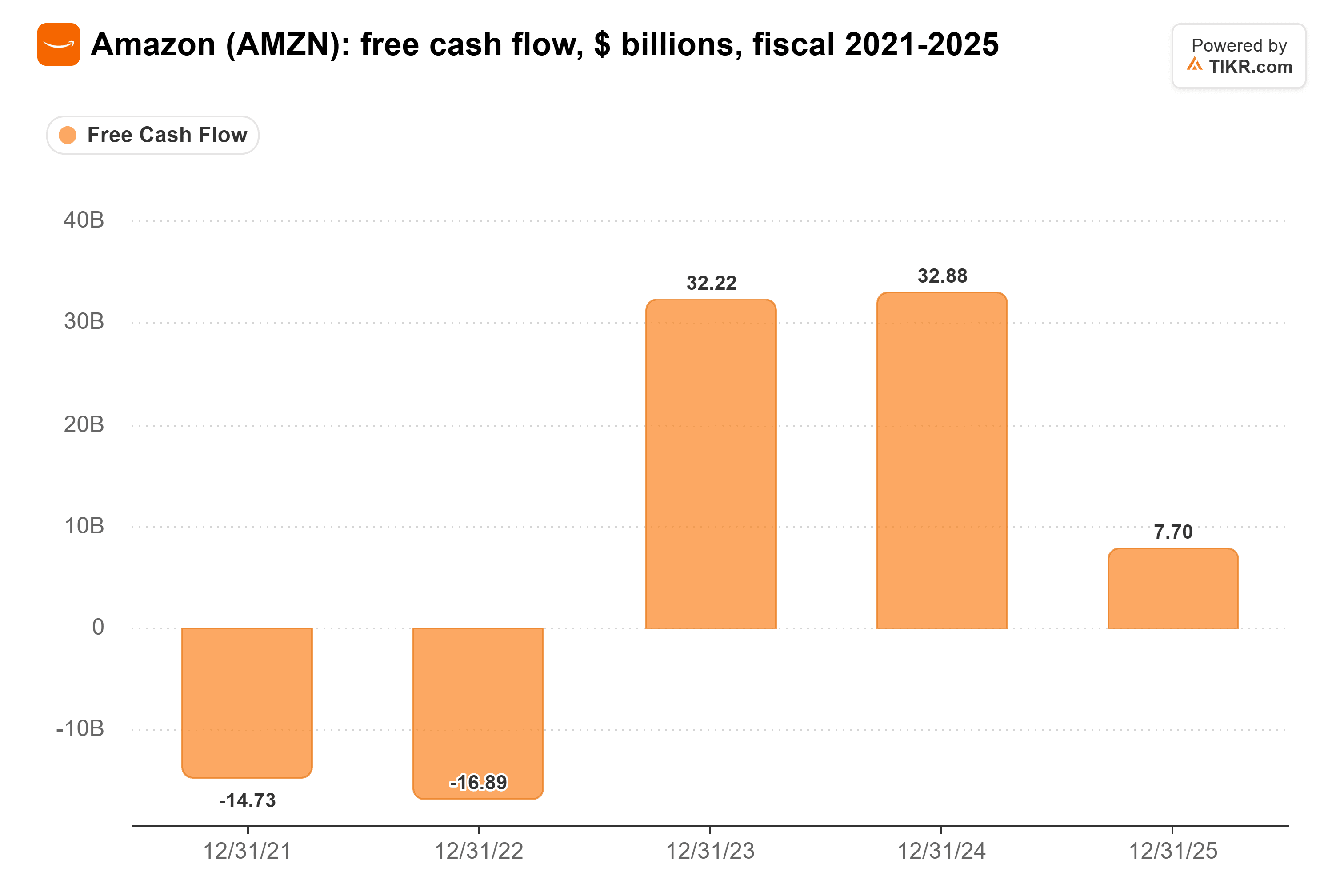
CEO Andy Jassy expects about $220 billion of capex this year and “meaningfully more” in 2027, and analysts expect free cash flow to be a $41.2 billion outflow for 2026. The 13F doesn’t say why Third Point sold. But if you take the bear math seriously, Amazon is one of the big spenders with the least room to wait for the revenue to show up.
Oracle has even less room. Its free cash flow was negative $5 billion in the quarter ended Aug. 31, and it sold $20 billion of stock in that quarter to help pay for the build. S&P has said OpenAI accounts for about half of its $664 billion backlog.
Meta can afford to wait
Meta is now Third Point’s largest reported holding, at $475 million. It turned out $46.1 billion of free cash flow in 2025 while spending heavily on AI, down from $54.1 billion in 2024:
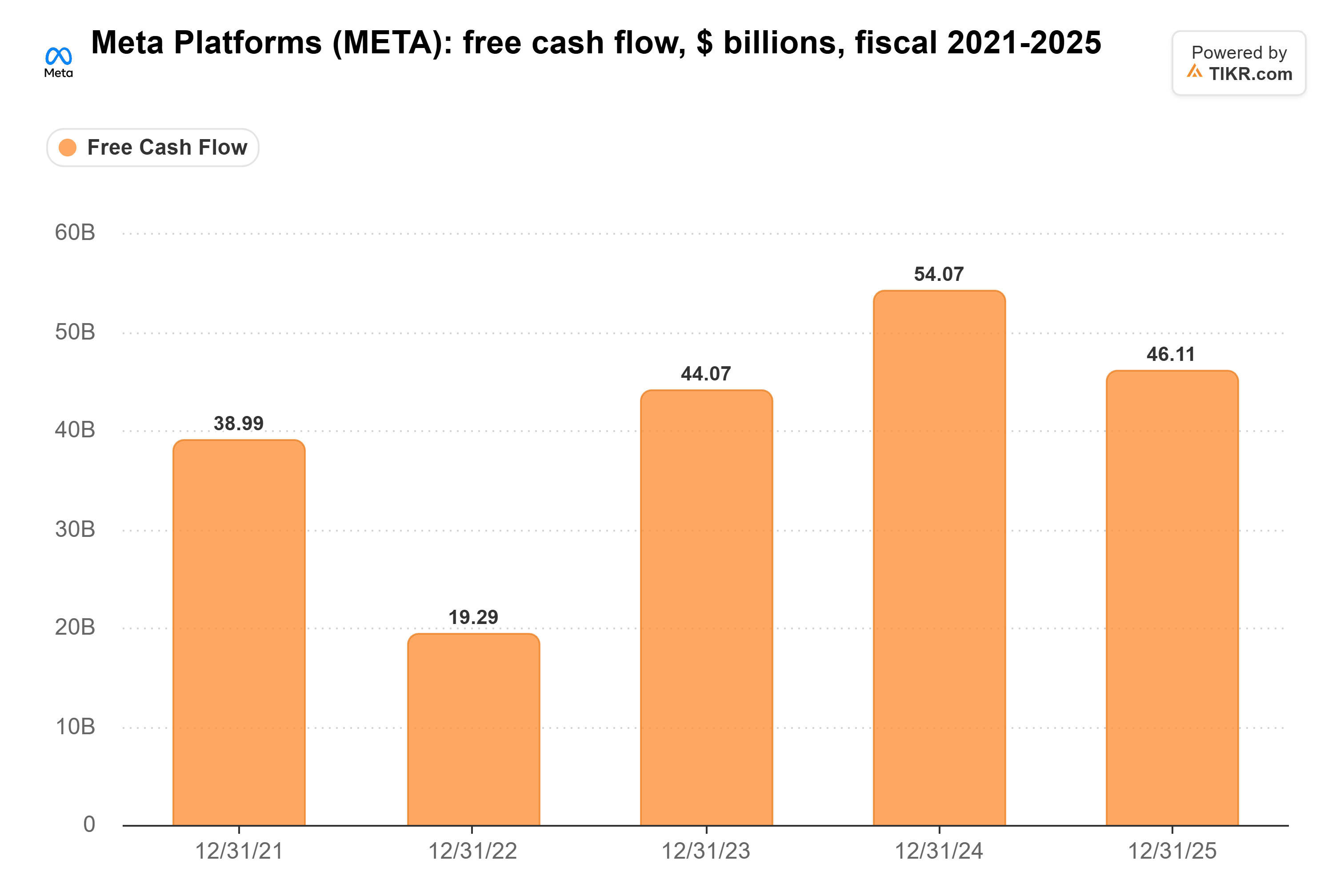
Meta pays for all of it with ads: third-quarter revenue rose 26.1% to $64.60 billion. If AI revenue arrives later than hoped, Meta can keep spending out of its own pocket in the meantime.
Nvidia is the tell
The Nvidia buy is the most telling one. Nvidia sells the chips the spenders are buying, so if spending slows, Nvidia takes the hit first. For now the orders keep pouring in: fiscal third-quarter revenue more than doubled, up 103.2% to $115.84 billion, and management guided to $130 billion, plus or minus 3%, for the fourth quarter.
My read: Loeb treats the bear math as a real risk, and he still expects the spending to keep coming for now. Owning Nvidia and the two spenders with the deepest pockets fits that view.
Own the spenders who can wait
Until someone shows AI can bring in that much new revenue, I’d rather own the companies that can pay for the wait out of cash flow, and that’s Meta and Microsoft. Amazon’s demand looks real: Jassy says much of its compute is already reserved through 2027 and into 2029. Still, it’s the big spender most exposed if the payback runs late.
The next test comes in early February, when Amazon guides 2027 capex with its fourth-quarter results. If that guide lands well above the $278.2 billion analysts expect, its free cash flow likely stays negative for longer. Oracle reports Dec. 10, and Third Point’s next 13F, due in mid-February, will show whether it still holds all three.
So what is Amazon stock actually worth?
TIKR lets you forecast the future price of any stock in less than a minute. Just enter a few assumptions into TIKR’s valuation model and see what Amazon could be worth. Start from Wall Street consensus estimates, or adjust the inputs to reflect your own view of the business. It’s free to use.
Disclaimer:
Please note that the articles on TIKR are not intended to serve as investment or financial advice from TIKR or our content team, nor are they recommendations to buy or sell any stocks. We create our content based on TIKR Terminal’s investment data and analysts’ estimates. Our analysis might not include recent company news or important updates. TIKR has no position in any of the stocks mentioned. Thank you for reading, and happy investing!