Key Takeaways
- Andy Jassy expects Amazon to spend about $220 billion on capex this year and “meaningfully more” next year.
- The spending looks likely to pay off, since customers have reserved much of the capacity through 2027 and beyond.
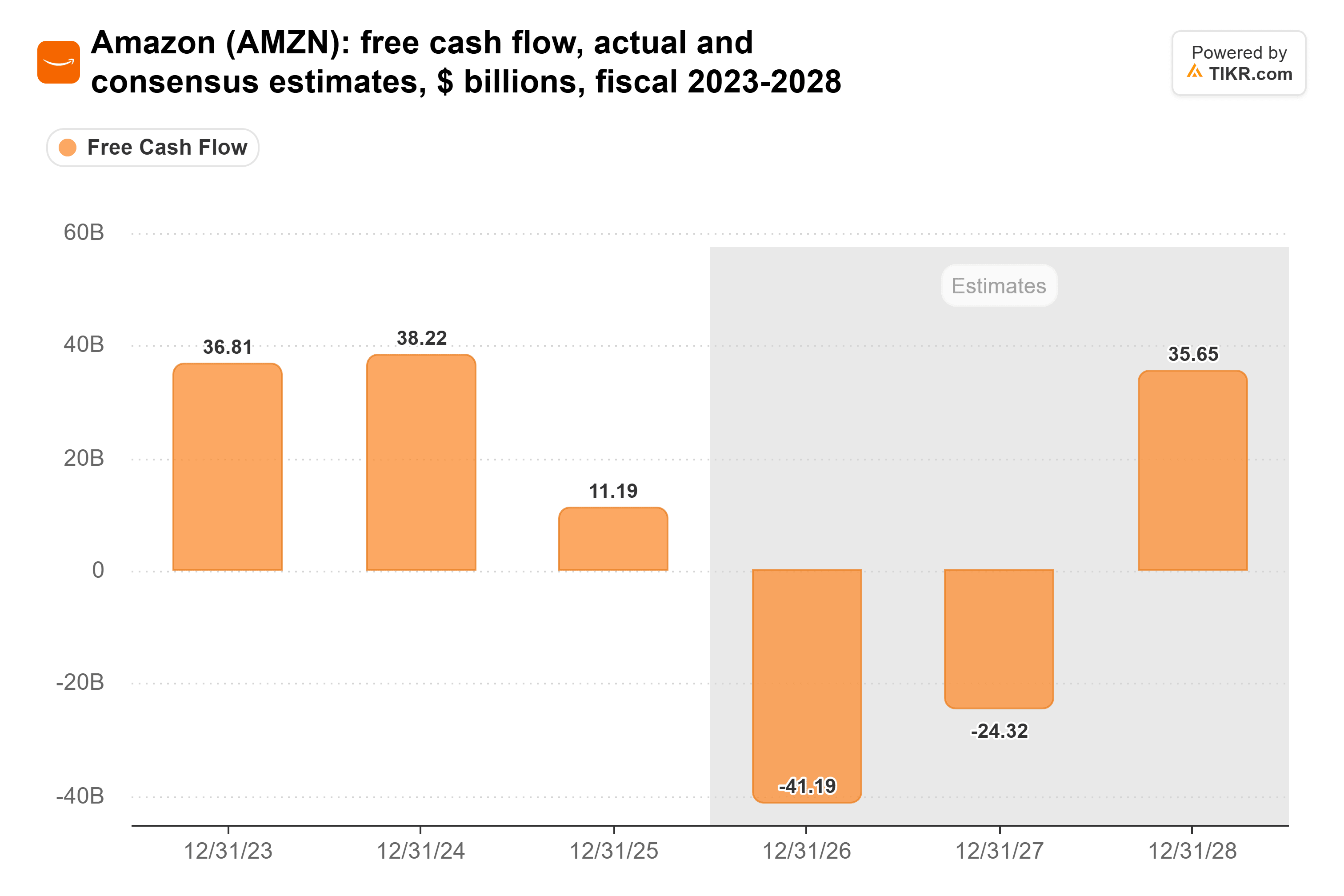
- Analysts expect a $41.2 billion free cash flow outflow in 2026, and much of what AWS has sold went to OpenAI and Anthropic, two labs Amazon also funds.
- The next test is Amazon’s 2027 capex outlook, likely in early February.
Amazon (AMZN) CEO Andy Jassy isn’t tapping the brakes.
Asked on CNBC’s Halftime Report on Nov. 17 whether Wall Street was right to expect much bigger capex budgets over the next two years, he said: “we expect to spend around $220 billion this year in CapEx and that we expect to spend meaningfully more next year.”
Jassy had sized up the business a few minutes earlier: “in the first three years of this generative AI wave, our AI revenue in AWS is over $25 billion.”
So this year’s budget alone is nearly 9x AWS’s AI revenue. (Not all of it goes to AI, of course, but AWS took 76% of the property and equipment Amazon added in the first half of 2026.)
His case rests on demand he can already see: “the big chunks of compute are largely reserved for us in 27 and a good chunk of that in 28 and actually a fair bit in 29.”
Amazon is paying for it now
Jassy’s promise is that “we will be a much larger revenue business, a much larger free cash flow business in the coming years because of this investment.”
Analysts see that turn too, just not yet: free cash flow going from $38.2 billion in 2024 to a $41.2 billion outflow this year, staying negative in 2027 and recovering to $35.7 billion in 2028:
The spending behind that swing had been rising before this year’s budget, from $52.7 billion in 2023 to $132 billion in 2025:
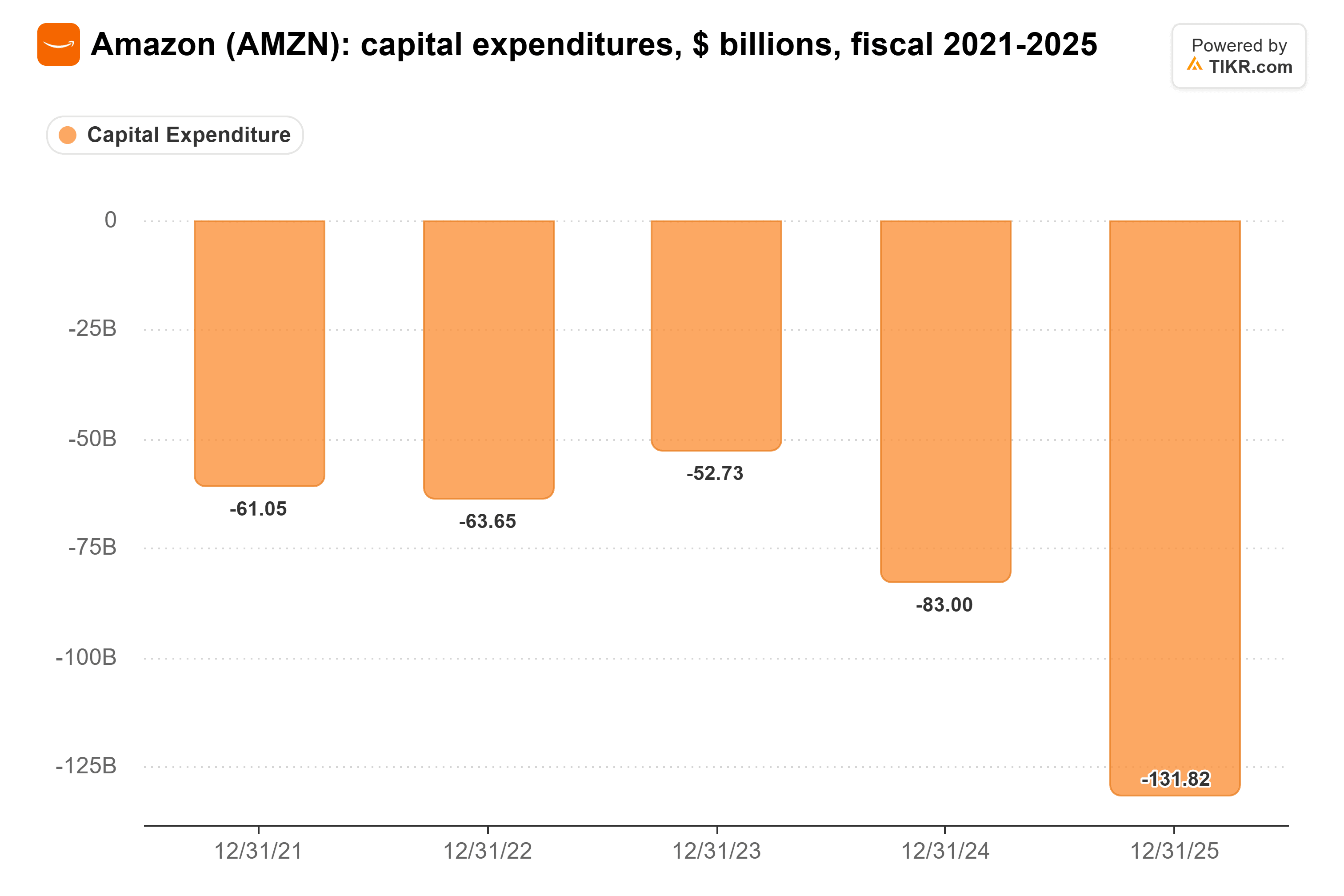
This year’s $220 billion is two-thirds more again, and Amazon’s long-term debt nearly doubled in the first half of 2026, to $128.9 billion.
TIKR tracks 62 analysts on Amazon. How many say “Buy”?
See the full breakdown of Buy, Hold, and Sell ratings on Amazon, along with Wall Street’s revenue and earnings estimates, all in one place. More than 500,000 investors use TIKR to research stocks like this one. See Amazon’s Analyst Ratings
Sold, and much of it to two labs
On Prof G Markets, D.A. Davidson analyst Gil Luria said Jassy can promise about 40% growth in each of the next two years because “he’s already sold all that capacity,” and to far more buyers than Anthropic and OpenAI.
The numbers back the first part. AWS revenue grew 39% to $46.0 billion in the third quarter, its fastest growth in nearly five years. On Amazon’s third-quarter call, Jassy put AWS’s backlog at $578 billion.
The second part is harder to check. OpenAI expanded its AWS commitment by $100 billion over eight years in the first quarter, and Anthropic added more than $100 billion over ten years in the second. Together, that’s more than a third of the backlog. And Amazon helps fund both: it has put $50 billion into OpenAI this year and $18 billion into Anthropic since 2023.
A margin built on full data centers
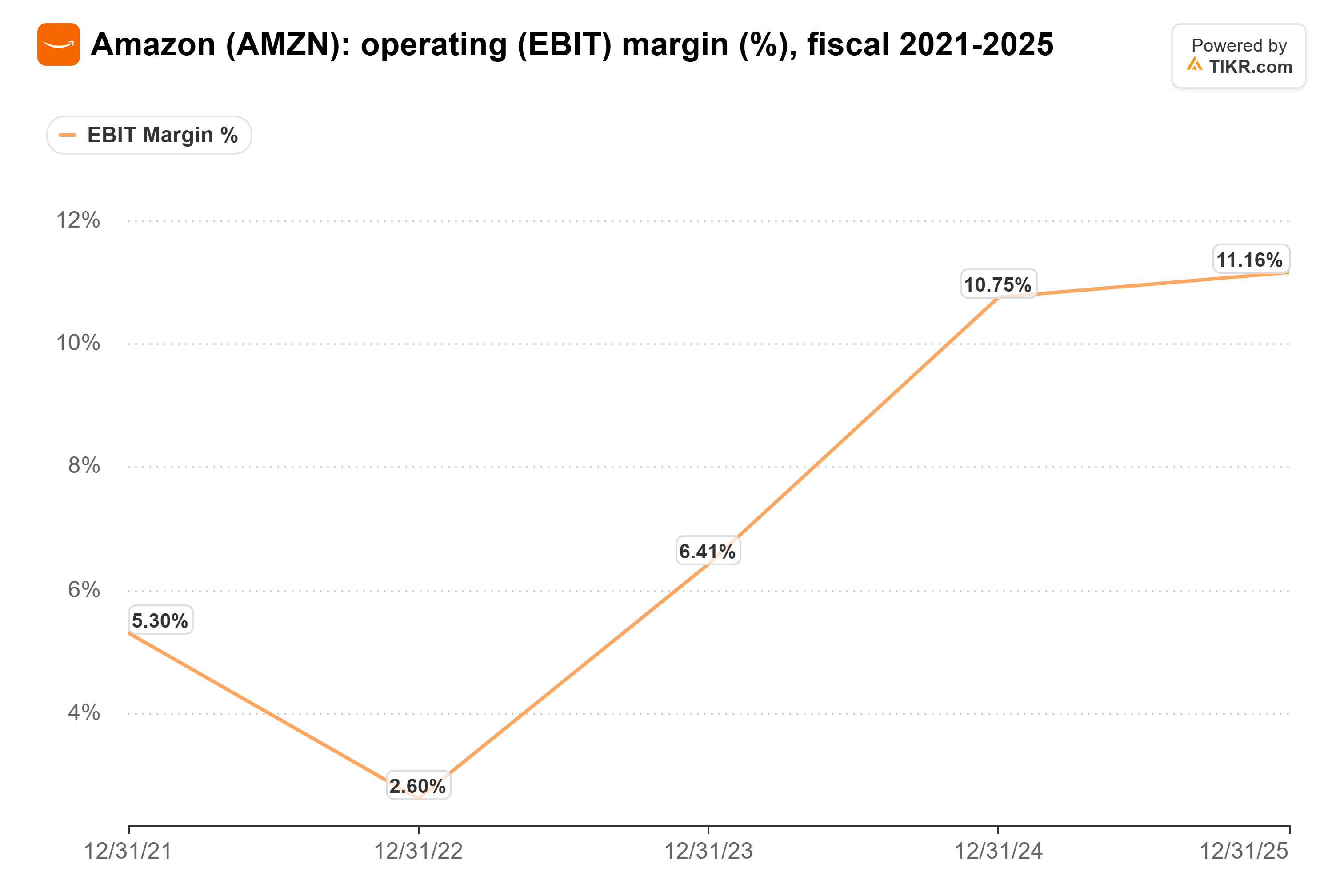
So far, Amazon’s operating margin has climbed right through the build, from 2.6% in 2022 to 11.2% in 2025:
Depreciation, though, has grown as a share of AWS’s sales, from 12.4% in 2024 to 19.1% in the second quarter of 2026. If AI demand cooled before the contracts ran their course, Amazon would be stuck with record depreciation on capacity it couldn’t fill.
I’d bet on the spending paying off
AWS growth keeps speeding up on capacity customers have already reserved, so I think the spending pays. What I’d watch is whether OpenAI and Anthropic can keep paying.
The next test is Amazon’s fourth-quarter report in early February, which is likely to put a number on 2027 capex. Luria expects Amazon, Microsoft and Google to spend 25% to 50% more on capex next year, which for Amazon would mean roughly $275 billion to $330 billion. A budget near the low end, with AWS still growing about 40%, keeps the 2028 recovery in sight. One near the top pushes it further out.
So what is Amazon stock actually worth?
TIKR lets you forecast the future price of any stock in less than a minute. Just enter a few assumptions into TIKR’s valuation model and see what Amazon could be worth. Start from Wall Street consensus estimates, or adjust the inputs to reflect your own view of the business. It’s free to use.
Disclaimer:
Please note that the articles on TIKR are not intended to serve as investment or financial advice from TIKR or our content team, nor are they recommendations to buy or sell any stocks. We create our content based on TIKR Terminal’s investment data and analysts’ estimates. Our analysis might not include recent company news or important updates. TIKR has no position in any of the stocks mentioned. Thank you for reading, and happy investing!