Key Takeaways
- Steve Eisman says the yield on CoreWeave’s bonds climbed from 9% at issue to 15%, and that he doesn’t trust its management.
- CoreWeave’s 2031 bonds recently yielded about 18%, while its banks are discussing a $4.5 billion loan backed by its Meta Platforms contract at 7% to 7.5%.
- Lenders will fund Meta’s contract cheaply, but CoreWeave’s own credit keeps getting more expensive, and shareholders are last in line.
- Nebius borrows to build GPU capacity, and Nvidia sells CoreWeave its chips and owns a stake in it, so CoreWeave’s next unsecured bond matters to both.
CoreWeave (CRWV) has a $4.5 billion loan to sell, and lenders look happy to buy it as long as its contract with Meta Platforms (META) stands behind it.
Steve Eisman, the investor made famous by The Big Short, is looking at the rest of the balance sheet. On the latest weekly wrap of his podcast, The Real Eisman Playbook, he walked through CoreWeave’s bond selloff since mid-October: “The yield climbed from its original 9%, which was pretty high to begin with, to 15%.”
Then he turned to management. CoreWeave’s three co-founders have sold about $3.3 billion of stock since the March 2025 IPO, and Eisman noted they haven’t bought any back as the stock collapsed. He added that the company said on its latest call it had alternative financing sources.
His verdict? “I would not trust one word this management says.”
The same risk applies to other companies. Nebius (NBIS) borrows to fund its own GPU buildout, and Nvidia (NVDA) sells CoreWeave its chips and owns a stake in it.
TIKR tracks 41 analysts on CoreWeave. How many say “Buy”?
See the full breakdown of Buy, Hold, and Sell ratings on CoreWeave, along with Wall Street’s revenue and earnings estimates, all in one place. More than 500,000 investors use TIKR to research stocks like this one. See CoreWeave’s Analyst Ratings
CoreWeave can’t build without borrowing
The bond yields matter because CoreWeave burns cash, and analysts expect it to burn far more before that improves:
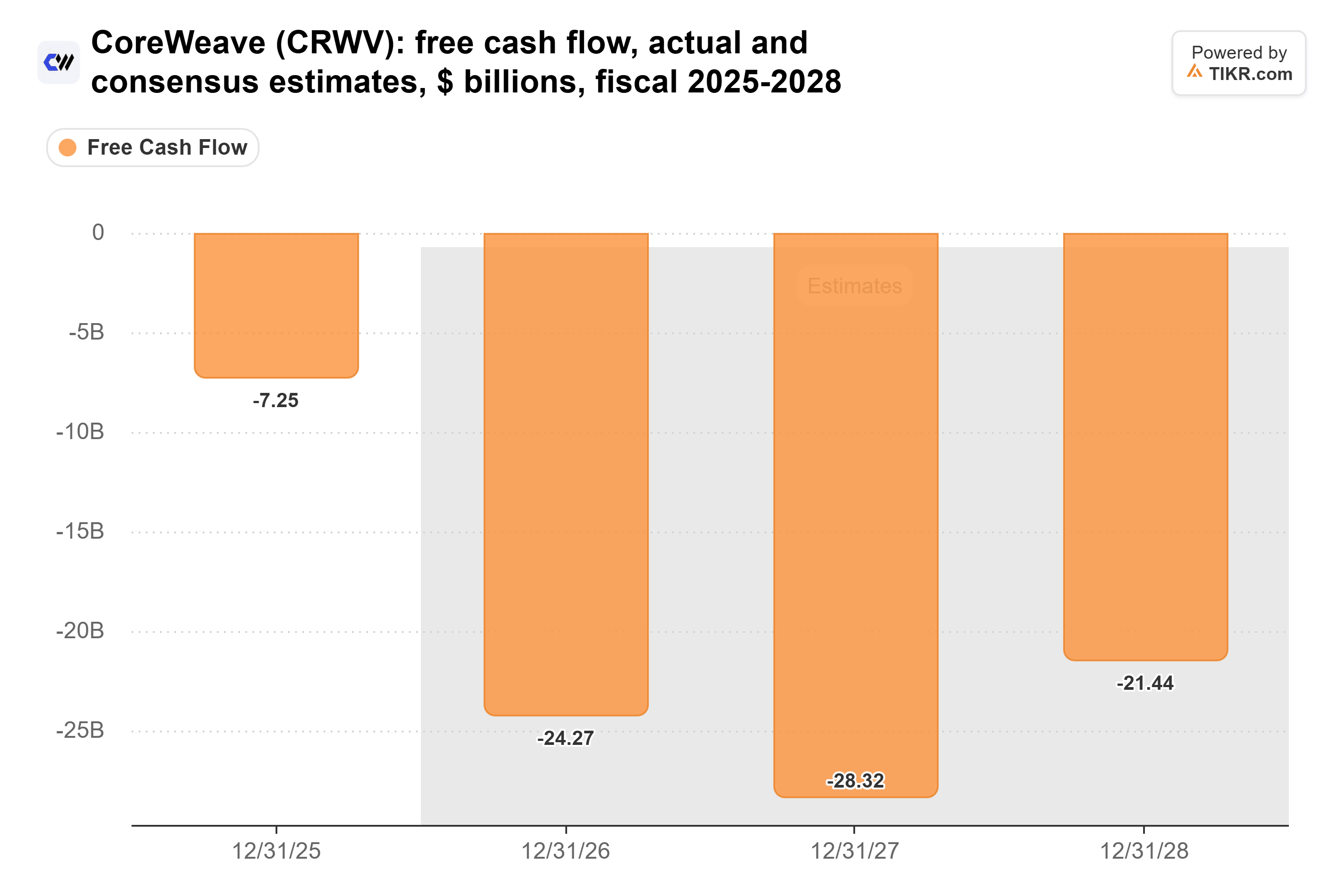
Consensus estimates add up to about $74 billion of negative free cash flow from 2026 through 2028.
Lenders keep raising the price of that money. CoreWeave’s 9% bonds due 2031 recently yielded about 18%, Bloomberg reported this week, and CoreWeave’s credit default swaps now price about a 68% chance of default within five years.
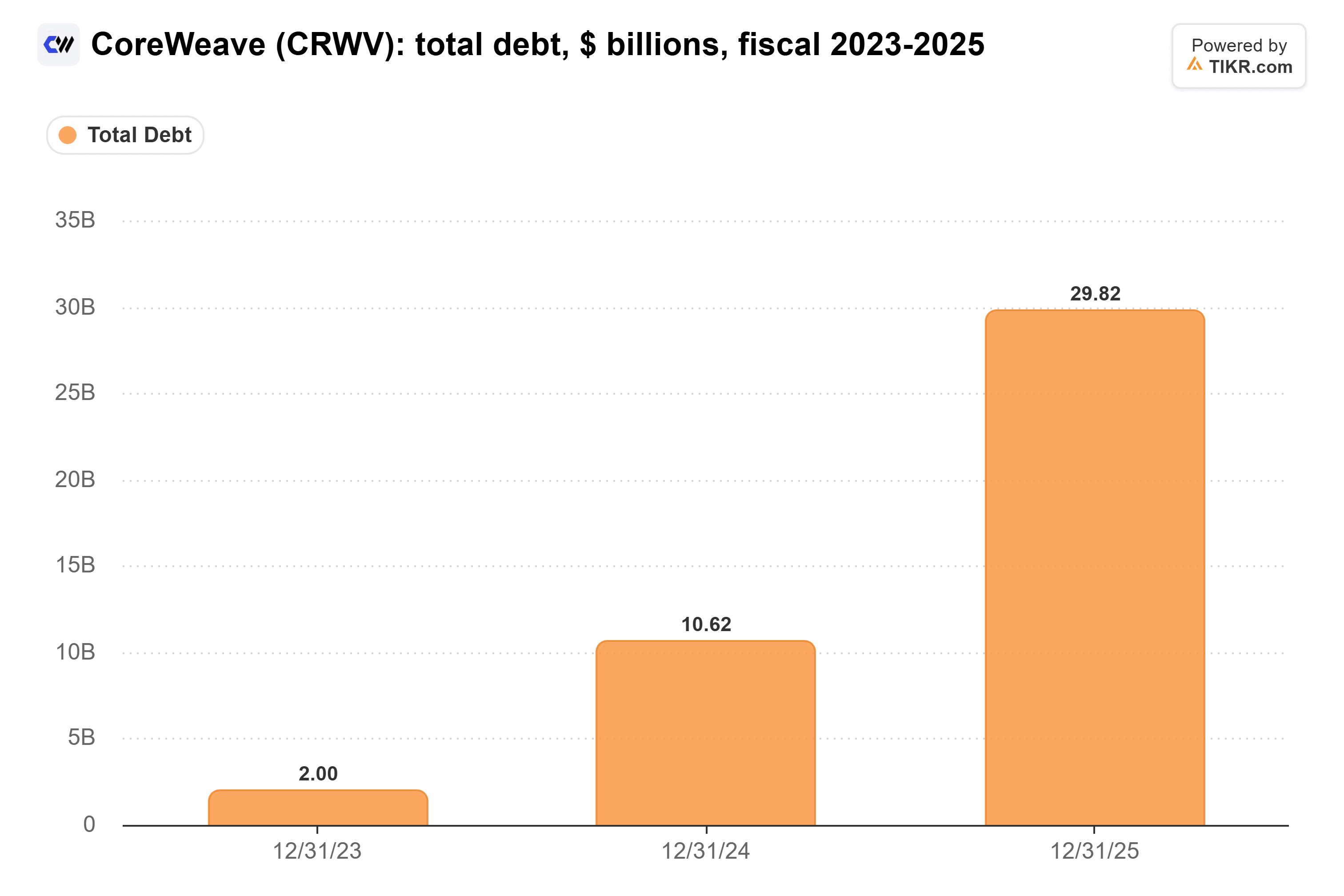
Its debt has piled up fast, too. TIKR’s total debt, which includes leases, went from $2.0 billion at the end of 2023 to $29.8 billion at the end of 2025:
Interest expense rose right along with it:
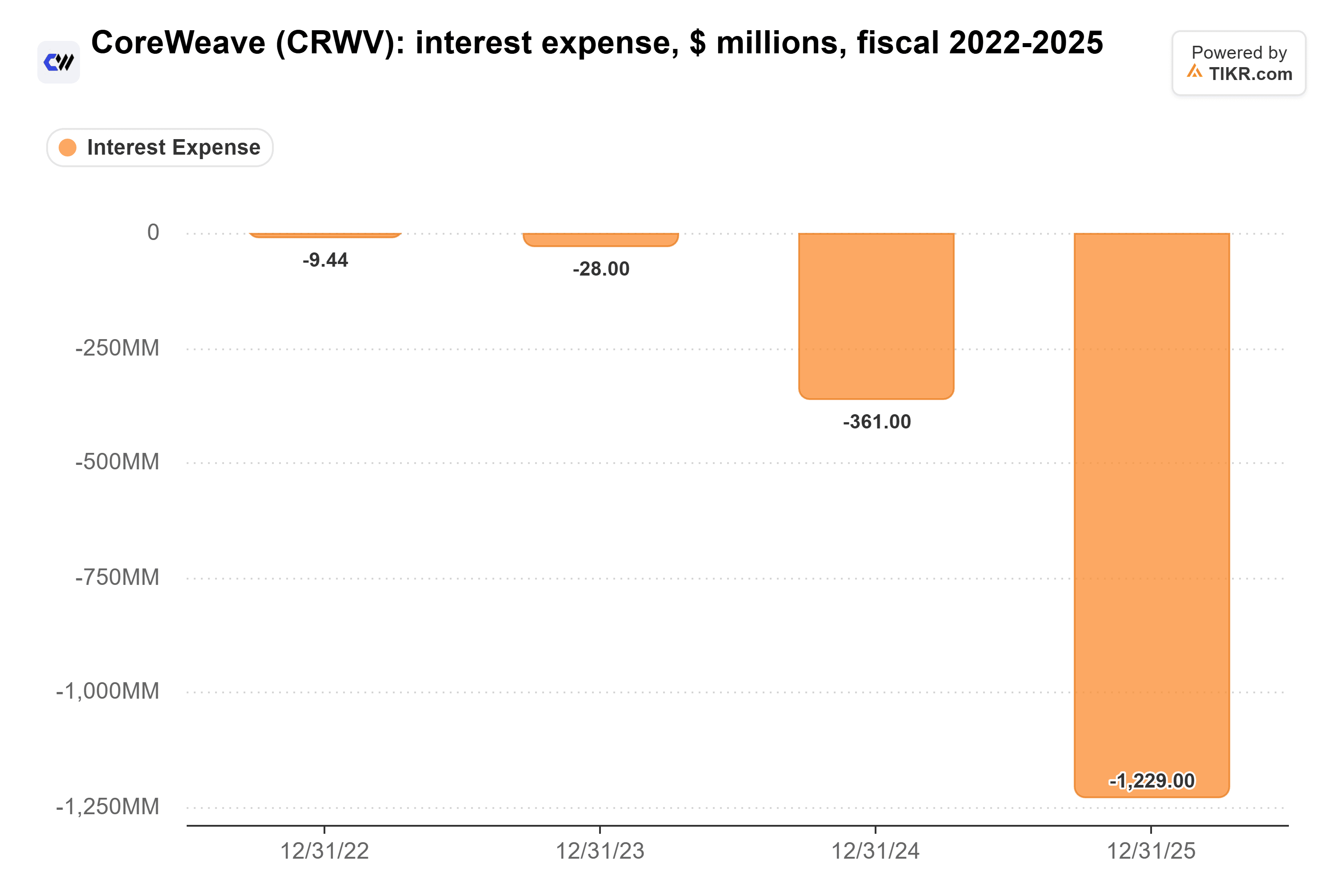
Interest expense was $1.23 billion in 2025. Net interest expense reached $846 million in the third quarter of 2026 alone, about 23.1% of that quarter’s revenue. In Eisman’s view, “funding a future data center construction is uneconomic, with debt at 15%.” At 18%, it’s even harder.
The cheap money comes with Meta attached
CoreWeave can still raise money. Its banks are preparing the $4.5 billion loan with early yield talk of 7% to 7.5%, Bloomberg reported.
So the alternative financing Eisman dismissed does exist. Moreover, GPUs for Meta’s contract secure the loan, which Bloomberg reported is likely to get investment-grade ratings. CoreWeave itself is rated below investment grade.
The company may be able to fund its backlog one contract at a time without relying on unsecured debt.
Shareholders stand behind all of those lenders. Even co-founder Brian Venturo, who says he has “never been more confident in CoreWeave,” bought $30 million in face value of the bonds, which get paid before the stock does.
Nebius and Nvidia are watching the same loan
Nebius’s revenue jumped to $980.8 million in the third quarter from $146.1 million a year earlier. It also earned about $50 million of GAAP operating income.
However, it still borrows to pay for its buildout. If lenders start pricing neoclouds’ own credit the way they price CoreWeave’s, its next raise will cost more. Its next report, likely in February, will show what it pays to borrow.
Nvidia invested $2 billion in CoreWeave at $87.20 a share in January. With $107.6 billion of data center revenue last quarter, it doesn’t depend on any one neocloud. Still, I’d expect CoreWeave to buy fewer racks with its own unsecured money while that money costs 18%.
Eisman has a point
The bond market agrees with Eisman. An unsecured bond priced near CoreWeave’s old 9% to 10% coupons would help address Eisman’s concerns.
The Meta loan could launch as soon as this week, per Bloomberg. The bigger test is CoreWeave’s next unsecured deal: a coupon well above 10% would suggest lenders remain concerned about the parent company’s credit risk.
So what is CoreWeave stock actually worth?
TIKR lets you forecast the future price of any stock in less than a minute. Just enter a few assumptions into TIKR’s valuation model and see what CoreWeave could be worth. Start from Wall Street consensus estimates, or adjust the inputs to reflect your own view of the business. It’s free to use.
Disclaimer:
Please note that the articles on TIKR are not intended to serve as investment or financial advice from TIKR or our content team, nor are they recommendations to buy or sell any stocks. We create our content based on TIKR Terminal’s investment data and analysts’ estimates. Our analysis might not include recent company news or important updates. TIKR has no position in any of the stocks mentioned. Thank you for reading, and happy investing!