Key Takeaways
- At today’s prices, $1,000 a month in dividends takes about 1,294 shares of UnitedHealth (about $454,700), 1,924 shares of Cigna (about $523,600) or 4,512 shares of CVS Health (about $372,700).
- CVS Health is the cheapest route by about $150,800, but its dividend hasn’t grown since fiscal 2025 and the company plans to split in two by the first half of 2028.
- Cigna’s dividend is the best covered, at 20% of free cash flow over the past year, while UnitedHealth’s 36% is the least covered of the three and faces a proposed cut to Medicare Advantage bonus payments.
- For a check a retiree can count on, Cigna’s is the one I’d want, even at the highest price.
It’s been a rough week to own health insurers. On Nov. 20, the Centers for Medicare & Medicaid Services proposed an overhaul of Medicare Advantage star ratings that it estimates would cut the industry’s bonus payments by about $107 billion from 2028 to 2037. Shares of UnitedHealth Group (UNH) and CVS Health (CVS) slid on the news, and Cigna Group (CI) had already fallen 4% on Nov. 19 on a separate proposed CMS rule.
So let’s say a hypothetical retiree wants $1,000 a month in dividends from just one of these stocks. At today’s prices, here’s what it takes:
| Stock | Shares | Cost | Yield | Pays a month | Cash dividend payout ratio |
|---|---|---|---|---|---|
| UnitedHealth Group | 1,294 | $454,725 | 2.6% | $1,001 | 36% (TTM to Sept. 30, 2026) |
| Cigna Group | 1,924 | $523,559 | 2.3% | $1,000 | 20% (TTM to Sept. 30, 2026); 18% (fiscal 2026 est.) |
| CVS Health | 4,512 | $372,736 | 3.2% | $1,000 | 29% (TTM to June 30, 2026) |
Source: TIKR and StockAnalysis, at today’s prices and each company’s current dividend rate.
6 safe dividend stocks paying retirees 6%+ yields
There are over 100 stocks paying 6%+ annual dividends today.
But after an extensive investment review leveraging TIKR’s proprietary data, we now believe only six of them are truly safe for retirees.
They’re all yours as part of our new investment report. Learn more about how to get access right here.
UnitedHealth’s cash is back
UnitedHealth has the best growth record here: its dividend rose 12.6% a year from fiscal 2020 to fiscal 2025, to $8.73 a share from $4.83. At that pace, those same shares would pay about $34,850 a year in year 10.
The business is mending, too. Third-quarter earnings from operations rose to $6.6 billion from $4.3 billion a year earlier, and management now expects adjusted earnings of at least $20.50 a share for 2026.
The cash took a hit first. Free cash flow fell to $16.1 billion in fiscal 2025 from $25.7 billion in fiscal 2023, while dividends paid kept climbing, to $7.92 billion:
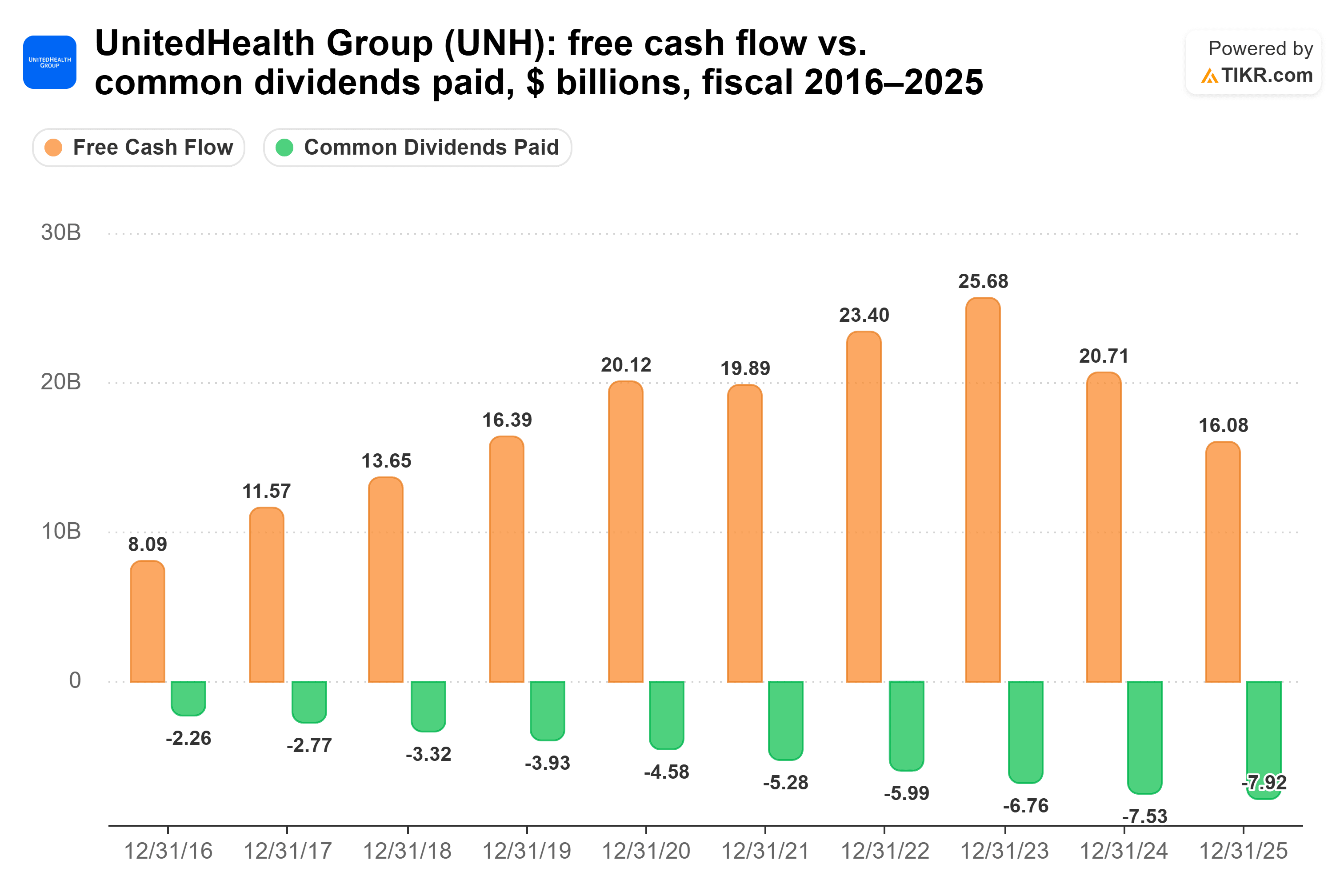
That pushed the cash dividend payout ratio to 49.2% in fiscal 2025, from 26.3% two years earlier. Over the twelve months to Sept. 30, 2026, free cash flow came back to $22.83 billion, and the dividend took a comfortable 36% of it.
Cigna costs the most, and covers it best
Cigna’s 2.3% yield is the lowest of the three, so $1,000 a month takes about 1,924 shares, or about $523,600. That buys the most room under the dividend: 20% of free cash flow over the twelve months to Sept. 30, 2026, and 18% for fiscal 2026 by analysts’ estimates.
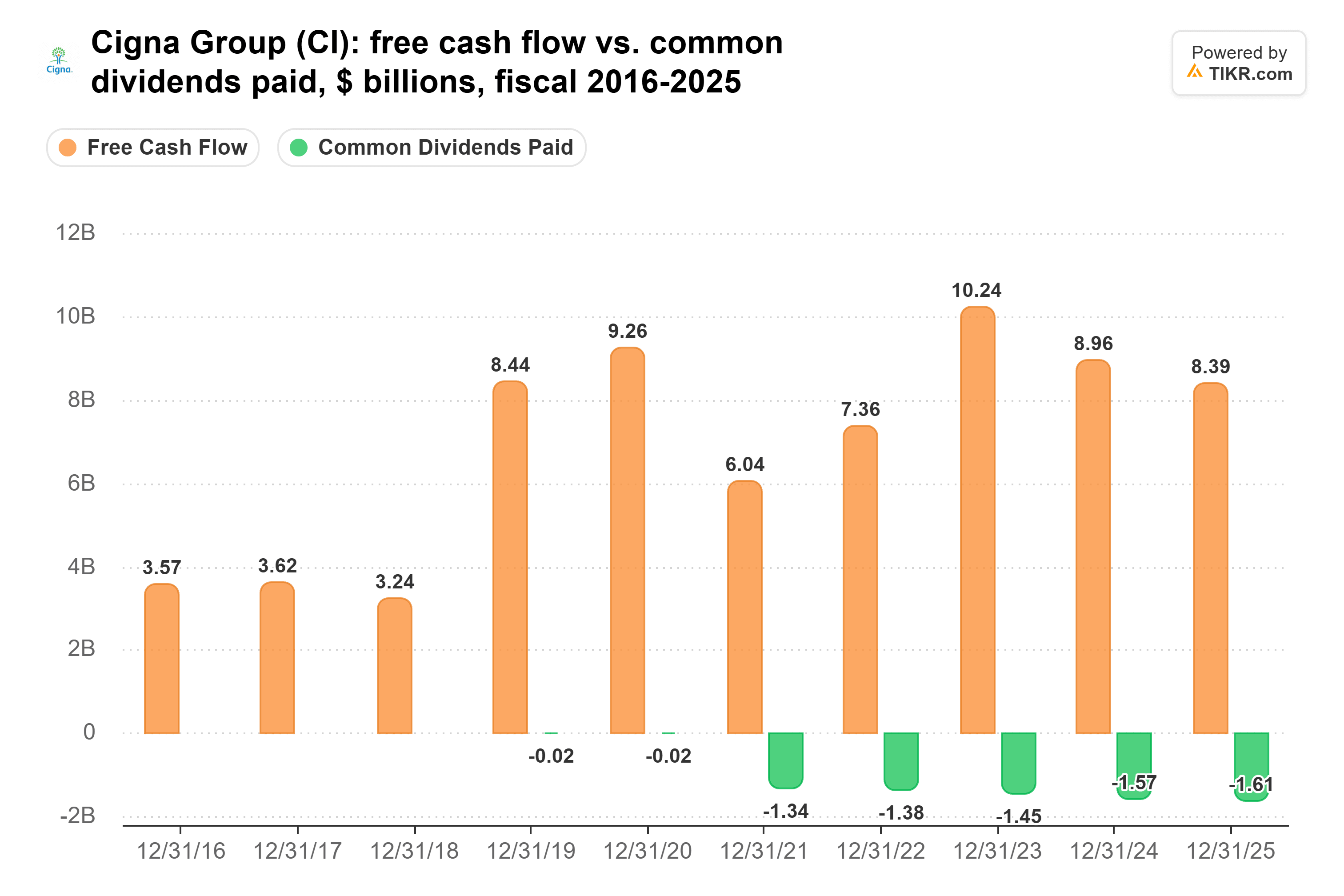
Cigna paid just $0.04 a share in fiscal 2020, and its dividends paid jumped to $1.34 billion in fiscal 2021. Free cash flow has covered them easily ever since:
Third-quarter revenue rose 6% to $73.7 billion, with pretax adjusted earnings up 15% in both Specialty and Care and Cigna Healthcare, offsetting a 22% drop in pharmacy benefit services. It lifted its 2026 outlook to at least $30.60 of adjusted earnings a share, from $30.45. The risk sits in pharmacy benefits, where management expects shrinking rebate pools and less employer coverage of GLP-1s for weight loss in 2027.
CVS is cheapest, with a breakup attached
CVS Health’s 3.2% yield makes it the cheapest route, at about 4,512 shares, or about $372,700. Third-quarter adjusted EPS rose to $2.09 from $1.60 a year earlier, and it raised its 2026 cash flow from operations guidance to at least $15.5 billion, from at least $11.5 billion.
Free cash flow has been bumpier. It peaked at $15.8 billion in fiscal 2021 and fell to $6.33 billion in fiscal 2024, before coming back to $7.81 billion in fiscal 2025:
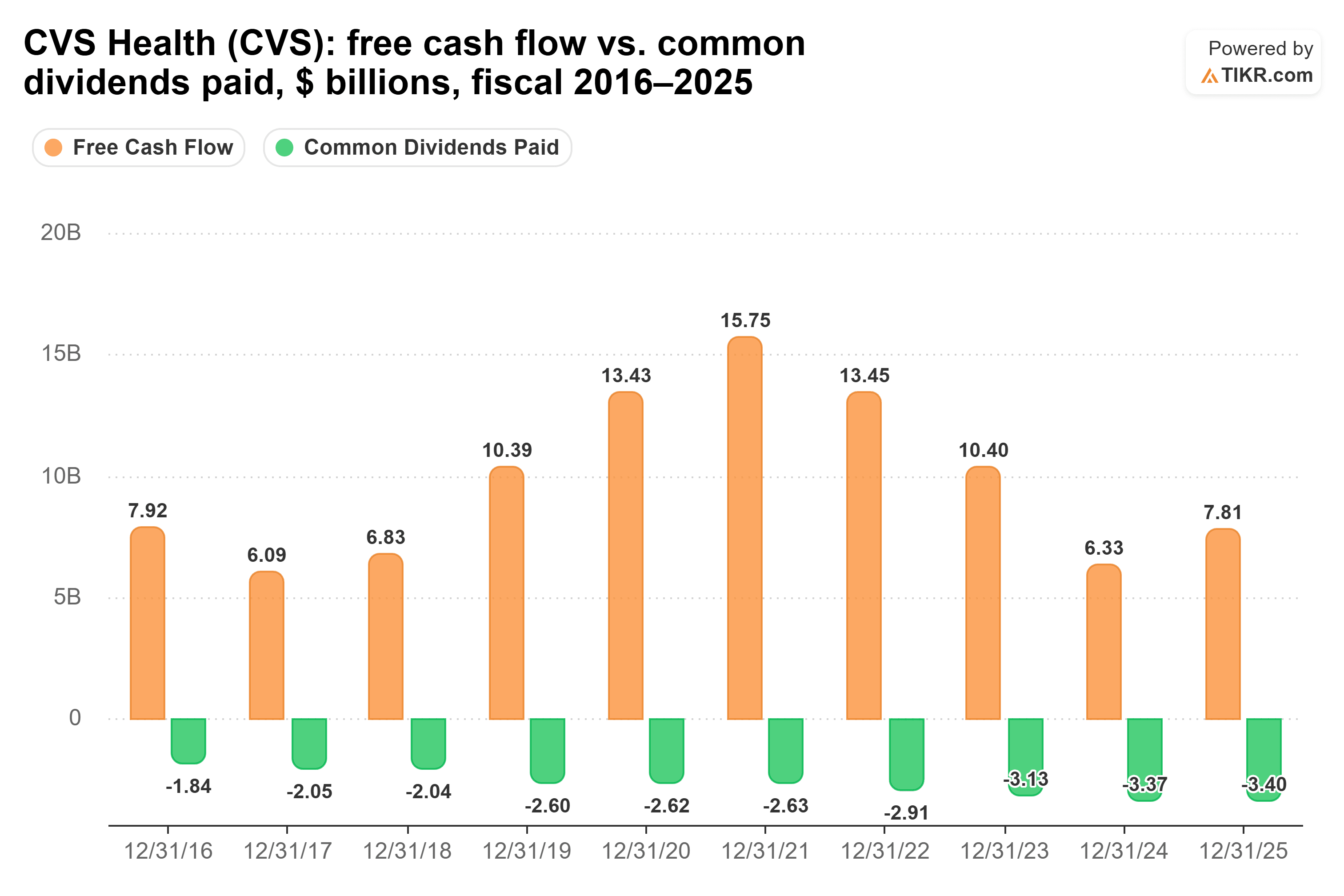
Dividends took a heavy 53.3% of free cash flow in fiscal 2024, then a well-covered 29% over the twelve months to June 30, 2026. But the check hasn’t grown: CVS pays $2.66 a share a year, the same as in fiscal 2025.
Then there’s the split. On Nov. 4, CVS said it plans to separate its retail pharmacies from its insurance and pharmacy benefits businesses by the first half of 2028, and expects both companies to pay a dividend, without saying how much.
The check I’d want
UnitedHealth’s dividend is the least covered of the three at 36%. On Nov. 20, it sued the government over its 2027 star ratings. Still, 36% leaves plenty of room, and the bonus cuts are only proposed. Most at risk here doesn’t mean truly risky.
CVS’s $150,800 discount is real money. But it buys a check that hasn’t grown, from the most indebted company here at 2.98x net debt to EBITDA, ahead of a split whose dividends haven’t been set.
So I’d pay up for Cigna. It covers its dividend with the most room, and its outlook is still rising. UnitedHealth’s growth record makes a strong case, and if the star-ratings fight breaks its way, it could well be the bigger check by year 10. For a retiree who needs that $1,000 every month, though, I’d start with the safest one. Of course, if CMS softens the final rule and UnitedHealth’s payout ratio stays well below fiscal 2025’s 49.2%, that gap narrows fast.
Forget Cigna Group: 6 safe 6%+ dividend yields you can buy right now
Dividends can hold the key to enormous wealth. But only if you buy the right ones.
Picking the right high-yield dividend stock can be the difference between a dream retirement…and scraping by every month, waiting for the next Social Security check to clear.
We’ve identified six stocks yielding 6%+ that we believe every retiree should know about right now. (And Cigna Group isn’t one of them.)
Disclaimer:
Please note that the articles on TIKR are not intended to serve as investment or financial advice from TIKR or our content team, nor are they recommendations to buy or sell any stocks. We create our content based on TIKR Terminal’s investment data and analysts’ estimates. Our analysis might not include recent company news or important updates. TIKR has no position in any of the stocks mentioned. Thank you for reading, and happy investing!