
Key Takeaways
- Goldman Sachs estimates memory will take roughly 40% of hyperscaler capex in 2028, down from about 44% in 2027, as DRAM prices fall.
- Goldman still has that capex growing, so hyperscalers like Meta Platforms would buy far more memory at lower prices, which is good news for Micron.
- Lower prices would still pull down Micron’s 87% gross margin, and Goldman’s cuts hit SK hynix and Sandisk harder.
- At 3.7x forward earnings, Micron already trades as if 2028 will be far worse than Goldman’s base case.
Goldman Sachs just marked down its 2028 memory prices, but its latest forecast holds better news for Micron Technology (MU) than the price cuts suggest.
The bank also cut its targets on SK hynix (SKHY) and Samsung and deepened its 2028 NAND price cut, which matters most for Sandisk (SNDK). And the whole forecast rests on the budgets of buyers like Meta Platforms (META).
A smaller slice of a bigger budget
Goldman now expects conventional DRAM prices to fall 19% in 2028, compared with a 5% drop before. It also expects NAND prices to fall 21%, compared with 14% previously. That’s why it sees memory’s share of hyperscaler capex slipping to roughly 40% in 2028 from around 44% in 2027, a drop it says reflects “our expectation for memory pricing to decline in 2028E.”
But Goldman’s baseline still has hyperscaler capex growing more than 10% in 2028, to about $1.2 trillion to $1.3 trillion. So 40% of 2028’s budget is about the same amount of money as 44% of 2027’s: around $500 billion of memory each year. If hyperscalers spend the same dollars while prices fall by a fifth, they’re buying roughly a quarter more memory. That fits Micron management’s outlook, which has industry DRAM bit shipments growing in the low 20% range in both 2027 and 2028.
TIKR tracks 50 analysts on Micron. How many say “Buy”?
See the full breakdown of Buy, Hold, and Sell ratings on Micron, along with Wall Street’s revenue and earnings estimates, all in one place. More than 500,000 investors use TIKR to research stocks like this one. See Micron’s Analyst Ratings
Volume is what Micron can count on
Micron’s record year came almost entirely from price. Fiscal 2026 revenue rose to $133.2 billion from $37.4 billion as DRAM prices rose about 180% and bit shipments grew in the mid-20% range. Analysts expect revenue to keep growing through fiscal 2028, which ends in August 2028:

If bits grow in the low 20s while prices fall a fifth, memory revenue stays roughly flat in calendar 2028. So I’d expect that $316 billion fiscal 2028 estimate to drift lower from here.
Micron’s 26 long-term customer agreements, which management estimates cover over 35% of revenue through 2030, back up that volume.
Lower prices still cost margin
Higher prices took Micron’s gross margin from 38.4% to 86.8% in under two years:
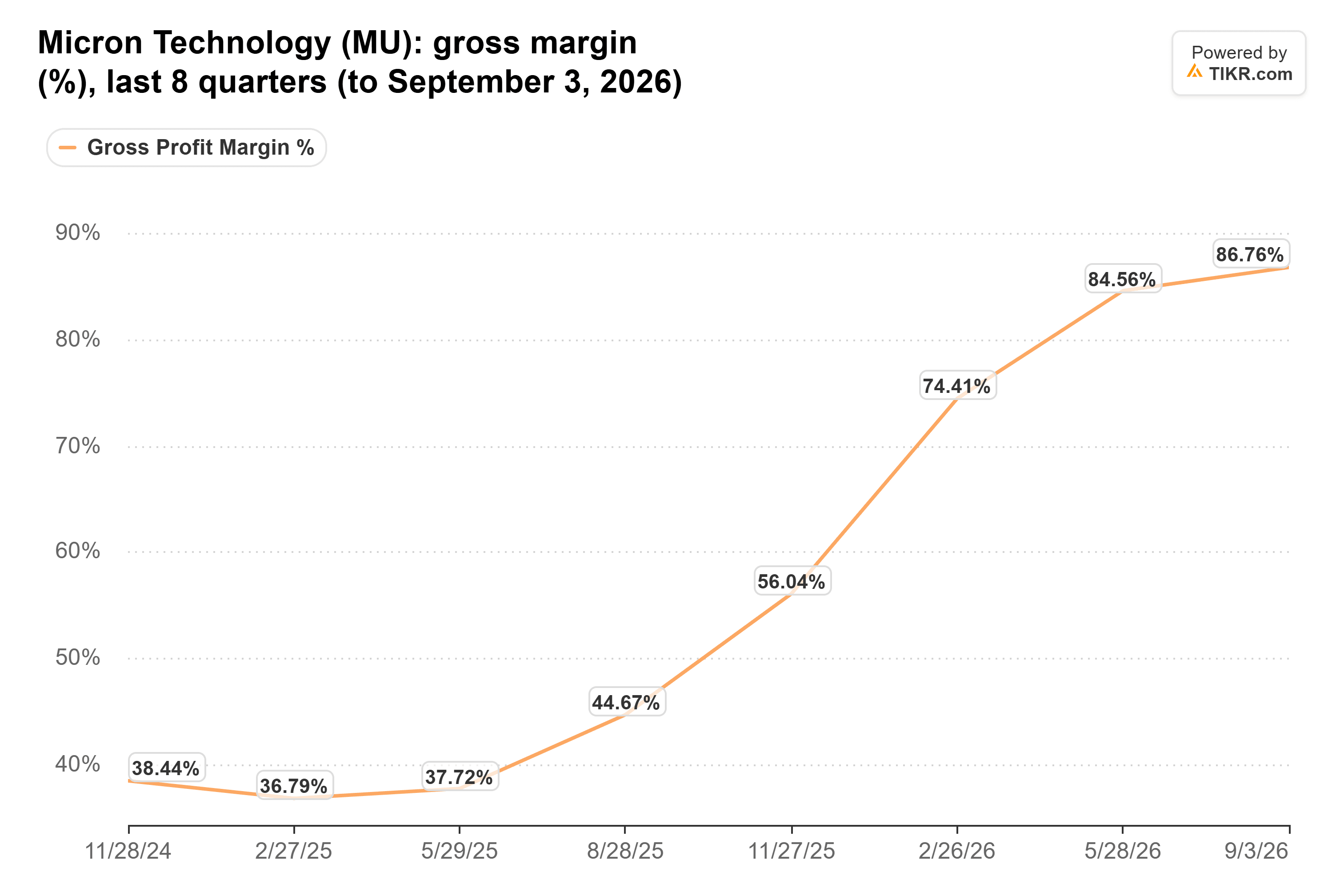
Analysts already have gross margin easing to 78.4% by fiscal 2029, and Goldman’s deeper price cuts point the same way.
Goldman cut SK hynix’s target by 43% to 2 million won and Samsung’s by 30% to 350,000 won. Meanwhile, Sandisk’s data center revenue jumped 61% from the previous quarter to $4.80 billion. With deeper NAND price cuts, enterprise SSD volume now has to do even more of the work.
At 3.7x, Micron is priced for worse
Micron trades at 3.7x forward earnings, against a three-year average of 13x:
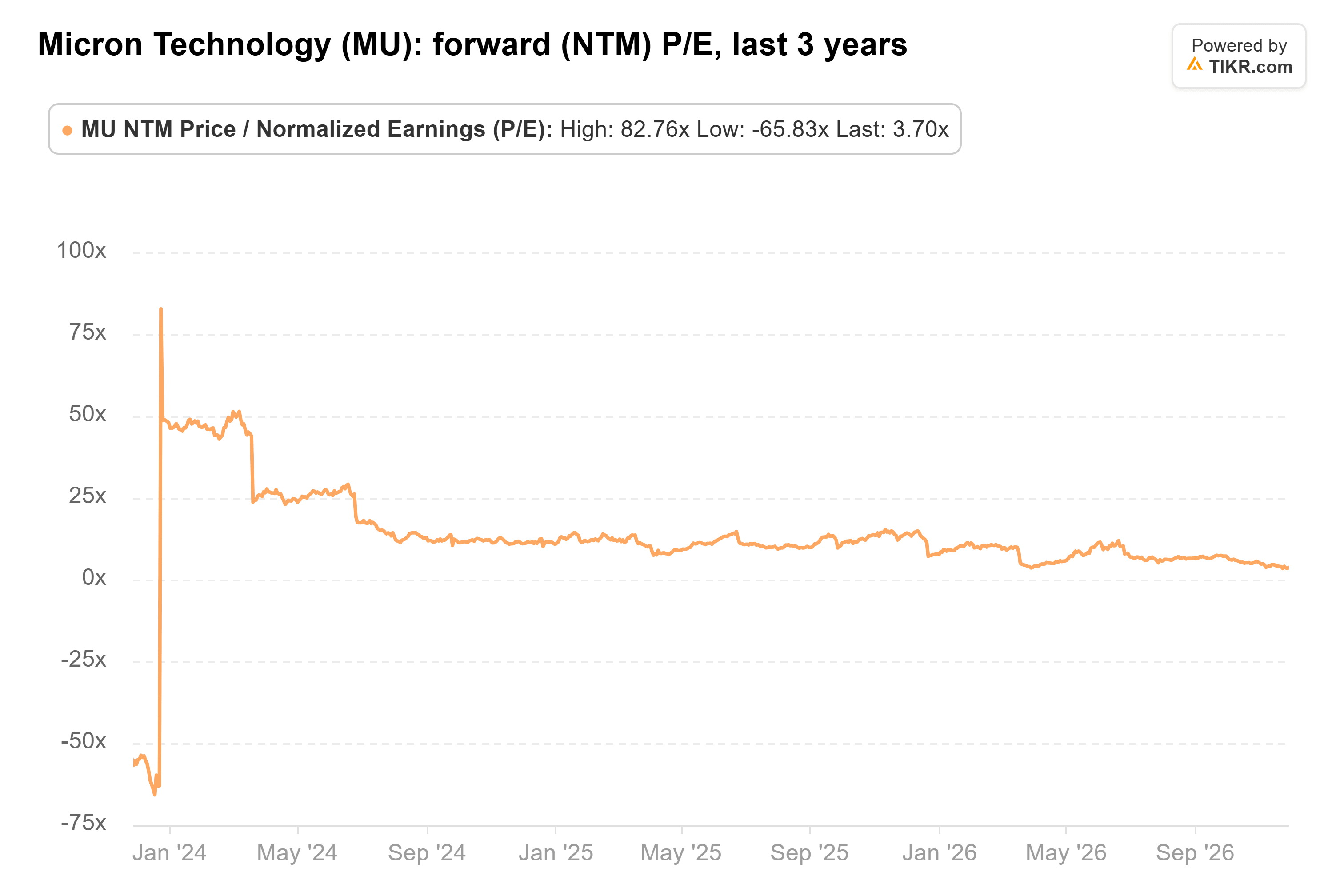
At that multiple, investors are pricing in a much steeper fall in earnings than Goldman’s baseline.
The risk is the budgets themselves. Meta guides 2026 capex, including finance-lease principal, to $135 billion to $145 billion, nearly double 2025’s $72.2 billion. Goldman’s own stress tests have 2028 hyperscaler capex flat, down 10% or down 20%, and any of those would cut into the volume.
Goldman still has hyperscalers buying memory in bulk as prices fall, and that’s what Micron needs. Micron reports its fiscal first quarter on December 17. A gross margin at or above its 86.3% non-GAAP guide, with management’s 2028 bit outlook still in the low 20s, would back that up.
So what is Micron stock actually worth?
TIKR lets you forecast the future price of any stock in less than a minute. Just enter a few assumptions into TIKR’s valuation model and see what Micron could be worth. Start from Wall Street consensus estimates, or adjust the inputs to reflect your own view of the business. It’s free to use.
Disclaimer:
Please note that the articles on TIKR are not intended to serve as investment or financial advice from TIKR or our content team, nor are they recommendations to buy or sell any stocks. We create our content based on TIKR Terminal’s investment data and analysts’ estimates. Our analysis might not include recent company news or important updates. TIKR has no position in any of the stocks mentioned. Thank you for reading, and happy investing!