Key Takeaways
- Verizon raised its dividend 2.5% in January, and Enterprise Products Partners is on track for its 28th straight year of distribution growth in 2026.
- Verizon yields 6.8% at its current dividend rate, against 6.2% for Enterprise.
- Verizon’s dividend uses a comfortable 54% of free cash flow over the last twelve months, while Enterprise’s distributable cash flow covered its payout 1.7x in 2025, with 1.9x expected in 2026.
- Enterprise’s payout grew 4% a year from 2020 to 2025, more than twice Verizon’s 1.9%.
Verizon Communications (VZ) expects free cash flow to grow 9% to 10% this year, after it rose 24.4% to $6.4 billion in the second quarter of 2026. That cash funds a dividend Verizon has now raised for 20 straight years.
Over at Enterprise Products Partners (EPD), the second quarter was a record. Operational distributable cash flow rose 21% from a year before, to $2.3 billion, and the partnership is on track for its 28th straight year of distribution growth.
Both yield more than 6% at their current rates. So which is the better high-yield dividend stock?
| Metric | Verizon (VZ) | Enterprise Products (EPD) |
|---|---|---|
| Yield at the current dividend rate | 6.8% ($2.83 a year) | 6.2% ($2.24 a year) |
| Dividend growth, fiscal 2020–2025 | 1.9% a year | 4.0% a year |
| Record (company’s own count) | 20 straight years of raises (2026) | On track for 28 straight years of growth (2026) |
| Coverage, last reported | Cash dividend payout ratio: 54% (TTM to June 30, 2026) | Distributable cash flow coverage: 1.69x (fiscal 2025) |
| Coverage, forward (fiscal 2026 consensus) | 54% | 1.91x |
| Net debt / EBITDA (LTM) | 3.35x | 3.2x |
Verizon has room to spare
Verizon’s core business is still growing. Mobility and broadband service revenue rose 2.8% to $23.4 billion in the second quarter of 2026 from a year before. Verizon also expects AI Connect, its new fiber business for AI data centers, to add multibillion-dollar revenue starting in 2027.
The dividend took a well-covered 54% of free cash flow over the twelve months to June 30, 2026, and analysts expect the same 54% in fiscal 2026. Free cash flow fell short of the dividend in fiscal 2016 and 2017, and it has run ahead of it every year since.
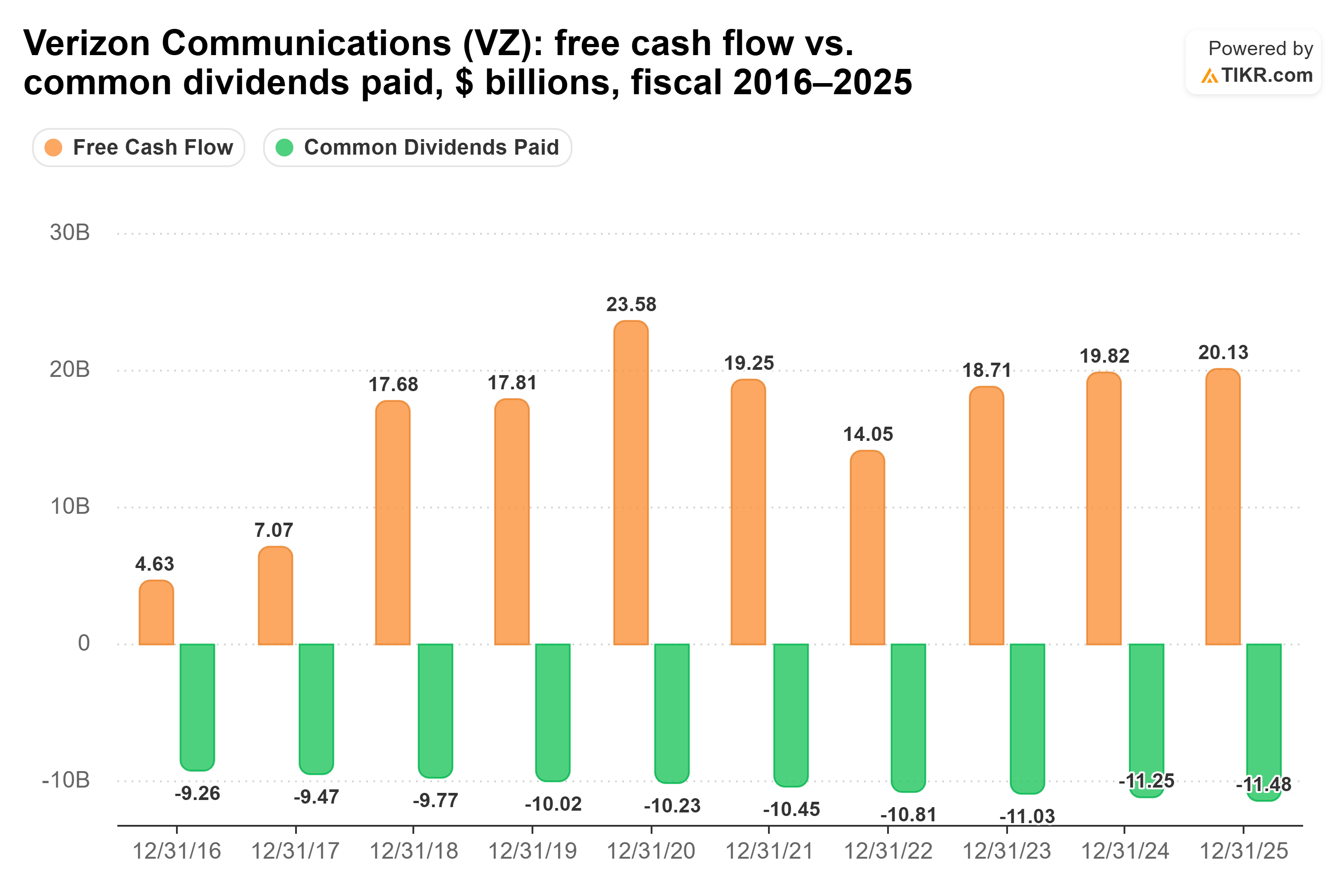
Management says it’s growing the dividend and paying down debt at the same time, and using 54% of free cash flow leaves room for both. The raises are small, though: 1.9% a year from fiscal 2020 to fiscal 2025 ($2.48 to $2.73 a share), and 2.5% in January, to $0.7075 a quarter. The risk to watch is the debt, at 3.35x net debt to EBITDA over the last twelve months.
The newest risk is competition. SpaceX agreed on Oct. 8 to buy nationwide low-band spectrum for its Starlink phone service, and Verizon’s stock fell 8.7% the next day. The deal still needs the FCC’s approval, and Verizon says spectrum alone “does not provide the network or infrastructure to offer true nationwide coverage.”
Enterprise’s cushion keeps widening
Enterprise’s payout runs on a different measure from Verizon’s. It’s a pipeline, so it’s judged on distributable cash flow coverage. (It’s also a master limited partnership: it pays distributions on units, and holders get a K-1 at tax time.)
Coverage was 1.69x in fiscal 2025 ($3.66 of distributable cash flow per unit against $2.17 of distributions), and analysts expect 1.91x in fiscal 2026 ($4.27 against $2.24). The 17% jump in distributable cash flow per unit is already showing up: operational distributable cash flow covered the second-quarter distribution 1.9x. On Oct. 8, Enterprise declared $0.56 a unit for the third quarter, the same as the second and 2.8% more than a year earlier.
The cushion has widened from 1.22x in fiscal 2016 to 1.69x in fiscal 2025, as distributable cash flow per unit outgrew the distribution.

Management says distributions should grow in line with distributable cash flow per unit. They’ve trailed it a little: distributions rose 4.0% a year from fiscal 2020 to fiscal 2025 ($1.78 to $2.17 a unit), while distributable cash flow per unit went from $2.91 to $3.66. That’s still more than twice Verizon’s pace.
The risk is that some of this year’s strength fades. Management says marine terminal volumes normalized in June and July, after a rush in April and May tied to the Middle East conflict.
So which dividend wins?
Enterprise Products Partners is the better high-yield dividend stock. Verizon pays the bigger check today, 6.8% at its current rate against 6.2%. But Enterprise’s distribution has grown more than twice as fast, its coverage is set to widen to 1.91x this year, and it carries a little less debt (3.2x net debt to EBITDA against 3.35x). At their 5-year rates, Enterprise’s income would pass Verizon’s around 2030. I’ll take that growth over a 0.6-point head start.
Verizon’s dividend is still a safe one. It uses just over half of free cash flow, management guides for 9% to 10% free cash flow growth this year, and AI Connect could give the business a new lane. Enterprise’s payout simply grows faster on a cushion that keeps widening, and that’s what I want from a high-yield holding.
Of course, 1.91x is still a forecast, so Enterprise’s third-quarter results will show how much of the first half’s strength carries through.
So what is Enterprise Products Partners stock actually worth?
TIKR lets you forecast the future price of any stock in less than a minute. Just enter a few assumptions into TIKR’s valuation model and see what Enterprise Products Partners could be worth. Start from Wall Street consensus estimates, or adjust the inputs to reflect your own view of the business. It’s free to use.
Value Enterprise Products Partners for free
Disclaimer:
Please note that the articles on TIKR are not intended to serve as investment or financial advice from TIKR or our content team, nor are they recommendations to buy or sell any stocks. We create our content based on TIKR Terminal’s investment data and analysts’ estimates. Our analysis might not include recent company news or important updates. TIKR has no position in any of the stocks mentioned. Thank you for reading, and happy investing!