


Key Takeaways
- Pfizer yields 6.3% and UPS yields 7.0%, and both raised their 2026 revenue guidance this summer.
- Over the twelve months to June 2026, Pfizer’s dividend took 89% of its free cash flow and UPS’s took 99%, so neither has much cushion.
- UPS raised its dividend per share 0.6% in fiscal 2025, and Pfizer’s CEO says its dividend growth returns after the drug patent losses that hit revenue through 2028.
- UPS’s revenue rose 7.6% in the second quarter of 2026 after it finished cutting Amazon volume. Pfizer’s rose 3%, or 1% operationally.
Pfizer (PFE) and United Parcel Service (UPS) both raised their 2026 revenue guidance this summer. Both also pay the kind of yield income investors go hunting for: 6.3% for Pfizer and 7.0% for UPS.
The catch? Both are handing out nearly every dollar of free cash flow they bring in.
So which is the better high-yield dividend stock?
| Metric | Pfizer (PFE) | UPS (UPS) |
|---|---|---|
| Dividend yield | 6.3% | 7.0% |
| Annual dividend | $1.72 | $6.56 |
| Dividend growth, fiscal 2020–2025 | 2.5% a year | 10.2% a year |
| Cash dividend payout ratio (TTM to June 2026) | 89% | 99% |
| Net debt/EBITDA | 1.97x | 1.63x |
| Interest coverage (EBIT/interest) | 6.98x | 7.56x |
Pfizer is waiting out its patent losses
Pfizer’s newer drugs are carrying the business. Launched and acquired products grew 18% operationally in the second quarter of 2026. COVID-19 sales are shrinking: Pfizer now expects about $4 billion from those products this year, down from about $5 billion in its earlier guidance. Second-quarter revenue was $15.0 billion, up 3% (1% operationally), with adjusted EPS of $0.77 against $0.78 a year before.
The cash behind the dividend has come down hard. Free cash flow went from $29.9 billion in fiscal 2021 to $9.08 billion in fiscal 2025, short of the $9.77 billion Pfizer paid in dividends that year.

Over the twelve months to June 28, 2026, the cash dividend payout ratio was 89%: $9.79 billion of dividends from $10.98 billion of free cash flow. That’s thin cover, after 107.7% in fiscal 2025.
Chairman and CEO Albert Bourla says that in “even the most stretched scenarios that we are running, we will be able to maintain our dividend.”
Maintain is the word. Pfizer paid $0.86 a share in the first six months of 2026, the same $1.72 annual rate as fiscal 2025. Bourla said growth starts again “after the LOE period,” as lost exclusivity on its drugs weighs on revenue through 2028. A bigger hit from those patent losses is the main risk.
UPS has done the hard part
While Pfizer waits out its patent losses, UPS has finished its own reset. In July, it said it had completed its cut of lower-yielding Amazon volume and the network changes that came with it. As CEO Carol Tomé put it on the call, “this reconfiguration was never the destination. It was the foundation.”
So far, it’s paying off. Second-quarter 2026 revenue was $22.8 billion, up 7.6% from $21.2 billion a year before. Adjusted operating profit rose 12% to $2.1 billion, and UPS raised its full-year outlook.
The dividend is the weak spot. Free cash flow went from $10.8 billion in fiscal 2021 to $4.77 billion in fiscal 2025, short of the $5.40 billion UPS paid in dividends.
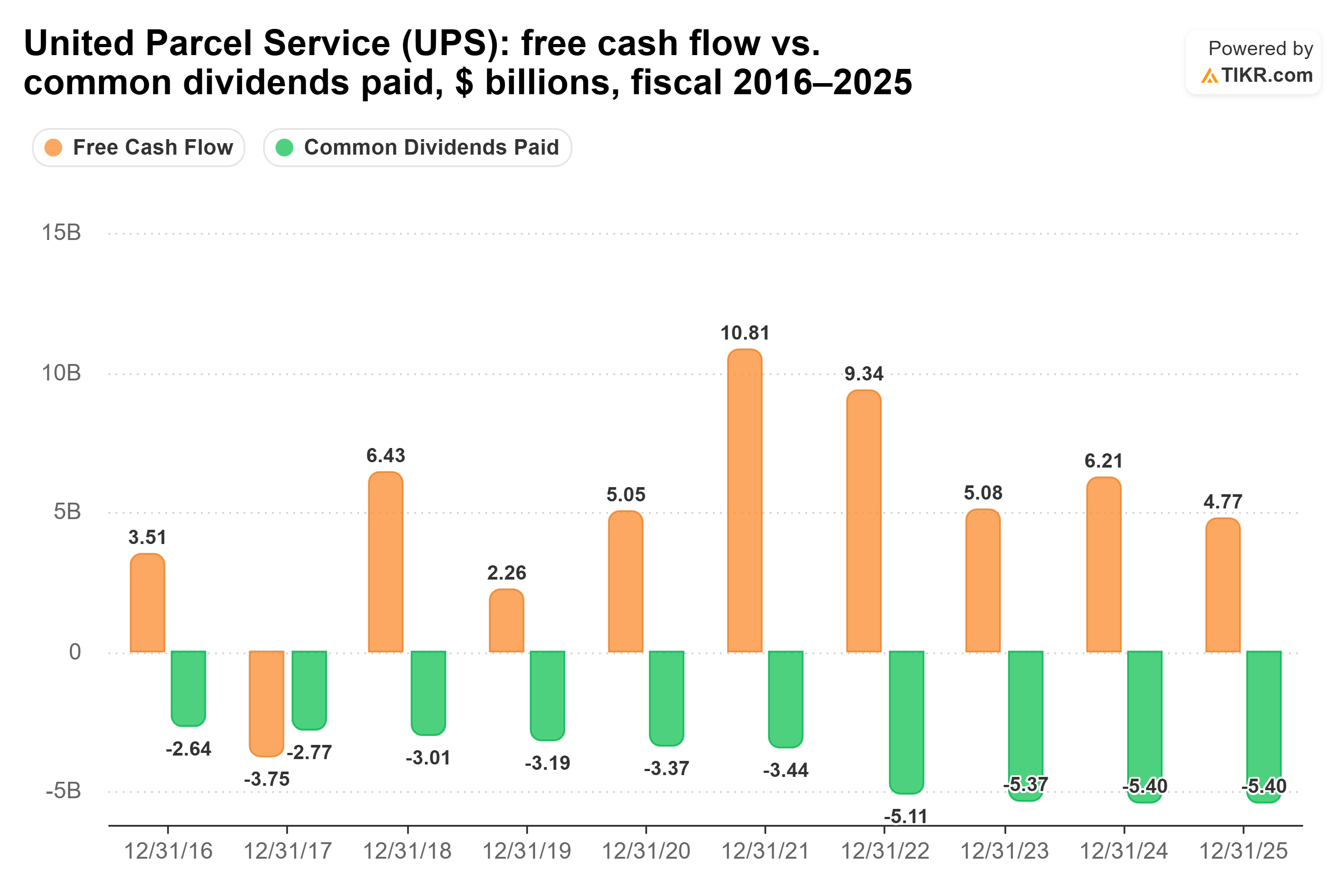
The chart also shows where that 10.2% five-year growth rate came from: one big step, from $3.44 billion paid in fiscal 2021 to $5.11 billion in fiscal 2022. Dividends paid were $5.40 billion in both fiscal 2024 and fiscal 2025, and management plans about $5.4 billion in 2026.
Free cash flow was $1.57 billion in the first six months of 2026, more than double the $742 million a year before. Even so, over the twelve months to June 30, 2026, dividends took 99% of it. UPS names fuel costs tied to the Middle East conflict and tariffs among its risks, and either would hit a dividend with no cushion.
So which dividend wins?
UPS is the better high-yield dividend stock. It pays the bigger check from a business growing faster, with less debt behind it: 1.63x net debt/EBITDA against 1.97x at Pfizer. $10,000 in UPS pays $700 a year today, against $630 from Pfizer.
High-yield investors want a check they can count on, and right now neither dividend is growing much. UPS’s dividend per share was $6.56 in fiscal 2025, just 0.6% more than in fiscal 2024, and it has been $1.64 a quarter since February 2025. At each dividend’s pace now, Pfizer’s income would pass UPS’s around 2033. That assumes Pfizer keeps raising its dividend 2.4% a year, as it did in fiscal 2025, while its CEO says growth comes back after the LOE period.
This isn’t to say Pfizer’s dividend is in trouble. It’s better covered today, at 89% of free cash flow against 99% at UPS, and Bourla couldn’t have been clearer: “I want once and for all to make that clear to all that the dividend will be maintained.” It’s just that, when it comes down to it, I’d rather collect the bigger check from the business that’s moving forward.
Of course, UPS has almost no room for error, so its free cash flow over the second half of 2026 is the number to watch.
So what is UPS stock actually worth?
TIKR lets you forecast the future price of any stock in less than a minute. Just enter a few assumptions into TIKR’s valuation model and see what UPS could be worth. Start from Wall Street consensus estimates, or adjust the inputs to reflect your own view of the business. It’s free to use.
Disclaimer:
Please note that the articles on TIKR are not intended to serve as investment or financial advice from TIKR or our content team, nor are they recommendations to buy or sell any stocks. We create our content based on TIKR Terminal’s investment data and analysts’ estimates. Our analysis might not include recent company news or important updates. TIKR has no position in any of the stocks mentioned. Thank you for reading, and happy investing!


