


Key Takeaways
- Pfizer yields 6.3% and Healthpeak Properties yields 6.7%, and both raised their 2026 guidance on Aug. 4.
- Pfizer’s dividend used 89% of its free cash flow over the twelve months to June 28, 2026, while Healthpeak’s used 72% of its AFFO per share in fiscal 2025.
- Healthpeak carries net debt of 5.4x EBITDA against Pfizer’s 2.0x, and its dividend per share fell from $2.27 in fiscal 2015 to $1.22 in fiscal 2025.
- At each dividend’s fiscal 2025 growth rate, $10,000 in either stock would pay about the same in year 10.
Anyone hunting for a 6%+ yield in health care is going to run into Pfizer (PFE) and Healthpeak Properties (DOC). Pfizer yields 6.3%, and Healthpeak yields 6.7%, paid monthly.
Both gave shareholders good news on Aug. 4. Pfizer raised its 2026 revenue guidance by $500 million at the midpoint, to $60.5 billion to $62.5 billion. Healthpeak raised its 2026 FFO as Adjusted guidance by $0.02 a share at the midpoint, to $1.73 to $1.77.
But a yield that high only matters if the cash behind it holds up. So which is the better high-yield dividend stock?
| Metric | Pfizer (PFE) | Healthpeak (DOC) |
|---|---|---|
| Dividend yield | 6.3% | 6.7% |
| Current dividend | $1.72 a year, paid quarterly | $1.22 a year, paid monthly |
| Dividend growth, fiscal 2020–2025 | 2.5% a year | -3.8% a year |
| Dividend growth, fiscal 2015–2025 | 4.4% a year | -6.0% a year |
| Coverage, last reported | Cash dividend payout ratio: 89% (TTM to June 28, 2026) | AFFO payout ratio: 72% (fiscal 2025) |
| Net debt / EBITDA (LTM) | 1.97x | 5.44x |
| Interest coverage (LTM) | 6.98x | 1.49x |
Pfizer’s dividend has outrun its cash
Pfizer’s COVID-19 business keeps shrinking: management now expects about $4 billion of COVID revenue in 2026, down from the roughly $5 billion it expected before. Its launched and acquired products, including Padcev, Nurtec and the Vyndaqel family, grew 18% operationally in the second quarter of 2026.
The cash hasn’t kept pace with the dividend, though. Free cash flow fell from $29.9 billion in fiscal 2021 to $4.79 billion in fiscal 2023, and came in at $9.08 billion in fiscal 2025, while dividends paid rose every year, to $9.77 billion.
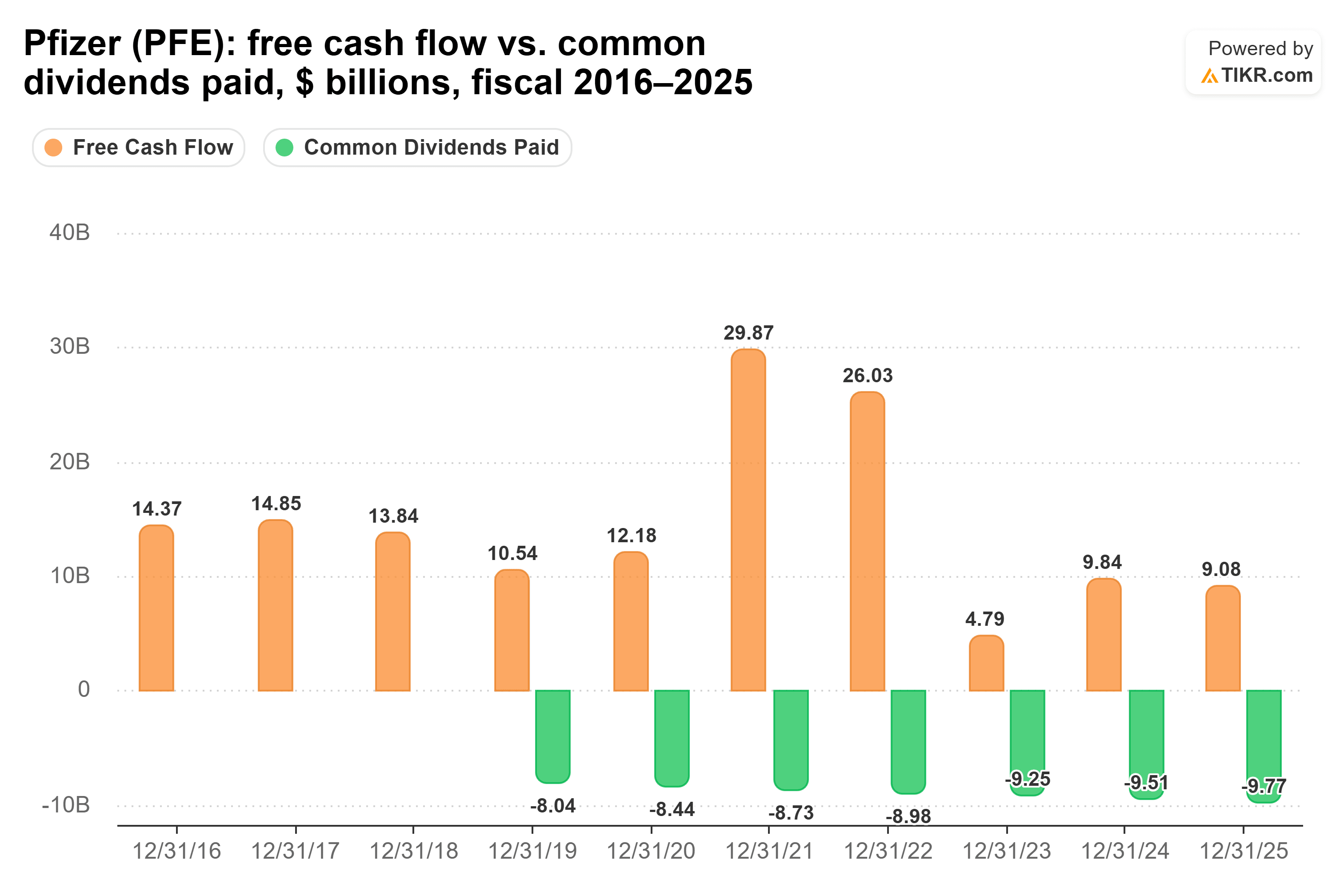
That put the cash dividend payout ratio at a risky 108% in fiscal 2025. Over the twelve months to June 28, 2026, it eased to 89%, which still leaves little room.
CEO Albert Bourla was emphatic on the Aug. 4 call: “We feel extremely confident that we will — even the most stretched scenarios that we are running, we will be able to maintain our dividend.” He said growth would resume after the loss-of-exclusivity period, which weighs on revenue through 2028. The current rate of $1.72 a year matches Pfizer’s fiscal 2025 dividend, so don’t count on raises until then.
The balance sheet can carry that promise: net debt is 1.97x EBITDA, and EBIT covers interest 6.98x.
Healthpeak’s coverage keeps getting wider
Healthpeak has the opposite story: its cash flow has improved, but its dividend record hasn’t. As a REIT, it’s judged on AFFO per share. Its dividend fell from $2.10 a share in fiscal 2016 to $1.48 in fiscal 2017 and to $1.20 in fiscal 2021, while AFFO per share climbed from $1.35 in fiscal 2021 to $1.69 in fiscal 2025.

That took the AFFO payout ratio from 102% in fiscal 2020 to a comfortable 72% in fiscal 2025, the year Healthpeak raised its dividend 1.7% to $1.22.
The business is mixed. Senior housing (Janus Living) grew revenue 45% year over year in the second quarter of 2026, and lab occupancy rose 80 basis points from the prior quarter to 78.5%. But lab same-store adjusted NOI fell 3.2% from a year earlier.
The risk is debt: net debt runs 5.44x EBITDA, and EBIT covers interest just 1.49x. CEO Scott Brinker said on the Aug. 5 call that he means to keep leverage in check: “This is not the right environment to have elevated leverage.”
So which dividend wins?
Pfizer is the better high-yield dividend stock.
The income doesn’t separate them. $10,000 pays $630 a year from Pfizer today and $670 from Healthpeak. If each dividend keeps growing at its fiscal 2025 pace, Pfizer’s income passes Healthpeak’s in about 2035, and year 10 pays about $779 from Pfizer and about $777 from Healthpeak. Basically a dead heat.
So what decides it for me is what backs each check through a rough patch. Pfizer’s dividend grew from $1.52 a share in fiscal 2020 to $1.72 in fiscal 2025, right through a collapse in free cash flow, and it did so with net debt of 1.97x EBITDA. Healthpeak’s fell from $1.48 to $1.22 over the same years, and it carries 5.44x.
This isn’t to say Healthpeak’s dividend is in trouble. Its coverage is wider, AFFO per share has risen every year since fiscal 2021, management just raised guidance, and you get a slightly bigger check every month. It’s just that, when it comes down to it, I’d rather lean on Pfizer’s balance sheet than on interest coverage of 1.49x.
Of course, Pfizer’s patent losses run through 2028, and management doesn’t see high single-digit revenue growth until after that. If free cash flow doesn’t stay above the dividend bill in the meantime, that 89% has very little give.
So what is Pfizer stock actually worth?
TIKR lets you forecast the future price of any stock in less than a minute. Just enter a few assumptions into TIKR’s valuation model and see what Pfizer could be worth. Start from Wall Street consensus estimates, or adjust the inputs to reflect your own view of the business. It’s free to use.
Disclaimer:
Please note that the articles on TIKR are not intended to serve as investment or financial advice from TIKR or our content team, nor are they recommendations to buy or sell any stocks. We create our content based on TIKR Terminal’s investment data and analysts’ estimates. Our analysis might not include recent company news or important updates. TIKR has no position in any of the stocks mentioned. Thank you for reading, and happy investing!


