Key Takeaways
- Energy Transfer yields 7.4% and BP yields 4.9%, and in October Energy Transfer raised its quarterly distribution for the 20th straight time while BP held its dividend flat.
- BP’s dividend used 31% of its free cash flow over the twelve months to June 30, 2026, and BP is sending its spare cash to debt and its remaining Deepwater Horizon liabilities.
- Energy Transfer’s distributable cash flow covered its distribution 1.8x in fiscal 2025, and it raised its 2026 adjusted EBITDA guidance to $19.7-$19.9 billion.
- Energy Transfer’s leverage reached 4.5x EBITDA in fiscal 2025, the top of its target, and it expects to spend about $7 billion on growth projects in 2027.
Energy Transfer (ET) raised its quarterly distribution to $0.3425 a unit on Oct. 22. That’s more than 3% above a year earlier and its 20th straight quarterly increase.
Eight days later, BP (BP) held its dividend at $0.0866 a share, or $0.5196 per ADS. It did that even though its underlying replacement cost profit rose to $8.5 billion in the third quarter from $5.7 billion in the second.
BP has other jobs for that cash first. So which is the better high-yield dividend stock: a 7.4% yield that keeps climbing, or a 4.9% yield from a company still shoring up its balance sheet?
| Metric | BP (BP) | Energy Transfer (ET) |
|---|---|---|
| Dividend yield | 4.9% | 7.4% |
| Dividend growth, fiscal 2020-2025 | 0.6% a year | 7.8% a year |
| Coverage, on its own measure | 31% cash dividend payout ratio (TTM to June 30, 2026) | 1.8x distributable cash flow coverage (fiscal 2025) |
| Net debt/EBITDA (LTM) | 0.5x | 3.8x |
| Interest coverage (LTM) | 6.0x | 3.1x |
Source: TIKR; yields at today’s prices.
6 safe dividend stocks paying retirees 6%+ yields
There are over 100 stocks paying 6%+ annual dividends today.
But after an extensive investment review leveraging TIKR’s proprietary data, we now believe only six of them are truly safe for retirees.
They’re all yours as part of our new investment report. Learn more about how to get access right here.
BP’s spare cash has somewhere else to go
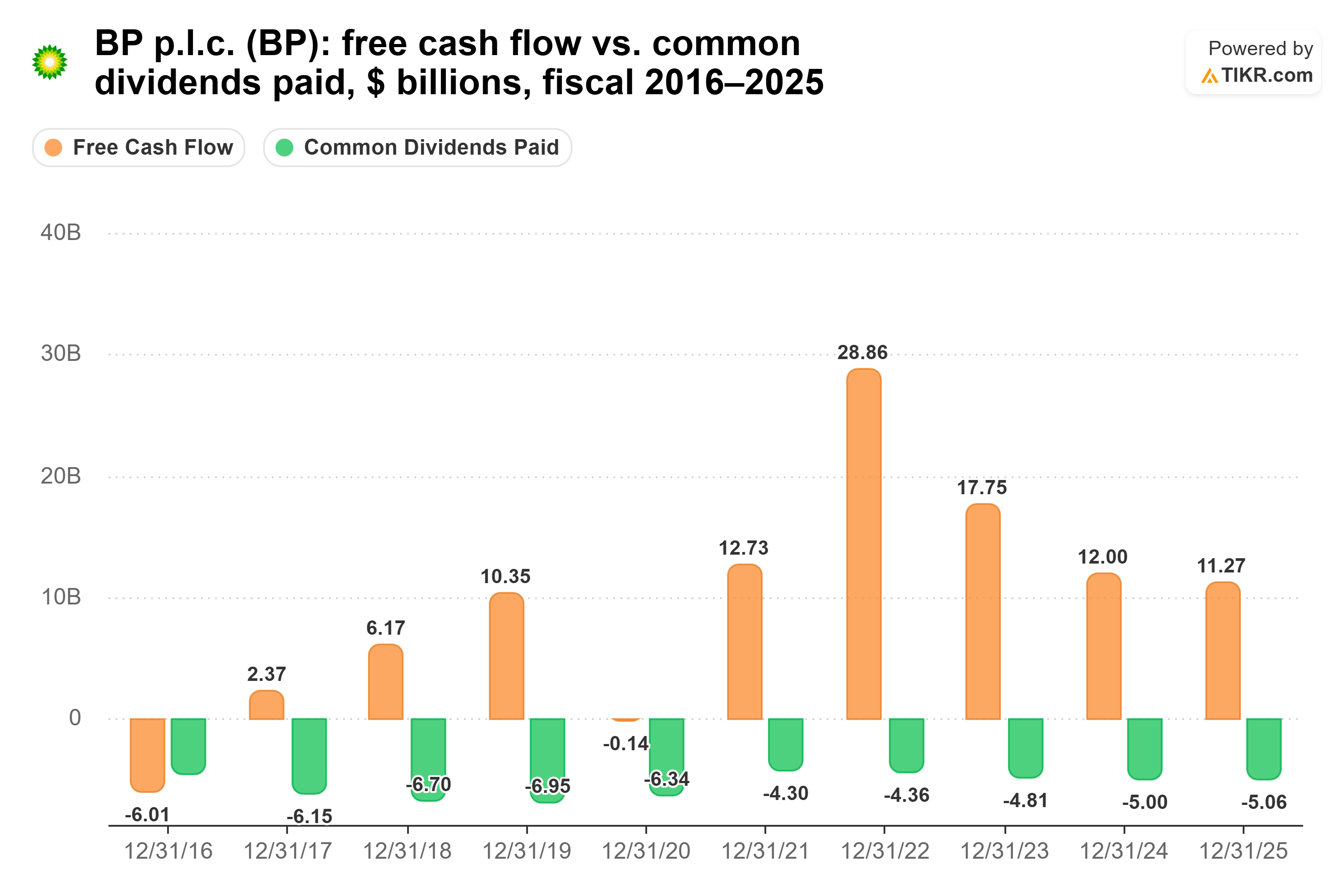
BP’s cash dividend payout ratio was a well-covered 31% over the twelve months to June 30, 2026: $5.06 billion of dividends against $16.14 billion of free cash flow. Free cash flow fell from $28.9 billion in fiscal 2022 to $11.3 billion in fiscal 2025, which lifted the payout ratio from 15.1% to 44.9%. Even so, it has covered the dividend every year since fiscal 2021.
Refining and trading drove the third quarter, and BPX production is growing, while retail fuel volumes are softening. BP also cut net debt by $8.4 billion in the quarter, to $13.9 billion.
BP says the dividend gets first call on its capital, but the extra cash is spoken for. “Our intention now is to prioritize the use of excess cash flow to address our remaining Deepwater Horizon liabilities in full,” CEO Marguerite O’Neill said on the Oct. 30 call. Financial obligations stood at $44.3 billion after the third quarter, against a target of $33 billion to $35 billion by the end of 2026. And BP’s cash flow still swings with oil prices.
Energy Transfer keeps raising the check
While BP aims its spare cash at old liabilities, Energy Transfer is still raising its payout. As a pipeline partnership, it pays distributions on units, with a K-1 at tax time, and it’s judged on distributable cash flow coverage. In fiscal 2025, distributable cash flow of $2.38 a unit covered the $1.34 distribution a comfortable 1.8x.
That’s down from 2.4x in fiscal 2022. The distribution climbed from $1.00 a unit over those years, while distributable cash flow stayed between $2.38 and $2.44 a unit through fiscal 2025.

The cash is growing again. Third-quarter adjusted EBITDA rose 31% from a year earlier to $5.03 billion.
Energy Transfer raised its 2026 adjusted EBITDA guidance to $19.7-$19.9 billion from $18.8-$19.1 billion. Management targets distribution growth of 3% to 5% a year, and 1.8x coverage leaves room for it.
So which dividend wins?
Energy Transfer is the better high-yield dividend stock. It pays $740 a year on $10,000, against $490 from BP, and its distribution grows inside a stated target.
Say BP’s dividend kept up the 6.5% rise TIKR shows for fiscal 2025, and Energy Transfer’s grew 4.7%, as it did that year. Even then, BP’s income wouldn’t pass Energy Transfer’s until about 2051.
The spending is what to watch. Energy Transfer expects about $7 billion of growth capital in 2027, up from $5.4 billion to $5.6 billion in 2026. Its leverage rose from 3.9x EBITDA in fiscal 2021 to 4.5x in fiscal 2025, the top of its 4x-to-4.5x target.

On TIKR’s figures for the last twelve months, it’s 3.8x, though Energy Transfer also priced $2.7 billion of senior notes on Nov. 5.
BP’s balance sheet is in far better shape, with much less debt and stronger interest coverage. In August, O’Neill said she wants “more of the value proposition to move back to equity holders through growth, distributions or both.” But for now, BP’s dividend waits behind its debt and Deepwater Horizon, while Energy Transfer’s bigger check is growing today.
Of course, BP plans to lay out in December how it will share upside with shareholders, including through buybacks. If more of that cash goes to the dividend, this one gets closer.
Forget Energy Transfer: 6 safe 6%+ dividend yields you can buy right now
Dividends can hold the key to enormous wealth. But only if you buy the right ones.
Picking the right high-yield dividend stock can be the difference between a dream retirement…and scraping by every month, waiting for the next Social Security check to clear.
We’ve identified six stocks yielding 6%+ that we believe every retiree should know about right now. (And Energy Transfer isn’t one of them.)
Disclaimer:
Please note that the articles on TIKR are not intended to serve as investment or financial advice from TIKR or our content team, nor are they recommendations to buy or sell any stocks. We create our content based on TIKR Terminal’s investment data and analysts’ estimates. Our analysis might not include recent company news or important updates. TIKR has no position in any of the stocks mentioned. Thank you for reading, and happy investing!