Key Takeaways
- Verizon yields 6.1% and Comcast 5.4% after a rough fall for both: SpaceX moved into wireless, and Comcast lost broadband customers and warned of a charge of more than $1 billion.
- Comcast’s dividend took 24% of free cash flow over the last 12 months, against 52% for Verizon, and Comcast carries less debt.
- Comcast’s dividend grew 7.5% a year from fiscal 2020 to fiscal 2025 but hasn’t risen in 2026, and analysts expect its free cash flow to fall 29% this year.
- Verizon raised its 2026 outlook in October and now expects free cash flow growth approaching 12%.
SpaceX agreed on Oct. 9 to buy a nationwide block of airwaves for its Starlink Mobile service, and Verizon (VZ) shares fell 9% that day.
Comcast (CMCSA) hit a 52-week low of $20.48 the same day. Two weeks later, it reported losing 144,000 broadband customers in the third quarter and warned of a fourth-quarter charge of more than $1 billion.
Both still yield more than 5%. So which is the better dividend stock?
| Metric | Verizon (VZ) | Comcast (CMCSA) |
|---|---|---|
| Dividend yield | 6.1% | 5.4% |
| Annual dividend | $2.83 | $1.32 |
| Dividend growth, fiscal 2020-2025 | 1.9% a year | 7.5% a year |
| Cash dividend payout ratio, TTM to Sept. 30, 2026 | 52% | 24% |
| Cash dividend payout ratio, fiscal 2026 consensus | 53% | 36% |
| Net debt/EBITDA, LTM | 3.3x | 2.3x |
| Forward P/E (NTM) | 8.7x | 7.0x |
Source: TIKR and StockAnalysis, Nov. 5, 2026.
6 safe dividend stocks paying retirees 6%+ yields
There are over 100 stocks paying 6%+ annual dividends today.
But after an extensive investment review leveraging TIKR’s proprietary data, we now believe only six of them are truly safe for retirees.
They’re all yours for free as part of our new investment report, which you can access right here.
Verizon is growing again
In the third quarter, mobility and broadband service revenue rose 2.9% to $23.5 billion, and Verizon added 406,000 postpaid phone customers. In October, it raised its 2026 guidance for free cash flow growth to approaching 12%, up from 9% to 10%.
The dividend has plenty of cover. Over the twelve months to Sept. 30, 2026, it took a comfortable 52% of free cash flow. On the fiscal 2026 consensus, it’s 53%: analysts expect free cash flow of $22.2 billion, a 10% rise that fits that guidance level. Free cash flow has covered the dividend every year since fiscal 2018:
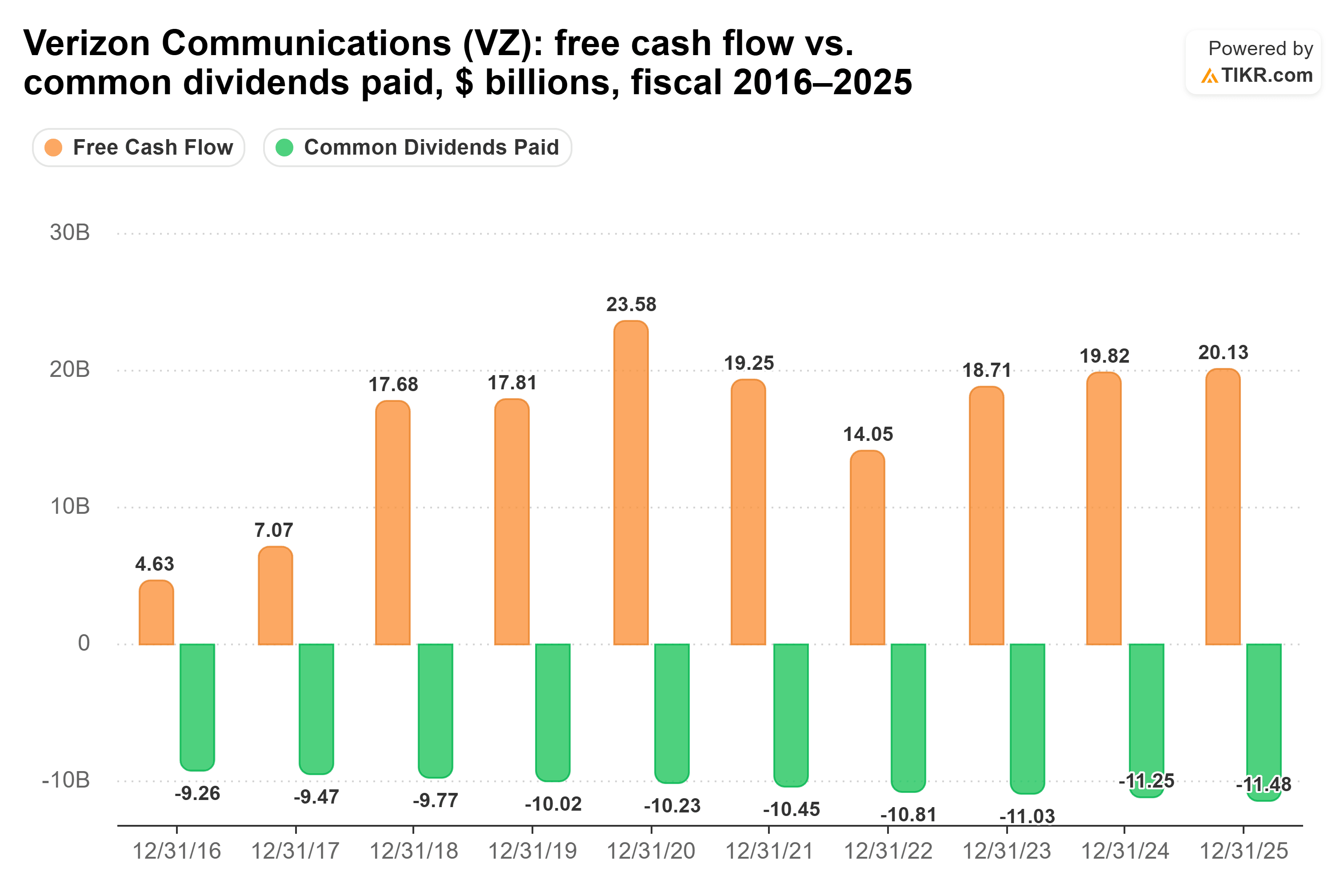
“We remain committed to growing the dividend and delivering enhanced returns to our shareholders through share repurchases,” Verizon said on its third-quarter call. The coverage leaves room for that, though the raises have been small: 1.9% a year from fiscal 2020 to fiscal 2025, from $2.48 a share to $2.73.
The main risk is SpaceX. Bloomberg reported on Oct. 23 that SpaceX is in talks to access at least 80,000 US cell sites. SpaceX President Gwynne Shotwell said on its Oct. 20 call that Starlink Mobile is targeting service on its own airwaves for early 2028.
Comcast has room to spare
Comcast’s dividend has far more cushion than Verizon’s. It took just 24% of free cash flow over the twelve months to Sept. 30, 2026. In every fiscal year since 2021, it has taken between 22% and 31%:

The business behind it is shrinking, though. Third-quarter revenue fell 6.1% to $29.3 billion, and free cash flow fell 14.8% to $4.2 billion. Comcast is losing broadband customers to fiber and fixed wireless rivals.
“These investments are creating near-term financial pressure, but we believe they’re necessary to strengthen customer relationships and position the business for a return to growth over the long term,” Co-CEO Michael Cavanagh said on the third-quarter call.
The dividend has stalled. It grew 7.5% a year from $0.92 a share in fiscal 2020 to $1.32 in fiscal 2025, and the $0.33 quarterly dividend declared on Oct. 22 still comes to $1.32 a year. Comcast has also paused buybacks since July 1 and plans to spin off NBCUniversal and Sky by the middle of 2027. It hasn’t said what either company will pay after the split. On the July call, CFO Jason Armstrong said: “we will take the coming months, obviously, to work through capital allocation, capital structure policies.”
So which dividend wins?
Verizon is the better dividend stock. It pays the bigger check, that check is still growing, and the business behind it just raised its outlook.
$10,000 in Verizon pays $607 a year at today’s 6.1% yield. The same $10,000 in Comcast pays $536 at 5.4%. At their 5-year rates, Comcast’s income would pass Verizon’s around 2029. But that needs 7.5% raises, and Comcast’s dividend hasn’t moved this year.
Comcast’s free cash flow is also set to fall. On TIKR’s consensus figures, 16 analysts expect $13.6 billion in fiscal 2026, 29% below fiscal 2025’s $19.2 billion. Analysts then see $13.0 billion to $13.4 billion a year through fiscal 2028:

Even so, the dividend would take only 36% of fiscal 2026’s free cash flow. Comcast’s dividend is safe, the company carries less debt, and the stock is cheaper at 7.0x forward earnings against Verizon’s 8.7x.
Still, I’d rather own the bigger check that’s still rising, from a business that’s growing.
One thing would change my call: Comcast committing both companies to dividend growth before the separation closes in mid-2027.
Enjoy your retirement in style with these safe 6%+ dividend yields
Dividends can hold the key to enormous wealth. But only if you buy the right ones.
Picking the right high-yield dividend stock can be the difference between a dream retirement…and scraping by every month, waiting for the next Social Security check to clear.
We’ve identified six stocks yielding 6%+ that we believe every retiree should know about right now.
Disclaimer:
Please note that the articles on TIKR are not intended to serve as investment or financial advice from TIKR or our content team, nor are they recommendations to buy or sell any stocks. We create our content based on TIKR Terminal’s investment data and analysts’ estimates. Our analysis might not include recent company news or important updates. TIKR has no position in any of the stocks mentioned. Thank you for reading, and happy investing!