Key Takeaways
- Hercules Capital yields 11.7% at its current $1.88-a-share annual dividend, more than three times U.S. Bancorp’s 3.6%.
- U.S. Bancorp paid out 44% of its fiscal 2025 normalized EPS as dividends, and Hercules paid out 98%.
- Hercules covered its base distribution 118% with net investment income in the third quarter, even as early loan repayments fell sharply.
- Analysts expect U.S. Bancorp’s normalized EPS to rise 16% in fiscal 2026, and the bank plans to restart buybacks soon.
An 11.7% yield will stop almost any income investor in their tracks.
That’s what Hercules Capital (HTGC) pays at its current rate, after holding its third-quarter distribution at $0.47 a share. U.S. Bancorp (USB), which raised its quarterly dividend 3.8% to $0.54 in June, yields 3.6%.
The bank pays out less than half of what it earns, while Hercules hands back nearly all of it. So which is the better dividend stock?
| Metric | U.S. Bancorp (USB) | Hercules Capital (HTGC) |
|---|---|---|
| Yield at the current rate | 3.6% | 11.7% |
| Annual dividend at the current rate | $2.16 | $1.88 |
| Dividend growth, fiscal 2020-2025 | 4.0% a year | 6.4% a year |
| Payout ratio of normalized EPS, fiscal 2025 | 44% | 98% |
| Payout ratio of normalized EPS, fiscal 2026 consensus | 40% | 88% |
Source: TIKR and StockAnalysis, at today’s prices.
6 safe dividend stocks paying retirees 6%+ yields
There are over 100 stocks paying 6%+ annual dividends today.
But after an extensive investment review leveraging TIKR’s proprietary data, we now believe only six of them are truly safe for retirees.
They’re all yours for free as part of our new investment report, which you can access right here.
U.S. Bancorp has room to spare
U.S. Bancorp’s third-quarter net revenue hit a record $7.97 billion, up from $7.33 billion a year earlier, and diluted EPS rose 9.8% to $1.34. Capital markets revenue jumped 69.3% with the BTIG acquisition, while mortgage banking revenue fell 13.9% on higher rates. Management now expects 8%-9% net revenue growth for 2026.
That outlook supports analysts’ expectation that normalized EPS will rise 16% to $5.34 in fiscal 2026. That would take the payout ratio down to 40% from a well-covered 44%. The dividend has kept rising even when earnings swung:
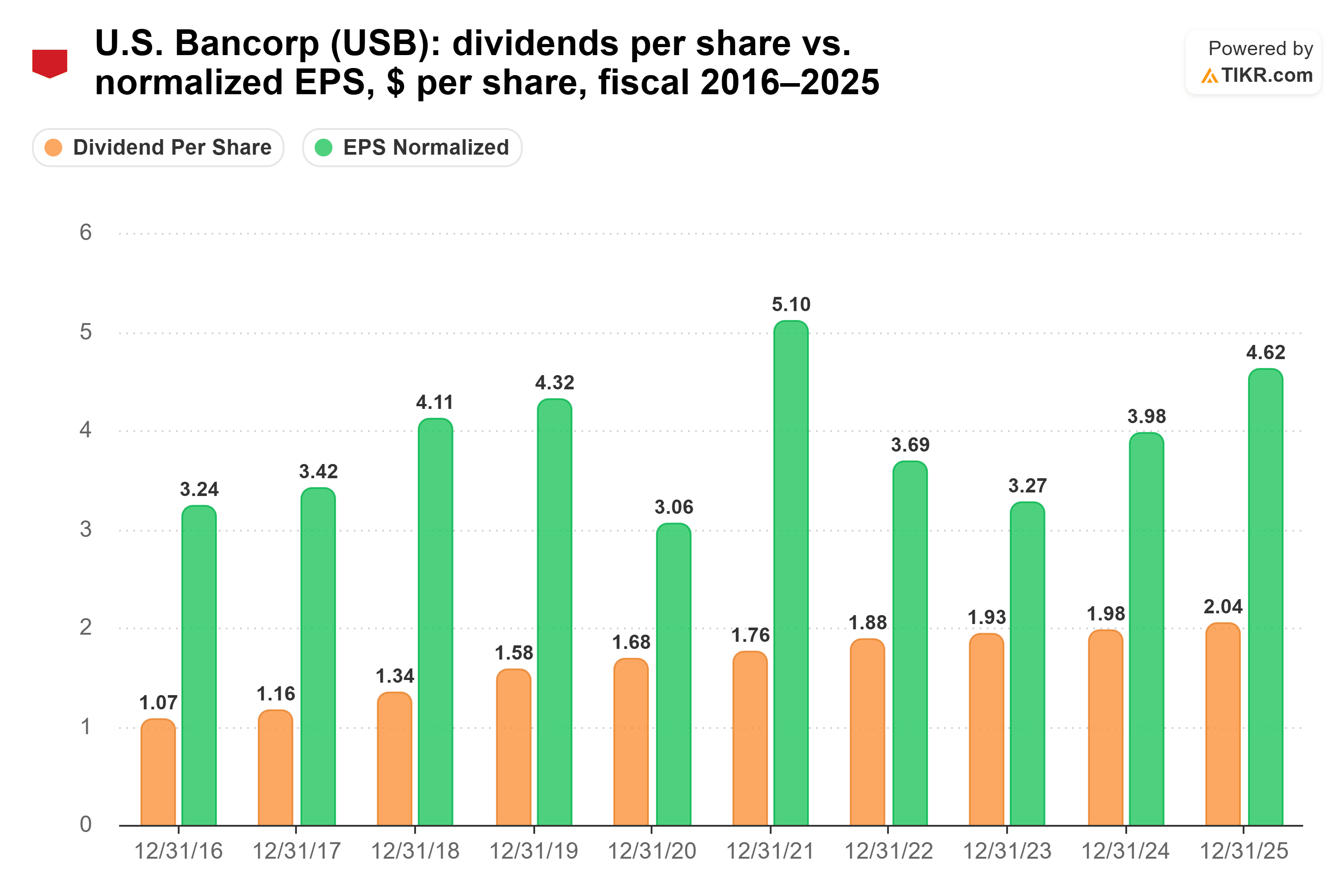
The tightest year was fiscal 2023, when normalized EPS fell to $3.27 and the payout ratio hit 59%.
CFO John Stern said on the third-quarter call that the bank is “very much committed to the 70% to 75% payout from a capital distribution standpoint.” That target counts buybacks as well as the dividend. At a Nov. 6 conference, Stern said buybacks would restart soon after a pause for loan growth and an Amazon small-business credit card portfolio.
Chief Risk Officer Jodi Richard resigned on Oct. 23 to join another public company, and Chief Credit Officer Troy Remington is filling in while the bank looks for a replacement. Credit hasn’t slipped, though. The net charge-off ratio improved to 0.51% in the third quarter from 0.56% a year earlier.
Hercules runs close to the line
U.S. Bancorp keeps more than half its earnings. Hercules, a business development company, pays out almost all of its own. Its $0.47 quarterly payment is a $0.40 base distribution plus a $0.07 supplemental one. Hercules called it its “25th consecutive quarter of being able to provide our shareholders with a supplemental distribution.”
Its payout ratio of normalized EPS was a tight 98% in fiscal 2025. Analysts’ forward 88% assumes a $1.69 dividend in fiscal 2026. At the current $1.88 rate, set against the same $1.92 of expected EPS, the payout ratio is back at 98%. That margin has been thin for a decade:
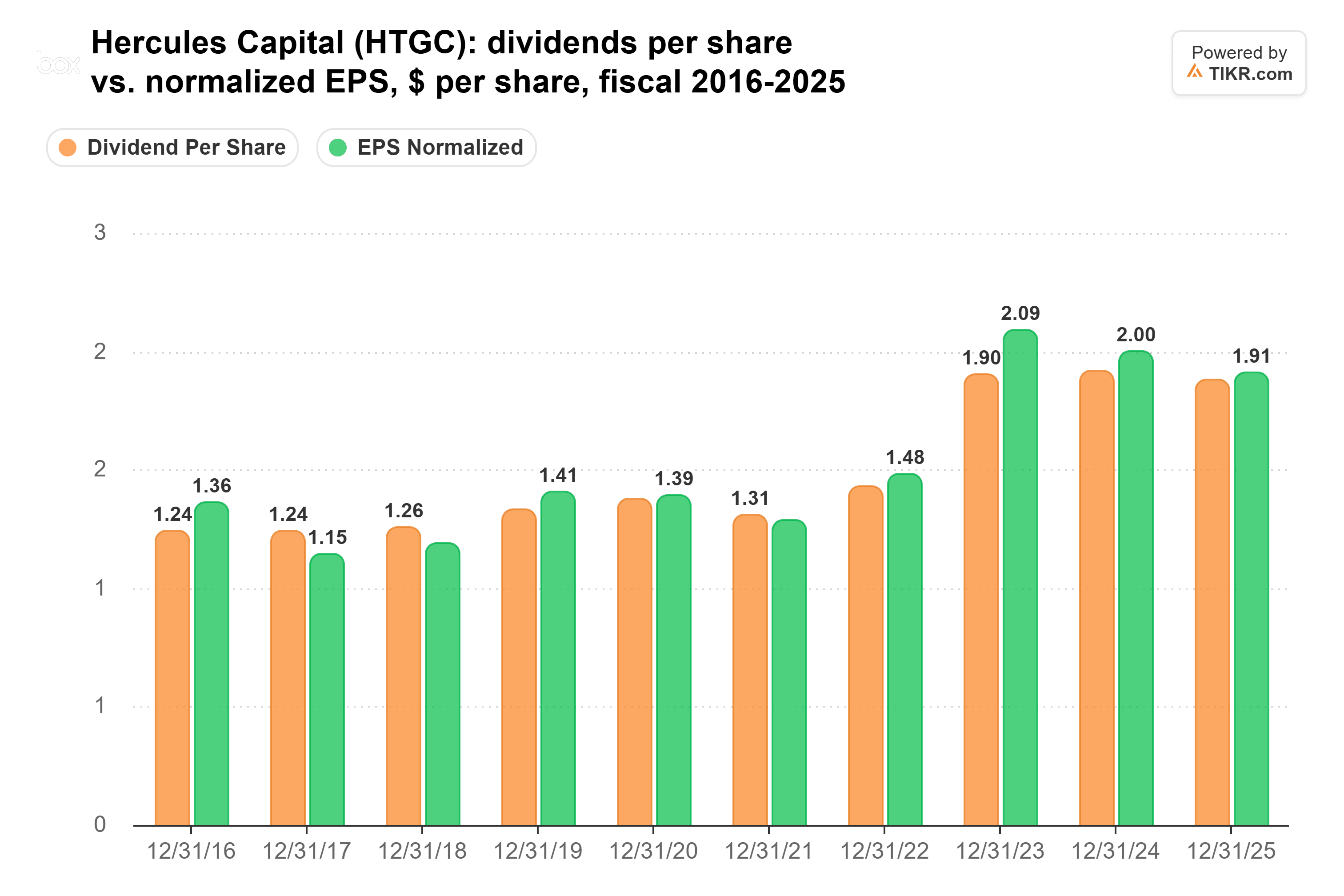
The payout ratio has ranged from 91% to 108% since fiscal 2016. Over that stretch, the dividend dipped only in fiscal 2021 and fiscal 2025.
The base looks safer than that record suggests. “We continue to comfortably cover our base dividend operating at these levels with 118% coverage for Q3, despite a nearly 75% reduction in early repayment volume during the quarter,” CEO Scott Bluestein said in the third-quarter release. Hercules also carried $0.88 a share of undistributed earnings into the fourth quarter.
The quarter was soft, though. Net investment income was $0.47 a share, down from $0.49 a year earlier. But year-to-date commitments hit a record $3.44 billion, and management expects income to rise in the fourth quarter as prepayments return to $200 million to $300 million. Fitch affirmed Hercules’ BBB- investment-grade rating with a stable outlook on Oct. 16. The main risk is competition: Bluestein said a handful of rival lenders remain aggressive on deal structure and pricing.
So which dividend wins?
Hercules Capital is the better dividend stock. Its check is far bigger, and its base distribution looks safe. $10,000 in Hercules pays $1,171 a year at today’s prices, against $360 in U.S. Bancorp. The $1.60 base alone is a 10.1% yield. At the pace each dividend is growing now, U.S. Bancorp’s income wouldn’t pass Hercules’ for more than 30 years. In year 10, that’s about $471 against about $1,171.
That isn’t to say U.S. Bancorp’s dividend isn’t great. It’s far better covered, it has risen every year on the chart, and analysts see room for more:
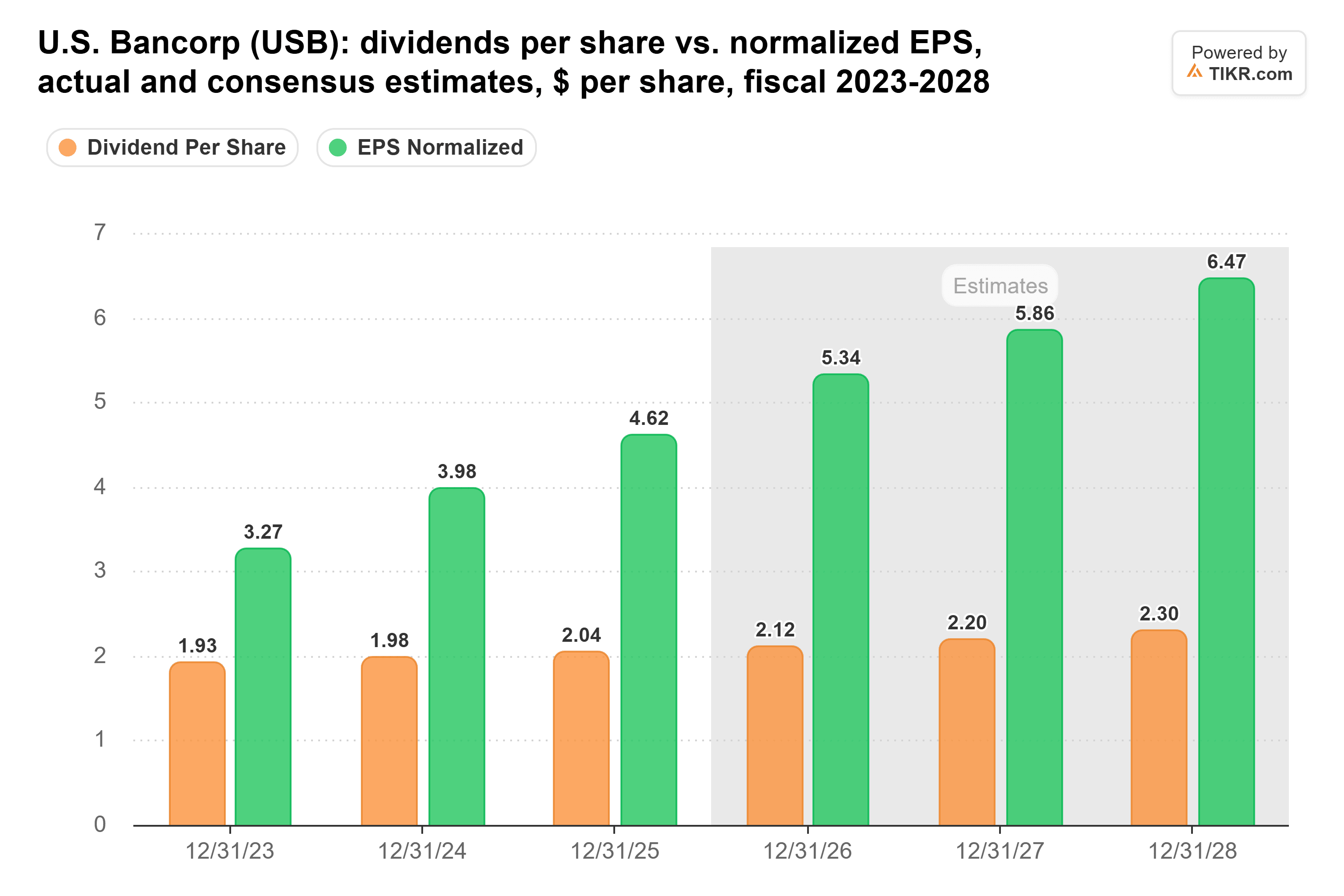
At its 4.0% five-year pace, $10,000 in U.S. Bancorp would pay about $511 in year 10, a 5.1% yield on today’s cash, before any gains in the stock. Still, Hercules has a base covered 118%, a spillover cushion and an investment-grade rating. That makes its much bigger check one worth counting on.
Of course, the fourth-quarter report is the one to watch. If prepayments don’t recover as management expects, I’d expect the supplemental to go before the base.
Forget Hercules Capital: 6 safe 6%+ dividend yields you can buy right now
Dividends can hold the key to enormous wealth. But only if you buy the right ones.
Picking the right high-yield dividend stock can be the difference between a dream retirement…and scraping by every month, waiting for the next Social Security check to clear.
We’ve identified six stocks yielding 6%+ that we believe every retiree should know about right now. (And Hercules Capital isn’t one of them.)
Disclaimer:
Please note that the articles on TIKR are not intended to serve as investment or financial advice from TIKR or our content team, nor are they recommendations to buy or sell any stocks. We create our content based on TIKR Terminal’s investment data and analysts’ estimates. Our analysis might not include recent company news or important updates. TIKR has no position in any of the stocks mentioned. Thank you for reading, and happy investing!