Key Takeaways
- Procter & Gamble declared its $1.0885 quarterly dividend in October, while PepsiCo cut its 2026 core EPS growth outlook and lost KFC’s U.S. drinks business to Coca-Cola.
- PepsiCo pays the bigger check, a 4.3% yield against 2.7% for Procter & Gamble, but Procter & Gamble’s dividend has more cash behind it.
- Dividends used 67% of Procter & Gamble’s free cash flow over the trailing twelve months, against 75% for PepsiCo, whose dividends roughly matched its free cash flow in fiscal 2024 and 2025.
- PepsiCo trades at 17x forward earnings, below its five-year average of 21x, while Procter & Gamble trades at 23x.
Procter & Gamble (PG) declared its quarterly dividend of $1.0885 a share on Oct. 13 and noted that it “has increased its dividend for 70 consecutive years.”
PepsiCo (PEP) had a rougher October. In its third-quarter report on Oct. 8, it cut its 2026 earnings growth outlook. Then on Oct. 15, KFC said it will switch about 3,700 U.S. restaurants from Pepsi to Coca-Cola starting in January 2027.
So if you could buy only one of them and hold it for the next 20 years, which should it be?
| Metric | Procter & Gamble | PepsiCo |
|---|---|---|
| Dividend yield | 2.7% | 4.3% |
| Dividend growth, 5 years | 5.6% a year (fiscal 2021-2026) | 6.9% a year (fiscal 2020-2025) |
| Cash dividend payout ratio (TTM) | 67% | 75% |
| Net debt/EBITDA | 0.9x | 2.0x |
| Interest coverage | 24.2x | 14.9x |
| Forward P/E | 23x | 17x |
Source: TIKR, as of Nov. 9, 2026. P&G’s fiscal year ends in June.
6 safe dividend stocks paying retirees 6%+ yields
There are over 100 stocks paying 6%+ annual dividends today.
But after an extensive investment review leveraging TIKR’s proprietary data, we now believe only six of them are truly safe for retirees.
They’re all yours for free as part of our new investment report, which you can access right here.
P&G’s dividend has room to spare
In the first quarter of fiscal 2027, the three months to Sept. 30, P&G’s organic sales rose 4%, with growth in all 10 product categories and all six regions. The company kept its full-year outlook for 1% to 3% organic sales growth.
Over the twelve months to Sept. 30, 2026, dividends used a comfortable 67% of free cash flow: $10.29 billion paid out of $15.34 billion. Free cash flow has covered the dividend in every one of the last ten fiscal years, rising from $9.37 billion in fiscal 2017 to $15.2 billion in fiscal 2026.
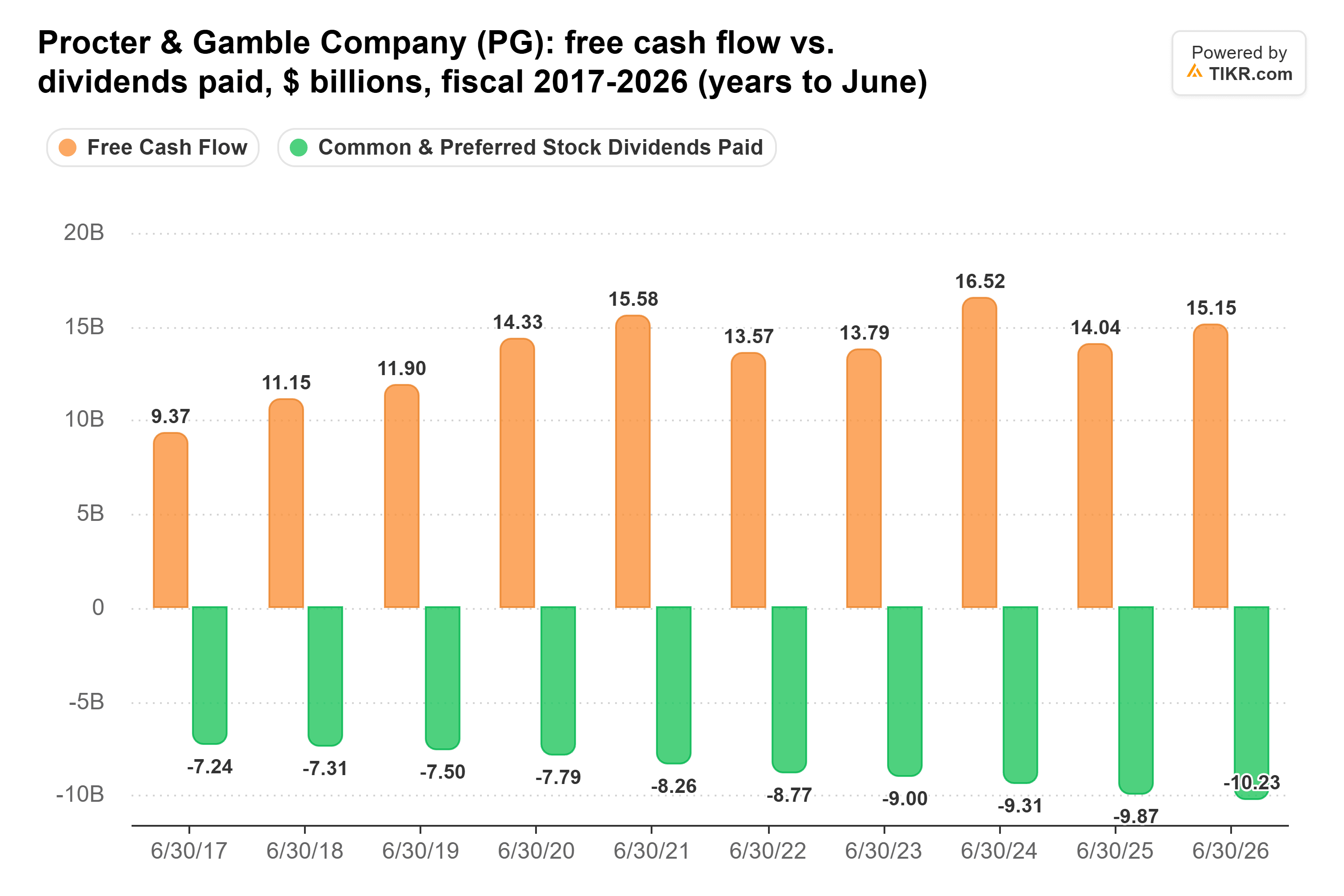
That cash backs up management’s line that many shareholders “rely on the steady, reliable income earned with their investment in P&G.” It expects to pay over $10 billion in dividends in fiscal 2027.
P&G’s dividend grows slowly, though: 5.6% a year from fiscal 2021 to fiscal 2026. It also expects roughly $1.9 billion of after-tax headwinds in fiscal 2027 from commodities, energy, transportation, currency and interest.
PepsiCo’s bigger check has less cushion
PepsiCo’s dividend starts bigger than P&G’s, and it has grown faster: 6.9% a year from fiscal 2020 to fiscal 2025, to $5.62 a share. Its free cash flow hasn’t kept up. Dividends paid rose from $4.23 billion in fiscal 2016 to $7.64 billion in fiscal 2025, while free cash flow went from $7.62 billion to $7.67 billion.
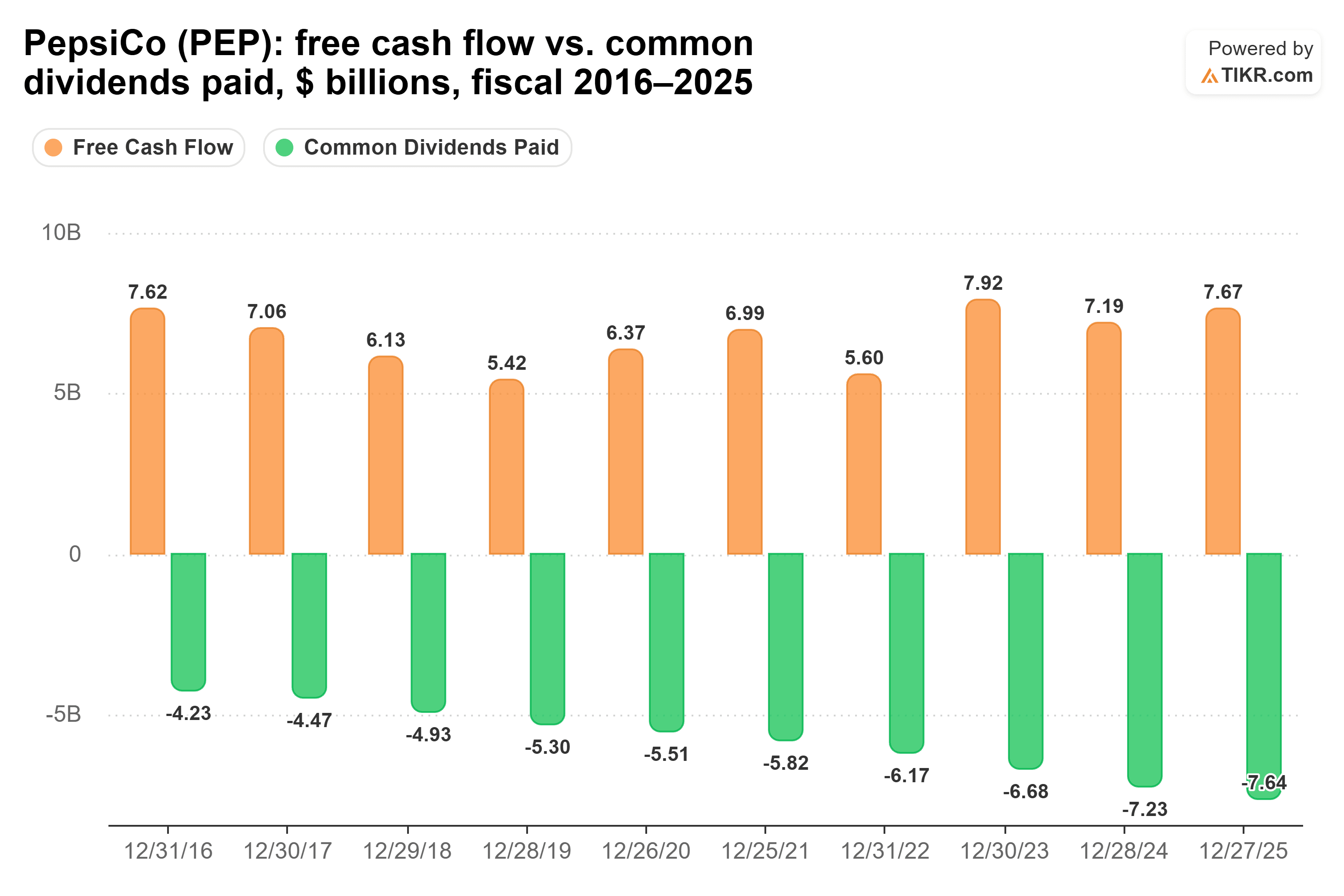
That pushed dividends to 110.1% of free cash flow in fiscal 2022, 100.6% in fiscal 2024 and 99.6% in fiscal 2025, a risky level for any payer. Coverage has improved since then. Dividends used 75% of free cash flow over the twelve months to September 2026 ($7.88 billion of $10.47 billion).
The business is split. In the third quarter, the 12 weeks to Sept. 5, organic revenue rose 3.1%. But CEO Ramon Laguarta said on PepsiCo’s third-quarter call, “we’re not satisfied with the performance in the U.S.” The core EPS growth outlook fell to 2.5%-3.5%, from the low end of 5%-7%, with management pointing to rising input costs and mix. The KFC loss lands in that same U.S. drinks business.
So which dividend wins?
If I could hold only one for the next 20 years, I’d hold Procter & Gamble. Its dividend has more cash behind it, less debt and 70 straight years of raises.
PepsiCo pays more today, and a lot more over time. At each stock’s five-year growth rate, $10,000 in PepsiCo pays about $17,495 over 20 years, against about $9,542 for P&G, and P&G’s income never catches up. But PepsiCo’s 6.9% rate came from dividends outgrowing flat free cash flow. I don’t see that pace holding for 20 more years unless the cash starts growing again.
PepsiCo is also cheap. It trades at 17x forward earnings, well below its five-year average of 21x.
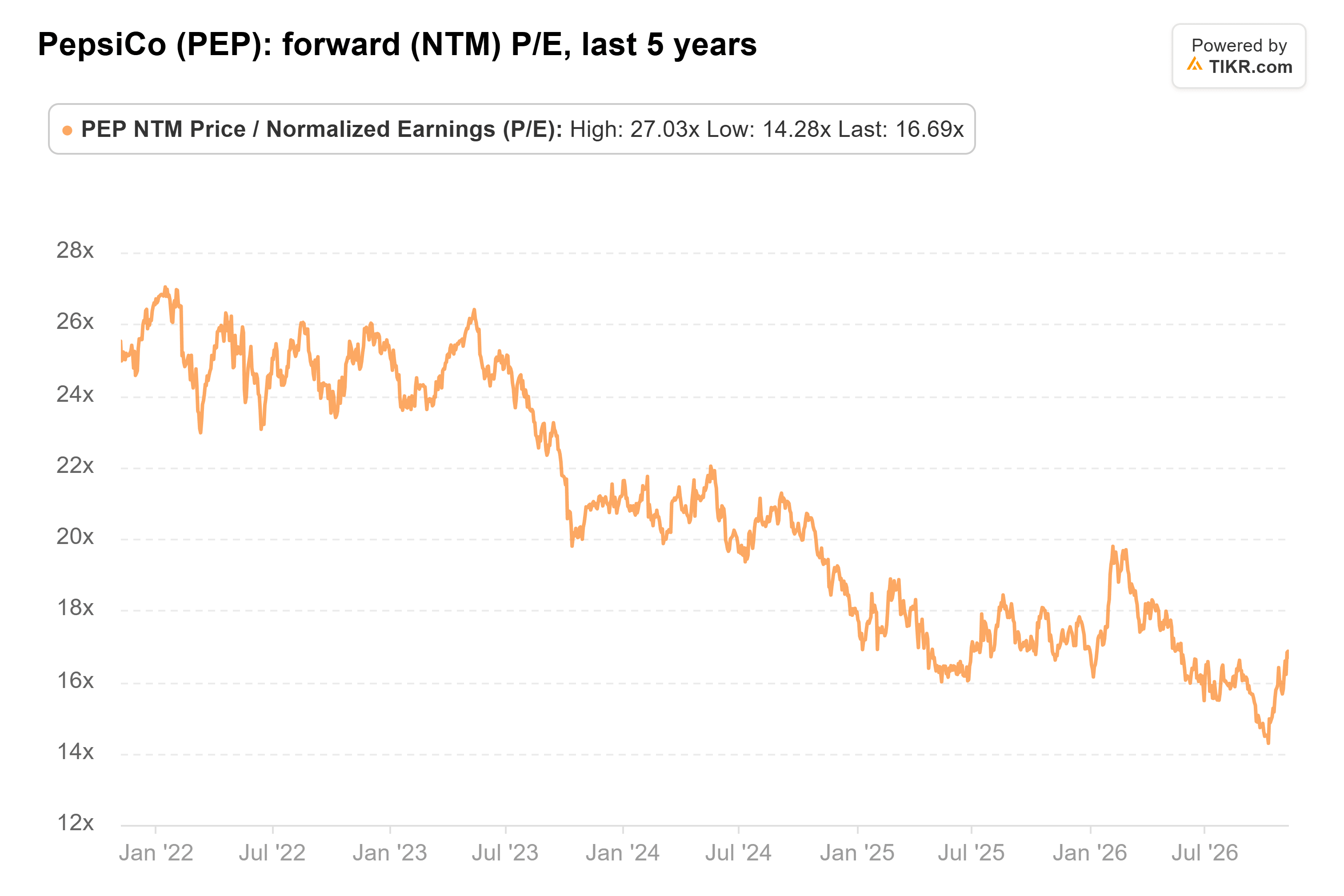
So much of that 4.3% yield comes from a beaten-down price that a buyer today gets a lot of income for the money. It’s just that, over 20 years, I trust P&G’s cash flow to keep pace with its dividend, and PepsiCo still has to show me that.
Of course, Laguarta says more structural cost cuts will be put in place “in the coming months.” If they get PepsiCo’s free cash flow growing again, that extra income would be hard to pass up.
Forget Procter & Gamble: 6 safe 6%+ dividend yields you can buy right now
Dividends can hold the key to enormous wealth. But only if you buy the right ones.
Picking the right high-yield dividend stock can be the difference between a dream retirement…and scraping by every month, waiting for the next Social Security check to clear.
We’ve identified six stocks yielding 6%+ that we believe every retiree should know about right now. (And Procter & Gamble isn’t one of them.)
Disclaimer:
Please note that the articles on TIKR are not intended to serve as investment or financial advice from TIKR or our content team, nor are they recommendations to buy or sell any stocks. We create our content based on TIKR Terminal’s investment data and analysts’ estimates. Our analysis might not include recent company news or important updates. TIKR has no position in any of the stocks mentioned. Thank you for reading, and happy investing!