
Key Takeaways
- Texas Instruments raised its quarterly dividend 7% to $1.52 a share in September, and Cisco raised its dividend for the 15th straight year in fiscal 2026.
- Texas Instruments yields 2.0% and grew its dividend 8.1% a year from fiscal 2020 to 2025, against a 1.7% yield and 2.6% a year at Cisco.
- Cisco’s dividend uses 51% of its free cash flow, while Texas Instruments’ uses 71%, after three years of paying out far more than its free cash flow as it built new fabs.
- Texas Instruments’ capacity plans, due at its February capital management call, are the main thing to watch.
Texas Instruments (TXN) raised its quarterly dividend 7% to $1.52 a share on Sept. 17, 2026, which it says marks “23 consecutive years of dividend increases.” A month later, it reported third-quarter revenue of $6.06 billion, up 28% from a year before.
That data center buildout is lifting Cisco Systems (CSCO), too. Its revenue grew 12% to $63.3 billion in fiscal 2026, the year ended July 25. It raised its dividend for the 15th year in a row that year and now pays $0.42 a share a quarter.
So which is the better dividend stock?
| Metric | Texas Instruments (TXN) | Cisco Systems (CSCO) |
|---|---|---|
| Dividend yield | 2.0% | 1.7% |
| Dividend growth, 5 years | 8.1% a year (fiscal 2020-2025) | 2.6% a year (fiscal 2021-2026) |
| Years of dividend increases (company’s count) | 23 | 15 |
| Cash dividend payout ratio (TTM) | 71% (to Sept. 30, 2026) | 51% (to July 25, 2026) |
| Net debt/EBITDA (LTM) | 0.5x | 0.8x |
| Interest coverage (LTM) | 15.1x | 10.9x |
Source: TIKR, Nov. 5, 2026; dividend streaks are the companies’ own counts.
6 safe dividend stocks paying retirees 6%+ yields
There are over 100 stocks paying 6%+ annual dividends today.
But after an extensive investment review leveraging TIKR’s proprietary data, we now believe only six of them are truly safe for retirees.
They’re all yours for free as part of our new investment report, which you can access right here.
Texas Instruments spent big and kept raising
TI pays the bigger check. It has grown it 8.1% a year from fiscal 2020 to fiscal 2025, from $3.72 to $5.50 a share.
Coverage is the catch. TI aims to “return all free cash flow to its owners over time.” Yet from fiscal 2023 to fiscal 2025, its dividend ran far ahead of its free cash flow:
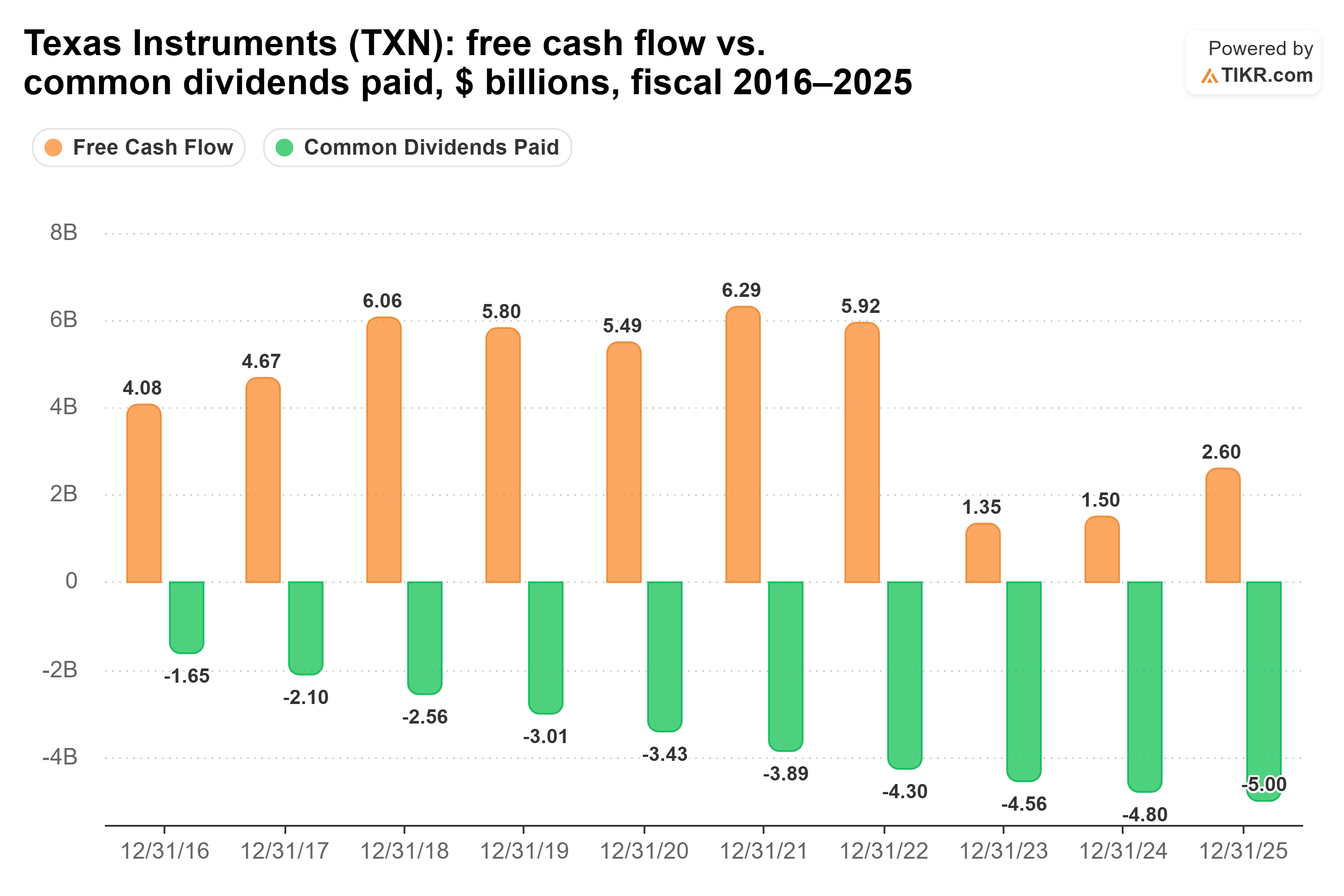
Dividends took 338% of free cash flow in fiscal 2023 and 192% in fiscal 2025, and TI kept raising anyway. Over the twelve months to Sept. 30, 2026, they used a manageable 71%. Over the same months, cash from operations rose 43% from the year before, to $9.9 billion.
The main risk is the cycle: a slump in industrial and automotive demand would hit TI’s cash just as it’s recovering.
Cisco’s dividend has room to spare
Cisco is the steadier payer. TI’s coverage swung hard over the decade, but Cisco’s free cash flow covered its dividend every year from fiscal 2017 to fiscal 2026:
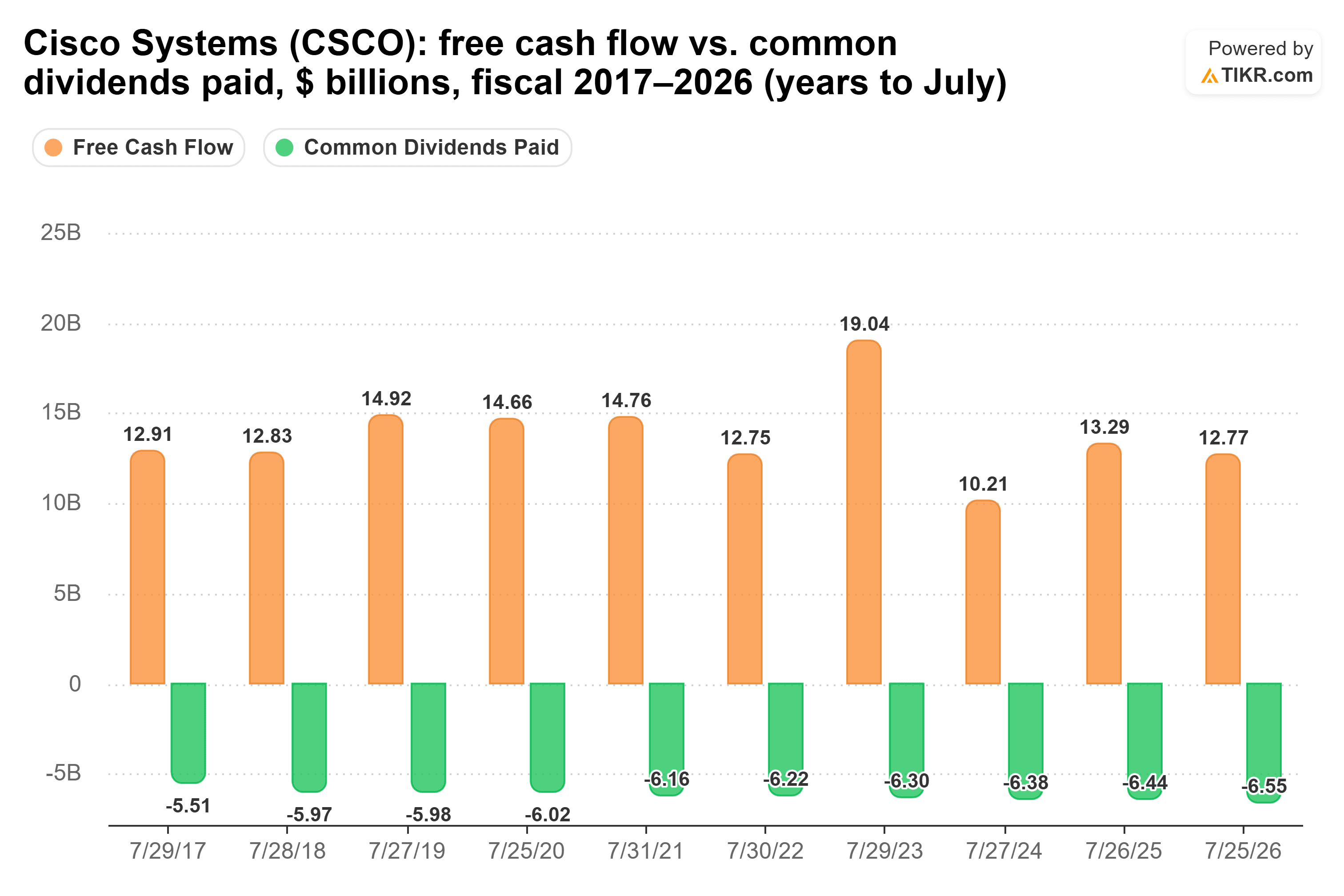
Free cash flow ranged from $10.2 billion in fiscal 2024 to $19.0 billion in fiscal 2023, and the dividend never took more than 63% of it. Over the twelve months to July 25, 2026, it used a well-covered 51%.
Networking revenue rose 28% in the fiscal fourth quarter from a year before, on AI infrastructure for hyperscalers.
But the dividend barely grows. It rose 2.6% a year from fiscal 2021 to fiscal 2026, from $1.46 to $1.66 a share. Margins are under pressure, too: Cisco’s adjusted product gross margin fell 270 basis points in the fiscal fourth quarter from a year before, on more hardware and pricier memory. On Nov. 5, Morgan Stanley downgraded the stock to Equal-Weight, pointing to that pressure ahead of Cisco’s next report later this month.
So which dividend wins?
For me, Texas Instruments is the better dividend stock. It pays a bigger check, has grown it more than three times as fast over the last five years, and carries less debt.
Its coverage problem came from a choice to build new fabs. Compare TI’s cash from operations with its capital spending:
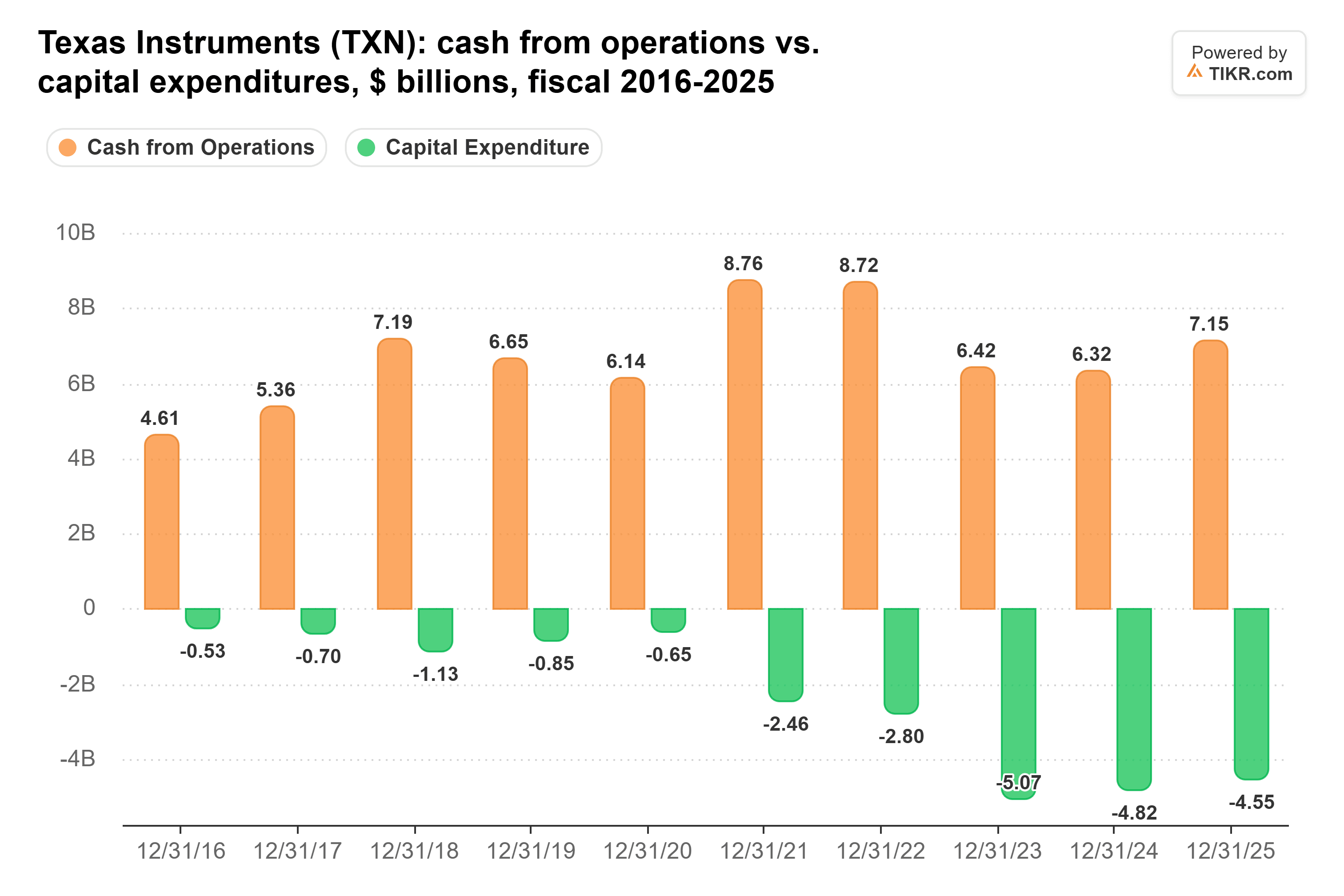
TI’s cash from operations stayed between $6.3 billion and $7.2 billion a year from fiscal 2023 to fiscal 2025. Over the same stretch, capex jumped from $0.65 billion in fiscal 2020 to $5.07 billion in fiscal 2023, then eased to $4.55 billion in fiscal 2025. With that spending past its peak, the cash behind the dividend is back.
TI pays more over time, too. Put $10,000 into TI at its 2.0% yield, and it pays $200 a year now and about $404 in year 10 at its 5-year growth rate. So, call it a 4% yield on your cash today. Cisco’s $170 grows to about $214, a 2.1% yield. Even at fiscal 2025’s 4.6% increase, slower than September’s 7% raise, TI would pay about $299 in year 10. Cisco’s income never catches up.
That isn’t to say Cisco’s dividend isn’t safe. It’s the better-covered of the two, and its free cash flow has covered the dividend every year since fiscal 2017. It’s just that 2.6% a year does little for an income investor, and TI’s bigger, faster-growing check has the cash behind it again.
Of course, TI could start spending heavily again. It will lay out its capacity plans at its capital management call in February, and another big round of fab building would squeeze the cash behind its dividend once more.
Forget Texas Instruments: 6 safe 6%+ dividend yields you can buy right now
Dividends can hold the key to enormous wealth. But only if you buy the right ones.
Picking the right high-yield dividend stock can be the difference between a dream retirement…and scraping by every month, waiting for the next Social Security check to clear.
We’ve identified six stocks yielding 6%+ that we believe every retiree should know about right now. (And Texas Instruments isn’t one of them.)
Disclaimer:
Please note that the articles on TIKR are not intended to serve as investment or financial advice from TIKR or our content team, nor are they recommendations to buy or sell any stocks. We create our content based on TIKR Terminal’s investment data and analysts’ estimates. Our analysis might not include recent company news or important updates. TIKR has no position in any of the stocks mentioned. Thank you for reading, and happy investing!