Key Takeaways
- Lowe’s yields 2.2% and Target 2.9%, and both raised their quarterly dividends in the past year.
- Lowe’s paid out 38% of its free cash flow in dividends over the twelve months to July 31, 2026, against 46% for Target over the twelve months to Aug. 1.
- Analysts expect Lowe’s ratio to hold near 36% this fiscal year, while Target’s payout ratio rises to 67%.
- Target carries less debt, at 1.5x net debt to EBITDA against 2.7x for Lowe’s.
Lowe’s (LOW) and Target (TGT) both reported second-quarter results on Aug. 19, 2026, and came away with very different outlooks.
Lowe’s comparable sales rose just 0.2%, and it cut its full-year forecast to flat comparable sales, from as much as 2% growth. Target’s rose 3.8% with traffic up 3.6%, and it raised its full-year sales outlook.
Both still stand behind their dividends. Lowe’s calls itself “a dividend aristocrat,” and Target says it wants to “build on our more than 50-year record of annual increases.” So which is the better dividend stock?
| Metric | Lowe’s (LOW) | Target (TGT) |
|---|---|---|
| Dividend yield | 2.2% | 2.9% |
| Dividend growth, 5 years | 15.6% a year | 11.0% a year |
| Record, in its own words | “a dividend aristocrat” | “more than 50-year record of annual increases” |
| Cash dividend payout ratio, TTM | 38% | 46% |
| Cash dividend payout ratio, forward | 36% | 67% |
| Net debt/EBITDA | 2.7x | 1.5x |
| Interest coverage | 6.4x | 12.7x |
Source: TIKR, Nov. 9, 2026. Growth from the year ended January 2021 to the year ended January 2026; TTM to July 31, 2026 (Lowe’s) and Aug. 1, 2026 (Target); forward is consensus for this fiscal year, ending January 2027.
6 safe dividend stocks paying retirees 6%+ yields
There are over 100 stocks paying 6%+ annual dividends today.
But after an extensive investment review leveraging TIKR’s proprietary data, we now believe only six of them are truly safe for retirees.
They’re all yours for free as part of our new investment report, which you can access right here.
Lowe’s is waiting on housing
Lowe’s do-it-yourself shoppers are holding back. Comparable transactions fell 2.1% in the quarter ended July 31, 2026, led by weather-sensitive outdoor categories. Online sales grew 15.7% and the Pro business kept growing, but management now expects adjusted EPS of about $12.25 this fiscal year, the bottom of its earlier range.
The stock fell 38% from Feb. 13 to Oct. 5, 2026, then bounced 26% through Nov. 4. CEO Marvin Ellison is playing the long game: “We know at some point, we’re going to have to build houses in this country.”
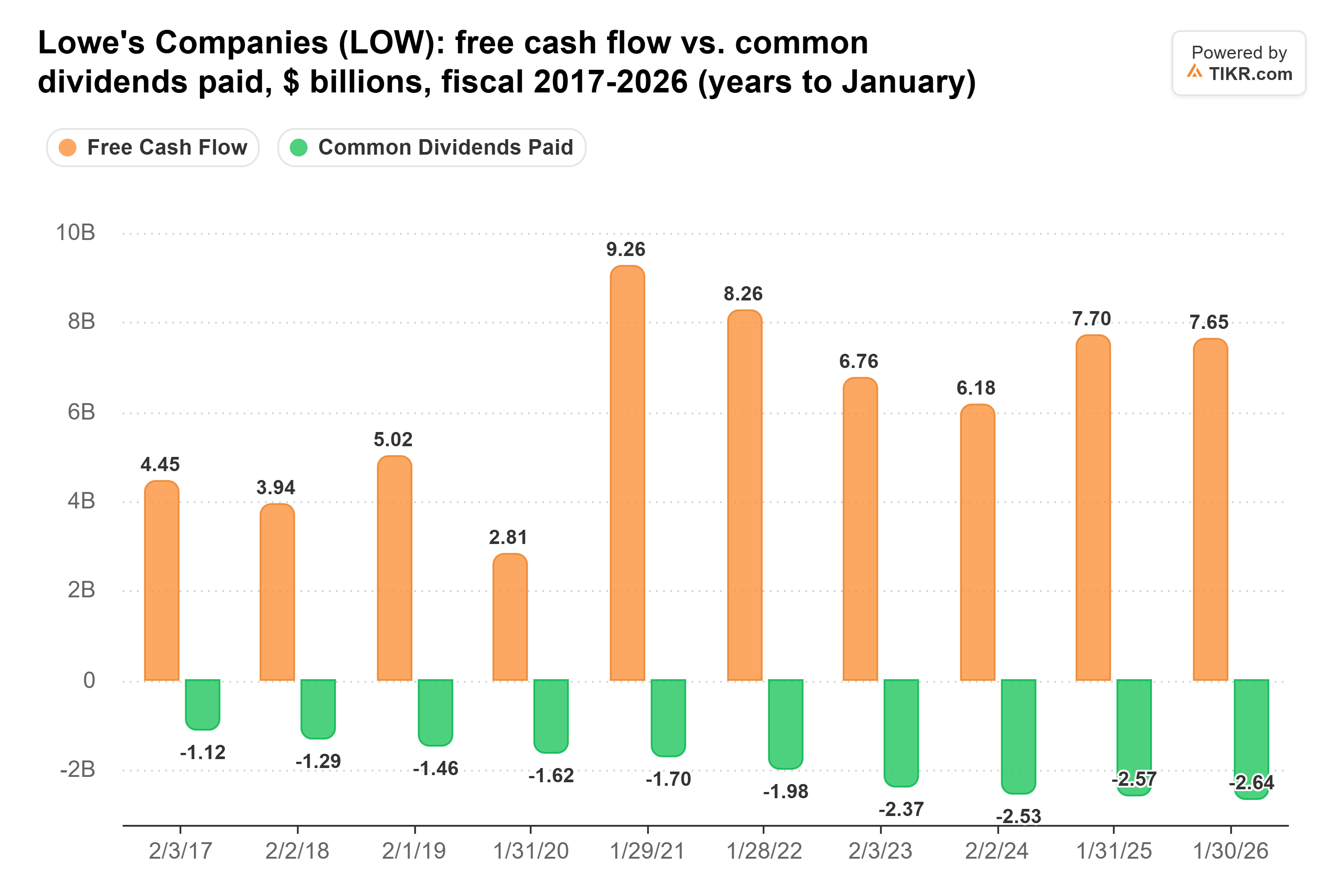
The dividend has plenty of room in the meantime. Lowe’s paid out a well-covered 38% of its free cash flow over the twelve months to July 31, 2026. Analysts expect 36% this fiscal year, on free cash flow of $7.66 billion, in line with last year’s. The ratio stayed at or below 41% in every fiscal year from the one ended January 2021 to the one ended January 2026:
On Aug. 28, the board declared another $1.25 quarterly dividend, paid Nov. 4. Debt is the risk. Net debt runs 2.7x EBITDA, and Foundation Building Materials, Lowe’s largest acquisition, is tied to the same soft new-home market.
Target has momentum and a thinner cushion
Target’s business is moving the other way. Net sales grew 5.3% to $26.5 billion in the quarter ended Aug. 1, 2026. EPS doubled to $4.11 from $2.05, including a $1.65-a-share tariff refund. Strip that out, and EPS still rose about 20%. Home and apparel are still lagging, and management says that work runs into 2027 and beyond.
The trailing cash dividend payout ratio looks comfortable at 46%. But Target paid out a stretched 72% of its free cash flow last fiscal year. Seven analysts expect 67% this fiscal year, on free cash flow of $3.13 billion, with Target planning about $5 billion of capital spending. Target’s free cash flow has swung far more than its dividend:
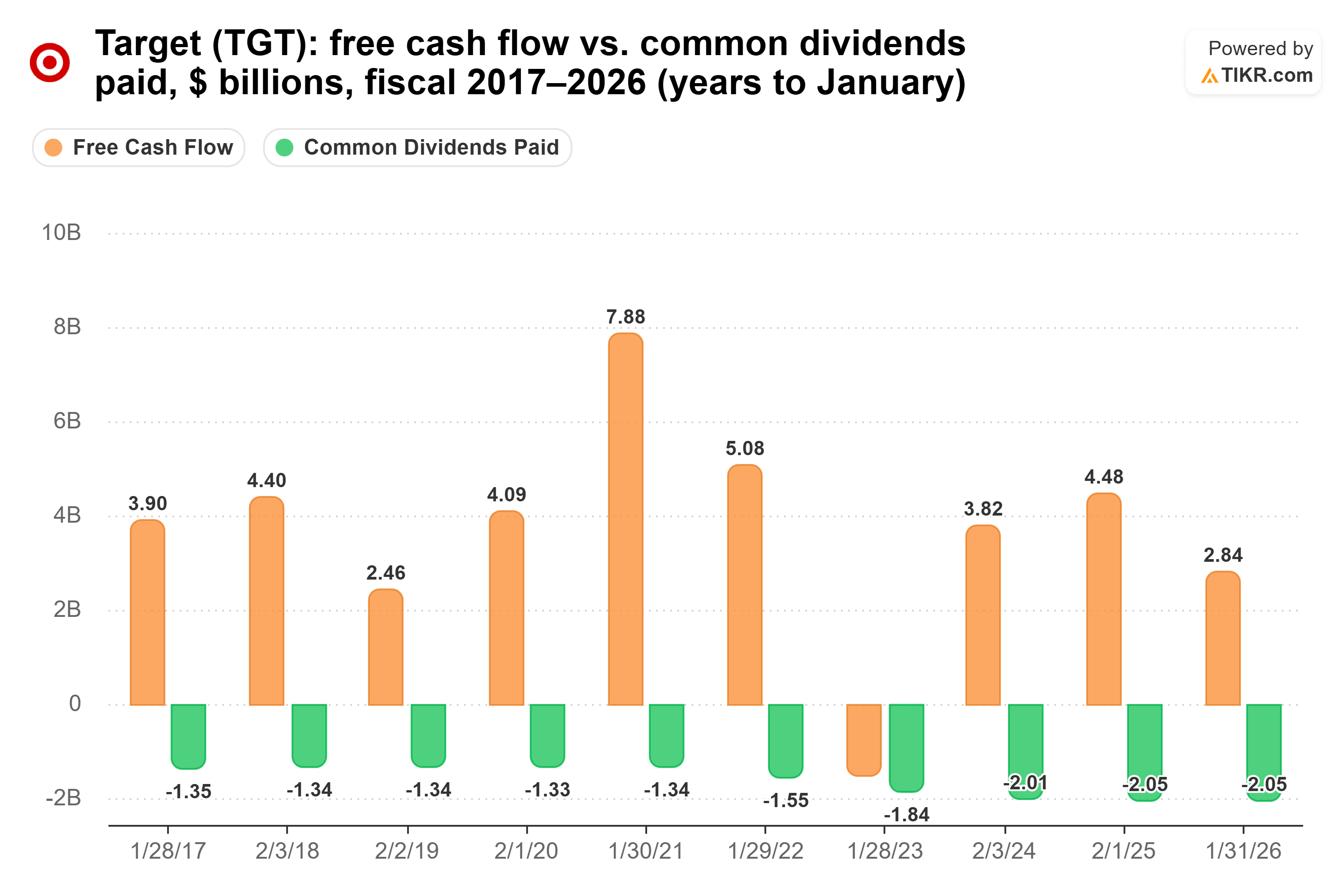
In the year ended January 2023, free cash flow was negative, and dividends per share still rose.
Management says it wants to support the dividend while “moving towards a 40% payout ratio over time.” This year’s 1.8% raise fits that goal: small increases while the business grows into the payout. The main risk is that this year’s earnings got a one-time lift, and Target expects harder comparisons in the back half.
So which dividend wins?
Lowe’s is the better dividend stock. Target pays more today, but Lowe’s covers its dividend with far more free cash flow and is still raising it faster.
The estimates show the gap. Analysts see Target’s free cash flow between $2.85 billion and $3.30 billion a year through the year ending January 2029, against $2.05 billion of dividends paid last fiscal year:
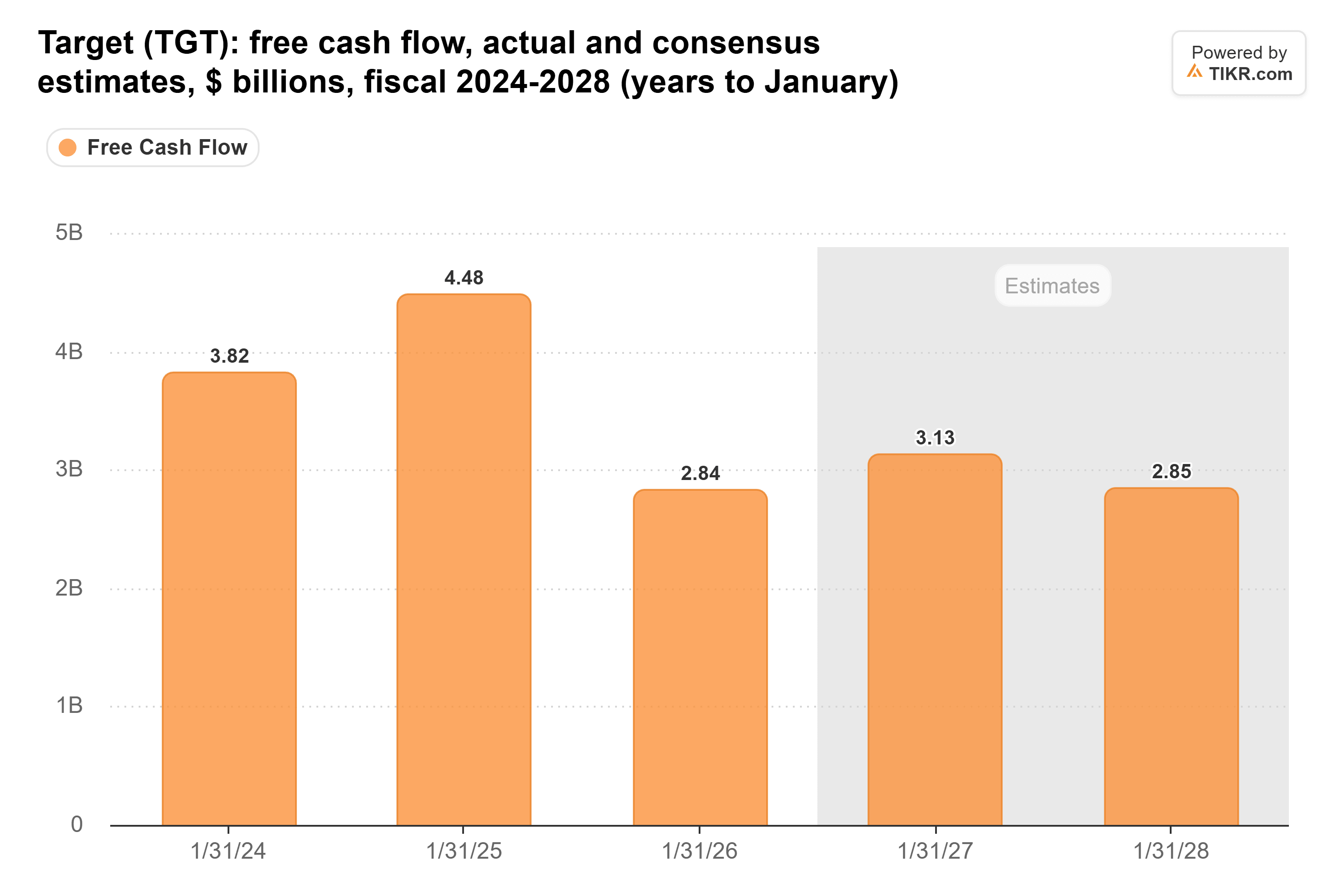
$10,000 in Target pays $290 a year today, against $220 from Lowe’s. At each company’s latest raise (4.4% for Lowe’s last fiscal year, 1.8% for Target), Lowe’s income wouldn’t catch up until about 2037. At their 5-year rates, it would pass Target’s around 2033 and pay about $812 in year 10, an 8.1% yield on the $10,000.
Target’s dividend is still safe. It pays the bigger check, covers its interest 12.7x, and kept raising through a year of negative free cash flow. Lowe’s still edges it, because it pays its dividend with about a third of its free cash flow, against about two-thirds at Target, and future raises come out of what’s left.
Of course, Lowe’s expects third-quarter adjusted EPS about 7% below last year’s. If new-home construction stays soft for longer, its free cash flow could slip from here.
Forget Lowe’s: 6 safe 6%+ dividend yields you can buy right now
Dividends can hold the key to enormous wealth. But only if you buy the right ones.
Picking the right high-yield dividend stock can be the difference between a dream retirement…and scraping by every month, waiting for the next Social Security check to clear.
We’ve identified six stocks yielding 6%+ that we believe every retiree should know about right now. (And Lowe’s isn’t one of them.)
Disclaimer:
Please note that the articles on TIKR are not intended to serve as investment or financial advice from TIKR or our content team, nor are they recommendations to buy or sell any stocks. We create our content based on TIKR Terminal’s investment data and analysts’ estimates. Our analysis might not include recent company news or important updates. TIKR has no position in any of the stocks mentioned. Thank you for reading, and happy investing!