Key Takeaways
- General Mills yields 6.9% and Molson Coors yields 5.0%, and both boards held their quarterly dividends flat this fall.
- General Mills’s dividend took 85% of its free cash flow over the trailing 12 months, against 31% at Molson Coors.
- General Mills plans to keep its dividend at the current rate while it pays down debt, which its CFO expects to take at least a couple of years.
- Molson Coors cut its 2026 earnings and free cash flow guidance on Nov. 5, and two banks downgraded the stock within days.
Any investor hunting for income among consumer staples will look hard at a 6.9% yield. That’s what General Mills (GIS) pays today, and Molson Coors (TAP) isn’t far behind at 5.0%.
Neither board is in a hurry to raise. General Mills declared its $0.61 quarterly dividend on Sept. 29 and again on Nov. 16, unchanged both times. Molson Coors held its own at $0.48 on Nov. 19.
So which is the better dividend stock?
| Metric | General Mills (GIS) | Molson Coors (TAP) |
|---|---|---|
| Dividend yield | 6.9% | 5.0% |
| Annual dividend | $2.44 | $1.92 |
| Dividend growth, 5 years | 3.9% a year (fiscal 2021-2026) | 27.0% a year (fiscal 2020-2025) |
| Dividend growth, 10 years | 3.2% a year (fiscal 2016-2026) | 1.4% a year (fiscal 2015-2025) |
| Cash dividend payout ratio, TTM | 85% | 31% |
| Cash dividend payout ratio, forward | 76% (fiscal 2027) | 36% (fiscal 2026) |
| Net debt / EBITDA | 3.67x | 2.47x |
Source: TIKR and StockAnalysis, at today’s prices.
6 safe dividend stocks paying retirees 6%+ yields
There are over 100 stocks paying 6%+ annual dividends today.
But after an extensive investment review leveraging TIKR’s proprietary data, we now believe only six of them are truly safe for retirees.
They’re all yours as part of our new investment report. Learn more about how to get access right here.
General Mills: a big check on hold
General Mills is still waiting for growth to return. In the first quarter of fiscal 2027, which ended Aug. 30, net sales fell 3% to $4.4 billion on the sale of its U.S. yogurt business, and organic net sales were flat.
The dividend has less cushion than it used to:

Free cash flow has covered dividends paid every year since fiscal 2017. But in fiscal 2026, which ended in May, free cash flow fell to $1.63 billion from $2.29 billion while dividends paid held at $1.32 billion. That pushed the cash dividend payout ratio to a stretched 81% from 58%. It’s 85% over the trailing 12 months to Aug. 30, and analysts’ fiscal 2027 estimates bring it to a still-tight 76%.
“We remain fully committed to our dividend, and in the near term, we expect to maintain the current rate per share while we prioritize deleverage,” CFO Kofi Bruce said on the first-quarter call.
Molson Coors: room to spare, but a rough year
Molson Coors has the opposite problem: plenty of cushion, but a business under pressure. Third-quarter net sales fell 1.6% to $2.93 billion, and underlying EPS fell 12.6% to $1.46. On Nov. 5, it cut its 2026 outlook. Underlying EPS is now expected to fall 16% to 19%, worse than the 11% to 15% it guided before, and underlying free cash flow to come in at $1.0 billion, plus or minus 10%, down from $1.1 billion.
Wells Fargo cut the stock to Underweight from Equal Weight on Nov. 6 and lowered its target to $36 from $38. JPMorgan followed on Nov. 9, to Underweight from Neutral, with its target cut to $37 from $41.
Still, the dividend takes only a small share of the cash:

In fiscal 2025, dividends paid were $0.38 billion against $1.07 billion of free cash flow, a cash dividend payout ratio of 35%. Over the trailing 12 months to Sept. 30, it’s a well-covered 31%, and analysts’ fiscal 2026 estimates put it at 36% even after the guidance cut.
The 27.0% a year of dividend growth overstates the pace, though. It starts in fiscal 2020, when dividends paid dropped to $0.13 billion from $0.42 billion the year before. Over 10 years, the dividend rose just 1.4% a year, to $1.88 a share in fiscal 2025 from $1.64 in fiscal 2015.
So which dividend wins?
Molson Coors is the better dividend stock. Its dividend uses about a third of its free cash flow, while General Mills’s uses 85% and it carries more debt than it wants.
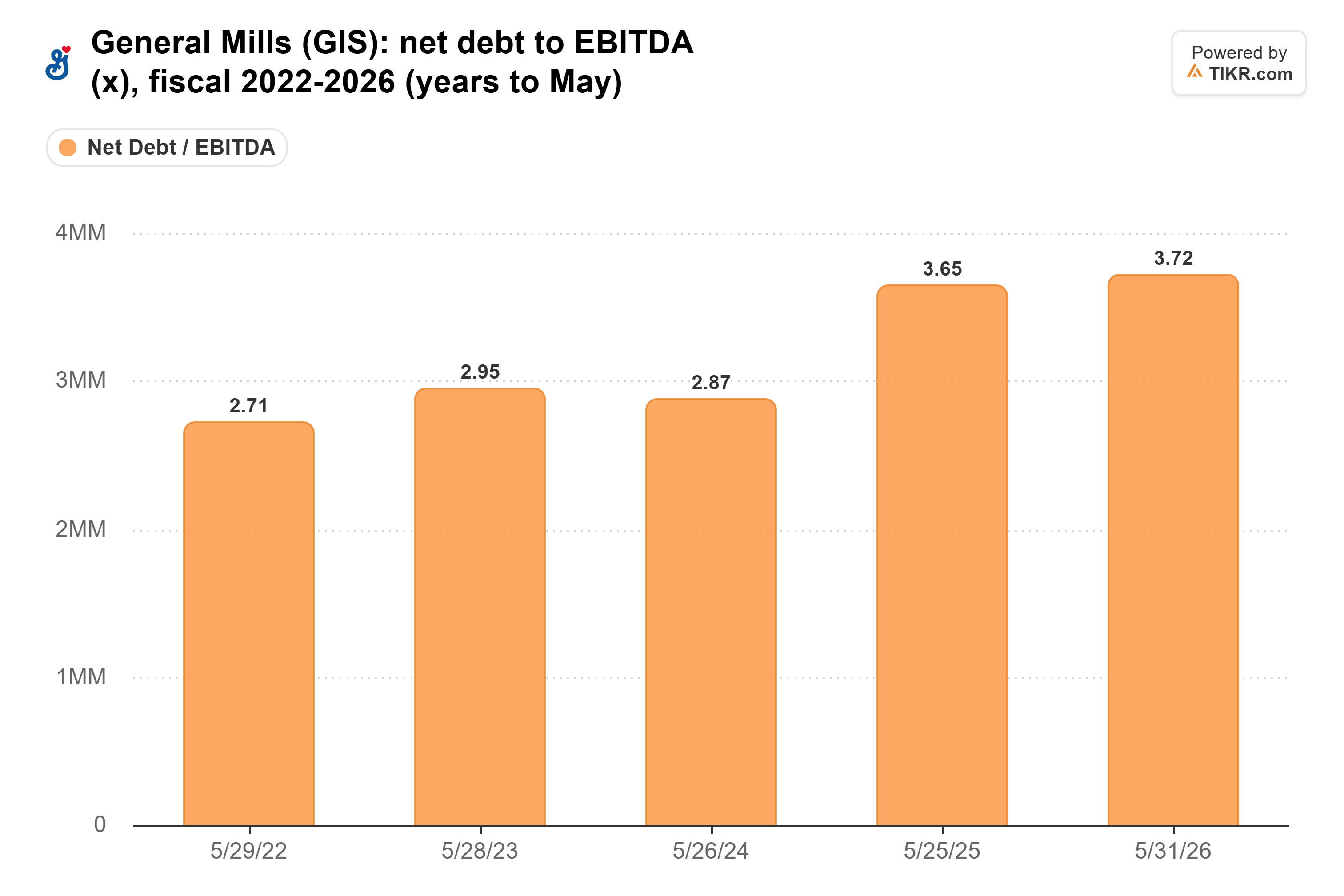
Net debt rose to 3.7x EBITDA in fiscal 2026 from 2.7x in fiscal 2022, above the company’s 3x target. Bruce expects it to take “at least a couple of years” to get back there, and the dividend stays flat until then.
General Mills’s case is the bigger check. $10,000 pays $690 a year at its 6.9% yield, against $500 from Molson Coors. Even if General Mills kept up its 1.7% raise of fiscal 2026 and Molson Coors its 6.8% of fiscal 2025, Molson Coors’s income wouldn’t pass it until about 2033.
But an 85% payout with no raises in sight leaves General Mills little room for another bad year. Molson Coors just had one, cut its guidance, and still covers its dividend about three times over.
Molson Coors’s full-year free cash flow still has to land inside its $1.0 billion guide to keep that cushion. General Mills reports its second quarter on Dec. 17, and the test there is whether free cash flow is tracking toward the 95% of adjusted after-tax earnings management expects this year.
Forget Molson Coors: 6 safe 6%+ dividend yields you can buy right now
Dividends can hold the key to enormous wealth. But only if you buy the right ones.
Picking the right high-yield dividend stock can be the difference between a dream retirement…and scraping by every month, waiting for the next Social Security check to clear.
We’ve identified six stocks yielding 6%+ that we believe every retiree should know about right now. (And Molson Coors isn’t one of them.)
Disclaimer:
Please note that the articles on TIKR are not intended to serve as investment or financial advice from TIKR or our content team, nor are they recommendations to buy or sell any stocks. We create our content based on TIKR Terminal’s investment data and analysts’ estimates. Our analysis might not include recent company news or important updates. TIKR has no position in any of the stocks mentioned. Thank you for reading, and happy investing!