Key Takeaways
- First Long Island Investors, which manages $1.86 billion, raised its Taiwan Semiconductor stake 67% last quarter, making it the fund’s third-largest holding, and opened a new position in Lumentum.
- Both bets have fallen since Sept. 30: Taiwan Semiconductor 30%, on worries around Nvidia and new US chip curbs on China, and Lumentum 53%, as Marvell’s all-stock offer for it shrank.
- Taiwan Semiconductor trades at 14x forward earnings, below its five-year average of 18.1x, while analysts expect its EPS to more than double from 2025 to 2027.
- The numbers back the fund’s bet, and the company’s 2027 guidance in mid-January is the next test.
First Long Island Investors raised its stake in Taiwan Semiconductor (TSM) by 67% in the third quarter, to 163,794 shares, per its 13F for the quarter ended Sept. 30, filed Nov. 16. That stake was worth $75 million at the quarter’s end, 5.3% of its 13F stocks.
The stock has fallen 30% since, caught up in worries around Nvidia (NVDA), widely reported to be its biggest customer, and new US limits on China’s access to AI chips. The fund’s other new AI bet, Lumentum (LITE), is down 53% over the same stretch, and its price now moves with Marvell Technology (MRVL), which agreed on Nov. 2 to buy it in an all-stock deal.
A top-three holding, with a smaller bet beside it
The firm manages $1.86 billion in all, and its 13F listed $1.40 billion of US stocks across 65 positions at Sept. 30. Taiwan Semiconductor ranked third among them. Lumentum was new, at 25,866 shares worth $25 million, or 1.8% of its 13F stocks. Marvell will pay 4.5 of its own shares for each Lumentum share, a deal worth about $1,132 a share when it was announced, against Lumentum’s last close of $460.54. So until the deal closes, expected in the first half of 2028, that position is mostly a bet on Marvell’s stock.
TIKR tracks 21 analysts on TSMC. How many say “Buy”?
See the full breakdown of Buy, Hold, and Sell ratings on TSMC, along with Wall Street’s revenue and earnings estimates, all in one place. More than 500,000 investors use TIKR to research stocks like this one. See TSMC’s Analyst Ratings
The selling came from Nvidia and Washington
Taiwan Semiconductor’s own results gave investors no reason to sell. On Oct. 15, it reported third-quarter revenue of $46.72 billion, above the top of its guidance, and its gross margin rose to 66.4% from 59.5% a year earlier.
Then Washington and Nvidia’s headlines took over. On Nov. 16, the Trump administration said it would further restrict China’s access to advanced AI chips, and Reuters reported that Taiwan Semiconductor suspended some advanced orders from Chinese chip designers as the rules took effect. China was 5% of its third-quarter revenue. Then Reuters reported on Nov. 20 that SEC staff are examining potential accounting issues at Nvidia, which neither the SEC nor Nvidia has confirmed.
Investors sold Taiwan Semiconductor hard on that one, since one customer made up 19% of its 2025 revenue. Nvidia’s business looks fine, though: on Nov. 17, it reported revenue up 103% to $115.8 billion and guided its fiscal fourth quarter to $130.0 billion, with no data center compute revenue from China assumed.
Do the numbers back the fund?
They do. Analysts expect normalized EPS of $17.50 this year, $23.39 in 2027 and $29.82 in 2028, up from $10.65 in 2025:
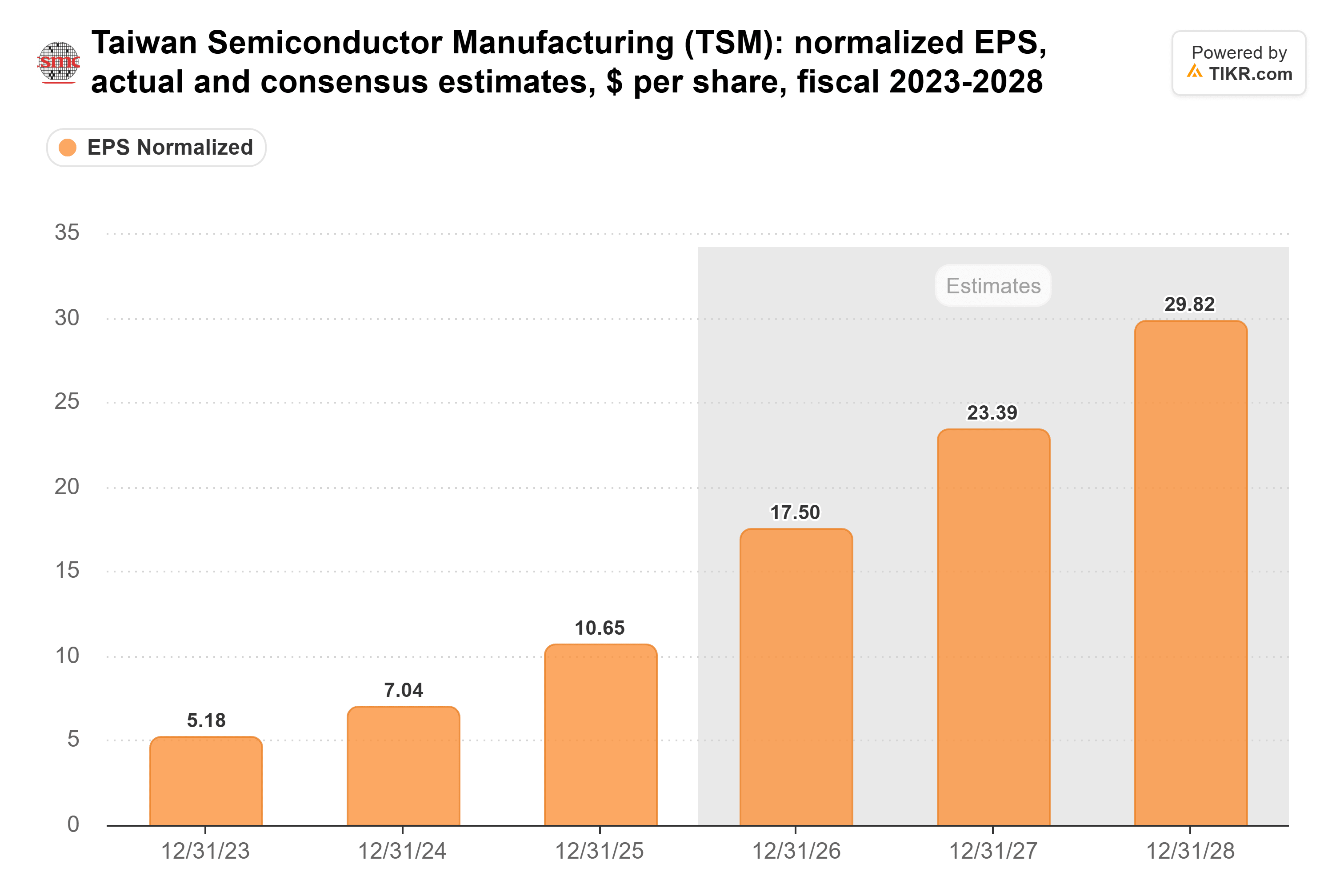
The 2027 figure is up from $21.28 three months ago. With China at 5% of revenue, I don’t expect the new curbs to move those estimates much.
The selloff has also left the stock cheaper than usual against those earnings. Its forward P/E is 14x, against an 18.1x average over the last five years:
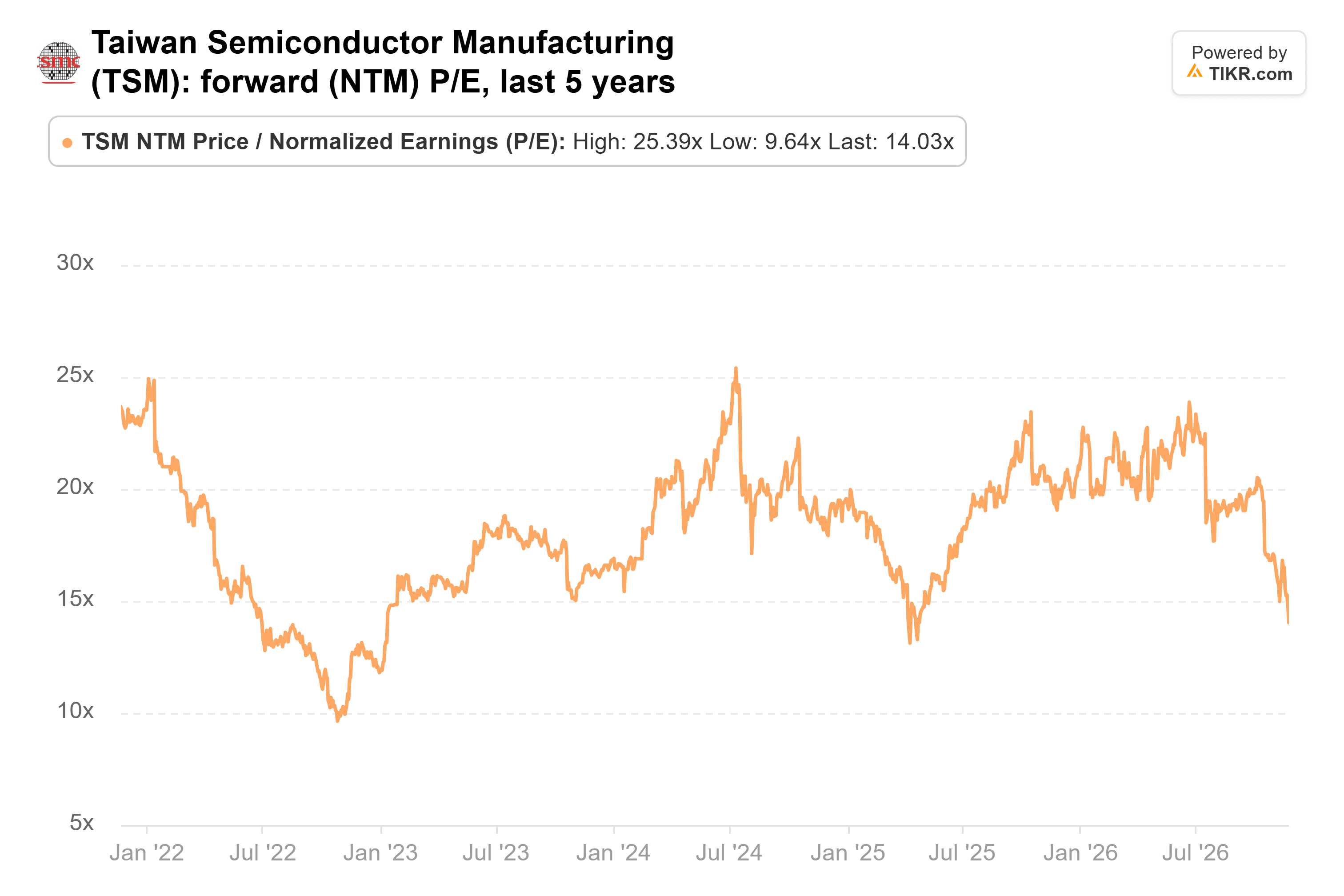
The low over that stretch was 9.6x, in October 2022, when its earnings were headed for a decline in 2023.
Analysts have gone the other way on price. Their average target rose to $587 from $340 a year ago:
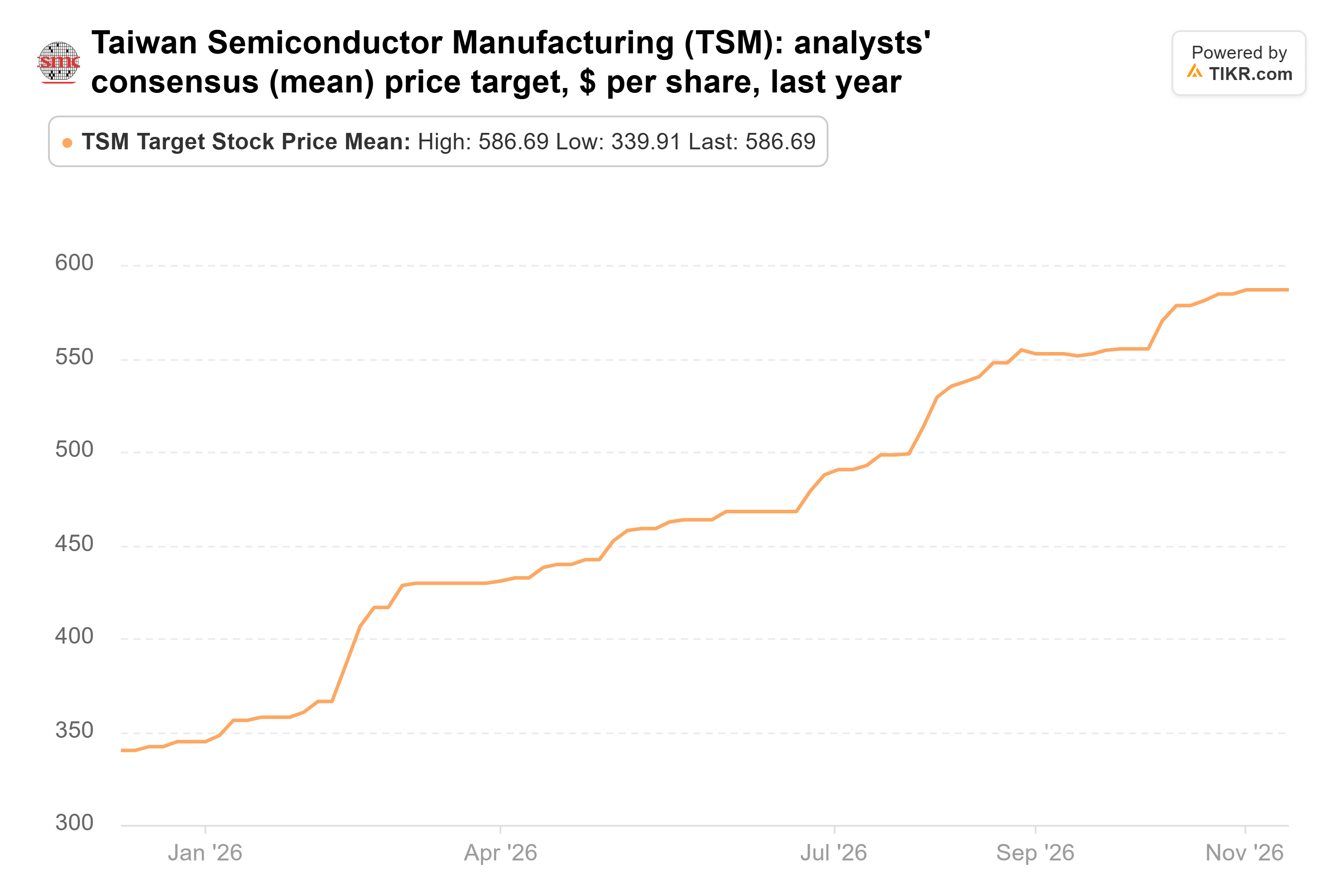
That’s 84% above today’s price, and even the lowest target, $440, sits well above it.
The fund had company, too. Twenty-five big funds opened or added to Taiwan Semiconductor positions in the same quarter, and two of its directors have bought stock this month.
I’d follow this one
The big risk is how much Taiwan Semiconductor is building. It plans $60 billion to $64 billion of capital spending this year, mostly for capacity that arrives in 2028 and 2029, so a pause in AI spending by a few big customers would hit hard.
Marvell is the next read on that demand. Its filings name Taiwan Semiconductor as the only wafer supplier for its most advanced chips, and on Nov. 2, alongside the Lumentum deal, it said its fiscal third-quarter revenue was tracking in line with its guidance. It reports on Dec. 1, and anyone holding either of the fund’s AI bets will be watching.
The way I see it, a stock at 14x with rising estimates and an 84% gap to the average target is worth owning, and the 30% drop since Sept. 30 only makes the fund’s bet cheaper to follow.
The next test comes in mid-January, with fourth-quarter results and 2027 guidance. The bet holds up if the company guides 2027 growth near the 37.5% analysts expect in Taiwan dollars and guides first-quarter gross margin to 65% or more. The fund’s next 13F, due in mid-February, will show whether it kept buying.
So what is Taiwan Semiconductor stock actually worth?
TIKR lets you forecast the future price of any stock in less than a minute. Just enter a few assumptions into TIKR’s valuation model and see what Taiwan Semiconductor could be worth. Start from Wall Street consensus estimates, or adjust the inputs to reflect your own view of the business. It’s free to use.
Value Taiwan Semiconductor for free
Disclaimer:
Please note that the articles on TIKR are not intended to serve as investment or financial advice from TIKR or our content team, nor are they recommendations to buy or sell any stocks. We create our content based on TIKR Terminal’s investment data and analysts’ estimates. Our analysis might not include recent company news or important updates. TIKR has no position in any of the stocks mentioned. Thank you for reading, and happy investing!