Key Takeaways
- Twenty-five big funds opened or added to Taiwan Semiconductor positions in the quarter ended Sept. 30, and the stock has fallen 21% since.
- The drop came during a chip-wide sell-off and turmoil at NVIDIA, widely reported to be TSMC’s largest customer. Over the same stretch, TSMC’s October sales hit a 2026 high.
- TSMC trades at 15x forward earnings, below its five-year average of 18x, and even Wall Street’s lowest price target is above today’s price.
- The numbers back the buyers, and TSMC’s 2027 guidance in mid-January is the next test.
Big money was busy buying Taiwan Semiconductor (TSM) last quarter. Twenty-five big funds opened a position or added more than 20% to one, according to their 13Fs for the quarter ended Sept. 30, filed between Oct. 14 and Nov. 16.
Since Sept. 30, though, the stock has fallen 21%, and it’s now 26% below its 52-week high. So did the funds walk into a trap, or did the sell-off just put the stock on sale?
Some of these were huge bets
GQG Partners made the biggest move in dollars. The firm manages $163.86 billion. It raised its TSMC stake 562% to 5.74 million shares, worth $2.62 billion at quarter-end, or 4.9% of its 13F stocks. Andreas Halvorsen’s Viking Global added 23% to reach 3.90 million shares worth $1.78 billion, and TSMC ended the quarter as its largest holding. Lone Pine Capital raised its stake 1,595% to 1.72 million shares worth $783 million.
Some smaller funds went further. TSMC was 15.1% of Greenwoods Asset Management’s 13F stocks and 14.8% of Carrhae Capital’s, which made it Carrhae’s biggest position. Five funds, Castle Hook Partners among them, opened new positions.
Plenty of these funds were adding to the AI chip trade more broadly. GQG also raised its NVIDIA (NVDA) stake 376%. Lee Ainslie’s Maverick Capital added 21% to NVIDIA, its largest holding, and 41% to TSMC. Avantyr Capital Partners moved the other way on NVIDIA: it sold all of its NVIDIA shares in the quarter and opened a new TSMC position.
TIKR tracks 21 analysts on TSMC. How many say “Buy”?
See the full breakdown of Buy, Hold, and Sell ratings on TSMC, along with Wall Street’s revenue and earnings estimates, all in one place. More than 500,000 investors use TIKR to research stocks like this one. See TSMC’s Analyst Ratings
TSMC’s business hasn’t slowed
TSMC fell along with the rest of the chip group. On Nov. 5, TSMC sank in a chip rout after Democrats’ midterm wins, amid fears of tighter AI rules and slower US data center construction. TSMC had no news of its own that day.
Then, before the open on Nov. 12, NVIDIA CEO Jensen Huang resigned. NVIDIA’s board had said it would investigate reports that he was the target of a foreign intelligence effort. That hits close to home for TSMC, since NVIDIA is widely reported to be the unnamed customer behind 19% of its 2025 revenue.
TSMC’s own numbers look a lot better. Third-quarter revenue of US$46.72 billion topped the high end of its guidance. Then October revenue rose 59.7% from a year earlier to NT$586.89 billion, a 2026 high and ahead of the monthly pace its fourth-quarter guidance implies. And on the day of the rout, independent director Michael Splinter bought $299,880 of TSMC stock, according to his Form 4.
Do the numbers back the buyers?
Analysts expect TSMC’s normalized EPS to nearly triple, from $10.65 in 2025 to $29.82 in 2028:
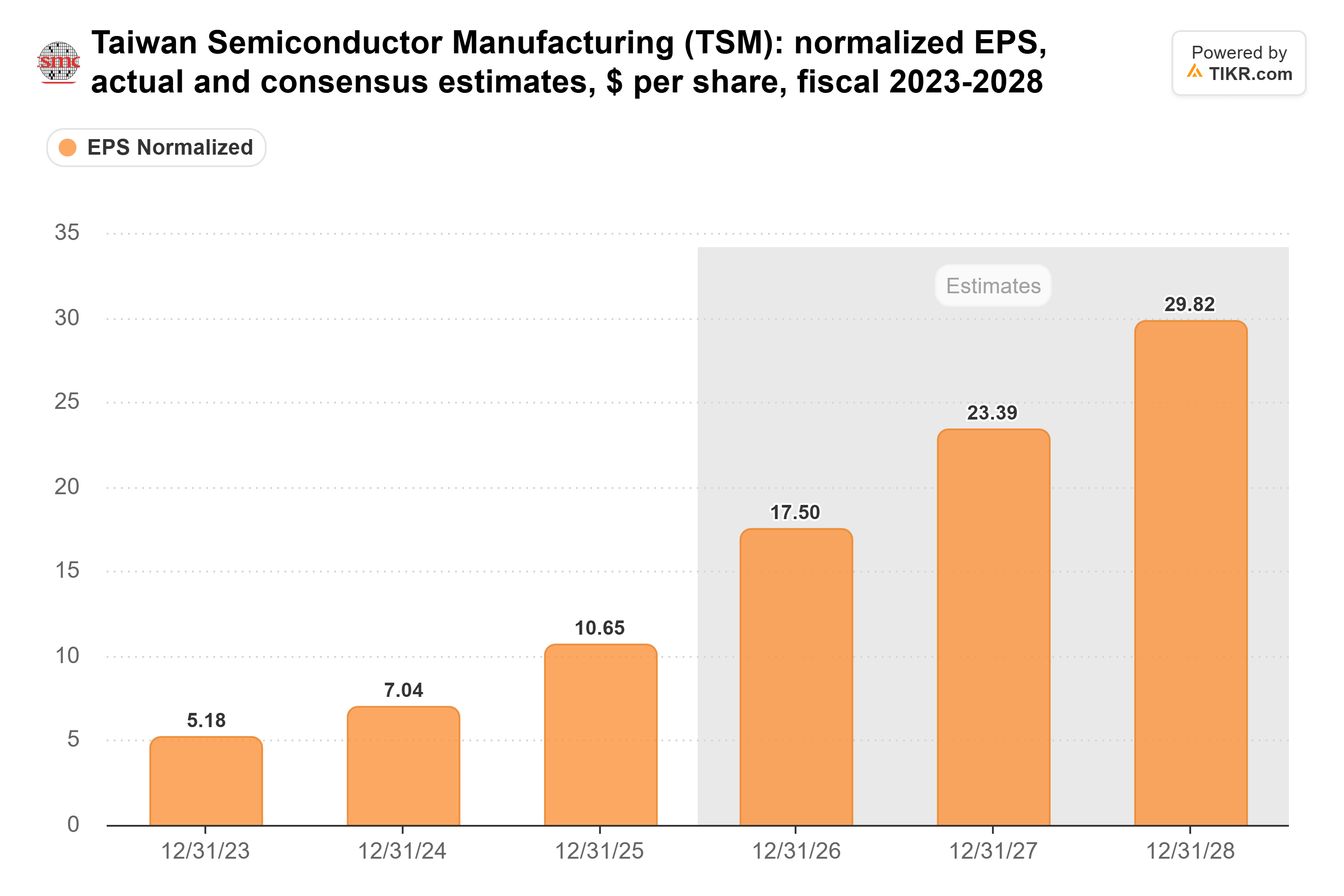
Those estimates came after TSMC’s October earnings report, and the 2027 figure has risen 16% since the end of June.
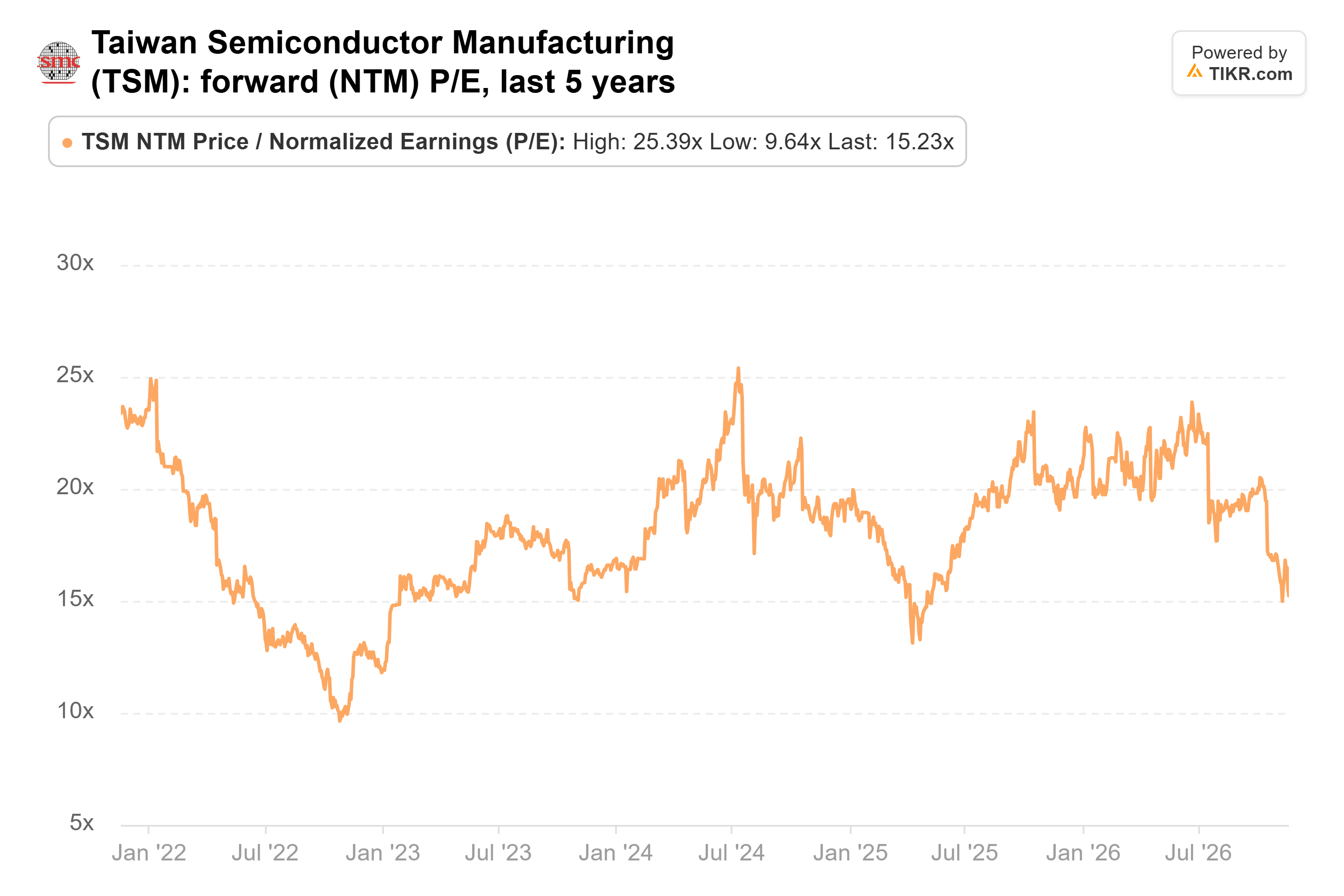
Even so, the stock trades at 15x forward earnings. That’s below its five-year average of 18x and far from its 25x peak in July 2024:
Wall Street’s consensus price target has climbed with the estimates, to $587 from $340 a year ago:
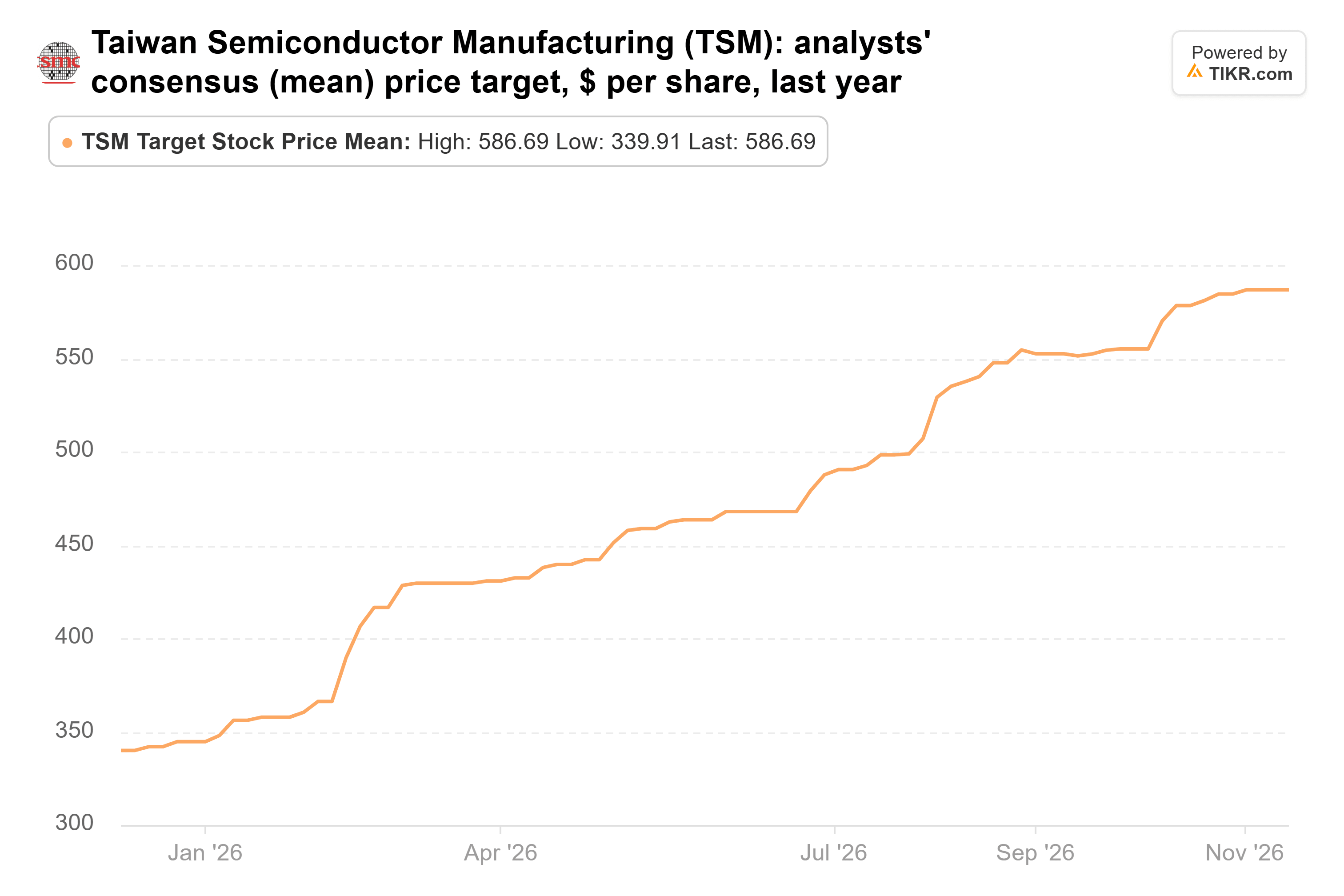
That’s 63% above today’s price. Even the lowest of the 21 analysts’ targets, $440, sits above it. By my math, $587 is about 20x 2028’s consensus EPS, a touch above the five-year average. So the target doesn’t need the market to pay a much higher multiple. It only needs the estimates to hold.
I’d follow the funds on this one
TSMC is spending heavily on capacity that starts producing in 2028 and 2029. It guides 2026 capital spending to US$60 billion to US$64 billion, up from US$40.9 billion in 2025. If AI spending pauses before then, TSMC carries those costs into a slower market, as it did in 2023, when revenue fell 4.5%.
But today’s multiple already assumes far less growth than analysts expect, and October’s sales show no crack in demand yet. The way I see it, the sell-off lets investors buy the business these funds were buying for a lot less than it cost on Sept. 30.
The next test comes in mid-January, when TSMC reports fourth-quarter results and gives its 2027 outlook. A first-quarter gross margin guide of 65% or more would back the case. 2027 growth guided in the low 20s would weaken it. The funds’ next 13Fs, due in mid-February, will show who held on.
So what is Taiwan Semiconductor stock actually worth?
TIKR lets you forecast the future price of any stock in less than a minute. Just enter a few assumptions into TIKR’s valuation model and see what Taiwan Semiconductor could be worth. Start from Wall Street consensus estimates, or adjust the inputs to reflect your own view of the business. It’s free to use.
Value Taiwan Semiconductor for free
Disclaimer:
Please note that the articles on TIKR are not intended to serve as investment or financial advice from TIKR or our content team, nor are they recommendations to buy or sell any stocks. We create our content based on TIKR Terminal’s investment data and analysts’ estimates. Our analysis might not include recent company news or important updates. TIKR has no position in any of the stocks mentioned. Thank you for reading, and happy investing!