
Key Takeaways
- General Mills yields 7.0% and Kimberly-Clark 4.6%, so $10,000 in each pays $700 and $461 a year today.
- Both dividends are tightly covered: General Mills paid out 85% of its free cash flow over the twelve months to Aug. 30, and Kimberly-Clark 87% over the twelve months to Sept. 30.
- General Mills is holding its dividend flat while it pays down debt, and its CFO expects that to take at least a couple of years.
- Kimberly-Clark has raised its dividend for 54 straight years, and it just closed its Kenvue purchase, which added new debt and about 281.1 million new shares.
On Sept. 29, General Mills (GIS) declared its quarterly dividend at an unchanged $0.61 a share. That check now works out to a 7.0% yield.
Kimberly-Clark (KMB) pays a smaller 4.6%. But its Nov. 5 earnings release calls it a Dividend Aristocrat, “having paid a dividend for 92 consecutive years and increasing its dividend in each of the past 54 consecutive years.”
So which is the better bet for a retiree who wants a check they can count on?
| Metric | General Mills (GIS) | Kimberly-Clark (KMB) |
|---|---|---|
| Dividend yield | 7.0% | 4.6% |
| 5-year dividend growth | 3.9% a year, fiscal 2021-2026 | 3.3% a year, 2020-2025 |
| Record (company’s own count) | Paid without interruption for 128 years | Raised 54 consecutive years |
| Cash dividend payout ratio (TTM) | 85% | 87% |
| Net debt/EBITDA (LTM) | 3.7x | 1.2x |
| Interest coverage (LTM) | 4.9x | 13.1x |
Source: TIKR, Nov. 9, 2026. TTM and LTM to Aug. 30 for General Mills and Sept. 30 for Kimberly-Clark. Records from each company’s releases.
6 safe dividend stocks paying retirees 6%+ yields
There are over 100 stocks paying 6%+ annual dividends today.
But after an extensive investment review leveraging TIKR’s proprietary data, we now believe only six of them are truly safe for retirees.
They’re all yours for free as part of our new investment report, which you can access right here.
General Mills is holding the line
General Mills’s dividend took a tight 85% of its free cash flow over the twelve months to Aug. 30, 2026: $1.31 billion of $1.55 billion. Free cash flow fell to $1.63 billion in fiscal 2026 (the year ended May 2026), from $2.29 billion in fiscal 2025. Dividends paid held at $1.32 billion over the same year.
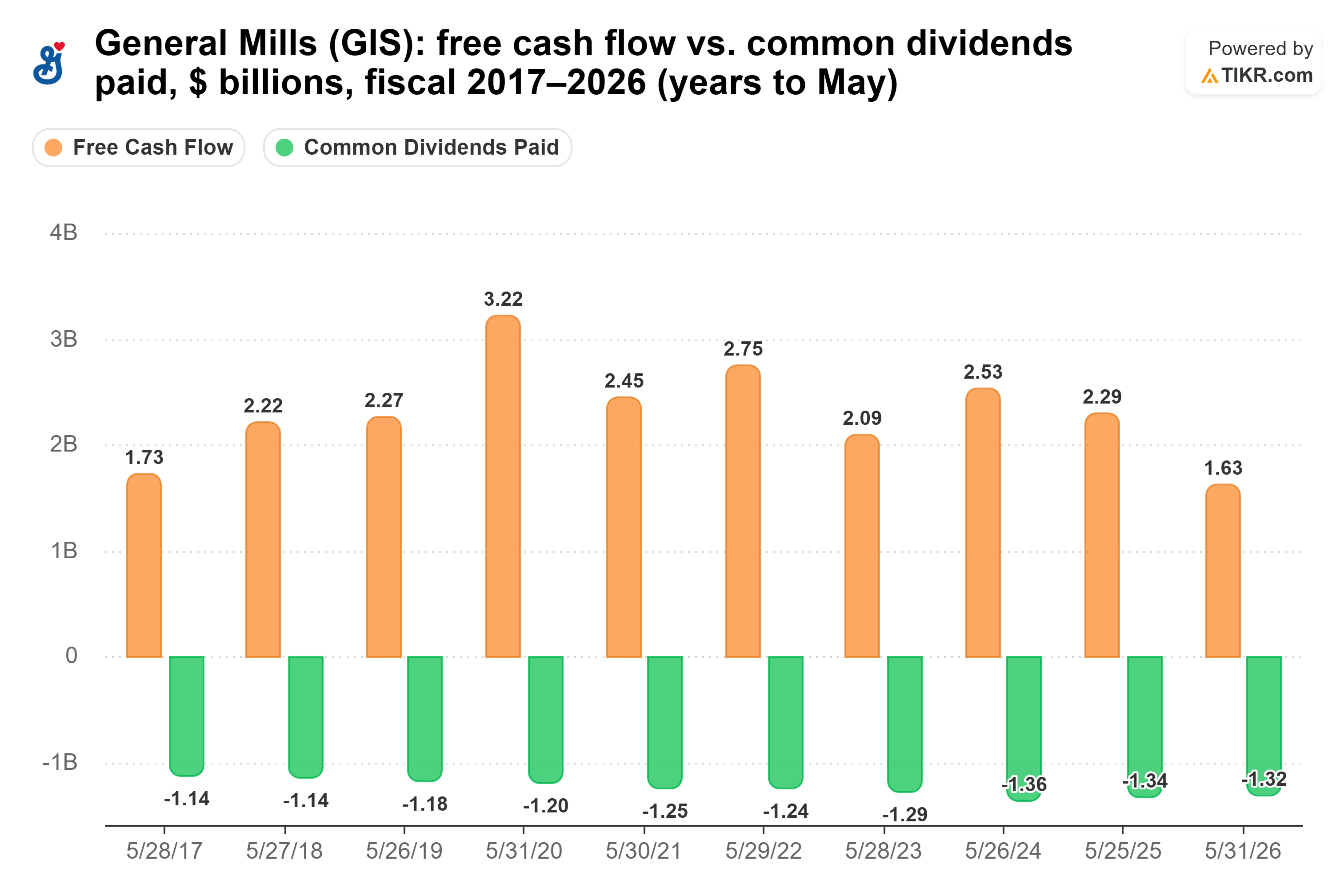
That took the payout ratio from 50.8% in fiscal 2021 to 80.9% in fiscal 2026.
The business isn’t helping yet. In the quarter ended Aug. 30, 2026, organic net sales were flat, and adjusted EPS fell 13% in constant currency. On Sept. 23, management stood by its fiscal 2027 guidance for adjusted EPS of $3.00 to $3.20.
CFO Kofi Bruce said on Sept. 23 that “we remain fully committed to our dividend, and in the near term, we expect to maintain the current rate per share while we prioritize deleverage.” That’s the right call.
Kimberly-Clark’s cushion predates Kenvue
Kimberly-Clark’s coverage is just as tight. Its dividend took 87% of free cash flow over the twelve months to Sept. 30, 2026: $1.69 billion of $1.94 billion. Since 2016, free cash flow has swung between $1.53 billion and $2.78 billion a year, while the dividend has risen every year.
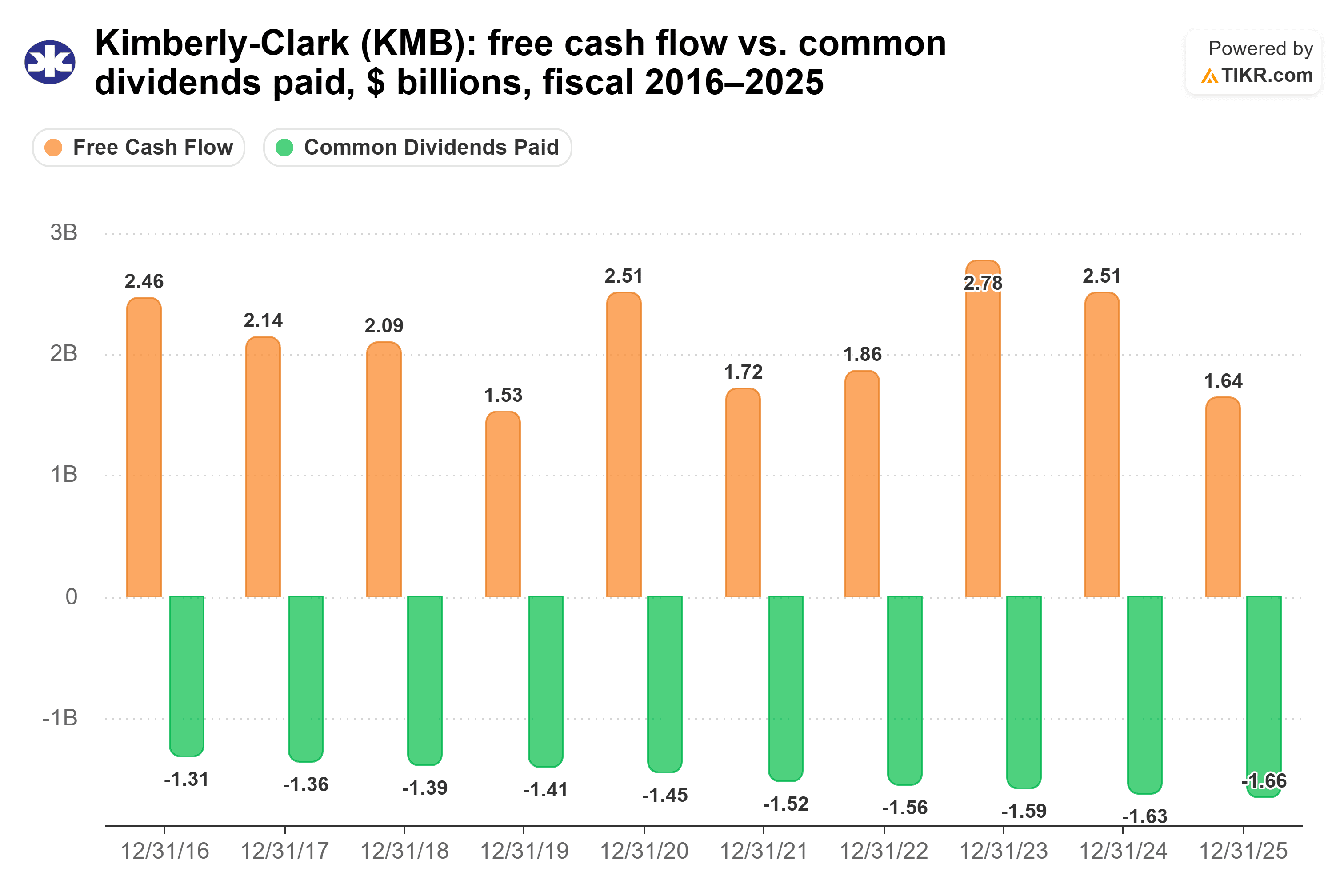
In 2025, it paid out $1.66 billion against $1.64 billion of free cash flow, a 101.3% payout ratio.
2026 looks better so far, and on Oct. 15 the company said its outlook for the year hadn’t changed. Cash from operations was $2.4 billion in the first nine months, up from $1.8 billion a year earlier.
Then there’s Kenvue. To close the deal on Nov. 2, Kimberly-Clark paid about $6.7 billion in cash. It also issued about 281.1 million new shares, each owed the $1.28 quarterly dividend. That means its 87% coverage and 1.2x net debt to EBITDA both come from before the deal. Management targets about 2x leverage by the end of the deal’s second year.
So which dividend wins?
For retirees, General Mills is the better dividend stock. Its coverage is a touch better than Kimberly-Clark’s, and its check is far bigger: $10,000 pays $700 a year today, against $461. At each one’s 5-year growth rate, that’s about $983 against about $619 in year 10, and Kimberly-Clark never catches up. Even at the pace each dividend grew in its latest fiscal year, Kimberly-Clark wouldn’t pass General Mills until about 2053.
The catch is that General Mills’s check won’t grow for a while. Its leverage jumped in fiscal 2025 and stayed there.
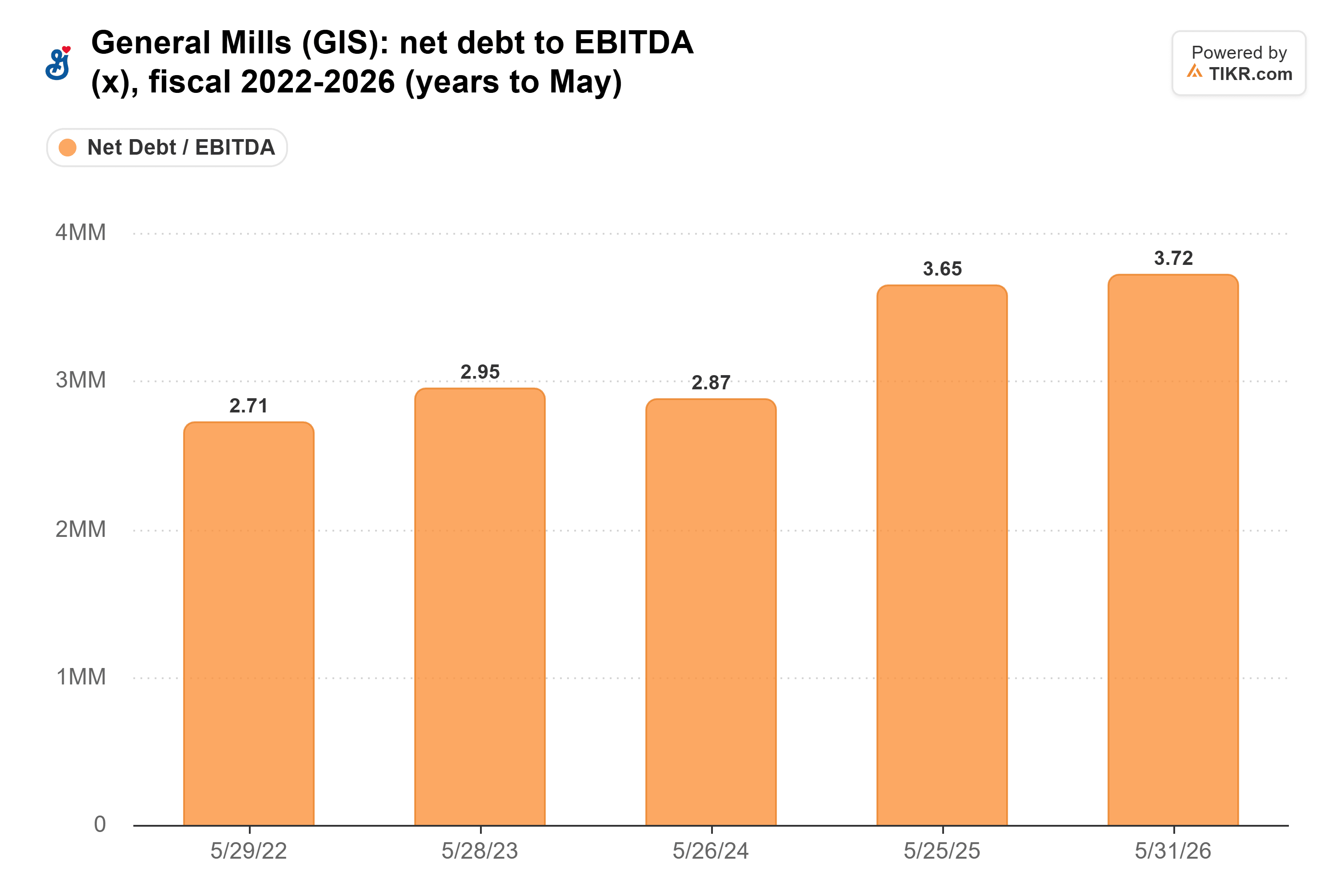
Bruce expects it to take “at least a couple of years to work ourselves back to our target of 3x net debt to EBITDA.” For a 7.0% yield from a company that has paid for 128 years straight, I can wait.
Kimberly-Clark’s case is a good one too. Management will work hard to keep its 54-year streak of raises, and the company came into the deal with 13.1x interest coverage. But the combined company now owes dividends on about 281.1 million more shares, and nobody knows its coverage yet.
Of course, if Kenvue’s cash flow and the $2.1 billion of run-rate synergies that management reiterated at the close cover those shares with room to spare, Kimberly-Clark’s case gets a lot stronger. We’ll know more from its first reports as a combined company.
Forget General Mills: 6 safe 6%+ dividend yields you can buy right now
Dividends can hold the key to enormous wealth. But only if you buy the right ones.
Picking the right high-yield dividend stock can be the difference between a dream retirement…and scraping by every month, waiting for the next Social Security check to clear.
We’ve identified six stocks yielding 6%+ that we believe every retiree should know about right now. (And General Mills isn’t one of them.)
Disclaimer:
Please note that the articles on TIKR are not intended to serve as investment or financial advice from TIKR or our content team, nor are they recommendations to buy or sell any stocks. We create our content based on TIKR Terminal’s investment data and analysts’ estimates. Our analysis might not include recent company news or important updates. TIKR has no position in any of the stocks mentioned. Thank you for reading, and happy investing!