Key Takeaways
- Piper Sandler downgraded General Mills on Nov. 12 and warned that a payout ratio of about 80% raises the risk of a dividend cut.
- General Mills yields 7.2% and Bristol Myers Squibb yields 4.1%, but General Mills is holding its dividend flat while it pays down debt.
- Bristol Myers Squibb’s dividend took 55% of free cash flow over the past year, against 85% at General Mills.
- Bristol Myers Squibb expects Eliquis revenue to fall by $1.5 billion to $2 billion in 2027, so its newer drugs have to keep growing.
Any retiree hunting for dividend income has probably noticed General Mills (GIS)‘s high yield. Its stock yields 7.2% at today’s prices. On Nov. 12, Piper Sandler downgraded it to Neutral from Overweight and warned that a dividend cut is a growing risk.
Bristol Myers Squibb (BMY) pays less, with a 4.1% yield, but its recent news has been better. On Oct. 29, it raised its 2026 revenue guidance to $49.75 billion to $50.25 billion.
Retirees want a check they can count on. So which of these is the better dividend stock for them?
| Metric | General Mills (GIS) | Bristol Myers Squibb (BMY) |
|---|---|---|
| Dividend yield | 7.2% | 4.1% |
| Annual dividend | $2.44 | $2.52 |
| 5-year dividend growth | 3.9% a year (fiscal 2021-2026) | 6.2% a year (fiscal 2020-2025) |
| Cash dividend payout ratio (TTM) | 85% | 55% |
| Net debt/EBITDA | 3.7x | 1.7x |
| Interest coverage | 4.9x | 9.9x |
Source: TIKR and StockAnalysis, at today’s prices. TTM to Aug. 30, 2026 for General Mills and Sept. 30, 2026 for Bristol Myers Squibb.
6 safe dividend stocks paying retirees 6%+ yields
There are over 100 stocks paying 6%+ annual dividends today.
But after an extensive investment review leveraging TIKR’s proprietary data, we now believe only six of them are truly safe for retirees.
They’re all yours as part of our new investment report. Learn more about how to get access right here.
General Mills is holding the line
General Mills’ business is treading water. In the first quarter of fiscal 2027, which ended Aug. 30, organic net sales were flat from a year before, as North America Retail fell 3% organically on weakness in Big G cereal and US snacks. Management expects adjusted operating profit to fall 8% to 13% in constant currency this fiscal year.
Free cash flow fell from $2.29 billion in fiscal 2025 (the year ended May 2025) to $1.63 billion in fiscal 2026, while dividends paid went from $1.34 billion to $1.32 billion.
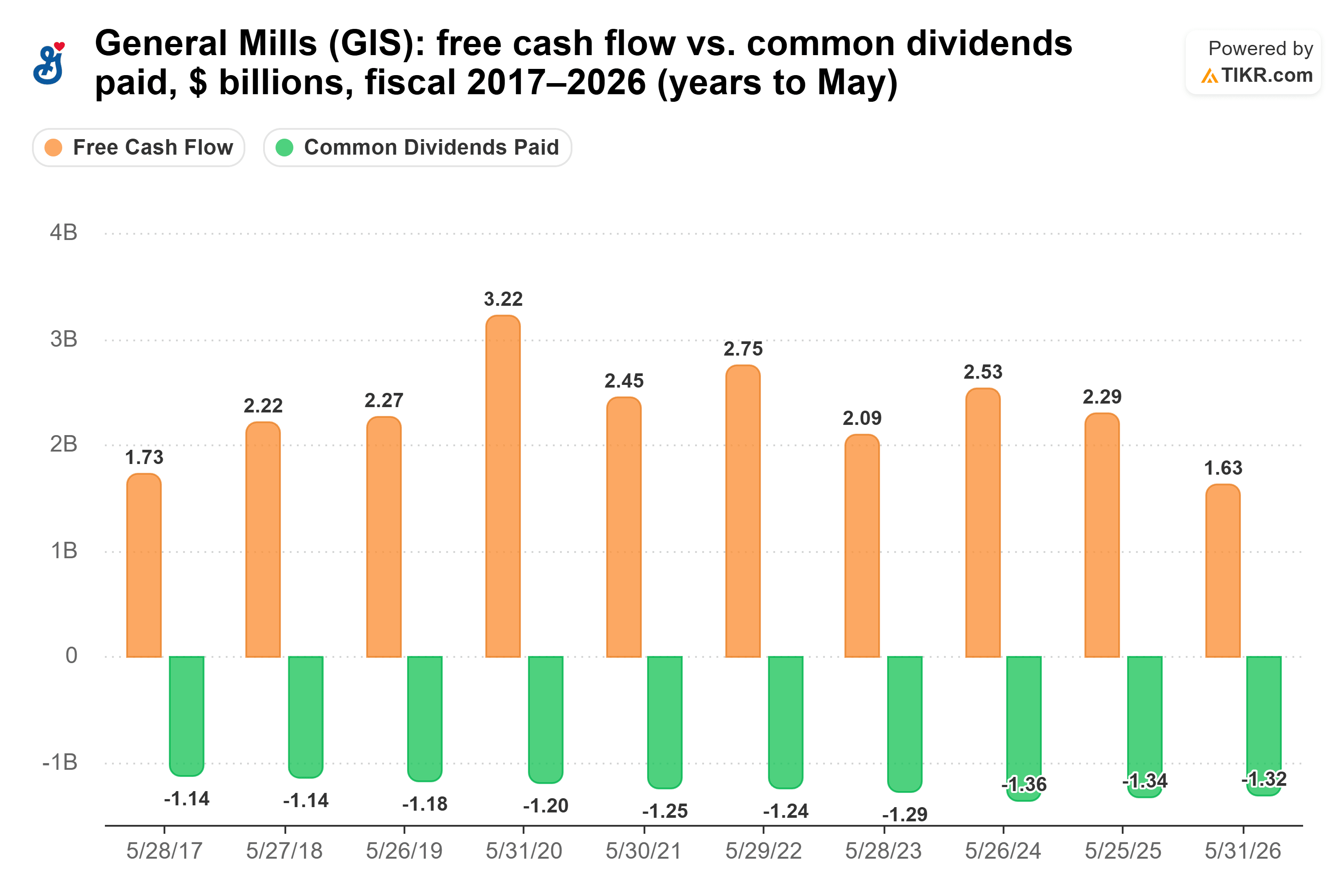
Over the twelve months to Aug. 30, 2026, dividends took a stretched 85% of free cash flow, up from 45% in fiscal 2022. In September, CFO Kofi Bruce said “we remain fully committed to our dividend, and in the near term, we expect to maintain the current rate per share while we prioritize deleverage.” The quarterly dividend has been $0.61 since mid-2025.
That means $10,000 here pays $720 a year today. At its 5-year rate, that grows to about $1,012 in year 10. At fiscal 2026’s 1.7% pace, it’s about $835.
The risk is a cut. Piper Sandler estimated that a roughly 35% cut in fiscal 2028 would bring the payout ratio back to its historical average of about 50%.
Bristol Myers Squibb has room to spare
Bristol Myers Squibb has shrinking products of its own, but it has far more cash behind its dividend. Third-quarter revenue rose 7% to $13.1 billion, as its Growth Portfolio climbed 12% to $7.7 billion, led by Opdivo Qvantig, Breyanzi and Camzyos.
Free cash flow has been at least $12 billion every year since 2020, while the dividend grew from $4.08 billion to $5.05 billion.
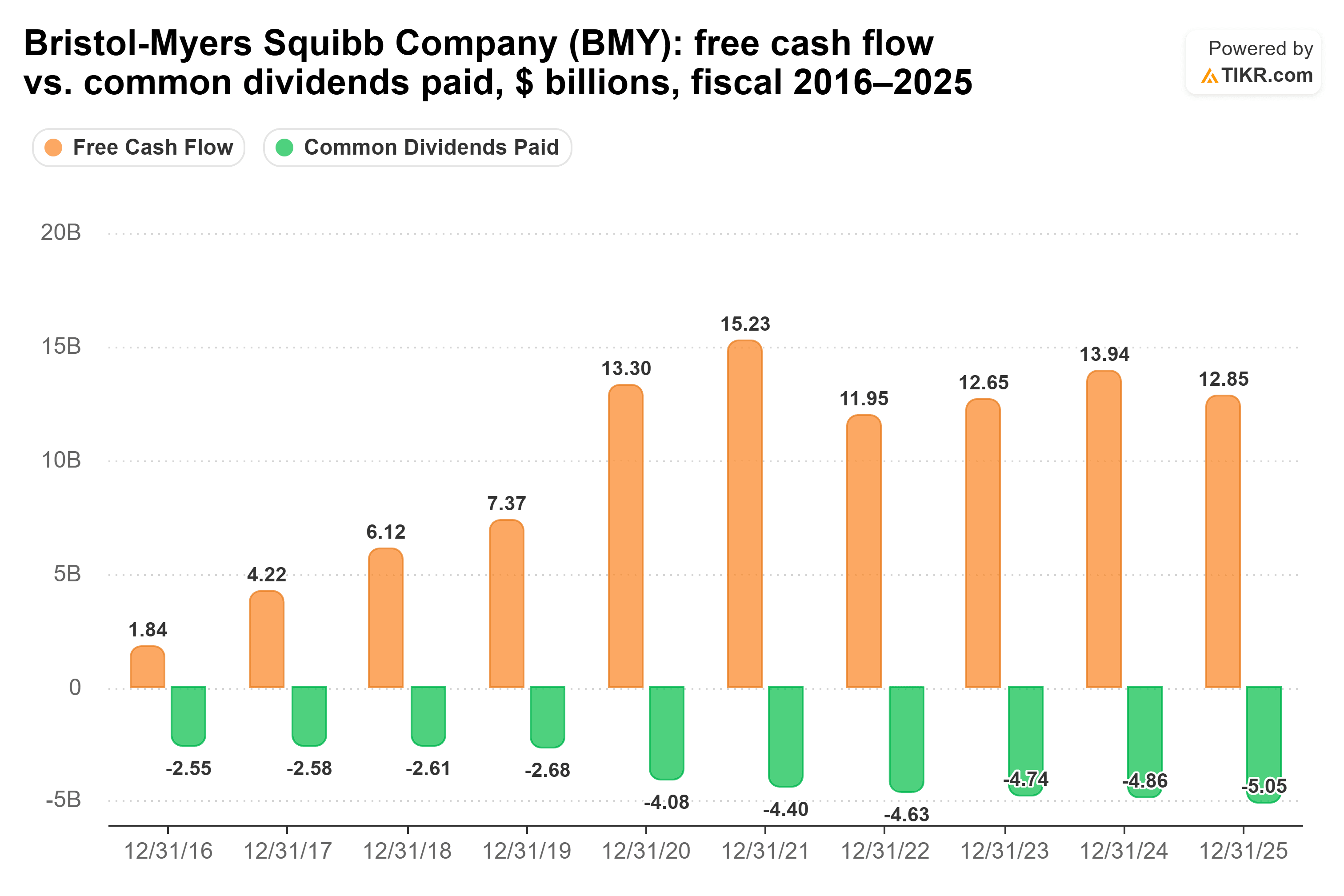
Over the twelve months to Sept. 30, 2026, dividends took a comfortable 55% of free cash flow: $5.12 billion of $9.29 billion. On the third-quarter call, CFO David Elkins called business development “a priority” while pointing to “our commitment to the dividend.” A big acquisition would compete for that cash, but at 55% there’s room for both.
That means $10,000 here pays $410 a year today. At 6.2% a year, that’s about $707 in year 10, a 7.1% yield on the $10,000. At fiscal 2025’s 2.9% pace, it’s about $530. The risk is generic competition: Revlimid sales fell 47% in the quarter.
So which dividend wins?
For retirees, Bristol Myers Squibb is the better dividend stock. General Mills pays the bigger check today, but Bristol Myers’ check is far easier to count on.
General Mills’ leverage has climbed above its own 3x target, from 2.7x net debt to EBITDA in fiscal 2022 to 3.7x in fiscal 2026.
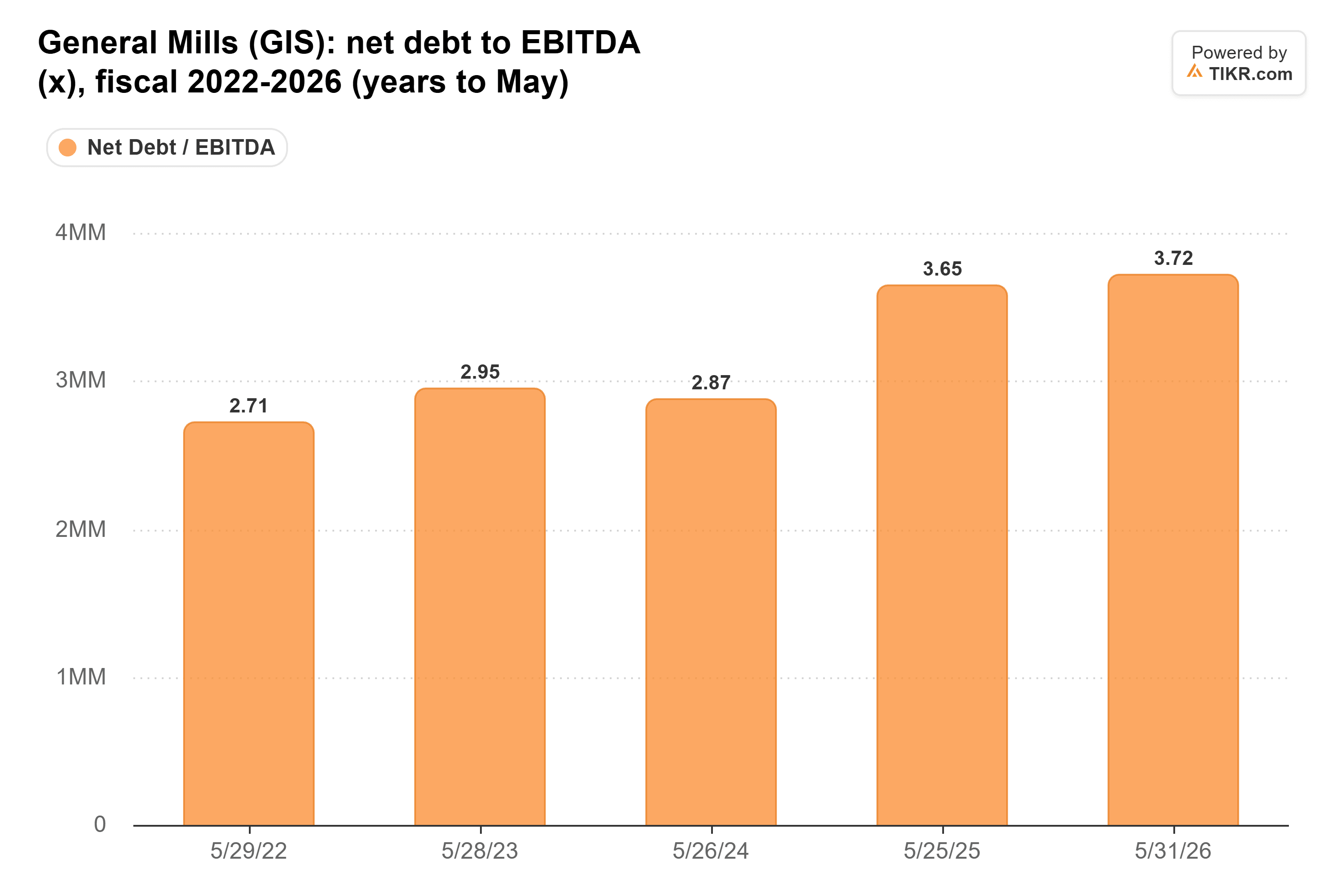
Bruce expects it to take “at least a couple of years to work ourselves back to our target of 3x net debt to EBITDA.” Until then, the dividend stays flat at best. If Piper Sandler’s 35% cut came, General Mills’ $720 on $10,000 would drop to about $468, not far above Bristol Myers’ $410. A retiree living on the check needs it to keep coming more than they need the extra $310 a year General Mills pays today.
This isn’t to say General Mills’ dividend is doomed. Management is committed to it and expects at least $750 million of cost savings this fiscal year. Still, with 55% coverage and 1.7x leverage, Bristol Myers’ check is the one I’d trust more.
Of course, Bristol Myers expects Eliquis revenue to fall by $1.5 billion to $2 billion in 2027, so its newer drugs will need to keep growing to fill that gap.
Forget Bristol Myers Squibb: 6 safe 6%+ dividend yields you can buy right now
Dividends can hold the key to enormous wealth. But only if you buy the right ones.
Picking the right high-yield dividend stock can be the difference between a dream retirement…and scraping by every month, waiting for the next Social Security check to clear.
We’ve identified six stocks yielding 6%+ that we believe every retiree should know about right now. (And Bristol Myers Squibb isn’t one of them.)
Disclaimer:
Please note that the articles on TIKR are not intended to serve as investment or financial advice from TIKR or our content team, nor are they recommendations to buy or sell any stocks. We create our content based on TIKR Terminal’s investment data and analysts’ estimates. Our analysis might not include recent company news or important updates. TIKR has no position in any of the stocks mentioned. Thank you for reading, and happy investing!