Key Takeaways
- ConocoPhillips raised its quarterly dividend 11% to $0.93 a share on Nov. 5, six days after ExxonMobil raised its own 3.9% to $1.07.
- Both stocks yield 2.4%, and each paid out 40% of its free cash flow as dividends over its latest twelve months.
- ConocoPhillips’s dividend grew 13.5% a year from fiscal 2020 to fiscal 2025, against 2.8% for ExxonMobil, which has the longer record and the lighter debt load.
- Higher oil prices tied to the Middle East conflict lifted both companies’ recent cash flow, so oil’s next move matters for both dividends.
ConocoPhillips (COP) gave shareholders an 11% raise on Nov. 5, lifting its quarterly dividend to $0.93 a share from $0.84.
That came six days after ExxonMobil (XOM) raised its own dividend 3.9% to $1.07 a share, its 44th straight year of higher annual dividends.
Both stocks yield 2.4%, and both paid out 40% of their free cash flow as dividends over their latest twelve months. With the yields and the coverage this close, which is the better dividend stock?
| Metric | ExxonMobil (XOM) | ConocoPhillips (COP) |
|---|---|---|
| Dividend yield | 2.4% | 2.4% |
| Dividend growth, fiscal 2020-2025 | 2.8% a year | 13.5% a year |
| Dividend growth, fiscal 2015-2025 | 3.3% a year | 0.8% a year |
| Cash dividend payout ratio (TTM) | 40% (to Sept. 30, 2026) | 40% (to June 30, 2026) |
| Net debt/EBITDA (LTM) | 0.3x | 0.6x |
| Interest coverage (LTM) | 58.7x | 18.6x |
Source: TIKR, Nov. 5, 2026.
6 safe dividend stocks paying retirees 6%+ yields
There are over 100 stocks paying 6%+ annual dividends today.
But after an extensive investment review leveraging TIKR’s proprietary data, we now believe only six of them are truly safe for retirees.
They’re all yours for free as part of our new investment report, which you can access right here.
ExxonMobil raises slowly for a reason
ExxonMobil is growing where it has invested: record refinery utilization and higher diesel yields, plus more output from Guyana, the Permian and its Golden Pass LNG project. The Middle East conflict has cost it upstream volumes in Qatar, and its chemical sales are down so far this year.
Over the twelve months to Sept. 30, 2026, it paid $17.26 billion of dividends out of $42.96 billion of free cash flow, a well-covered 40%. Its free cash flow has swung with oil prices over the past decade, while its dividend payments have never fallen:
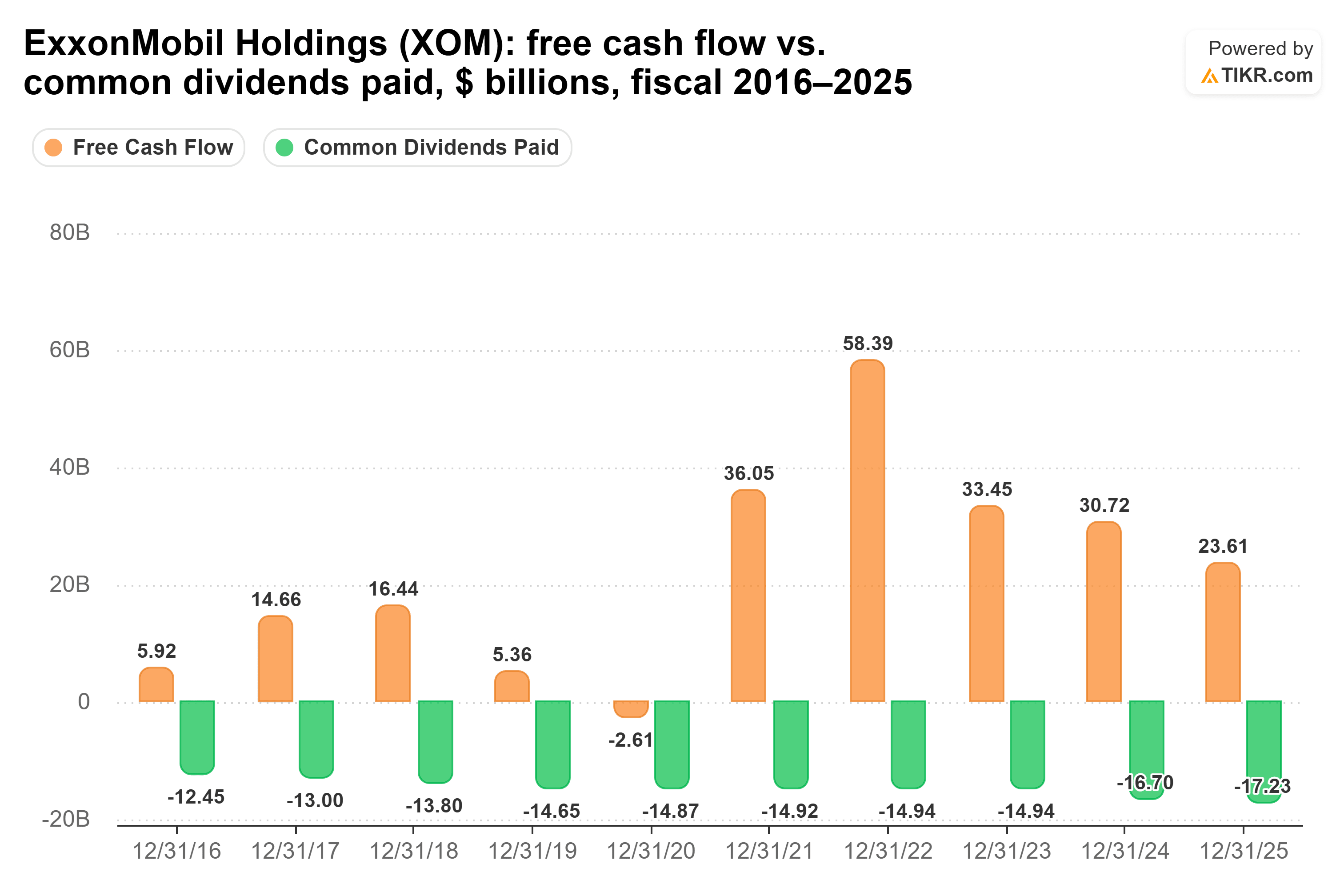
In fiscal 2016, 2019 and 2020, the dividend cost more than the free cash flow, and ExxonMobil paid it anyway.
CEO Darren Woods explained why it raises carefully on its Oct. 30 third-quarter call: “we’re not going to ever cut our dividend. So any increases we add becomes an obligation that we’ve got to commit to the future.”
The spare cash goes to buybacks instead: $5.1 billion in the third quarter of 2026, against $4.3 billion of dividends, with $20 billion planned for 2027. And at 0.3x net debt to EBITDA and 58.7x interest coverage, the balance sheet is about as strong as it gets.
The risk is a repeat of fiscal 2025, when free cash flow fell to $23.6 billion against $17.2 billion of dividends, a stretched 73.0% payout ratio.
ConocoPhillips raises a lot faster
ConocoPhillips covers its dividend just as well. Over the twelve months to June 30, 2026, it paid $4.07 billion of dividends out of $10.06 billion of free cash flow, the same 40%. It aims to grow the dividend at a rate competitive with the top quartile of the S&P 500, and the 11% raise fits.
ConocoPhillips is selling fewer barrels at much higher prices. Its realized price was $61.40 per barrel of oil equivalent in the third quarter of 2026, up 32% from $46.44 a year before. Production fell by 97,000 barrels of oil equivalent a day to 2.302 million as the Middle East conflict hit its Qatar volumes, though its Permian output kept growing.
Its free cash flow covered the dividend in every fiscal year from 2017 to 2025 except 2020:
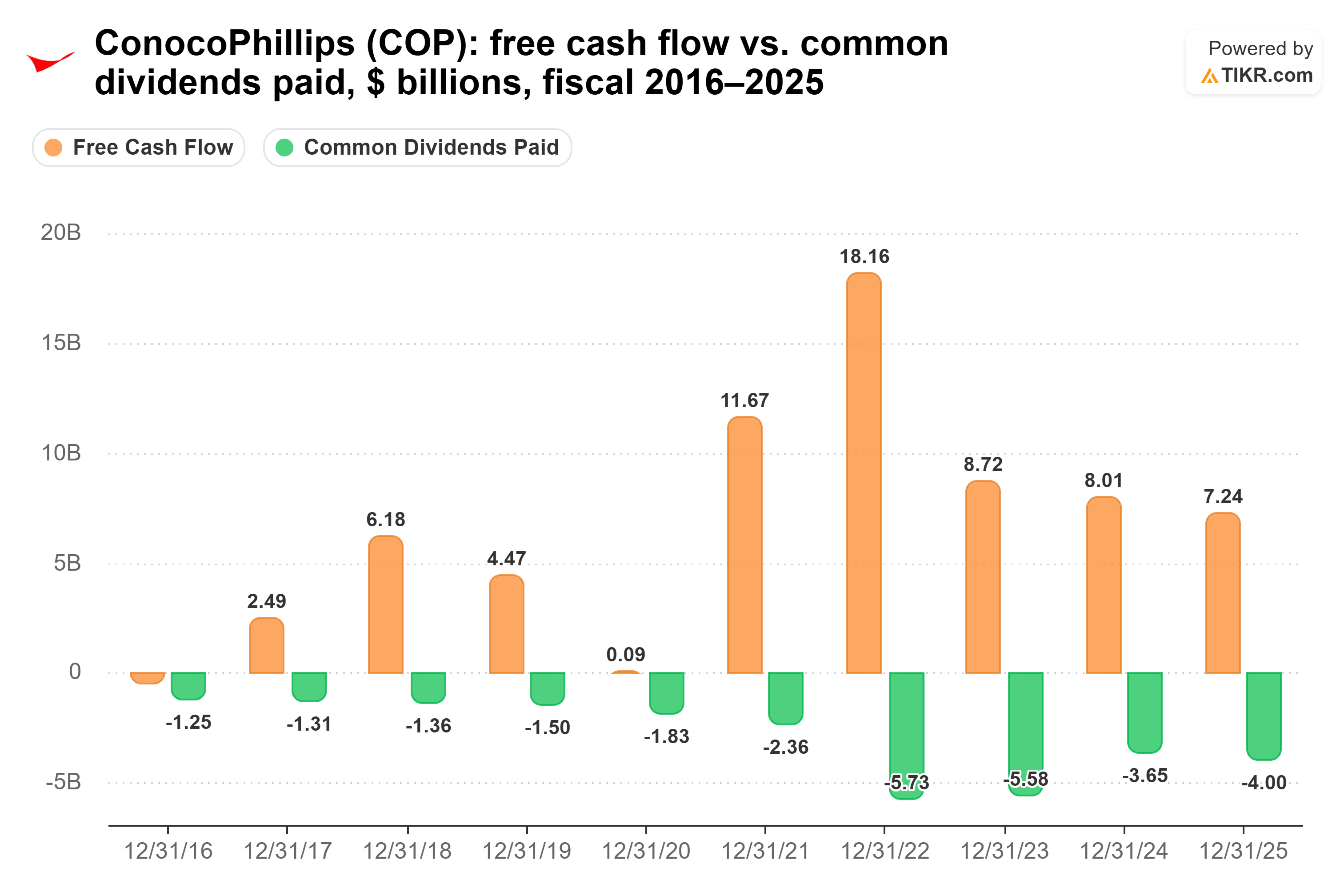
Management says it’s on track to lift free cash flow by $7 billion by 2029. It expects capital spending to fall once its Willow project in Alaska starts producing early that year, and its free cash flow breakeven to drop from the mid-40s WTI to the low 30s. It also had $10.4 billion of cash and short-term investments at Sept. 30.
The risk is its record. ConocoPhillips paid $2.94 a share in fiscal 2015 and $1.69 in fiscal 2020, which is why its 10-year growth rate is only 0.8% a year.
So which dividend wins?
ConocoPhillips is the better dividend stock. With the same 2.4% yield and the same 40% payout ratio, I’ll take the faster-growing dividend. At the pace each grew in fiscal 2025, $10,000 in each pays $240 a year today, and about $546 in year 10 from ConocoPhillips against about $347 from ExxonMobil. ConocoPhillips’s income moves ahead this year. And if its breakeven falls as planned, that growth has room to last.
ExxonMobil’s dividend is still as safe as they come. It has 44 straight years of raises, a CEO who says it will never be cut, and the stronger balance sheet of the two. It’s just that, with the yields and the coverage this close, I’d rather own the dividend that’s growing more than twice as fast.
Of course, both 40% ratios rest on oil prices the Middle East conflict pushed up, and Brent fell more than 4% on Nov. 3 on hopes the supply disruptions might ease. If prices keep sliding, ConocoPhillips’s raises will lean even harder on its 2029 plan.
Forget ConocoPhillips: 6 safe 6%+ dividend yields you can buy right now
Dividends can hold the key to enormous wealth. But only if you buy the right ones.
Picking the right high-yield dividend stock can be the difference between a dream retirement…and scraping by every month, waiting for the next Social Security check to clear.
We’ve identified six stocks yielding 6%+ that we believe every retiree should know about right now. (And ConocoPhillips isn’t one of them.)
Disclaimer:
Please note that the articles on TIKR are not intended to serve as investment or financial advice from TIKR or our content team, nor are they recommendations to buy or sell any stocks. We create our content based on TIKR Terminal’s investment data and analysts’ estimates. Our analysis might not include recent company news or important updates. TIKR has no position in any of the stocks mentioned. Thank you for reading, and happy investing!