Key Takeaways
- Barclays’ Alex Altmann says AI needs about $1 trillion of revenue by the end of 2028 to pay for its capex, and Barclays expects AI’s revenue run rate to be about $400 billion by then.
- Until that $600 billion gap closes, free cash flow at Amazon, Alphabet and Meta stays under pressure, and investors are now pricing these companies on cash.
- Amazon’s free cash flow was a $42.4 billion outflow over the 12 months to September, and Alphabet’s was negative $9.1 billion in the September quarter, while Microsoft generated almost $19 billion.
- Companies that generate cash, like Microsoft and NVIDIA, have the edge while the gap stays open, and Amazon’s 2027 capex outlook in early February is the next test.
Amazon (AMZN) posted the deepest cash burn in its history on Thursday, the same day Alphabet (GOOG) had its worst day as a public company, falling more than 12%. NVIDIA (NVDA) and Microsoft (MSFT) are in a similar position.
Barclays’ Alex Altmann has a number that explains why investors are so worried.
“We need a trillion dollars of revenues basically by the end of 2028 to pay for all of this capex,” Altmann, head of Barclays Equity Tactical Strategies, said on the latest episode of The Compound and Friends.
He puts AI capex at “1.2 trillion for next year, 1.4 for the year after.” Against that, Barclays expects AI’s revenue run rate to be around $400 billion by the end of 2028.
That’s a $600 billion gap.
Until it closes, the biggest spenders’ free cash flow stays under pressure. And the market is now pricing them on it.
TIKR tracks 63 analysts on Amazon. How many say “Buy”?
See the full breakdown of Buy, Hold, and Sell ratings on Amazon, along with Wall Street’s revenue and earnings estimates, all in one place. More than 500,000 investors use TIKR to research stocks like this one. See Amazon’s Analyst Ratings
The cash is already going out the door
Amazon’s free cash flow had already turned negative in the first half of 2026:
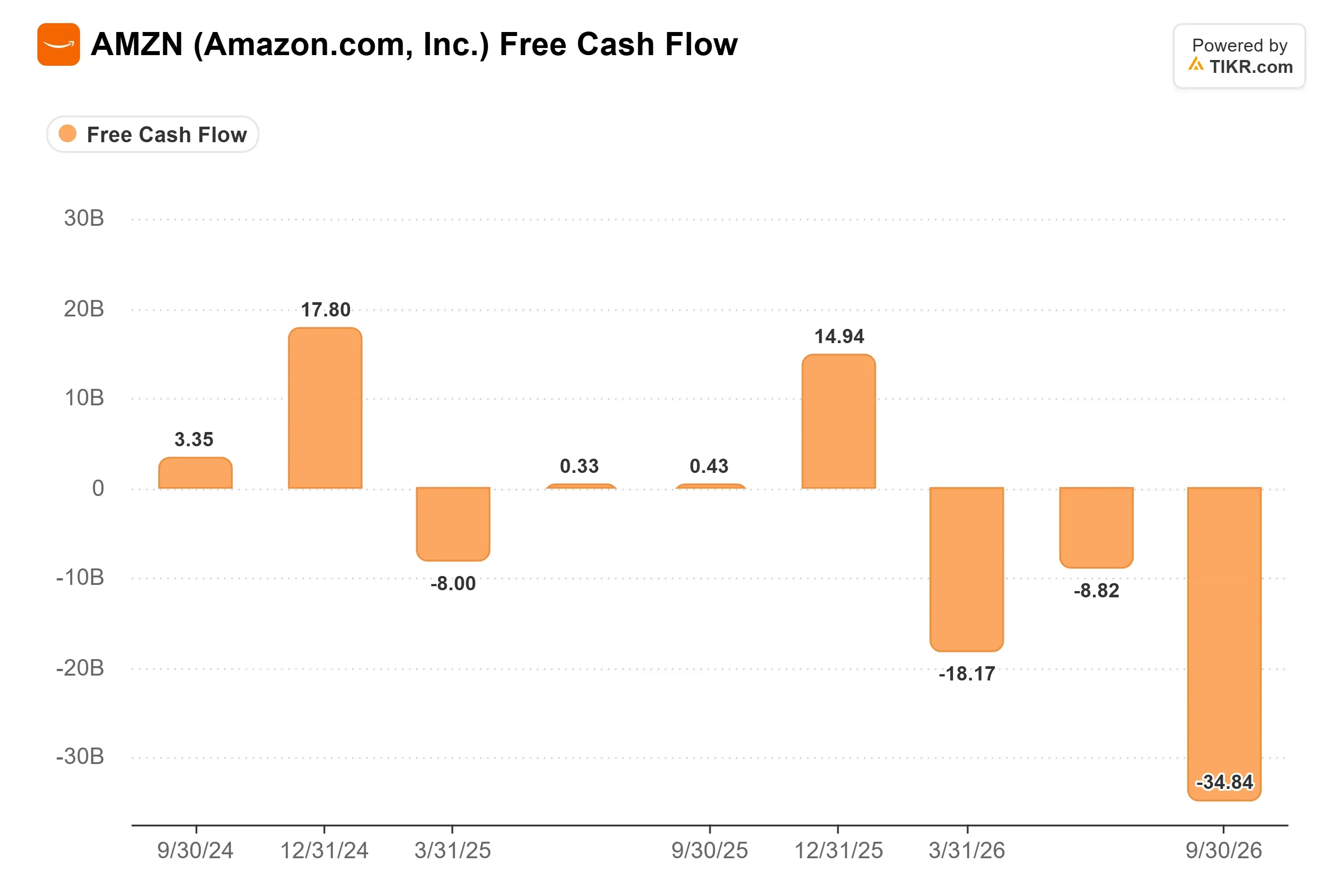
Then the September quarter made it worse. Amazon spent about $77 billion on property and equipment, more than double the $35 billion it spent a year earlier, against about $42 billion of cash from operations.
Over the 12 months to September, free cash flow was a $42.4 billion outflow, nearly double the previous record of about $23 billion in 2022.
CEO Andy Jassy said on Thursday’s call that Amazon still expects to spend about $220 billion this year and to “spend meaningfully more in 2027.” “We can fund this plan,” he added.
So far, that has meant borrowing: long-term debt reached about $173 billion at the end of September, from about $66 billion at the end of 2025.
Alphabet’s capex has climbed every quarter for two years, and it passed cash from operations in the June quarter:

That left free cash flow at negative $9.1 billion in the September quarter, worse than the quarter before. And CFO Anat Ashkenazi told analysts on the company’s Q3 call that capex will rise significantly in 2027.
Analysts expect Meta Platforms (META) to burn cash every year through 2028:

The market is grading on cash
Meta got a preview last week, when its cash burn overshadowed better-than-expected revenue growth. This week made the pattern plain.
The companies on the receiving end of the build-out are doing fine. NVIDIA (NVDA) sells the chips that take a big share of the hyperscalers’ capex, so their spending is its revenue. As Bloomberg’s Ed Ludlow put it on Bloomberg’s Alphabet earnings special:
“The best performers are those throwing off cash. NVIDIA, Apple. The worst performers in the stock market are those with negative free cash flow.”
Among the spenders, Microsoft (MSFT) is the one paying its own way. It generated almost $19 billion of free cash flow in its September quarter and spent 68% of its cash from operations on capex (excluding finance leases), against 121% at Alphabet, by Reuters’ count.
The backlogs help, slowly
The spenders do have plenty of contracts signed. Amazon Web Services’ backlog reached $578 billion at September 30, up from $244 billion at the end of 2025, and Jassy said in Thursday’s release that he projects AWS growth of more than 40% in both 2027 and 2028. Google Cloud’s revenue more than doubled to $30.71 billion in Q3.
But a backlog turns into revenue over years. For Amazon, considering AWS revenue in Q3 is $46 billion, and the backlog at the end of Q3 stands at $578 billion, the backlog will get converted into revenue in 3.14 years (roughly, if it comes in evenly). And more than $200 billion of it came from OpenAI and Anthropic in the first half of 2026, two labs Amazon also invests in.
My take: Altman’s gap won’t close in a quarter or two, so free cash flow is the number that matters for these stocks through 2028. I’d favor the hyperscalers that can pay for the build-out from their own cash, like Microsoft, over the ones borrowing for it.
Of course, AI revenue could ramp faster than Barclays expects. Amazon’s 2027 capex outlook, due with its Q4 results in early February, is the next real test of whether spending is starting to grow more slowly than revenue.
So what is Amazon stock actually worth?
TIKR lets you forecast the future price of any stock in less than a minute. Just enter a few assumptions into TIKR’s valuation model and see what Amazon could be worth. Start from Wall Street consensus estimates, or adjust the inputs to reflect your own view of the business. It’s free to use.
Disclaimer:
Please note that the articles on TIKR are not intended to serve as investment or financial advice from TIKR or our content team, nor are they recommendations to buy or sell any stocks. We create our content based on TIKR Terminal’s investment data and analysts’ estimates. Our analysis might not include recent company news or important updates. TIKR has no position in any of the stocks mentioned. Thank you for reading, and happy investing!