
Key Takeaways
- GPU lenders now want 50% to 60% loan-to-value, down from 80% over the summer, according to Odd Lots guest Stanley Lee.
- At those levels, a neocloud has to cover 40% to 50% of each chip itself, up from 20%.
- CoreWeave is borrowing against investment-grade customer contracts, and Nebius says prepayments now cover more than 100% of new capacity.
- IREN has raised $6.5 billion of GPU financing since May, but its diluted share count has more than tripled in two years.
Lenders are getting a lot pickier about AI chips. That’s bad news for the neoclouds that borrow against them, including CoreWeave (CRWV), IREN (IREN) and Nebius (NBIS).
On the Nov. 19 episode of Odd Lots, co-host Tracy Alloway asked guest Stanley Lee, chief product officer at Liquid Compute, what makes these GPU-backed loans go wrong. Lee’s answer:
“We were seeing 80 percent LTV loans get priced over the summer. I think post Labor Day, it was more 70 percent. And now people are asking for 50 to 60 percent.”
At 80% loan-to-value, a neocloud puts up $20 for every $100 of chips. At 50% to 60%, it has to find $40 to $50 from its own cash, a customer’s prepayment or new stock.
Lee said many mid-market players are now going to lenders for rescue and bridge loans with very tight covenants. If there isn’t “a takeout in three to six months,” he said, “lenders will foreclose and seize the equipment.”
Nvidia picked a bad week to step back
The timing makes this worse. On Nvidia’s Nov. 17 earnings call, Colette Kress, then interim CEO, said the company is “taking a very strong look” at which companies it helps finance. Nvidia’s CFO commentary puts its neocloud agreements at $32 billion, down from $36 billion in July, and they only kick in once a neocloud has its own financing lined up and the capacity is running. So the lenders Lee describes have to say yes first.
TIKR tracks 41 analysts on CoreWeave. How many say “Buy”?
See the full breakdown of Buy, Hold, and Sell ratings on CoreWeave, along with Wall Street’s revenue and earnings estimates, all in one place. More than 500,000 investors use TIKR to research stocks like this one. See CoreWeave’s Analyst Ratings
CoreWeave already went upmarket
Lee said CoreWeave now requires higher prepayments from its customers, and the delayed-draw term loan it’s marketing now is backed by investment-grade customers, while the last one leaned on Anthropic, HRT and Jane Street.
Bloomberg reported on Nov. 11 that CoreWeave is in talks to raise at least $4 billion through an investment-grade loan backed by a contract with Meta Platforms. A day earlier, on CoreWeave’s Nov. 10 earnings call, finance chief Nitin Agrawal said he expects the next contract-backed loan to yield 7% to 7.5%. Its unsecured 9.625% notes due 2032, with no customer contract behind them, fell below 80 cents on the dollar in October, pushing their yield near 15%.
CoreWeave’s capital spending went from $70 million in 2022 to $10.3 billion in 2025:

If chip loans funded all of that, every 10 points of loan-to-value would be about $1 billion a year that customers or shareholders have to cover.
Nebius has leaned even harder on prepayments. CEO Arkady Volozh said customer prepayments now cover “more than 100%” of the capital needed to bring new contracted capacity online, up from 50% to 60% last quarter. But Lee noted that those customers “don’t have unlimited coffers,” since much of their money comes from venture investors.
IREN says the door is still open
IREN pushed back on the funding worries on its Nov. 5 earnings call. Co-CEO Daniel Roberts said the company raised “$6.5 billion of GPU financing since May at 6% to 9.5%,” though he also said, “Capital markets have become more selective in the last few weeks.”
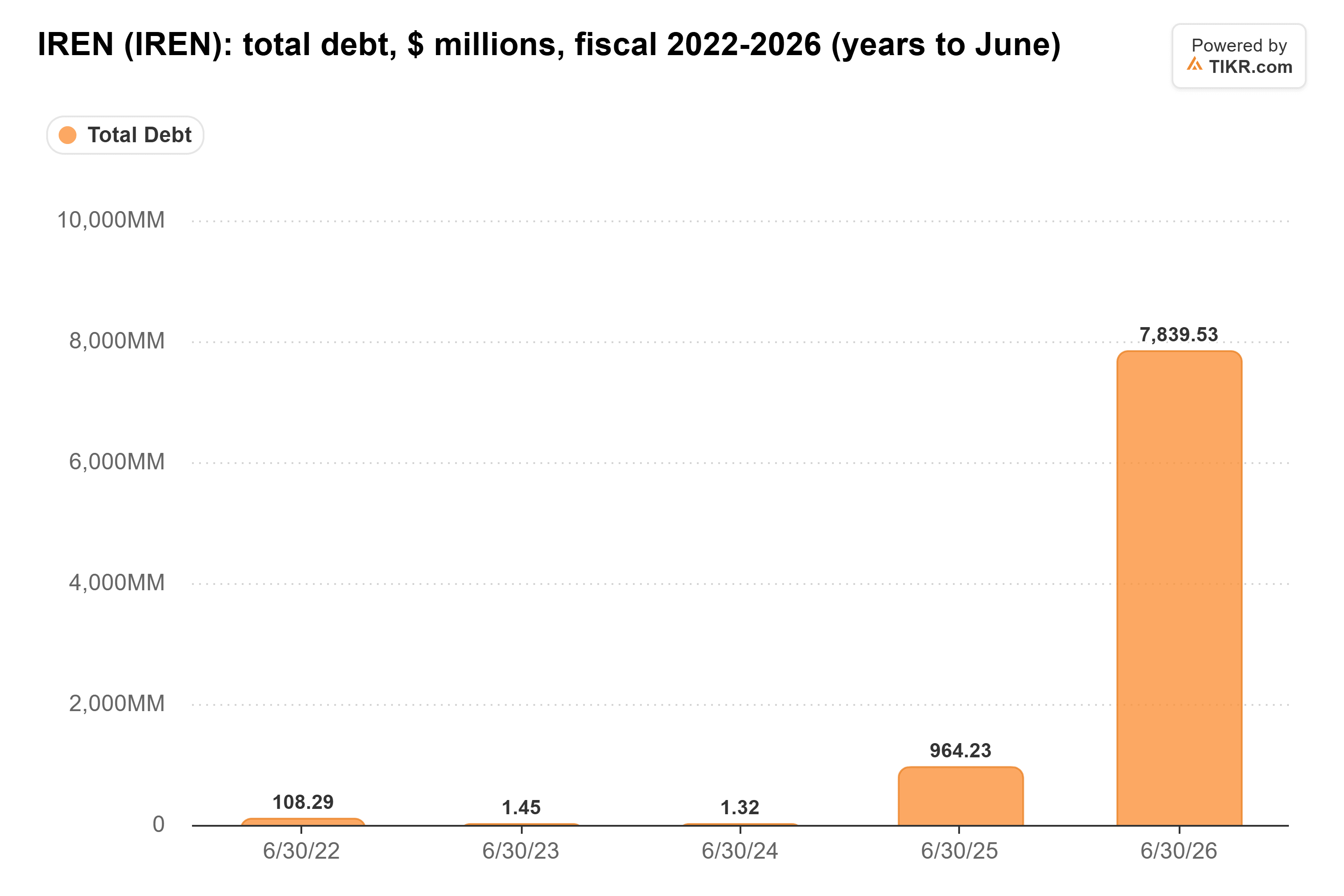
IREN’s total debt went from $964 million in the year ended June 2025 to $7.84 billion a year later:
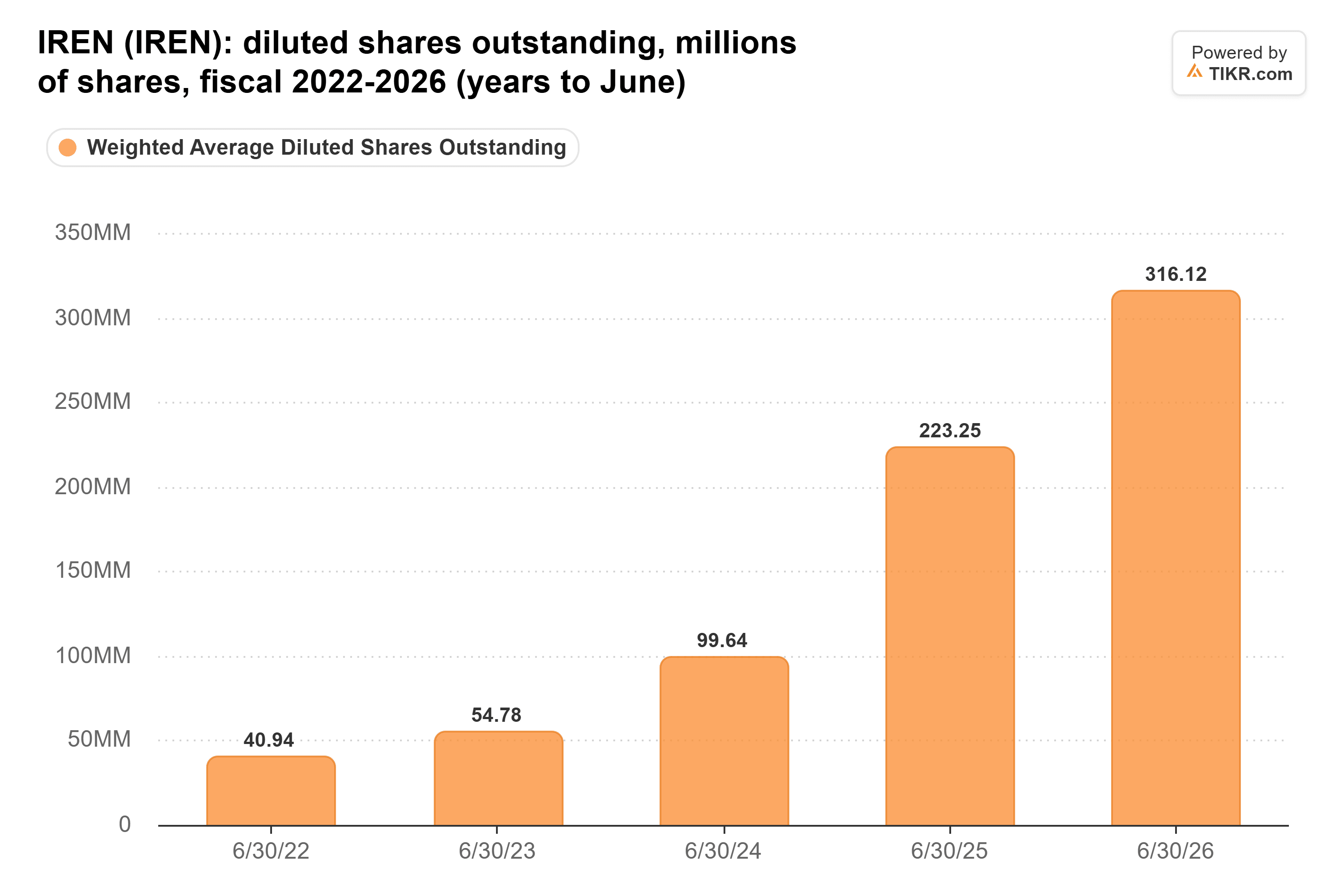
It also issued a lot of stock. Its diluted share count went from 99.6 million in fiscal 2024 to 316 million in fiscal 2026:
CFO Anthony Lewis pointed to “$6 billion of unencumbered GPUs before further secured financing and cash flows,” alongside the $10 billion of unencumbered data center assets IREN projects by the end of fiscal 2027 in June. At 50% to 60% loan-to-value, $6 billion of GPUs would support about $3 billion to $3.6 billion of debt, versus $4.8 billion at 80%.
Lenders want a blue-chip customer on every chip
CoreWeave and IREN can borrow on better terms than Lee’s middle market, but only when an investment-grade customer signs the contract. From here, they can only grow as fast as big customers will sign and prepay, and whatever those deals don’t cover falls to shareholders.
For IREN, the share count is the number to watch. The next tests come soon: whether CoreWeave’s Meta-backed loan prices within the 7% to 7.5% it expects, and what loan-to-value IREN gets when it borrows against those unencumbered GPUs.
So what is CoreWeave stock actually worth?
TIKR lets you forecast the future price of any stock in less than a minute. Just enter a few assumptions into TIKR’s valuation model and see what CoreWeave could be worth. Start from Wall Street consensus estimates, or adjust the inputs to reflect your own view of the business. It’s free to use.
Disclaimer:
Please note that the articles on TIKR are not intended to serve as investment or financial advice from TIKR or our content team, nor are they recommendations to buy or sell any stocks. We create our content based on TIKR Terminal’s investment data and analysts’ estimates. Our analysis might not include recent company news or important updates. TIKR has no position in any of the stocks mentioned. Thank you for reading, and happy investing!