Key Takeaways
- Salesforce CEO Marc Benioff says 226,000 custom agents from every major agent builder platform have been deployed to Slack.
- With Slack hosting agents and Microsoft bringing Salesforce’s data into Copilot and Teams, Salesforce is plugging into the AI tools investors feared would replace it.
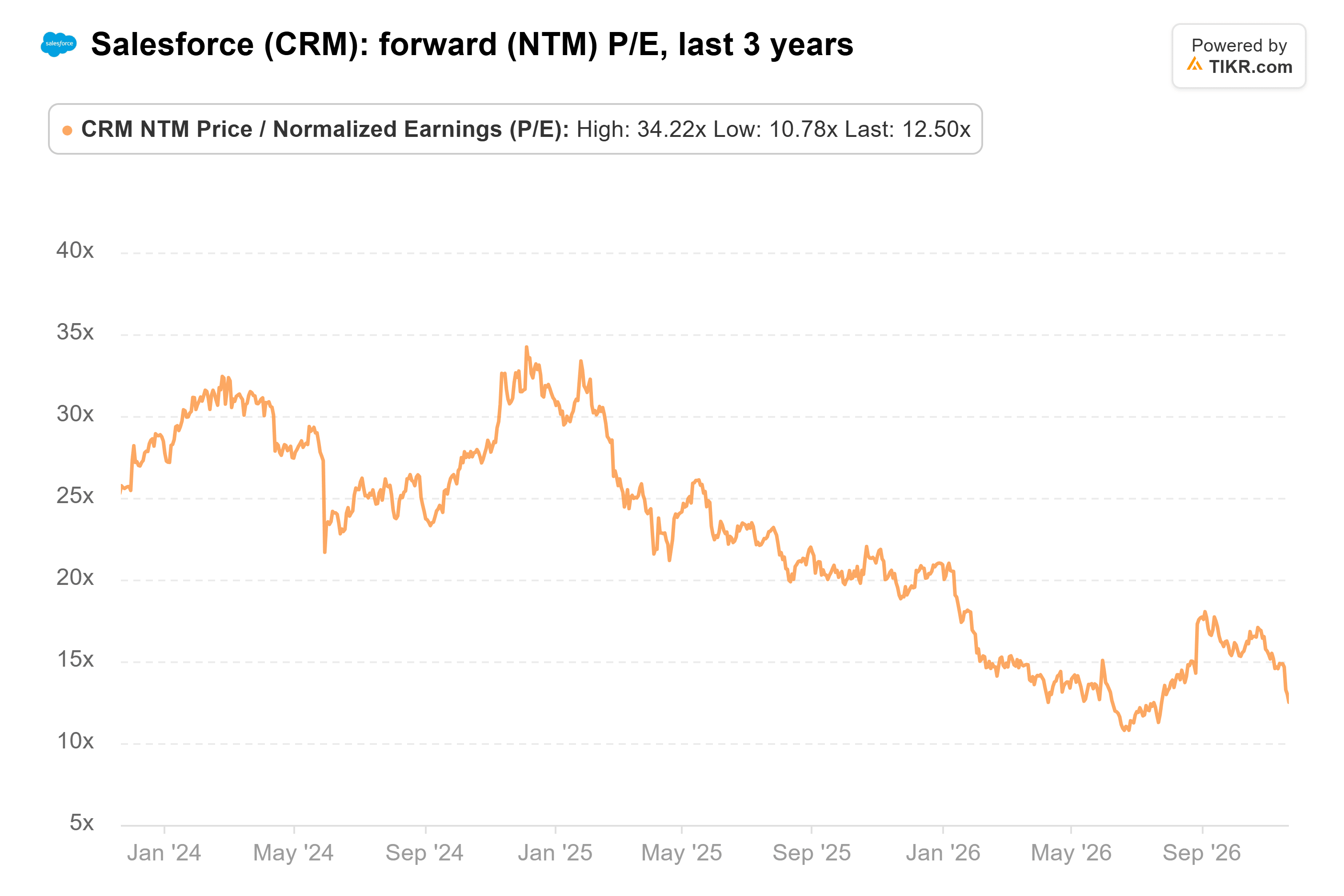
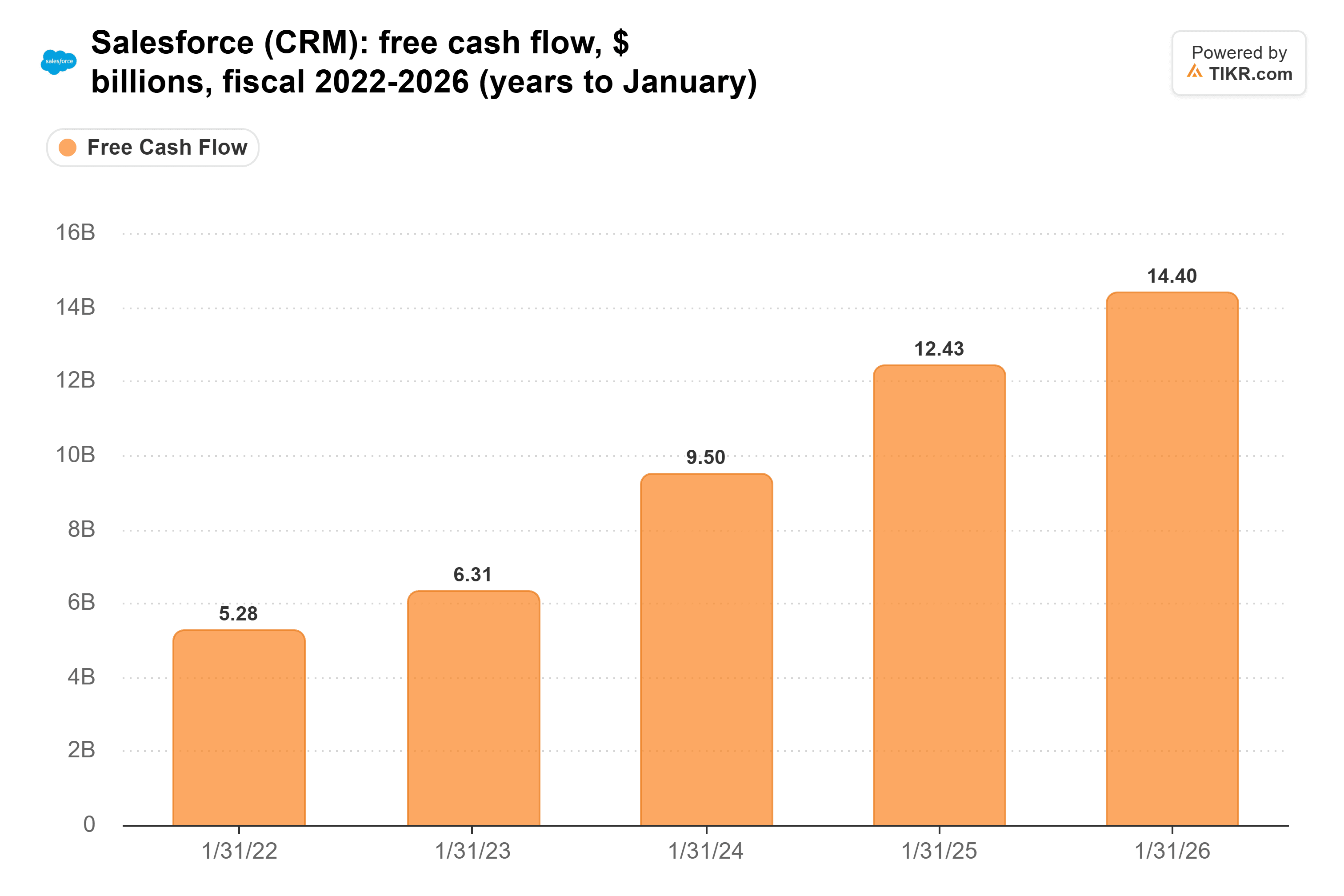
- Salesforce trades at about 13x forward earnings, against a three-year average of about 23x, even as its free cash flow nearly tripled from fiscal 2022 to fiscal 2026.
- The Dec. 2 report needs to show growth excluding acquisitions picking up from 6%, since agents on Slack may pay Salesforce little while rivals like Atlassian and HubSpot chase the same agents and new customers.
Salesforce (CRM) has a piece of the AI agent boom that almost nobody was counting: Slack.
CEO Marc Benioff put a number on it late on Nov. 18 in a post on X: “We’ve now seen 226K custom agents deployed to Slack from every major agent builder platform.”
“We never thought of this when we bought Slack,” he admitted. He singled out Cognition, the maker of the Devin coding agent, which had just launched Devin Bots on Slack.
Which is a pretty good answer to the SaaSpocalypse. Investors have been selling Salesforce on the fear that AI companies will route around its software, and a lot of their agents are running straight through Slack.
On Nov. 17, Salesforce and Microsoft (MSFT) announced Copilotforce, which puts Salesforce’s customer records and sales workflows inside Microsoft’s Copilot and Teams. Meanwhile, Atlassian (TEAM) is pitching the same agents-as-teammates idea, and HubSpot (HUBS) keeps adding the kind of new customers critics say Salesforce struggles to win.
TIKR tracks 56 analysts on Salesforce. How many say “Buy”?
See the full breakdown of Buy, Hold, and Sell ratings on Salesforce, along with Wall Street’s revenue and earnings estimates, all in one place. More than 500,000 investors use TIKR to research stocks like this one. See Salesforce’s Analyst Ratings
Slack became agent plumbing by accident
In Benioff’s telling, Slack gives agents like Devin their identity, memory, interface, and security controls, so builders can ship an agent once and put it straight to work. Copilotforce comes at it from the other direction, adding a Salesforce plugin for Copilot, now in public preview, with more than 38 prebuilt sales skills. Taken together, the two moves show a company that cares more about its data getting used wherever work happens than about which app shows it.
Atlassian wants the same agents. Its new Agentic Multiplayer Protocol “brings them into teams as accountable teammates,” CEO Mike Cannon-Brookes said with the company’s September-quarter results. If coding agents settle on Slack as the place they take requests and report back, Jira and Confluence give up ground. Investors still pay about 25x forward earnings for Atlassian, nearly double Salesforce’s multiple.
The market is pricing in the worst case
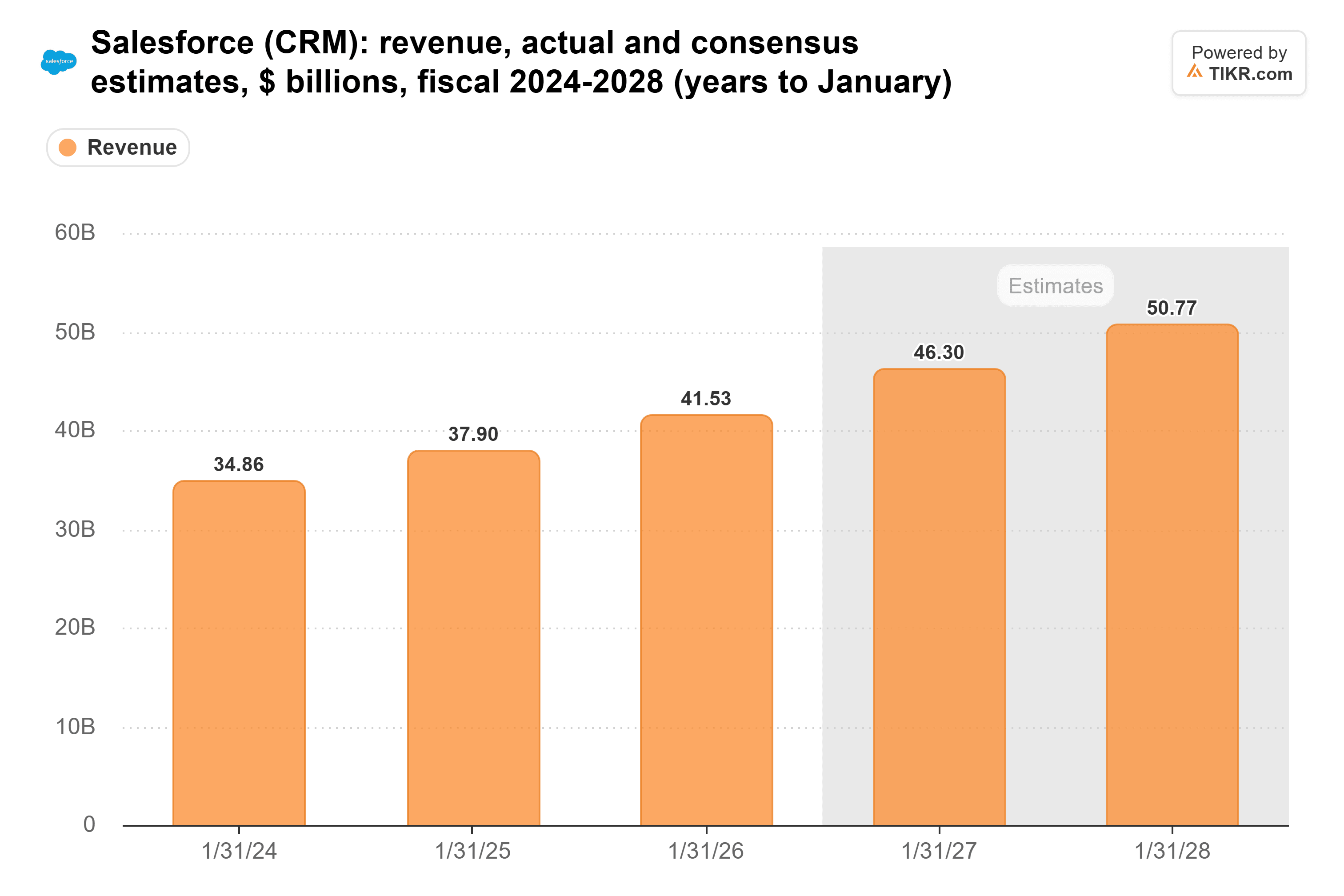
Analysts expect Salesforce’s revenue to grow about 11% a year, from $41.5 billion in the year ended January 2026 to about $50.8 billion in the year ending January 2028:
Yet the stock keeps getting cheaper. As CNBC’s Jim Cramer put it: “The multiple shrinkage at Salesforce and ServiceNow is extraordinary.”
Salesforce trades at about 13x forward earnings, against a three-year average of about 23x, and not far above its June low of 11x:
That’s happening while the cash keeps piling up. Free cash flow nearly tripled, from $5.3 billion in fiscal 2022 to $14.4 billion in fiscal 2026:
Slack still has to get paid
Benioff didn’t say what those 226,000 agents pay Salesforce. Agentforce annual recurring revenue passed $1.5 billion at July 31, and that figure already counts Slackbot. That’s small next to yearly revenue, and second-quarter revenue grew just 6% without the Informatica acquisition.
Jason Lemkin, founder of SaaStr, made the sharper bear case on a Nov. 19 episode of the 20VC podcast: “Salesforce is clearly a master of selling you five to 10 expensive products, but not so much in bringing in net new logos.”
New logos haven’t saved anyone from the AI selloff, though. HubSpot grew its customer count 12% to 311,704 by Sept. 30. Yet it trades at about 12x forward earnings, no richer than Salesforce, and its stock has fallen more than 40% over the past year. That suggests investors care less about Salesforce’s logo count than about whether agents still need its data, and Benioff’s 226,000 agents are a good sign they do.
Cheap, with a real answer on the table
Salesforce’s selloff looks overdone. The stock is priced as if agents will route around Salesforce, and Benioff’s count suggests many are running through it instead.
Of course, none of it shows up in the numbers yet. Salesforce reports its third quarter after the close on Dec. 2, with revenue guided up 11% to 12%, slightly more than 4 points of it from Informatica. The case gets a lot stronger if growth excluding acquisitions comes in clearly above the second quarter’s 6%, and stronger still if management puts any figure on what Slack’s agents bring in.
So what is Salesforce stock actually worth?
TIKR lets you forecast the future price of any stock in less than a minute. Just enter a few assumptions into TIKR’s valuation model and see what Salesforce could be worth. Start from Wall Street consensus estimates, or adjust the inputs to reflect your own view of the business. It’s free to use.
Disclaimer:
Please note that the articles on TIKR are not intended to serve as investment or financial advice from TIKR or our content team, nor are they recommendations to buy or sell any stocks. We create our content based on TIKR Terminal’s investment data and analysts’ estimates. Our analysis might not include recent company news or important updates. TIKR has no position in any of the stocks mentioned. Thank you for reading, and happy investing!