
Key Takeaways
- Arm Holdings (ARM) gained 88% in 2026 through October 30 despite falling 55% from its June high, while Advanced Micro Devices (AMD) climbed approximately 136%.
- Intel (INTC) added pressure to semiconductor stocks after issuing weaker-than-expected fourth-quarter guidance, with ARM declining nearly 10% on October 30.
- Qualcomm (QCOM) remains a risk because an unresolved royalty dispute could affect one of Arm’s largest licensing relationships.
- Arm’s AGI CPU demand exceeds $2 billion, while analysts expect normalized EPS to climb from $1.77 in fiscal 2026 to approximately $3.07 in fiscal 2028.
What Happened?
Arm Holdings (ARM) stock gained 88% in 2026 through October 30, closing around $206, although shares remained 55% below their June 18 high of approximately $453.
The rally accelerated after Arm introduced its AGI CPU in March, marking the company’s expansion beyond licensing processor designs into selling its own data center chips. By April 30, shares had reached approximately $210 before surging toward their June peak.
Investors initially rewarded Arm’s growing AI infrastructure exposure, pushing its forward P/E to approximately 202x in June. However, that elevated valuation left little room for disappointment, and concerns about manufacturing capacity, execution, and semiconductor spending contributed to the subsequent correction.
Despite the decline, AGI CPU demand now exceeds $2 billion across fiscal 2027 and 2028, more than double the $1 billion opportunity initially outlined at launch.
During July’s earnings call, CEO Rene Haas described demand as “north of $2 billion,” although Arm had secured manufacturing capacity for only the initial $1 billion opportunity.
Broader semiconductor weakness added pressure in late October. Intel reported data center and AI revenue of $7.3 billion, up 78% year over year, but guided for fourth-quarter revenue of $15 billion to $16 billion, below expectations.
Arm fell nearly 10% on October 30 as investors reassessed the sector’s supply constraints and premium valuations.
Meanwhile, AMD gained approximately 136% in 2026 through October 30 and reports earnings on November 3. Unlike AMD, which sells CPUs and AI accelerators, Arm primarily earns licensing and royalty revenue while expanding into its own data center processors.
Arm’s Earnings Growth Still Looks Strong
Arm reported fiscal first-quarter revenue of $1.29 billion, up 22% year over year, supported by record first-quarter licensing and royalty revenue.
Wall Street expects normalized EPS to increase from $1.77 in fiscal 2026 to approximately $3.07 in fiscal 2028 as AI infrastructure demand, higher royalty rates, and AGI CPU deployments expand.

However, analysts expect gross margins to decline from approximately 98% to 91% over the same period as Arm expands its physical chip business.
Another uncertainty involves Qualcomm, which accounted for approximately 9% of Arm’s fiscal 2026 revenue. An October jury found that Arm breached part of its licensing agreement and awarded Qualcomm nominal damages of $2, while a potential five-year royalty exemption remains unresolved.
Arm’s November 4 earnings report will test whether rising AGI CPU demand can translate into revenue growth while the company manages manufacturing constraints and licensing risks.
Is Arm Stock Undervalued or Overvalued?
Arm appears fairly valued to slightly overvalued despite its sharp decline, with its forward P/E standing near 88x on October 22, compared with a June peak of 202x and a three-year average of approximately 85x.
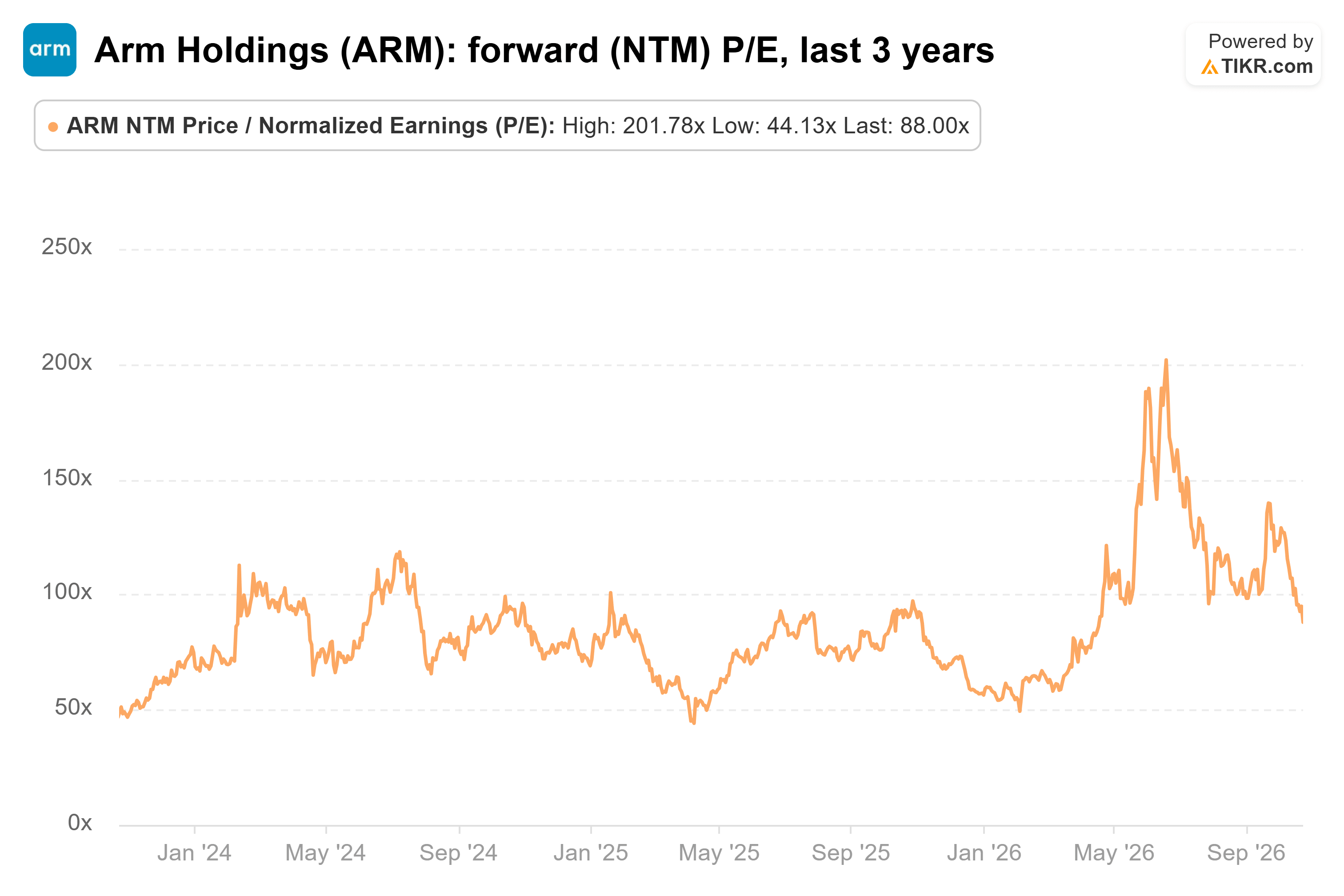
Following the October 30 decline, that multiple would be approximately 86x if earnings estimates remained unchanged, suggesting shares still carry a premium despite significant valuation compression.
Analysts’ average price target of approximately $291 implies around 41% upside from the October 30 closing price, although achieving that target depends on sustained earnings growth and successful AGI CPU deployment.

Over the next 12 months, higher royalty revenue and growing data center demand could support the stock, while manufacturing constraints, declining gross margins, and the Qualcomm dispute remain significant risks.
Gradually buying Arm after its decline looks more attractive than taking profits solely because of its 2026 gains, but its premium valuation makes aggressively loading up before November 4 difficult to justify.
So what is Arm stock actually worth?
TIKR lets you forecast the future price of any stock in less than a minute. Just enter a few assumptions into TIKR’s valuation model and see what Arm could be worth. Start from Wall Street consensus estimates, or adjust the inputs to reflect your own view of the business. It’s free to use.
Disclaimer:
Please note that the articles on TIKR are not intended to serve as investment or financial advice from TIKR or our content team, nor are they recommendations to buy or sell any stocks. We create our content based on TIKR Terminal’s investment data and analysts’ estimates. Our analysis might not include recent company news or important updates. TIKR has no position in any of the stocks mentioned. Thank you for reading, and happy investing!