Key Takeaways
- Applied Materials fell 7.5% on Friday in a chip rout sparked by Intel, days after agreeing to lift its Besi stake to about 20% from 9%.
- Besi’s third-quarter orders jumped 96%, yet its shares had fallen 54% since June as memory makers delayed hybrid bonding for HBM.
- Applied guided fiscal fourth-quarter revenue to $10.25 billion, up 51%, with EPS of $4.02 against a $3.69 consensus.
- The November 12 report will show whether that guide holds and how China, at 26% of core revenue, is trending.
Applied Materials (AMAT) slid 7.5% to $390 on Friday as Intel’s forecast dragged chip stocks lower. The stock now sits 47% below its 52-week high of $740.
Earlier in the week, though, Applied made a bet that points the other way. It agreed to raise its stake in BE Semiconductor Industries (BESI) to about 20% from 9%, and Besi shares jumped about 9% on the news.
That timing is telling. Besi had lost 54% between June 22 and the announcement, because memory makers pushed back adopting its hybrid bonding tools for HBM.
So Applied is adding to a partner the market had given up on.
Doubling down on Besi
The deal is straightforward:
- Applied is buying the shares through an accelerated purchase agreement, pending U.S. antitrust review.
- It has no plans to go beyond about 20% or to seek a board seat.
- The two have worked together on hybrid bonding since 2020 and co-developed Kinex, an integrated die-to-wafer system.
Prabu Raja, who runs Applied’s semiconductor products group, called hybrid bonding and next-generation interconnects “increasingly critical enablers of energy-efficient AI compute performance.”
Besi’s order book backs him up. Third-quarter orders rose 96% to €342.6 million, and hybrid bonding orders in the first nine months more than doubled all of 2025. Besi also said last week that ASML is not a hybrid bonding rival.
Here’s what analysts expect from Besi’s sales as those orders convert…

That order surge has to reach revenue for Applied’s bigger stake to pay off.
Memory is carrying the quarter
Applied’s own business is running hot. Fiscal Q3 revenue rose 25% to a record $9.12 billion, while non-GAAP EPS of $3.50 beat the $3.39 estimate.
DRAM was the standout. Revenue from DRAM, including HBM packaging, grew 52% to a record as customers expanded cleanroom space.
The Q4 guide is even stronger. Applied expects $10.25 billion of revenue, plus or minus $500 million, well above the $9.54 billion consensus. Semiconductor Systems should grow 62%, and services should grow 22%.
Compare that guide with how revenue has moved over the last two years.
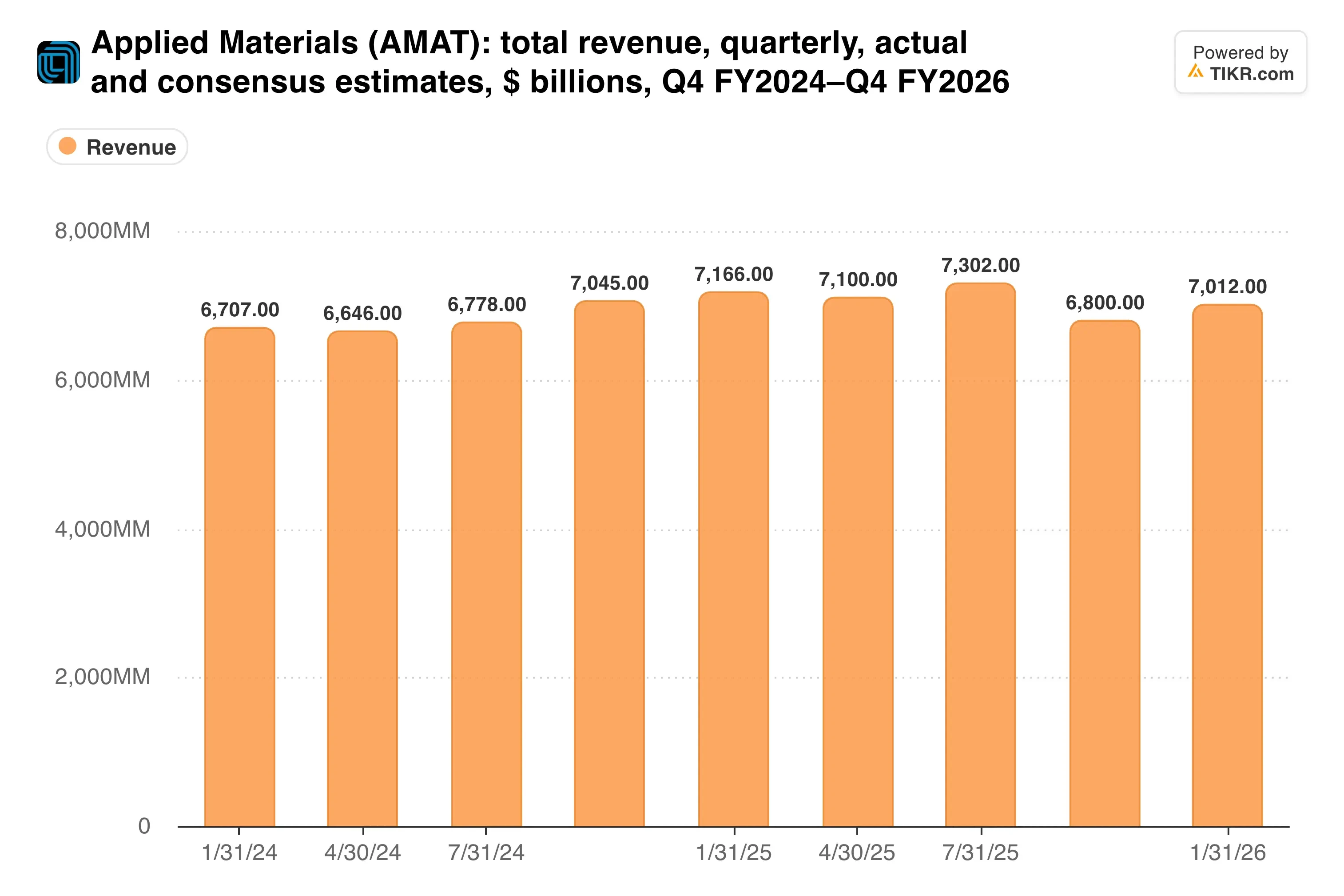
A $10.25 billion quarter would land about 12% above Q3’s record.
Services add a steadier layer. Applied expects that business to grow more than 20% this year and top $12 billion by 2030.
TIKR tracks 40 analysts on Applied Materials. How many say “Buy”?
See the full breakdown of Buy, Hold, and Sell ratings on Applied Materials, along with Wall Street’s revenue and earnings estimates, all in one place. More than 500,000 investors use TIKR to research stocks like this one. See Applied Materials’ Analyst Ratings
Cheaper than ASML, for a reason
Friday’s drop pulled Applied’s multiple back below its closest equipment peer:
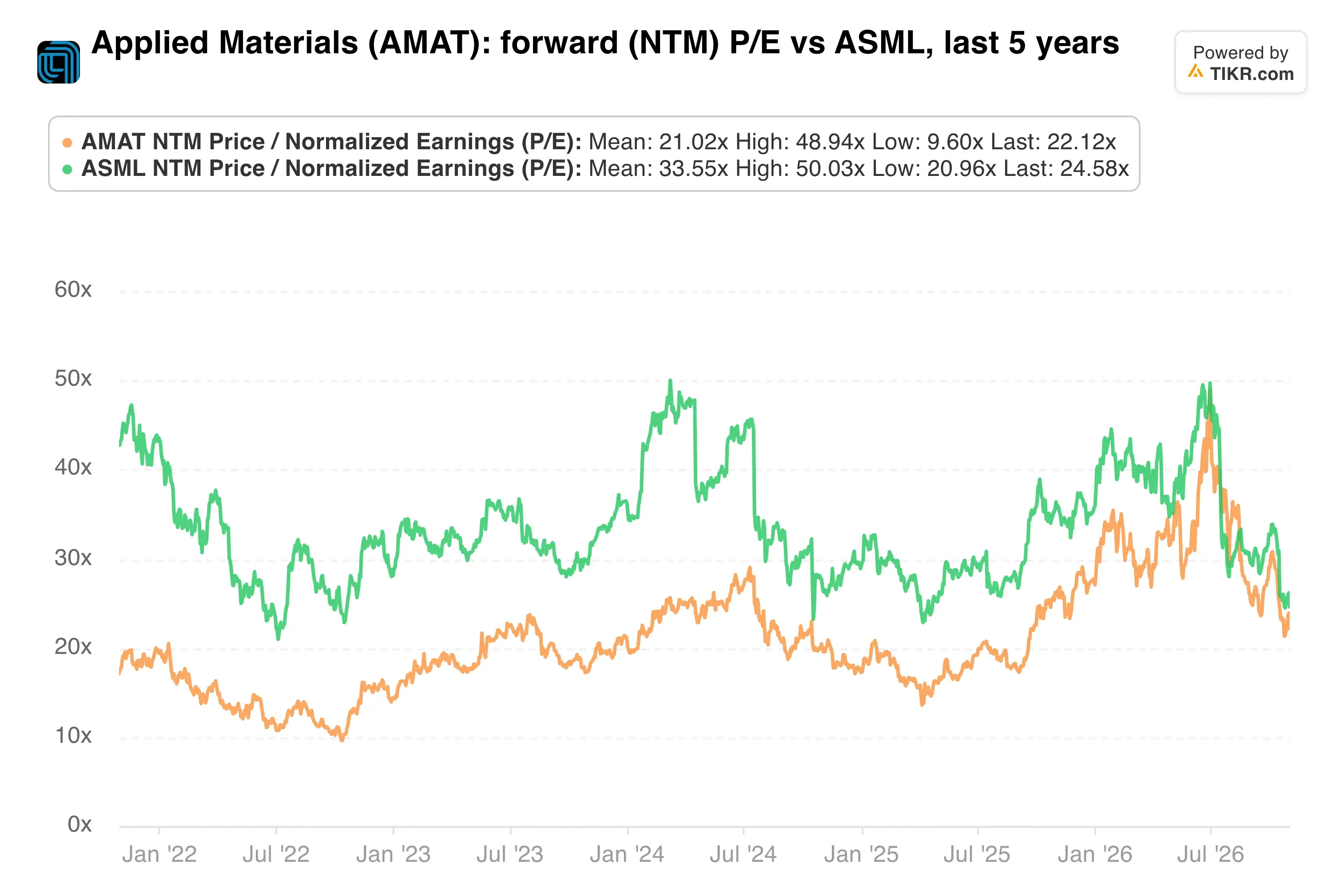
Applied trades at 22.1x forward earnings, while ASML trades at 24.6x.
China explains much of the gap. It made up 26% of Semiconductor Systems and services revenue in Q3, down from 35% the quarter before. Management still expects China revenue to grow this year and next, led by 28-nanometer foundry and logic work, yet export controls can change that quickly.
Wall Street’s average target of $628 implies 61% upside.
My take: I like the Besi move. Applied is buying a hybrid bonding leader while the market is pessimistic, and it keeps the stake small enough to avoid a control fight. Still, the stake is minor next to memory. Friday’s selloff reflects the fear that AI spending peaks before the 51% guide turns into growth in 2027, and I think that fear is early but fair to watch.
The November 12 report comes next. It will show whether Q4 landed near $10.25 billion and whether DRAM demand carries into calendar 2027.
So what is Applied Materials stock actually worth?
TIKR lets you forecast the future price of any stock in less than a minute. Just enter a few assumptions into TIKR’s valuation model and see what Applied Materials could be worth. Start from Wall Street consensus estimates, or adjust the inputs to reflect your own view of the business. It’s free to use.
Disclaimer:
Please note that the articles on TIKR are not intended to serve as investment or financial advice from TIKR or our content team, nor are they recommendations to buy or sell any stocks. We create our content based on TIKR Terminal’s investment data and analysts’ estimates. Our analysis might not include recent company news or important updates. TIKR has no position in any stocks mentioned. Thank you for reading, and happy investing!