Key Takeaways
- Anthropic told IPO investors that its Mythos model got Claude running on AMD chips in about three days. It says that work used to take six to 12 months.
- If code can move off NVIDIA’s CUDA software that fast, customers have less reason to stay, and that switching cost has helped NVIDIA keep its gross margin above 70% for three straight fiscal years.
- The claim covers one task for one model, and NVIDIA still counts more than 7.5 million CUDA developers.
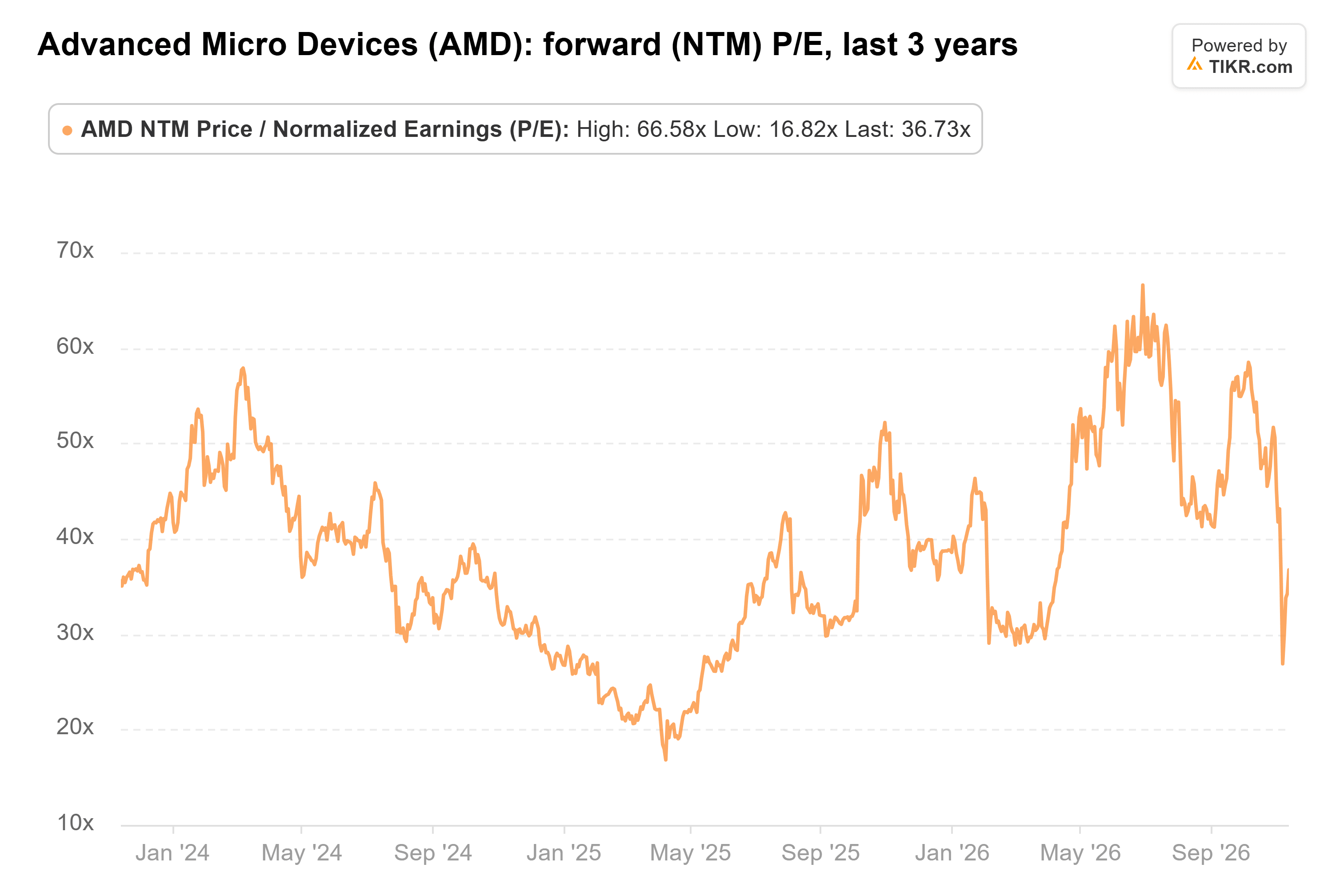
- AMD trades at 37x forward earnings, below its three-year average of 39x, while analysts expect its revenue to nearly triple from 2025 to 2027.
Anthropic is pitching IPO investors on a number that should worry anyone who owns NVIDIA (NVDA): three days.
That’s how long Anthropic says its Mythos model took to get Claude running on chips from Advanced Micro Devices (AMD). “It got Claude running on AMD in just three days with basically no human intervention. Claude ported or wrote almost 100% of the kernels,” Anthropic co-founder Tom Brown said in the company’s roadshow video. The company’s old approach took six to 12 months.
That’s at least 60x faster.
An investor on X argued that every AI IPO gets priced off NVIDIA’s multiple. Replit CEO Amjad Masad pushed back, saying Anthropic “made it clear that they’re not dependent on Nvidia and that they ported their software to run on amd in 3 days,” he wrote on X.
The claim also came out during a brutal week for NVIDIA. Its stock sank as CEO Jensen Huang resigned, after The Wall Street Journal reported that the board was preparing to oust him, while AMD and Broadcom rose on bets that they’ll pick up business.
TIKR tracks 53 analysts on AMD. How many say “Buy”?
See the full breakdown of Buy, Hold, and Sell ratings on AMD, along with Wall Street’s revenue and earnings estimates, all in one place. More than 500,000 investors use TIKR to research stocks like this one. See AMD’s Analyst Ratings
AMD’s software gap just got a lot smaller
NVIDIA hasn’t really had to worry about competition for four years, and AMD is closing in. The hard part for AMD has been software, because code written for CUDA has to be reworked before it runs well on anyone else’s chips. Brown said Anthropic only started working with AMD GPUs “this year,” and Mythos did most of the porting.
AMD has been talking about this for months. TBPN co-host John Coogan said on Wednesday’s episode that when the show spoke with AMD CEO Lisa Su over the summer, “the big story of the day was that the bring up time had been significantly reduced from these AI speed ups.”
AMD’s business is already growing fast. Third-quarter revenue rose 45% to $13.4 billion, data center revenue jumped 97% to $8.5 billion, and management guided to about $17 billion for the fourth quarter. Analysts expect revenue to go from $34.6 billion in 2025 to $95.9 billion in 2027, and then to $135 billion in 2028:

That’s a forecast for a company taking real share, and a faster way off CUDA makes it easier to hit.
What CUDA is worth to NVIDIA
NVIDIA can charge what it does partly because its customers’ code is hard to move. Its gross margin has stayed above 70% for three straight fiscal years, through the year ended January 2026:
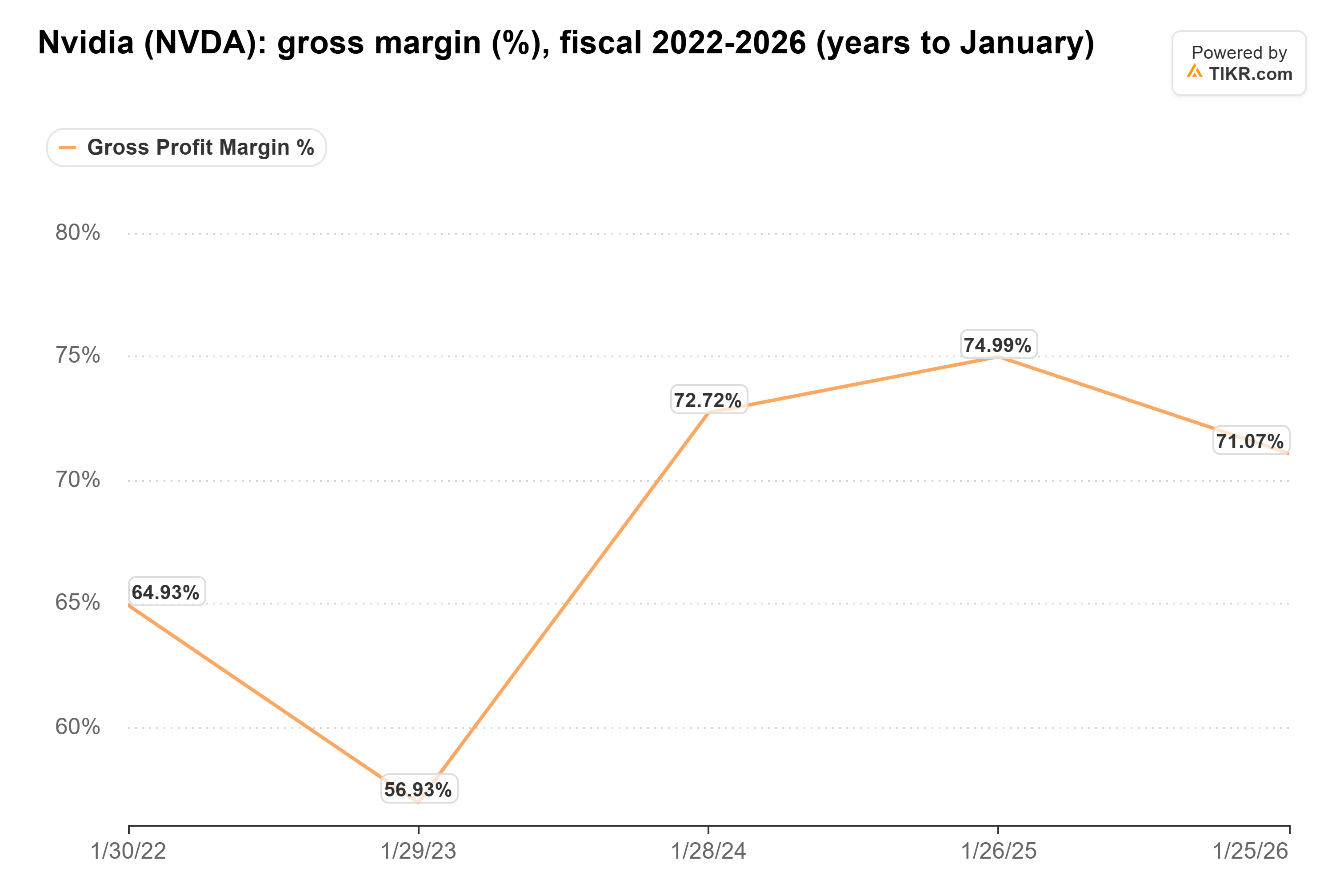
That pricing power is already under some strain. On its Aug. 26 call, management said it expects gross margin to bottom at 71% to 72% in the January 2027 quarter as memory prices climb. Cheaper ports would give customers more leverage on price at the same time. With NVIDIA’s leadership in flux, I’d expect buyers to use it.
Three days, for one task
Anthropic’s own slide is narrower than “running on AMD” sounds. Its footnote says the three days covered prompt processing for one Anthropic model on AMD’s MI355X GPUs, at a useful level of performance. NVIDIA’s annual report also counts more than 7.5 million CUDA developers.
Cerity Partners’ Jim Lebenthal owns NVIDIA, and he made the case for CUDA on Wednesday’s Halftime Report. He said a new CEO would inherit “one of the best jobs in America,” because “while you can replace the CEO, you can’t replace the CUDA architecture. Every developer builds on it.”
He’s right about today. But the tool that did the porting is the product Anthropic sells. My read: the other big labs and cloud customers will point coding models at the same job, and each port they finish makes CUDA less sticky for the next one.
AMD still trades below its usual multiple
For all the excitement, AMD’s multiple sits below its normal level. It trades at 37x forward earnings, against a three-year average of 39x and a peak of 67x at the end of June:
I think Anthropic just put a real dent in NVIDIA’s moat. The developer base won’t leave overnight, but the cost of leaving NVIDIA is falling fast, and AMD is the obvious place to go. At a below-average multiple, AMD looks like the better side of this trade to me.
Of course, Anthropic has every reason to talk up its independence from NVIDIA on a roadshow. NVIDIA reports on Nov. 17, and its gross margin guide for the January quarter will show us whether customers are already pushing back on price.
So what is AMD stock actually worth?
TIKR lets you forecast the future price of any stock in less than a minute. Just enter a few assumptions into TIKR’s valuation model and see what AMD could be worth. Start from Wall Street consensus estimates, or adjust the inputs to reflect your own view of the business. It’s free to use.
Disclaimer:
Please note that the articles on TIKR are not intended to serve as investment or financial advice from TIKR or our content team, nor are they recommendations to buy or sell any stocks. We create our content based on TIKR Terminal’s investment data and analysts’ estimates. Our analysis might not include recent company news or important updates. TIKR has no position in any of the stocks mentioned. Thank you for reading, and happy investing!