


Key Takeaways
- Junto Capital Management, which manages $10.52 billion, sold out of Walmart, Visa and Moody’s in the third quarter, its latest 13F shows.
- Walmart trades at about 43x forward earnings with 3% upside to the analysts’ average target, which makes that sale the easiest to agree with.
- By Sept. 30, the fund’s two biggest holdings were BlackRock and Ferguson Enterprises, where analysts see 16% and 17% upside.
- Visa trades near its long-run multiple with earnings still growing at a double-digit pace, so it’s the sale I’d most want to undo.
Junto Capital Management’s 13F for the quarter ended Sept. 30, filed Nov. 16, shows the fund sold out of 13 sizable positions. The three biggest are stocks plenty of investors own: Walmart (WMT), Visa (V) and Moody’s (MCO).
Junto manages $10.52 billion in all, per its latest Form ADV, and its 13F holds $5.63 billion of US stocks across 80 positions. By Sept. 30, the top of that list was BlackRock (BLK), after the fund added 35% to its stake, followed by Ferguson Enterprises (FERG), new in the quarter.
Walmart’s price already asks a lot
Junto held 1.49 million Walmart shares worth $168 million on June 30, 3.1% of its 13F stocks, and none by Sept. 30. The stock has gained 13% since the quarter ended. The analysts’ average target has climbed over the past year, though it’s below its June high:
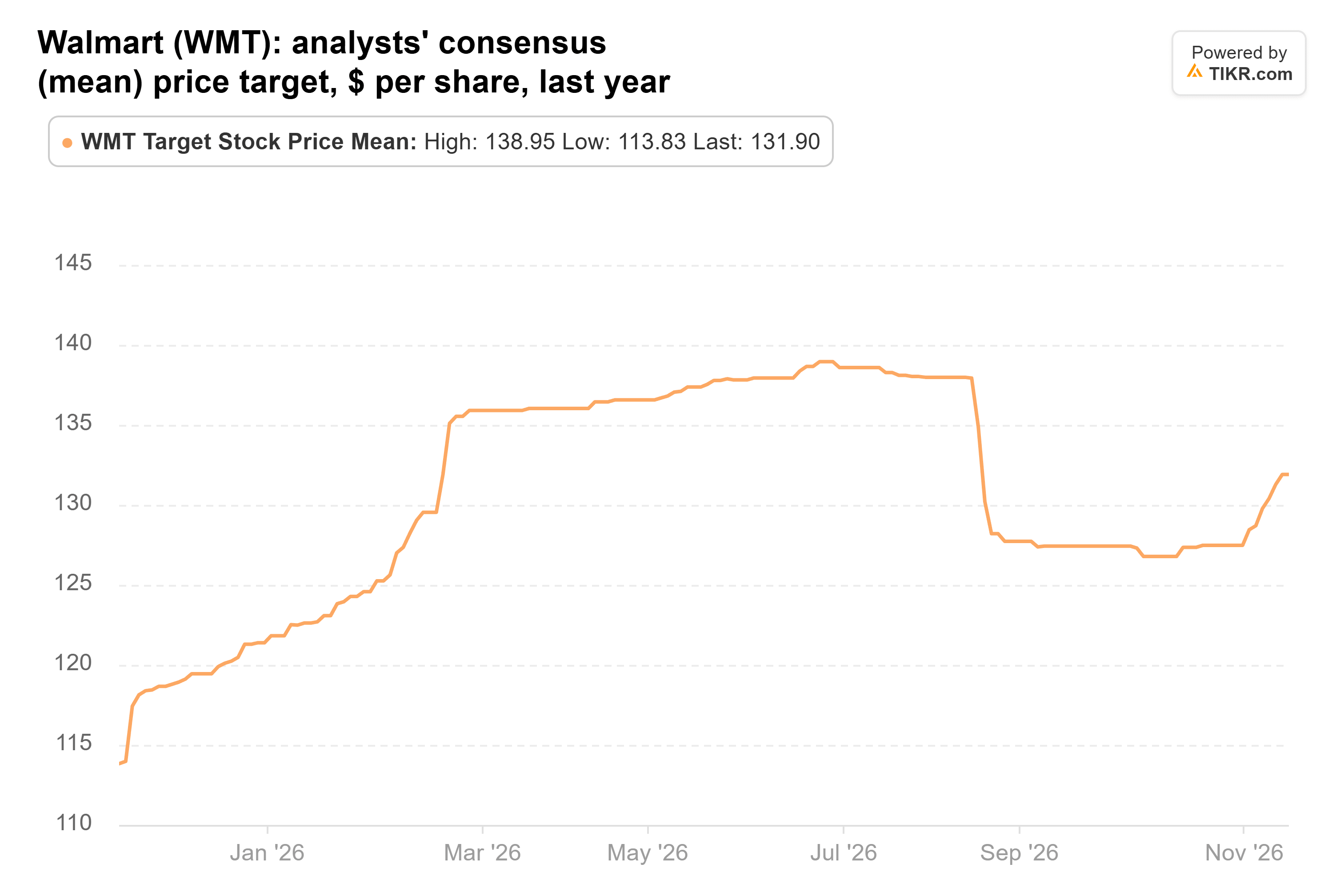
That $131.90 average, from 44 analysts, is just 3% above the price. At about 43x forward earnings, Walmart trades far above its five-year average of about 29x on TIKR. At that average, analysts’ fiscal 2029 EPS estimate of $3.63 would be worth about $107 a share. Meanwhile, Walmart is putting the roughly $2.9 billion of tariff refunds it booked in its fiscal second quarter into more than 11,000 rollbacks, and it guides third-quarter adjusted operating income up just 2% to 4% in constant currency. That’s a rich price for profit growth that slow.
TIKR tracks 45 analysts on Walmart. How many say “Buy”?
See the full breakdown of Buy, Hold, and Sell ratings on Walmart, along with Wall Street’s revenue and earnings estimates, all in one place. More than 500,000 investors use TIKR to research stocks like this one. See Walmart’s Analyst Ratings
Visa is the sale I’d question
Visa was a similar-sized position: 461,921 shares worth $158 million on June 30, 2.9% of its 13F stocks. It’s up 21% since Sept. 30, and the analysts’ average target has climbed to its highest point of the past year:
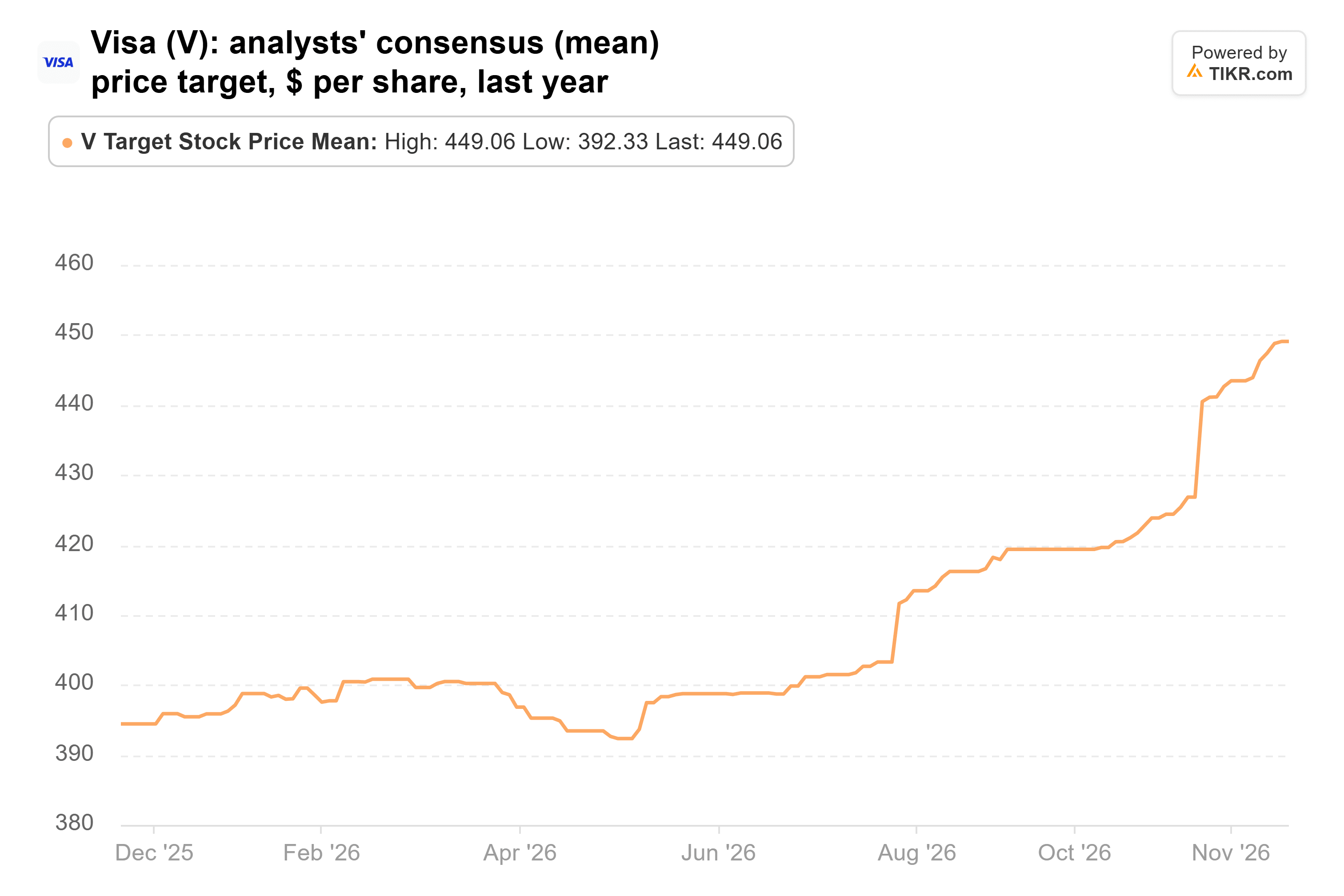
Even after that run, the $449.06 average from 40 analysts sits 8% above the price. Visa trades at about 28x forward earnings, right around its quarter-end average since 2014 on TIKR. Analysts expect normalized EPS to grow from $15.02 in fiscal 2027 to $17.13 in fiscal 2028. Visa also just raised its dividend 16%. And Pershing Square’s Bill Ackman told CNBC this month that he bought Visa this year, calling it “a royalty on people spending money.”
Not everyone agrees. Freedom Broker cut Visa to Hold from Buy on Nov. 4, pointing to rising client incentives, even as it raised its target to $427 from $410. The bigger risk is the Credit Card Competition Act. President Trump has backed it, and it would let merchants send credit card payments over rival networks.
Moody’s is the closest call
Moody’s was the smallest of the three: 260,298 shares worth $118 million on June 30, 2.2% of its 13F stocks. It’s up 7% since Sept. 30 and still 11% below its 52-week high. Its average target has stayed between $533 and $576 all year:
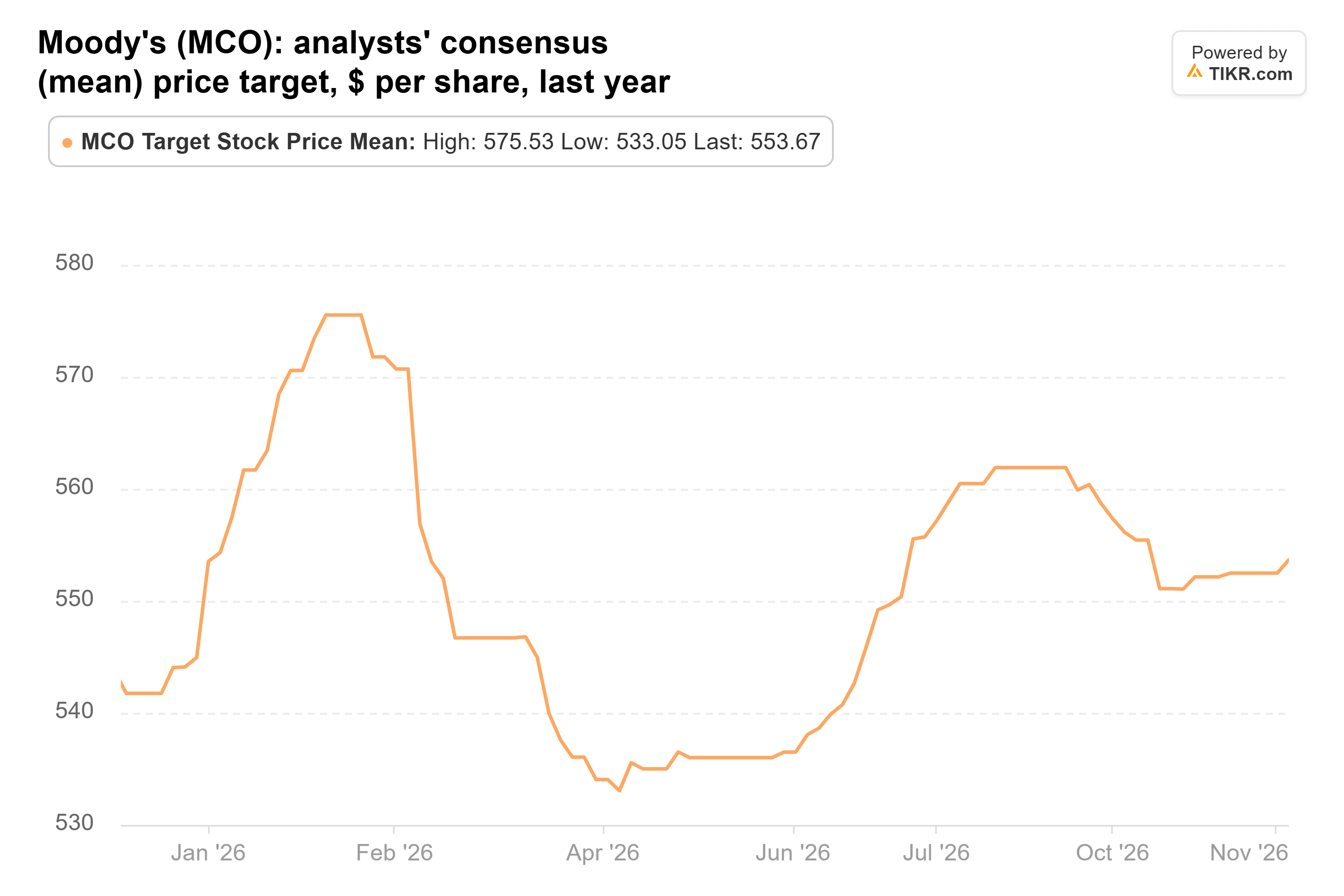
That $553.67 average from 24 analysts is 14% above the price, the most upside of the three, and even the lowest target, $480, is about where the stock trades. Growth has slowed, though. In its third-quarter release on Oct. 21, Moody’s said revenue rose 1% to $2.02 billion, and ratings revenue fell 1%. That came after 15% revenue growth in the second quarter. Moody’s still reaffirmed its 2026 guidance, including adjusted EPS of $16.50 to $17.00. At about 27x forward earnings, it costs about what Visa does, for a business that’s growing more slowly right now.
Its two biggest holdings look cheaper
The top of Junto’s 13F looks a lot cheaper than the three stocks it sold. By Sept. 30, BlackRock was its largest position: 191,489 shares worth $203 million, 3.6% of its 13F stocks, after a 35% jump in its share count over the quarter. Ferguson Enterprises, new in the quarter, came second at 778,403 shares worth $173 million, 3.1%. Both are up 12% since Sept. 30, and analysts still see 16% upside in BlackRock and 17% in Ferguson. At about 19x and 20x forward earnings, both trade far below Walmart’s multiple, and below Visa’s and Moody’s too.
If I could buy one back, it’s Visa
Selling Walmart at 43x looks like the easiest of the three calls, and I wouldn’t argue hard over Moody’s. I’d part ways with Junto on Visa. I’d rather own a business with double-digit earnings growth at its usual multiple, so if I could only buy back one of the three right now, it’d be Visa.
Walmart reports on Nov. 19. That sale would look early if adjusted EPS lands at the top of the $0.62-$0.64 guide or better, with Walmart U.S. comparable sales excluding health and wellness at 3% or more. Junto’s next 13F, for the quarter ending Dec. 31, is due by mid-February. It’ll show whether the fund bought any of the three back.
So what is Walmart stock actually worth?
TIKR lets you forecast the future price of any stock in less than a minute. Just enter a few assumptions into TIKR’s valuation model and see what Walmart could be worth. Start from Wall Street consensus estimates, or adjust the inputs to reflect your own view of the business. It’s free to use.
Disclaimer:
Please note that the articles on TIKR are not intended to serve as investment or financial advice from TIKR or our content team, nor are they recommendations to buy or sell any stocks. We create our content based on TIKR Terminal’s investment data and analysts’ estimates. Our analysis might not include recent company news or important updates. TIKR has no position in any of the stocks mentioned. Thank you for reading, and happy investing!


