


Key Stats for AMD
- Current Price: $495.07
- 52-Week Range: $149.22 – $584.73
- Street Mean Target: $612.84
- Market Cap: ~$788B
- LTM Gross Margin: 55.7%
- NTM P/E: ~43x
- Fwd 2-Year Revenue CAGR: ~59%
Now Live: Discover how much upside your favorite stocks could have using TIKR’s new Valuation Model (It’s free) >>>
AMD Just Posted Its Biggest Quarter Ever
The AI infrastructure buildout was supposed to create one dominant winner, and for most of the past two years, that winner was Nvidia. AMD (AMD) has been quietly rewriting its own story. Revenue in Q2 2026 came in at $11.5 billion, a record, up 50% from the same quarter a year ago.
More importantly, the data center segment, which includes AMD’s EPYC server CPUs and its Instinct AI GPUs, hit $6.7 billion in the quarter, more than doubling year-over-year and representing 58% of total company revenue.
AMD’s Revenue with Estimates chart tells the story of a business at an inflection point. Annual revenue sat at roughly $22.7 billion in 2023, climbed to $34.6 billion in 2025, and consensus now projects the figure approaching $51 billion by the end of 2026.
The trajectory from there only steepens, with Street estimates pushing toward $87 billion in 2027 and well beyond that by the end of the decade.

CEO Lisa Su summed it up on the earnings call: “Demand for both accelerators and CPUs is growing well above our prior expectations.”
Su has expressed confidence that AMD’s data center AI revenue alone could reach tens of billions of dollars in 2027, and CFO Jean Hu added that data center sales are expected to accelerate through the second half of 2026. The momentum investors have been betting on is not cooling down. It is speeding up.
See analysts’ full growth forecasts and estimates for AMD stock (It’s free) >>>
The Profitability Comeback Is the Other Half of the Story
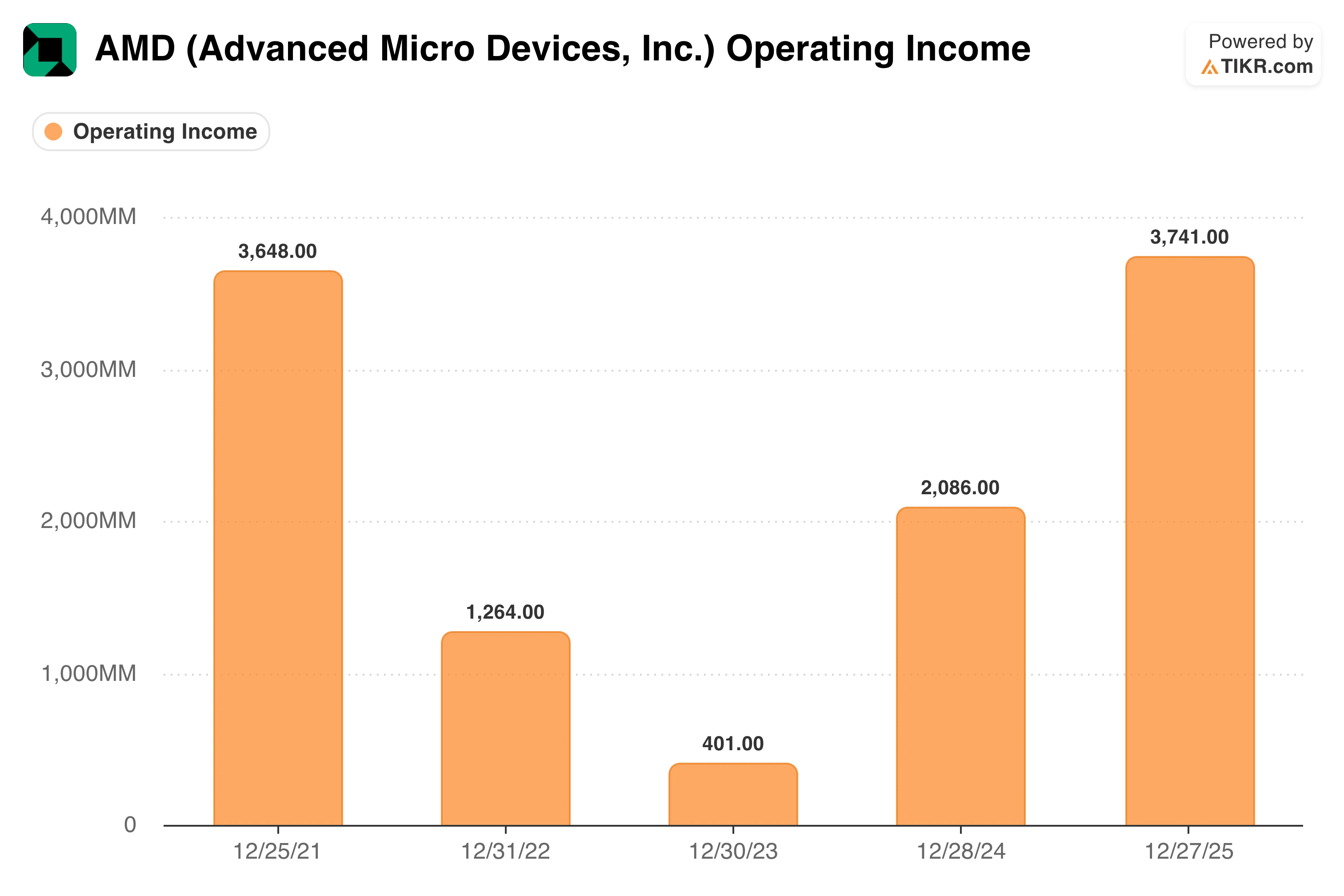
Revenue growth gets the headlines, but what is happening to AMD’s operating income deserves equal attention. The business went through a rough stretch, operating income collapsed from $3.6 billion in 2021 down to just $401 million in 2023, as the PC market cratered and AMD was caught with inventory it couldn’t move. The recovery has been steep.
Operating income rebounded to $2.1 billion in 2024 and climbed to $3.7 billion in 2025, essentially matching the 2021 peak on a revenue base that is now dramatically larger.
The chart captures that arc, a business that compressed hard, then rebuilt its earnings power as the product mix shifted decisively toward high-margin data center chips.
The profitability story connects directly to AMD’s competitive momentum. EPYC has been taking a meaningful share from Intel in cloud data centers, with hyperscalers like Microsoft and Google publicly expanding their EPYC deployments.
The Instinct GPU lineup is gaining ground in inference workloads, as customers seek alternatives to Nvidia’s premium pricing. AMD recently announced a strategic partnership with Anthropic, deploying Instinct GPUs in AMD’s new Helios rack-scale AI systems, a deal that adds a credible reference customer and signals the company’s software stack is mature enough to win at the frontier.
See what analysts think about AMD stock right now (Free with TIKR) >>>
AMD Trades at a Premium, and the Street Still Thinks It’s Cheap
The stock has pulled back roughly 19% from its June 2026 high, and that correction has sparked the obvious debate: is AMD expensive, or is it being handed to you at a discount? At around 43 times forward earnings, the valuation is not cheap by any traditional measure.
Real risk exists here too: if data center spending slows, if Nvidia closes the inference gap, or if AMD’s next-generation Instinct products face delays, the multiple compresses quickly.
The TIKR Street Targets table shows where consensus lands. The mean analyst price target is around $613, with 37 buy ratings and just 10 holds among 47 analysts covering the stock. The upper end of the range is $1,250.

The wide spread between the bull and bear cases reflects genuine uncertainty about how quickly AMD’s AI software ecosystem can close the gap on Nvidia’s CUDA platform, which has been the dominant standard for AI development for over a decade.
AMD’s ROCm software stack has improved considerably, but the competitive moat in software is real, and the company is still working to close it.
Should You Buy AMD Stock?
AMD is one of the more straightforward AI infrastructure stories in the market, a business with a clear and accelerating revenue driver, a recovering profitability profile, and a management team that has consistently delivered on ambitious targets.
The data center segment doubling in a single quarter reflects genuine structural demand from hyperscalers building out AI compute capacity, and the pullback from June highs brings the stock to a more defensible entry point.
The Street’s mean target of around $613 implies roughly 27% upside from current levels, and with 37 buy ratings out of 47 analysts, the consensus view is that AMD’s combination of CPU and GPU exposure makes it one of the more durable ways to own the AI infrastructure cycle.
See analysts’ growth forecasts and price targets for AMD stock (It’s free!) >>>
Looking for New Opportunities?
- See which stocks billionaire investors are buying to follow the smart money.
- Analyze stocks in as little as 5 minutes with TIKR’s all-in-one, easy-to-use platform.
- The more rocks you overturn… the more opportunities you’ll uncover. Search 100K+ global stocks, global top investor holdings, and more with TIKR.
Disclaimer:
Please note that the articles on TIKR are not intended to serve as investment or financial advice from TIKR or our content team, nor are they recommendations to buy or sell any stocks. We create our content based on TIKR Terminal’s investment data and analysts’ estimates. Our analysis might not include recent company news or important updates. TIKR has no position in any of the stocks mentioned. Thank you for reading, and happy investing!


