
Key Takeaways
- Alibaba’s Hong Kong shares fell as much as 7.3% after a report said Washington will stop Chinese firms from renting advanced chips in overseas data centers.
- Bloomberg reported that Alibaba rents Nvidia chips through Megaspeed International, which is why the selloff hit it harder than Tencent.
- Cloud revenue rose 45% last quarter, but CEO Eddie Wu tied faster growth to more supply, and the reported rule targets exactly that supply.
- The September-quarter report on November 19 will show whether cloud growth is still speeding up and how Alibaba plans to secure compute.
Alibaba Group (BABA) walked into earnings week with a fresh problem. Its Hong Kong shares slumped as much as 7.3% on November 12, dragging the Hang Seng Tech Index lower.
The trigger was a report from The Information. Commerce Department officials are preparing to finalize rules that would stop Chinese AI firms from remotely using advanced chips housed in overseas data centers.
That hit Alibaba harder than its peers. Bloomberg reported that it rents Nvidia (NVDA) chips through Megaspeed International, a Singapore firm caught up in a widening controversy around Nvidia. Meanwhile, Tencent (TCEHY) slipped just 1.5% in Hong Kong while Alibaba was down 5%.
The timing is awkward. Two days earlier, Alibaba disclosed that its T-Head chip unit had confidentially filed for a Hong Kong IPO.
Washington targets rented compute
Here is what the reported rule would do:
- Extend existing chip export controls to seven more countries, including Malaysia, Singapore and Thailand.
- Close a gap that lets Chinese firms rent processors they cannot legally import.
- Arrive as soon as this month.
Megaspeed adds a second layer of risk. U.S. agencies have investigated the company for more than a year, according to the WSJ, and it has denied any illegal chip transfers.
None of this touches the processors T-Head designs in-house. Still, investors were already wary before Thursday…
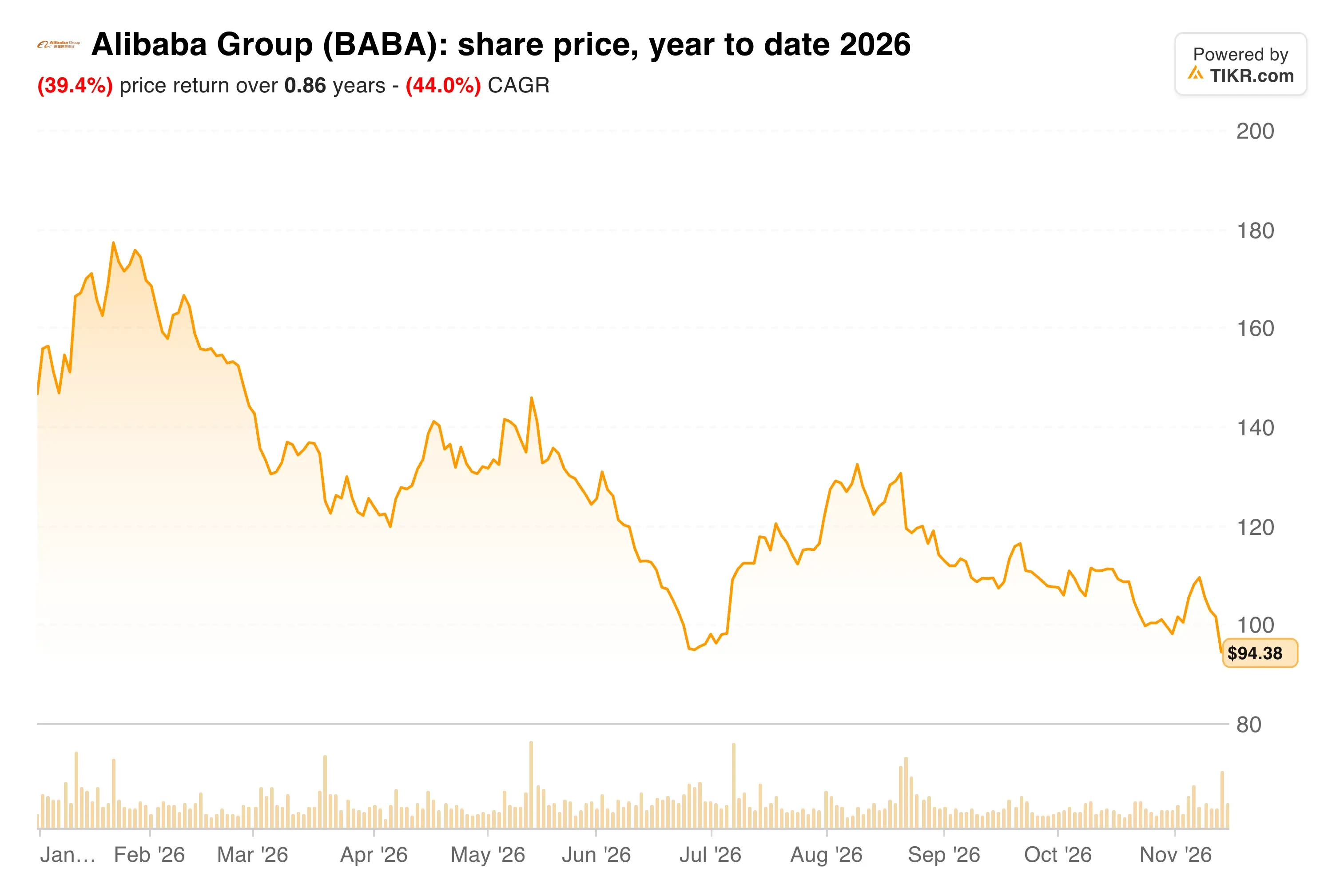
Alibaba’s Hong Kong shares had fallen nearly 30% this year by November 10, so the chip news landed on a stock with little cushion.
Cloud is carrying the quarter
The June quarter showed why compute access matters so much. AI Cloud and Compute Services revenue rose 45% to RMB48.4 billion. AI-related product revenue hit RMB12.4 billion, its 12th straight quarter of triple-digit growth.
So how much of the story now runs through that one segment?
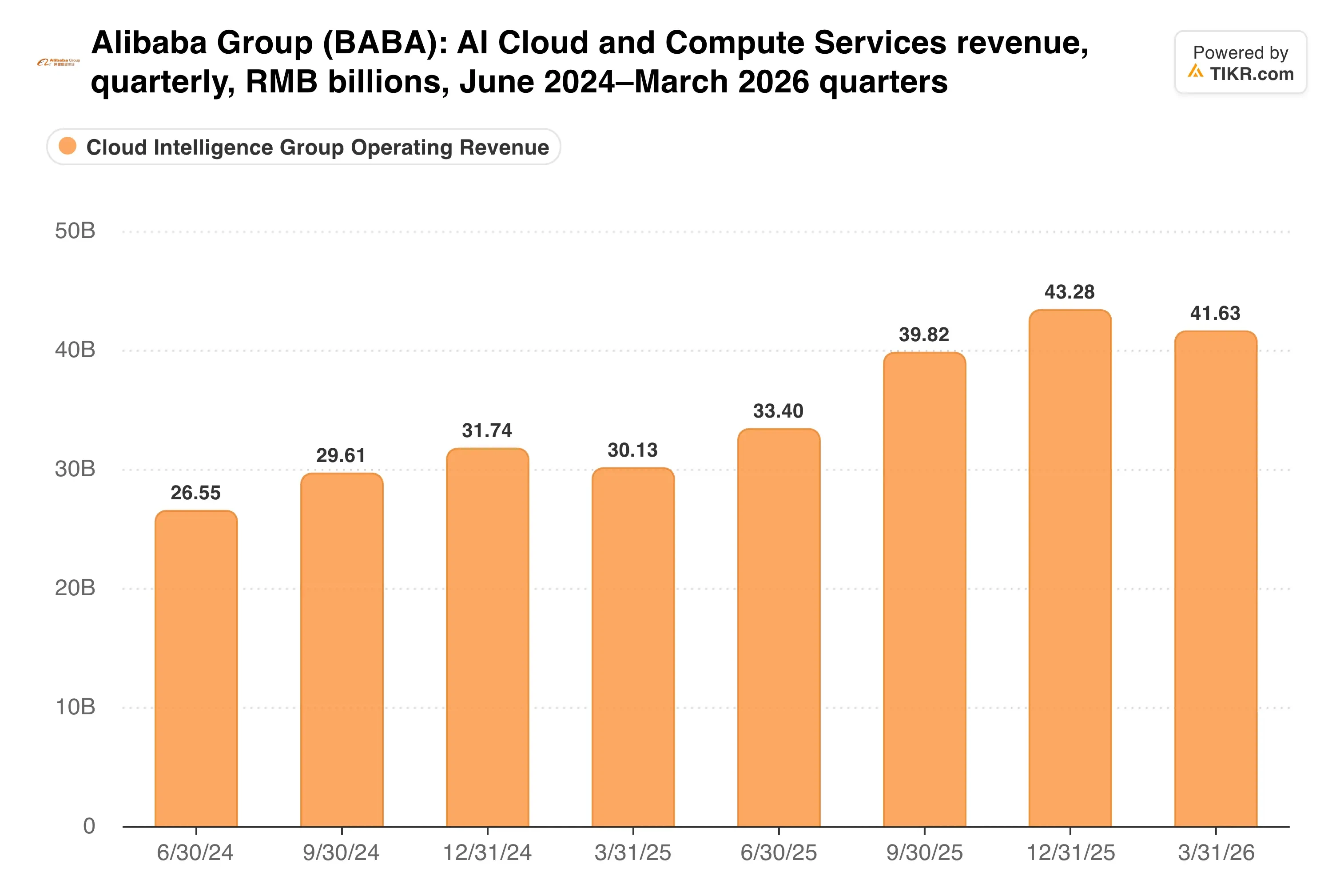
Quite a lot. Segment adjusted EBITA more than doubled to RMB5.6 billion, while customer management revenue in China e-commerce fell 7%.
Group revenue grew 9% to RMB269.0 billion, roughly in line with LSEG estimates. However, non-GAAP earnings per ADS of RMB8.52 missed the RMB10.53 consensus as AI spending ate into profit.
CEO Eddie Wu said on the August earnings call that “our AI and Cloud revenue growth will accelerate further in the coming quarters.” He tied that promise to ramping up supply, and supply is exactly what a remote-access ban threatens.
TIKR tracks 41 analysts on Alibaba. How many say “Buy”?
See the full breakdown of Buy, Hold, and Sell ratings on Alibaba, along with Wall Street’s revenue and earnings estimates, all in one place. More than 500,000 investors use TIKR to research stocks like this one. See Alibaba’s Analyst Ratings
Capex is outrunning the cash
Capex rose 75% to RMB67.7 billion in the June quarter, partly because chip components got more expensive. The cash flow statement shows the strain.
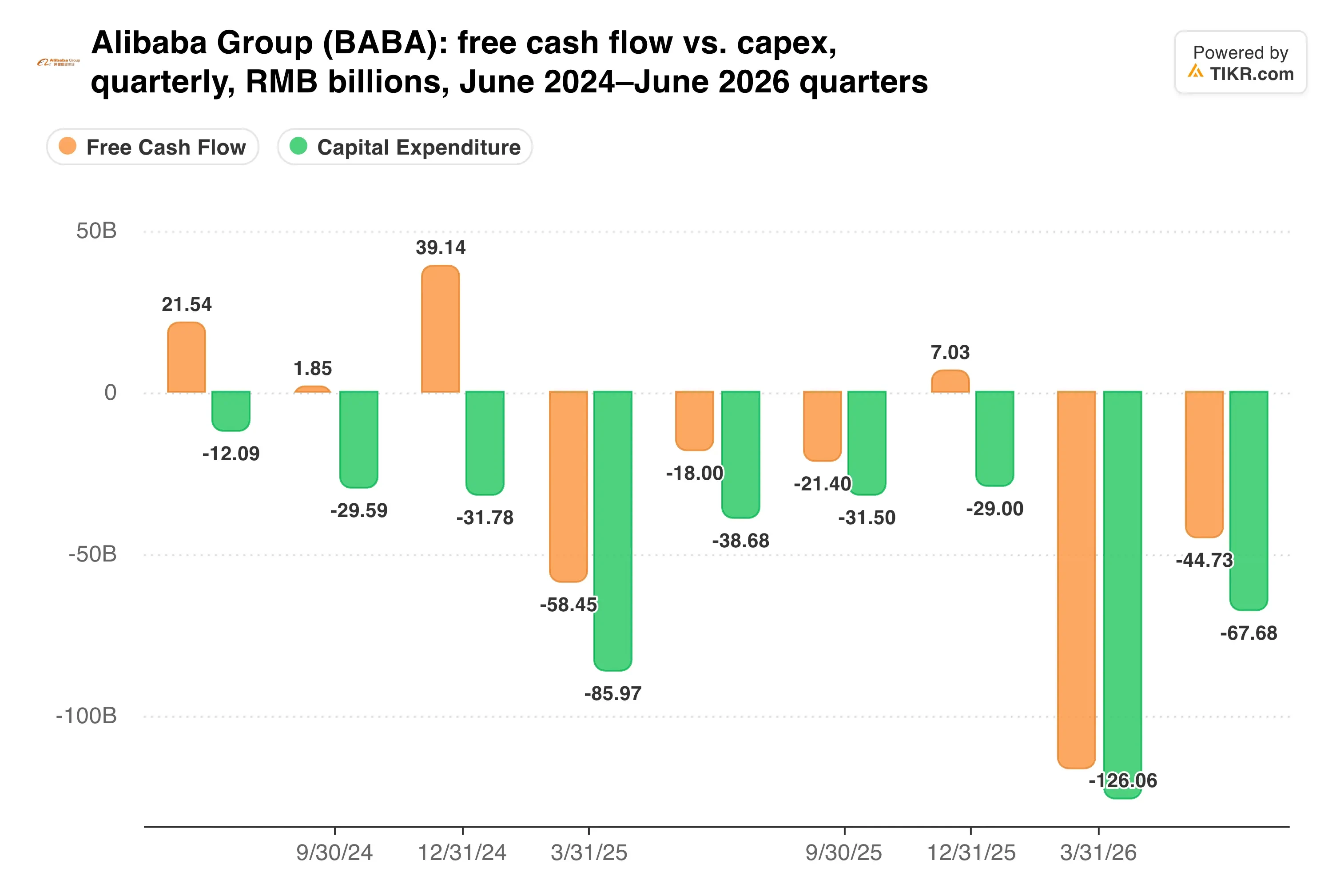
Free cash flow was an outflow of RMB44.7 billion, versus RMB18.8 billion a year earlier. Alibaba can absorb that, since it held RMB474.5 billion in cash and liquid investments at quarter end.
Losses are widening elsewhere too. AI Labs and Applications, home to the Qwen app, posted an adjusted EBITA loss of RMB13.9 billion, up from RMB3.2 billion.
T-Head is the hedge. IDC puts it at 7% of China’s data center AI accelerator market in the first half, ahead of Baidu’s Kunlunxin at 4%, Reuters reported. A listing would put a public price on that work, although Alibaba has given no size or date.
My take: The cloud growth is real, and in-house chips give Alibaba more room than most Chinese clouds. But Wu tied faster growth to more supply, and Alibaba has never said how much of its compute it rents abroad. I’d want that number before calling this dip a bargain.
Alibaba reports September-quarter results before the U.S. open on November 19. Options data compiled by Bloomberg point to a 5.7% move either way, and cloud growth is the line to watch.
So what is Alibaba stock actually worth?
TIKR lets you forecast the future price of any stock in less than a minute. Just enter a few assumptions into TIKR’s valuation model and see what Alibaba could be worth. Start from Wall Street consensus estimates, or adjust the inputs to reflect your own view of the business. It’s free to use.
Disclaimer:
Please note that the articles on TIKR are not intended to serve as investment or financial advice from TIKR or our content team, nor are they recommendations to buy or sell any stocks. We create our content based on TIKR Terminal’s investment data and analysts’ estimates. Our analysis might not include recent company news or important updates. TIKR has no position in any stocks mentioned. Thank you for reading, and happy investing!