Key Takeaways
- Alibaba reported on Thursday, Nov. 19, the day a US rule cutting Chinese companies off from AI chips in data centers abroad took effect, and said the rule will weigh on cloud growth next year.
- The cutoff makes computing power costlier, and that shows up first in free cash flow, which was a RMB 34.5 billion outflow in the September quarter.
- NVIDIA’s outlook counts on no China data-center compute sales, JD.com’s delivery losses are shrinking, and GDS Holdings reports Nov. 25.
- At about 11x forward earnings, Alibaba looks cheap if cloud growth holds near the top of management’s new 30% to 45% outlook and its own chips arrive on schedule.
Alibaba (BABA) reported September-quarter results before the open on Thursday, Nov. 19, the same day a new US rule took effect. The rule closes the route Chinese companies have used to rent NVIDIA-powered computing in data centers outside China, and the stock closed down 1.26% at $83.31.
NVIDIA (NVDA) gave its own answer on China on Nov. 17. JD.com (JD) reported the same day how much the delivery subsidy war is still costing it, and GDS Holdings (GDS), which runs data centers mostly for China’s big cloud providers, reports Nov. 25.
Singapore was the shortcut
The Commerce Department’s interim final rule requires a license to ship advanced chips or servers to any data center abroad that rents large amounts of computing power to China-headquartered companies. The law firm Nixon Peabody noted that existing arrangements get 90 days to obtain one.
Alibaba’s Singapore supply line let its engineers in China log on to NVIDIA chips sitting in Singapore, David Riedel of Riedel Research Group explained on CNBC’s Closing Bell on Nov. 12. His verdict: “for Alibaba in particular, it’s very bad.”
The rule also reaches GDS, which has a minority stake in DayOne, a hyperscale data-center platform based in Singapore. Its Nov. 25 call should show whether Chinese clouds are moving their AI build-outs back to China.
TIKR tracks 41 analysts on Alibaba. How many say “Buy”?
See the full breakdown of Buy, Hold, and Sell ratings on Alibaba, along with Wall Street’s revenue and earnings estimates, all in one place. More than 500,000 investors use TIKR to research stocks like this one. See Alibaba’s Analyst Ratings
Analysts still expect growth to speed up
AI cloud revenue grew 53% to RMB 61.0 billion in the September quarter, faster than June’s 45%. The segment’s adjusted EBITA margin rose to 14.5% from 11.6% in the June quarter. Analysts expect total revenue to grow about 9% in the fiscal year to March 2027, nearly 13% the year after and nearly 15% in fiscal 2029, up from 3% in fiscal 2026.
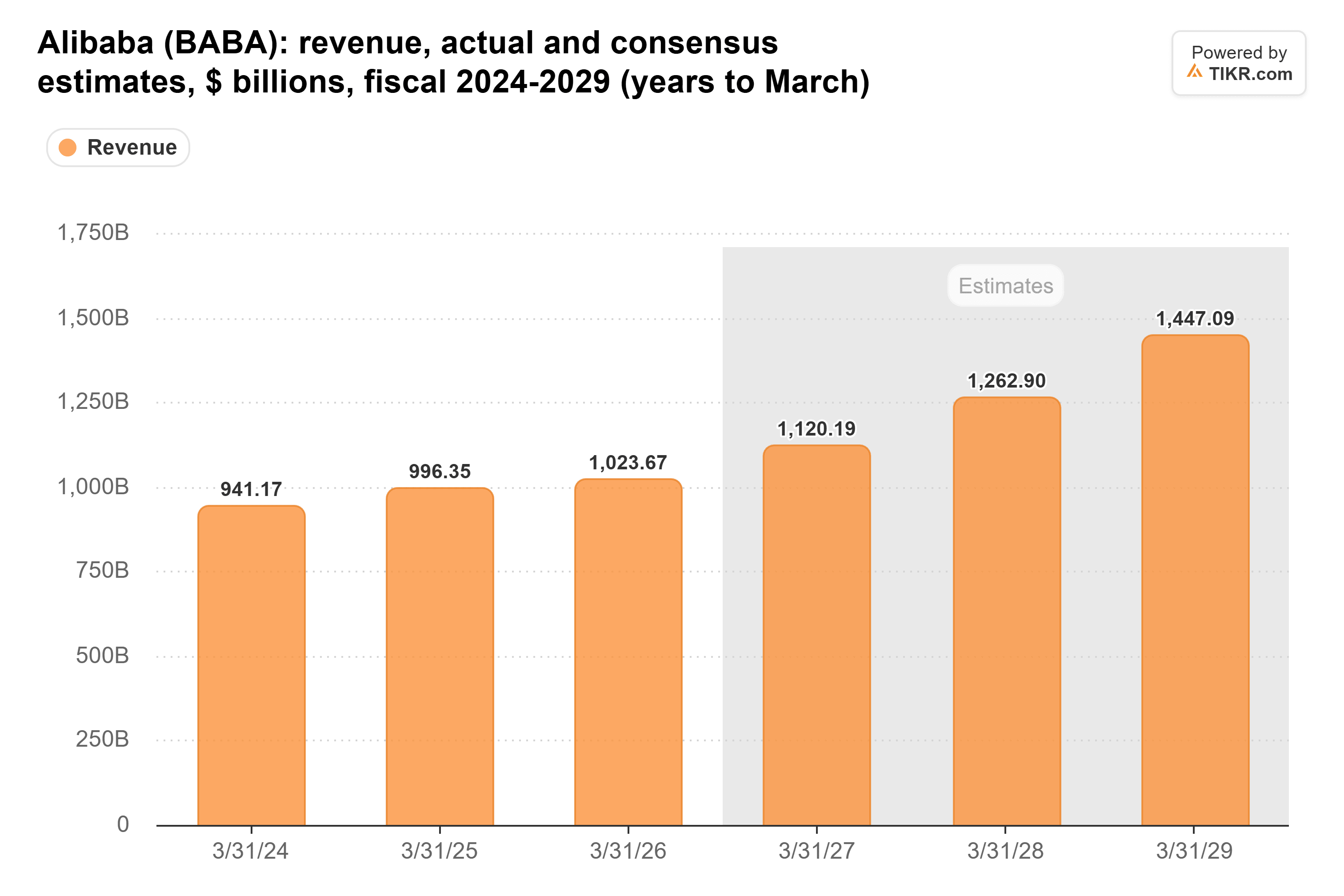
Those estimates were set before the Nov. 19 call, where management said cloud revenue growth could come in at 30% to 45% next year as it works through the rule. They also lean mostly on cloud: like-for-like customer management revenue on Taobao and Tmall grew just 1% in the September quarter.
The bill shows up in free cash flow
In the September quarter, capex was RMB 50.5 billion, up 60% from a year earlier, against RMB 15.7 billion of cash from operations. That left a RMB 34.5 billion free cash flow outflow, wider than RMB 21.8 billion a year earlier. The chart shows capex running ahead of operating cash flow in most quarters since mid-2025:
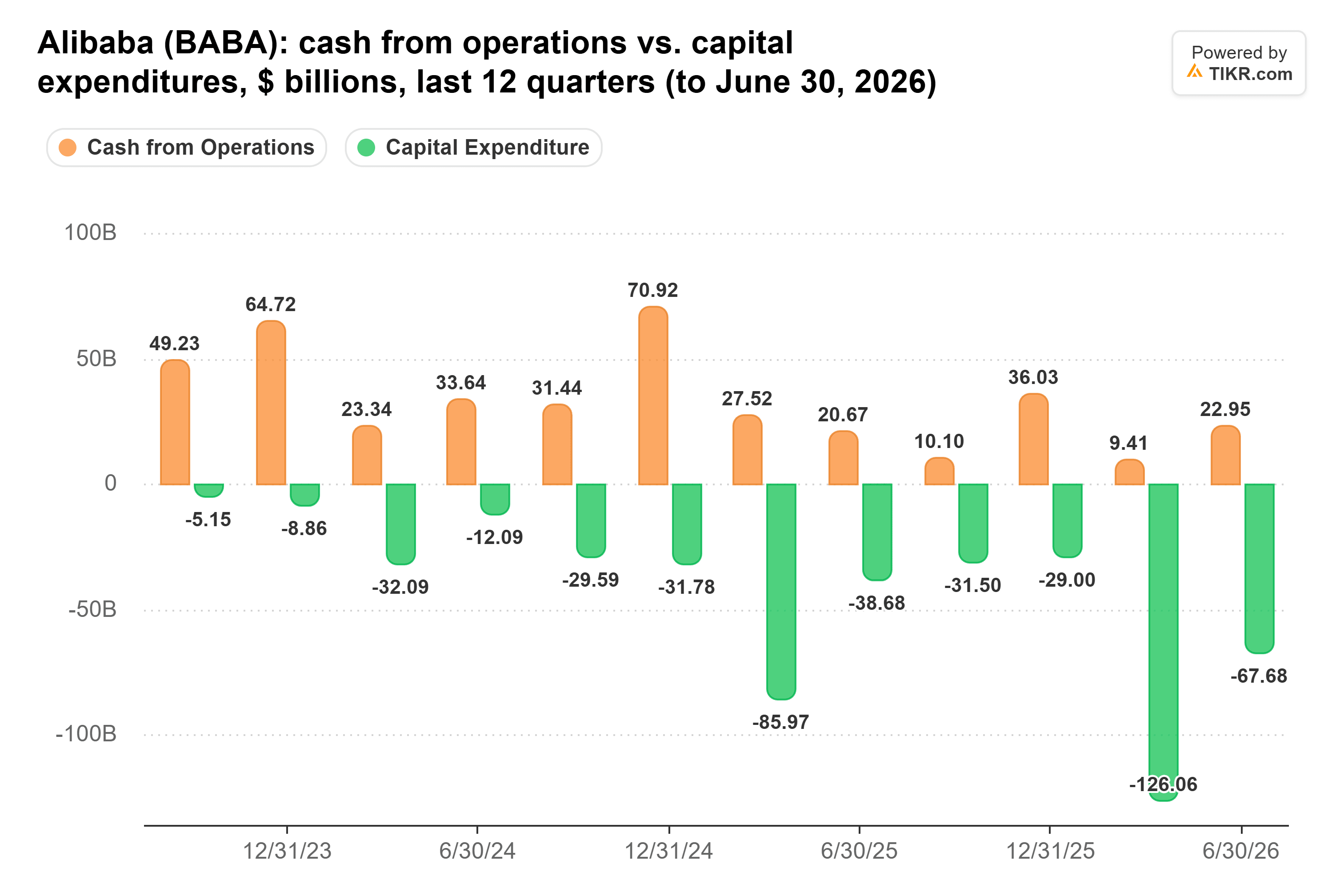
Analysts expect RMB 198.4 billion of capex for the full fiscal year. After RMB 118.2 billion in the first half, that implies roughly RMB 40 billion a quarter from here. The bigger number is the RMB 380 billion three-year plan, of which Alibaba had spent RMB 190 billion by June 30, and the Nov. 19 call put its size in question: management said its long-term 20-gigawatt compute target may be revised down because of the new rules. In May, management said a new server cost twice what it had a year earlier, so any capacity Alibaba now has to find elsewhere will likely cost more again.
JD.com shows the other drain can shrink: it swung to a GAAP operating profit of RMB 5.2 billion in its September quarter, up from a RMB 1.1 billion loss a year earlier, led by food delivery. Alibaba showed the same turn on Nov. 19, when its e-commerce group’s adjusted EBITA rose 243%, mainly on a significant loss reduction in quick commerce. That leaves more operating cash for servers.
NVIDIA’s guide puts more weight on T-Head
NVIDIA’s outlook for the January quarter assumes no data-center compute revenue from China. That leaves Alibaba relying on its own T-Head chips and on the export-compliant NVIDIA cards that Reuters reported in October it had ordered. IDC puts T-Head at 7% of China’s data-center AI accelerator market in the first half of 2026, but management has said T-Head’s chips still trail foreign rivals on performance. On Nov. 19, Alibaba said T-Head’s new Zhenwu V900 is scheduled for commercial release in the first quarter of 2027, and management expects most of its added AI chip capacity after 2027 to come from its own chips.
At 11x, a lot of pain is priced in
Alibaba trades at 11x forward earnings, below its five-year average of 13x and far from the 25x it reached in January.
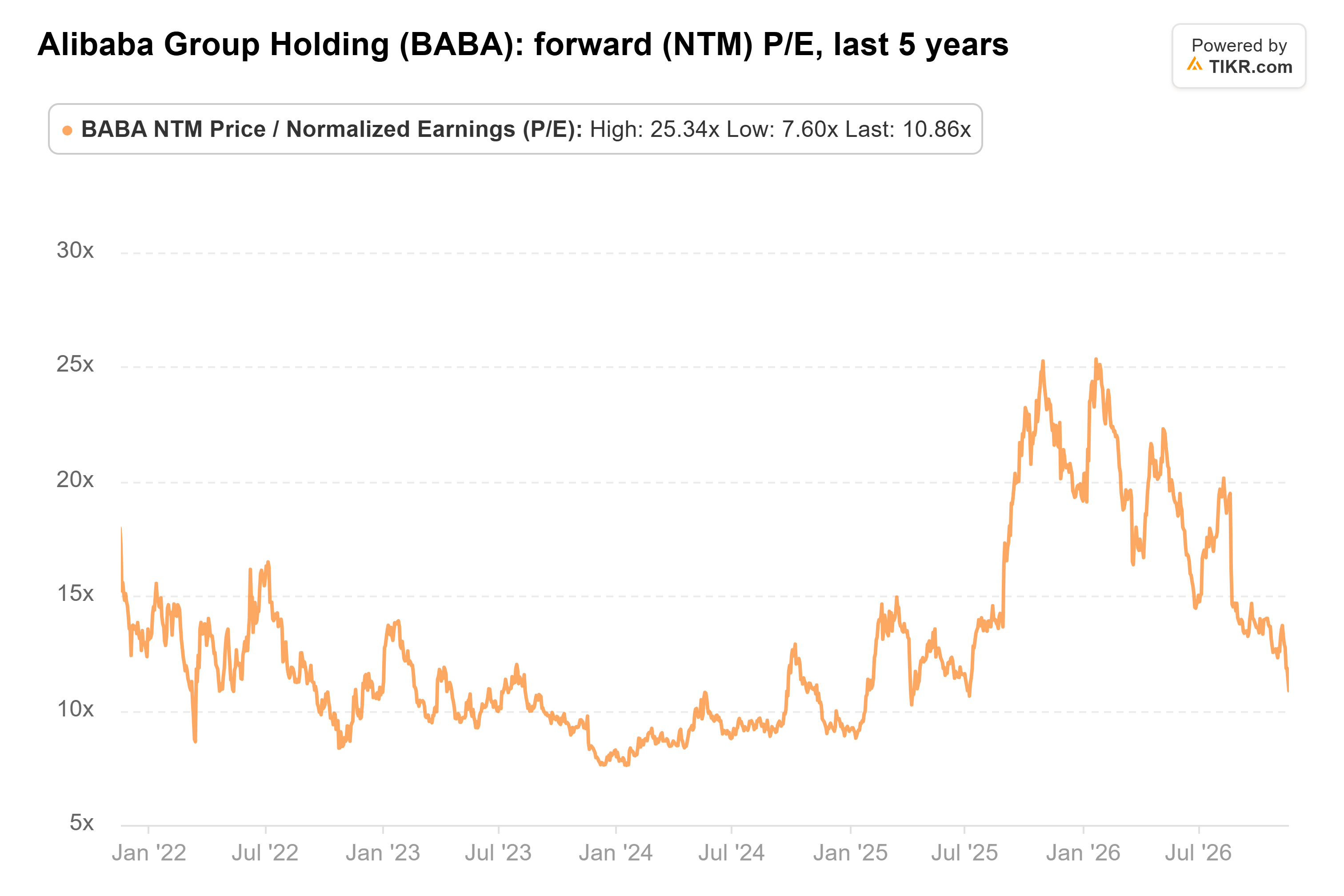
With about US$30.7 billion of net cash on June 30, before it raised roughly US $10.2 billion in an August share sale, Alibaba can afford the cutoff’s cost. CFO Toby Xu said in the results release that Alibaba “will maintain disciplined investments in AI capabilities” as AI monetization ramps up, while targeting positive free cash flow. If cloud growth holds near the top of the 30% to 45% range and the V900 lands on schedule, 11x is too cheap for a cloud business still growing faster than 50%. If growth slides toward 30%, the multiple will likely come down with the estimates.
Watch the cloud margin against 14.5% when Alibaba next reports. Management expects 2027 and 2028 to be the years compute is scarcest in China, which should support pricing if Alibaba can secure supply. The wildcard is still China’s commerce ministry, which has promised countermeasures if the US enforces the rule but hasn’t said what they are.
So what is Alibaba stock actually worth?
TIKR lets you forecast the future price of any stock in less than a minute. Just enter a few assumptions into TIKR’s valuation model and see what Alibaba could be worth. Start from Wall Street consensus estimates, or adjust the inputs to reflect your own view of the business. It’s free to use.
Disclaimer:
Please note that the articles on TIKR are not intended to serve as investment or financial advice from TIKR or our content team, nor are they recommendations to buy or sell any stocks. We create our content based on TIKR Terminal’s investment data and analysts’ estimates. Our analysis might not include recent company news or important updates. TIKR has no position in any of the stocks mentioned. Thank you for reading, and happy investing!