
Key Takeaways
- Boeing just hit a fresh 52-week low, 37% below its January high, because its 737 production ramp keeps slipping and its cash targets keep moving to later years.
- A 5% cut to its jet workforce and lower October deliveries show the slower ramp is real, and it also matters for engine maker GE Aerospace and for Southwest Airlines, which flies only 737s.
- The record $745 billion backlog shows demand is fine, and analysts have already cut their free cash flow estimates most of the way to management’s plan.
- The selling looks overdone for investors who can wait, and the next test is Boeing’s 2027 delivery plan, due with fourth-quarter results in late January.
Boeing (BA) closed at a fresh 52-week low, 37% below its late-January high.
Most of the drop is about one problem Boeing still hasn’t fixed: the 737 is coming off the line more slowly than planned, and with each delay, its cash arrives a year later. That matters to GE Aerospace (GE), which makes the engines on every 737 MAX with Safran, and to Southwest Airlines (LUV), which flies only 737s.
The 737 keeps slipping, and the cash slips with it
Boeing confirmed the delay with its third-quarter report on Oct. 27. Its adjusted loss of $0.34 a share was wider than the $0.20 analysts expected, and Commercial Airplanes posted a -6.5% operating margin. On the call, CEO Kelly Ortberg said the 737 won’t be fully stable at 47 a month until next year, Boeing pushed 52 a month into the back half of 2027, and 737 deliveries will fall short of 500 this year.
Investors liked the cash plan even less. Management sees roughly $2 billion of free cash flow in 2026, rising to $3 billion next year, $6 billion in 2028 and $10 billion by 2029. Before the call, analysts were at about $5.5 billion for 2027 and $9.8 billion for 2028. They’ve since cut most of the way to management’s numbers:
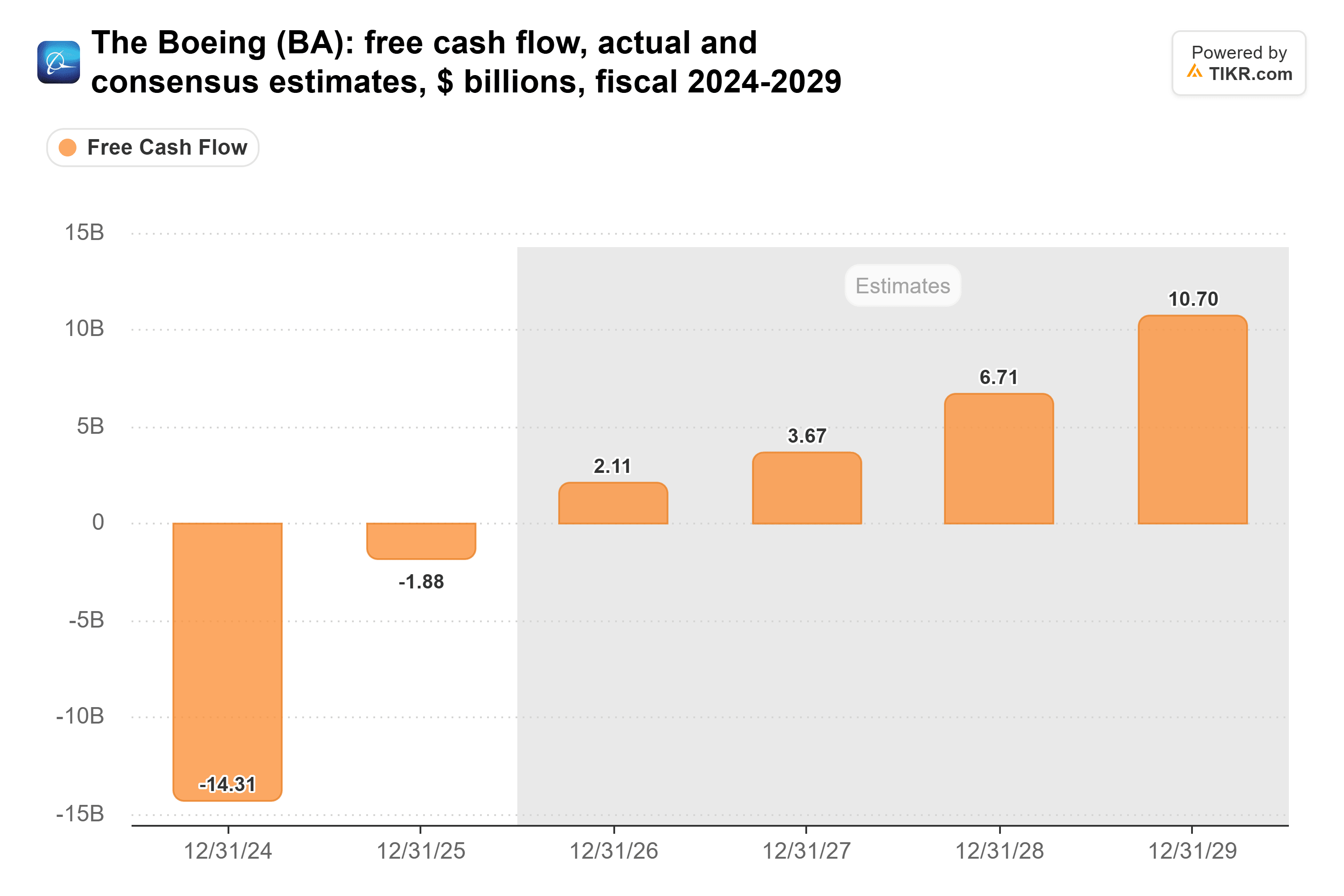
At $3.67 billion, the 2027 estimate is still above Boeing’s $3 billion, so it could fall further.
TIKR tracks 27 analysts on Boeing. How many say “Buy”?
See the full breakdown of Buy, Hold, and Sell ratings on Boeing, along with Wall Street’s revenue and earnings estimates, all in one place. More than 500,000 investors use TIKR to research stocks like this one. See Boeing’s Analyst Ratings
Boeing is cutting jobs over the slower ramp
On Nov. 9, Boeing said it would cut about 5% of its Commercial Airplanes workforce, roughly 2,500 jobs. Commercial Airplanes CEO Stephanie Pope wrote in a memo to employees that adjusting production schedules and reducing output “puts us in an overstaffed position.” The next day, Boeing reported 49 deliveries for October, down from 57 in September and 53 a year earlier.
Boeing’s partners feel it, too. GE Aerospace raised its 2026 guidance on Oct. 20, before Boeing’s call, with LEAP deliveries up 26% in the first nine months. But GE also sells to Airbus: this year it announced its largest LEAP agreement ever, for more than 1,000 LEAP-1A engines with IndiGo. GE’s January report should show how many 737 engines its 2027 plan counts on.
Southwest expects 67 737s this year, took 20 in the third quarter, and trimmed its 2026 capacity growth to about 1.2% from about 1.5%. With Boeing short of 500 737s this year, I’d watch whether Southwest gets all 67.
Patient buyers get a better price
Demand isn’t Boeing’s problem. Its backlog hit a record $745 billion at Sept. 30, the FAA certified the 737-10 in October, and lessor Avolon finalized an order for 140 of them on Nov. 4.
Investors have priced in a lot of the slower ramp. Boeing trades at 1.2x forward sales, below its five-year average of 1.5x and well under the 2.0x it hit in January:
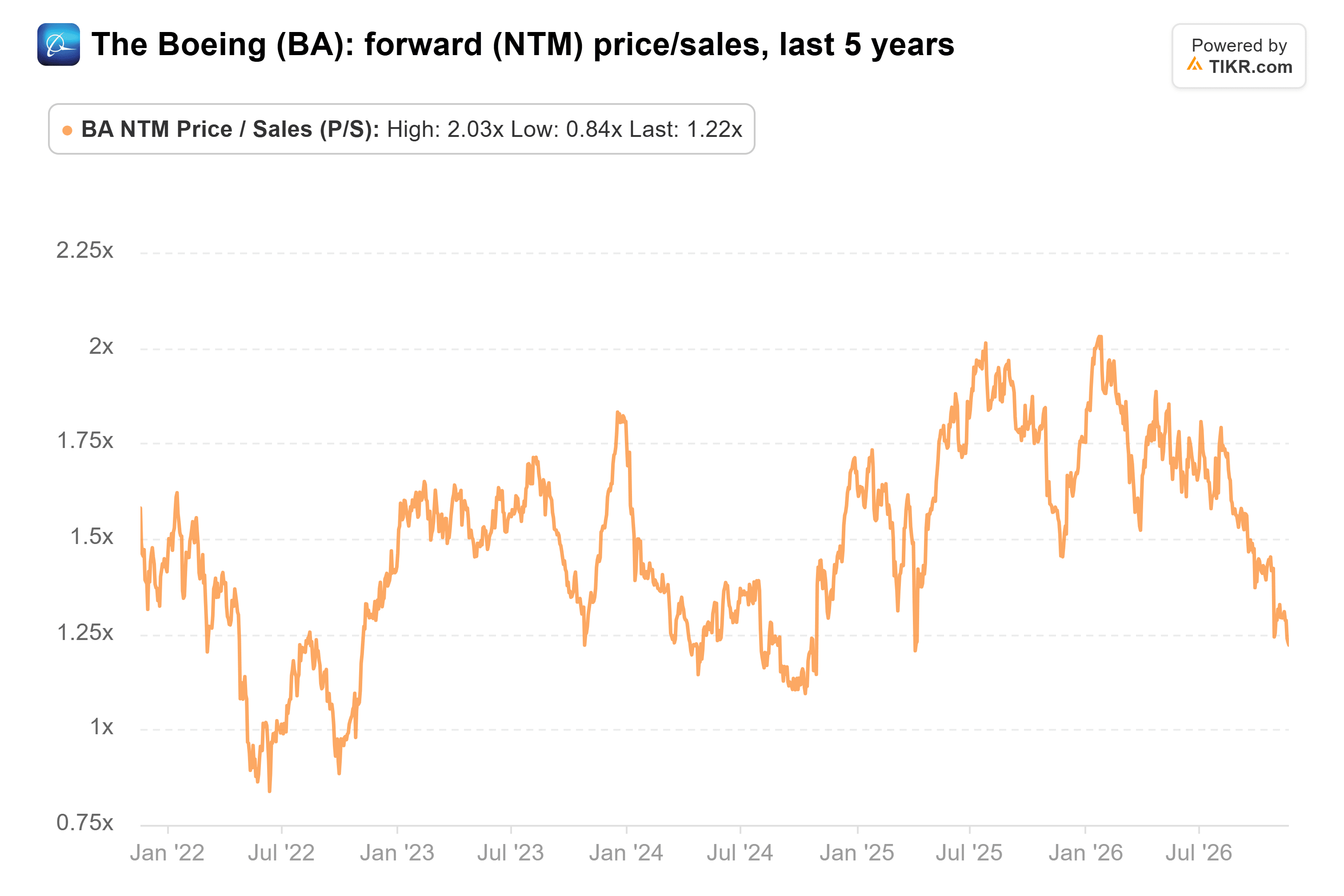
Its $127.2 billion market value at the last close is about 13x Boeing’s 2029 free cash flow target. Debt is the catch: $45.9 billion at Sept. 30 against $20.7 billion of cash and investments, and up to 40.22 million new shares arrive in October 2027, when its preferred stock converts.
With estimates cut and the stock at a new low, I think the selling has gone far enough for investors who can wait. Fourth-quarter results in late January bring Boeing’s 2027 delivery plan by program. If that plan keeps the 737 on track for 52 a month in the second half of 2027, Boeing’s $3 billion cash target for 2027 looks safe. If 737 output slips again, expect that target to move too.
So what is Boeing stock actually worth?
TIKR lets you forecast the future price of any stock in less than a minute. Just enter a few assumptions into TIKR’s valuation model and see what Boeing could be worth. Start from Wall Street consensus estimates, or adjust the inputs to reflect your own view of the business. It’s free to use.
Disclaimer:
Please note that the articles on TIKR are not intended to serve as investment or financial advice from TIKR or our content team, nor are they recommendations to buy or sell any stocks. We create our content based on TIKR Terminal’s investment data and analysts’ estimates. Our analysis might not include recent company news or important updates. TIKR has no position in any of the stocks mentioned. Thank you for reading, and happy investing!