
Key Takeaways
- Reflection AI CEO Misha Laskin warned that Chinese labs selling open models abroad will start selling their own chips and data centers along with them.
- NVIDIA already leaves China out of its outlook, so the new risk is to its sales outside the US and China, about a fifth of its fiscal 2026 revenue.
- NVIDIA can’t make enough chips to meet demand through fiscal 2028, so cheaper Chinese compute is more likely to hurt its later growth and its pricing.
- At 17x forward earnings, the lowest in five years, the stock already prices in a sharp slowdown after fiscal 2028, which makes the drop look like an opportunity.
China’s AI labs keep giving away some of the best models in the world, and one AI CEO says the real business is what gets sold alongside them. That’s a problem for NVIDIA (NVDA), whose stock is already down 11% in the past month.
Misha Laskin, co-founder and CEO of Reflection AI, a startup building American open models to compete with China’s, called open models “Trojan horses for the infrastructure that they bring” on the latest episode of Prof G Markets.
The model is only the engine, he said: “You need the car around it. And what’s the car? Well, it’s the chips, right?”
And Laskin expects China to sell the car abroad: “when Chinese companies go and sell open models into the Middle East or other Asian countries or Brazil or what have you, they will now also start selling chips and their data centers.”
He was making a national security point, warning that allied nations “will start getting locked into Chinese infrastructure.” For NVIDIA shareholders, it’s a sales problem too.
TIKR tracks 62 analysts on Nvidia. How many say “Buy”?
See the full breakdown of Buy, Hold, and Sell ratings on Nvidia, along with Wall Street’s revenue and earnings estimates, all in one place. More than 500,000 investors use TIKR to research stocks like this one. See Nvidia’s Analyst Ratings
China is already out of the forecast
NVIDIA has all but written China off. Its revenue from China, Hong Kong included, fell to $19.7 billion in fiscal 2026 (the year ended January 2026) from $25.0 billion. In the July quarter, H200 sales there were less than 1% of its $89 billion of data center revenue. CFO Colette Kress told analysts that “there is no China data center compute revenue in our forward outlook.”
Laskin is talking about everywhere else. Customers based outside the US and China brought in about a fifth of NVIDIA’s fiscal 2026 revenue. That’s the business a free model bundled with chips would go after.
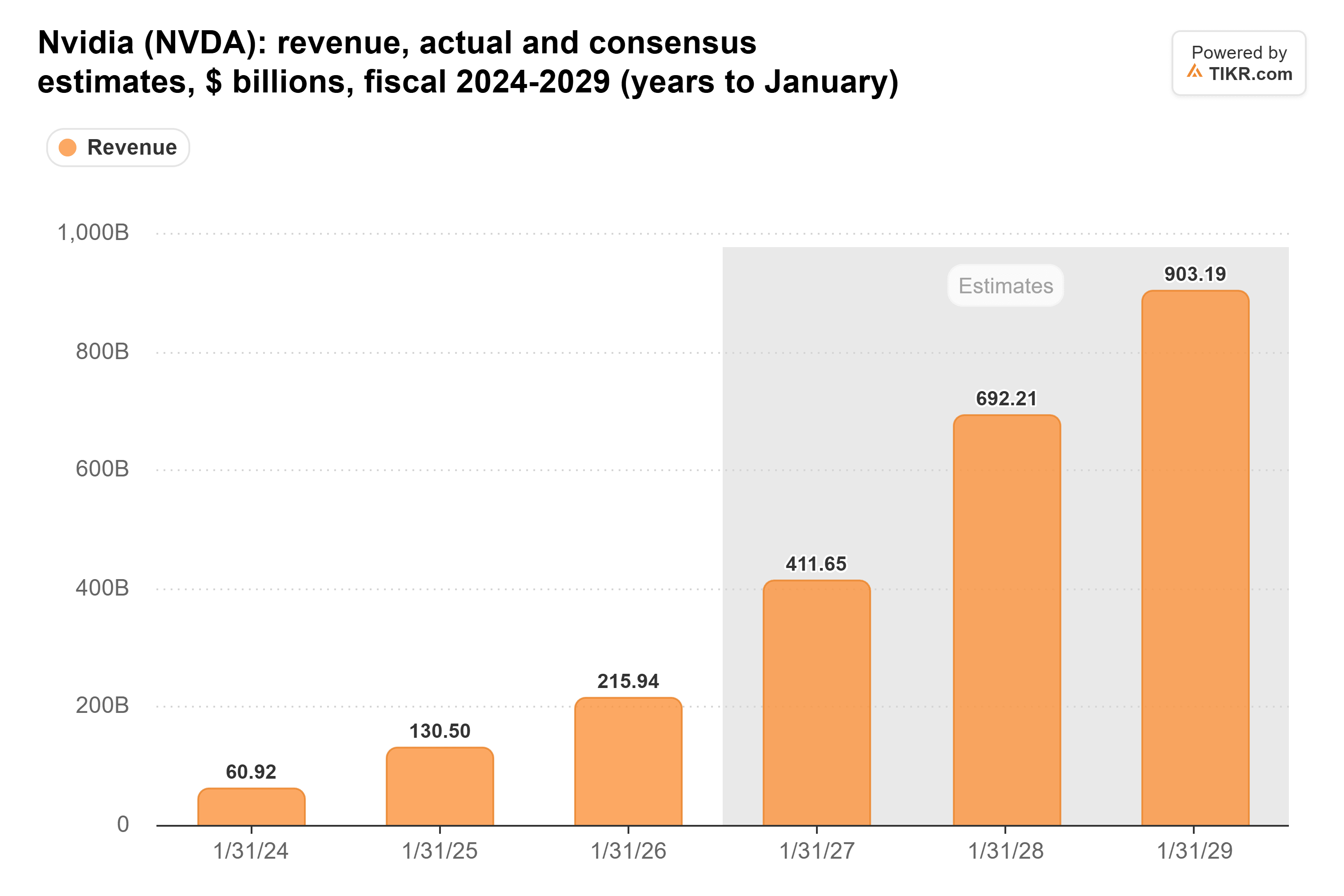
Analysts expect that business, and the rest of NVIDIA’s, to keep growing fast. They see revenue more than quadrupling, from $215.9 billion in fiscal 2026 to $903 billion in fiscal 2029:
Good enough, and cheaper
Chinese models are close behind the best American ones. Ramez Nam ran the numbers and found that Moonshot AI’s Kimi “is now about five weeks behind the U.S. frontier,” Peter Diamandis said on his Moonshots podcast. The newest Kimi model costs a third of what the last one did, and Moonshot plans to release its weights for anyone to run.
Chinese chipmakers are catching up, too. Peter Tchir, head of macro strategy at Academy Securities, said on Bloomberg Surveillance last week that “we’ve been talking a lot at Academy Securities about the potential for cheap Chinese compute to come on the market. And we feel that’s one of the biggest threats.”
Cheap is the word NVIDIA has to worry about. Its gross margin, the clearest sign of its pricing power, rose from 56.9% in fiscal 2023 to 75.0% in fiscal 2025, then eased to 71.1% in fiscal 2026:
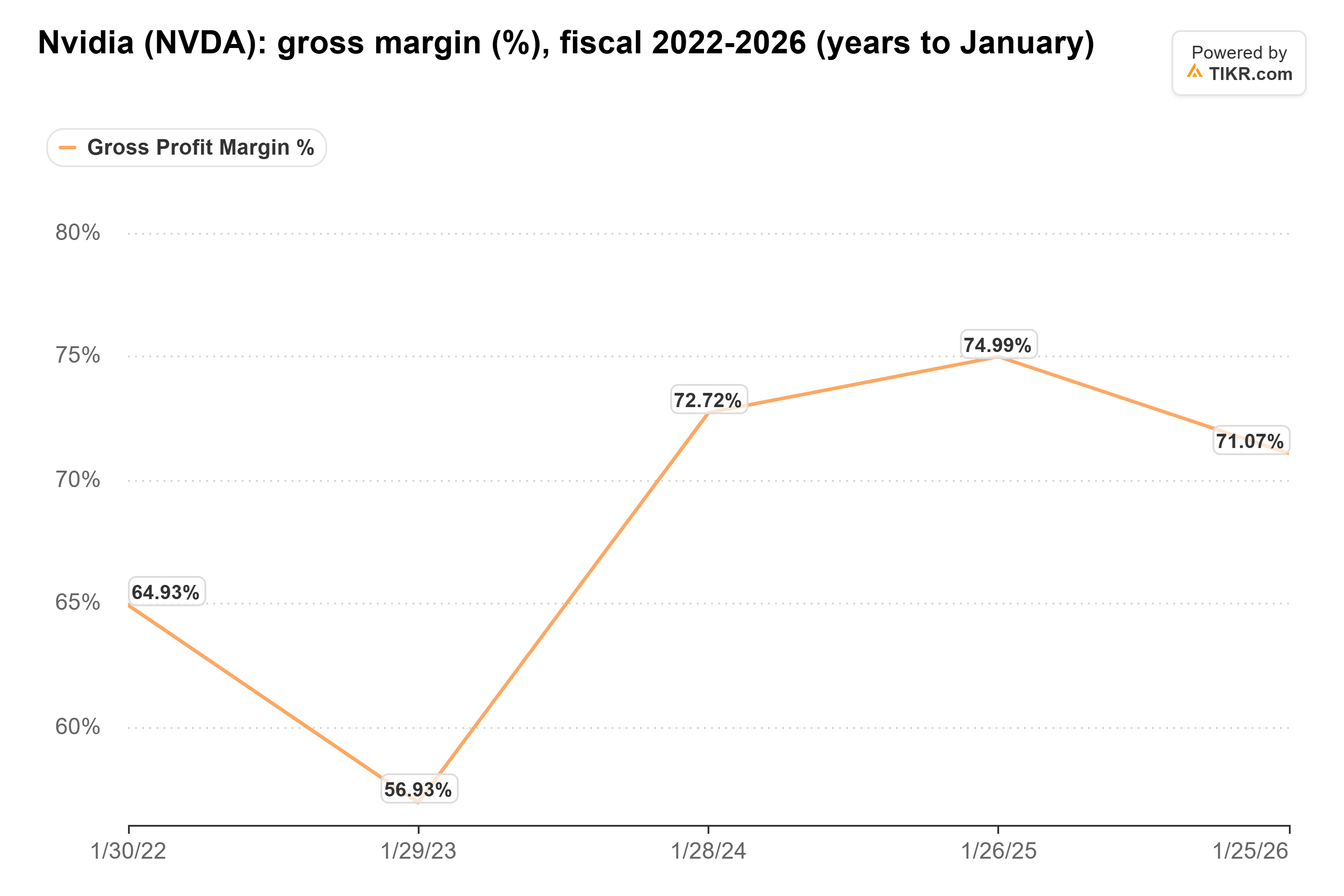
Management expects it to bottom at 71% to 72% in the January 2027 quarter as memory costs climb. That’s before any cheaper Chinese bid turns up in a government’s data center deal.
Sold out through fiscal 2028
NVIDIA has one big cushion: it can’t make enough chips. In August, management told analysts it expects revenue to grow about 70% in fiscal 2028, and said supply is what limits that number. I’d bet a sovereign deal lost in the Gulf today just frees up racks for the next buyer in line.
NVIDIA would feel it later. Analysts already expect revenue growth to slow from 68.2% in fiscal 2028 to 30.5% in fiscal 2029, and by then I’d expect buyers abroad to have more chips to choose from. If Laskin is right about lock-in, any government NVIDIA loses then will be hard to win back.
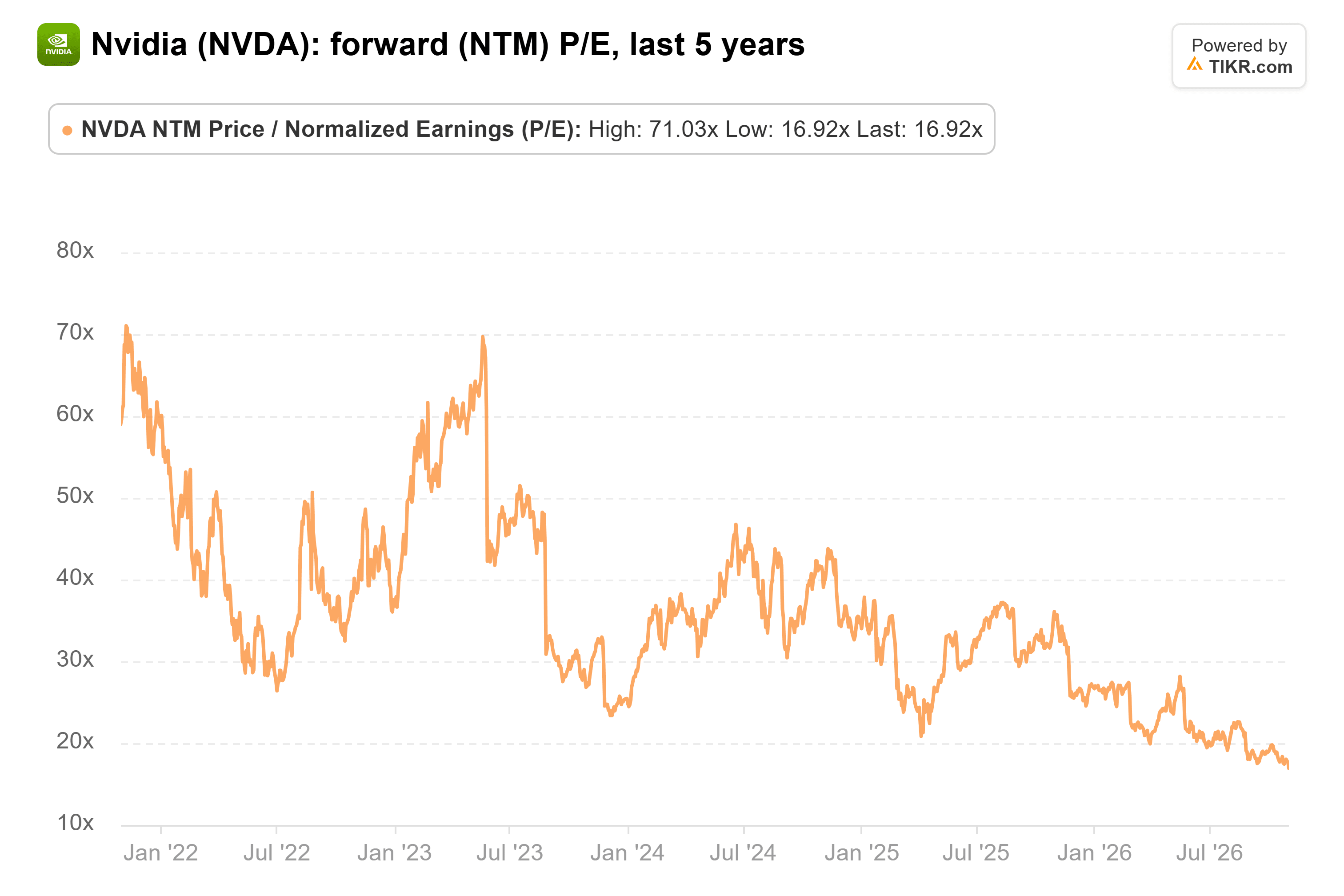
Investors already expect a sharp slowdown. NVIDIA trades at 17x forward earnings, its lowest in five years and less than half its 36x average:
Real, but priced in
Laskin’s playbook makes sense: give away the engine, sell the car. China’s labs already have the models, and Tchir thinks its chipmakers are catching up.
The way I see it, that threatens NVIDIA’s growth after fiscal 2028 and its margins. At 17x forward earnings, investors are already paying very little for those years. So for me, the drop looks like an opportunity.
Of course, Laskin is describing what he expects Chinese labs to do. What would change my mind is a Chinese lab winning a government deal abroad with its own chips in the package. NVIDIA reports on Nov. 17, and its outlook for the January quarter, margin included, is the next thing to watch.
So what is NVIDIA stock actually worth?
TIKR lets you forecast the future price of any stock in less than a minute. Just enter a few assumptions into TIKR’s valuation model and see what NVIDIA could be worth. Start from Wall Street consensus estimates, or adjust the inputs to reflect your own view of the business. It’s free to use.
Disclaimer:
Please note that the articles on TIKR are not intended to serve as investment or financial advice from TIKR or our content team, nor are they recommendations to buy or sell any stocks. We create our content based on TIKR Terminal’s investment data and analysts’ estimates. Our analysis might not include recent company news or important updates. TIKR has no position in any of the stocks mentioned. Thank you for reading, and happy investing!