Key Takeaways
- Affirm stock rose 14.6% in the week to Nov. 27 after President Trump backed a 10% cap on credit card rates, though a market-wide rally did much of the lifting. Block and PayPal gained about 11%.
- A card cap could push borrowers toward pay-over-time loans, but it’s only a proposal, and Trump’s January call for the same cap came to nothing.
- Interest is now more than half of Affirm’s revenue and its delinquencies are rising, so February’s report on holiday lending matters more for the stock than Washington.
Affirm (AFRM) stock rose 14.6% in the holiday-shortened week to Nov. 27, closing at $61.88. Pay-over-time rivals Block (XYZ) and PayPal (PYPL) gained 11.5% and 11.0%. President Donald Trump gets part of the credit.
In a Fox News interview on Saturday, Nov. 21, Trump said he would work with Democrats, who take control of Congress in January, on a one-year, 10% cap on credit card interest rates: “These credit card companies have made a lot and the credit card fees that they charge, I’m all into it.”
Affirm jumped 8.17% on Monday, Nov. 23, the first session after the interview. But that was the market’s best day since April 2025, after Nvidia reinstated Jensen Huang as CEO, and the Nasdaq 100 rose 6.86%. Over the full week, Affirm beat the index’s 6.78% gain by about 8 points, and that gap is the most the cap talk can claim.
Squeeze the cards, and pay-over-time looks better
Five banking groups, including the American Bankers Association, warned in January that a 10% cap would drive consumers “toward less regulated, more costly alternatives.” To Affirm, that warning reads like a sales pitch.
Block, which owns Afterpay, and PayPal sell the same kind of loan at checkout. Block’s Cash App gross profit rose 27% to $2.07 billion in the third quarter, helped by Cash App Borrow and Afterpay, and its fourth-quarter report early next year will show whether any card spending moves its way. PayPal raised its full-year non-GAAP EPS guidance to about $5.60, from about $5.38, in October.
Still, Trump called for this same one-year cap in January, and nothing came of it. Sen. Josh Hawley and Sen. Bernie Sanders introduced a bill for a five-year, 10% cap in February 2025, and it has not passed, though Hawley backed Trump’s latest remarks.
TIKR tracks 35 analysts on Affirm. How many say “Buy”?
See the full breakdown of Buy, Hold, and Sell ratings on Affirm, along with Wall Street’s revenue and earnings estimates, all in one place. More than 500,000 investors use TIKR to research stocks like this one. See Affirm’s Analyst Ratings
Affirm’s own loans still have to hold up
Affirm’s interest income grew 45% to $658 million in its fiscal first quarter (the September quarter), more than half of its $1.26 billion in revenue. That ties the stock to credit, and credit slipped. The share of monthly installment loans at least 30 days late climbed to 2.9%, from 2.5% in June, and the provision for credit losses jumped 59%.
Even after this week, the stock is down 14.9% from its Oct. 27 close and about 32% below the $90.44 intraday high it hit on Aug. 28.
Analysts expect normalized EPS to climb from $3.80 in fiscal 2027 (the year to June) to $6.00 in fiscal 2029:
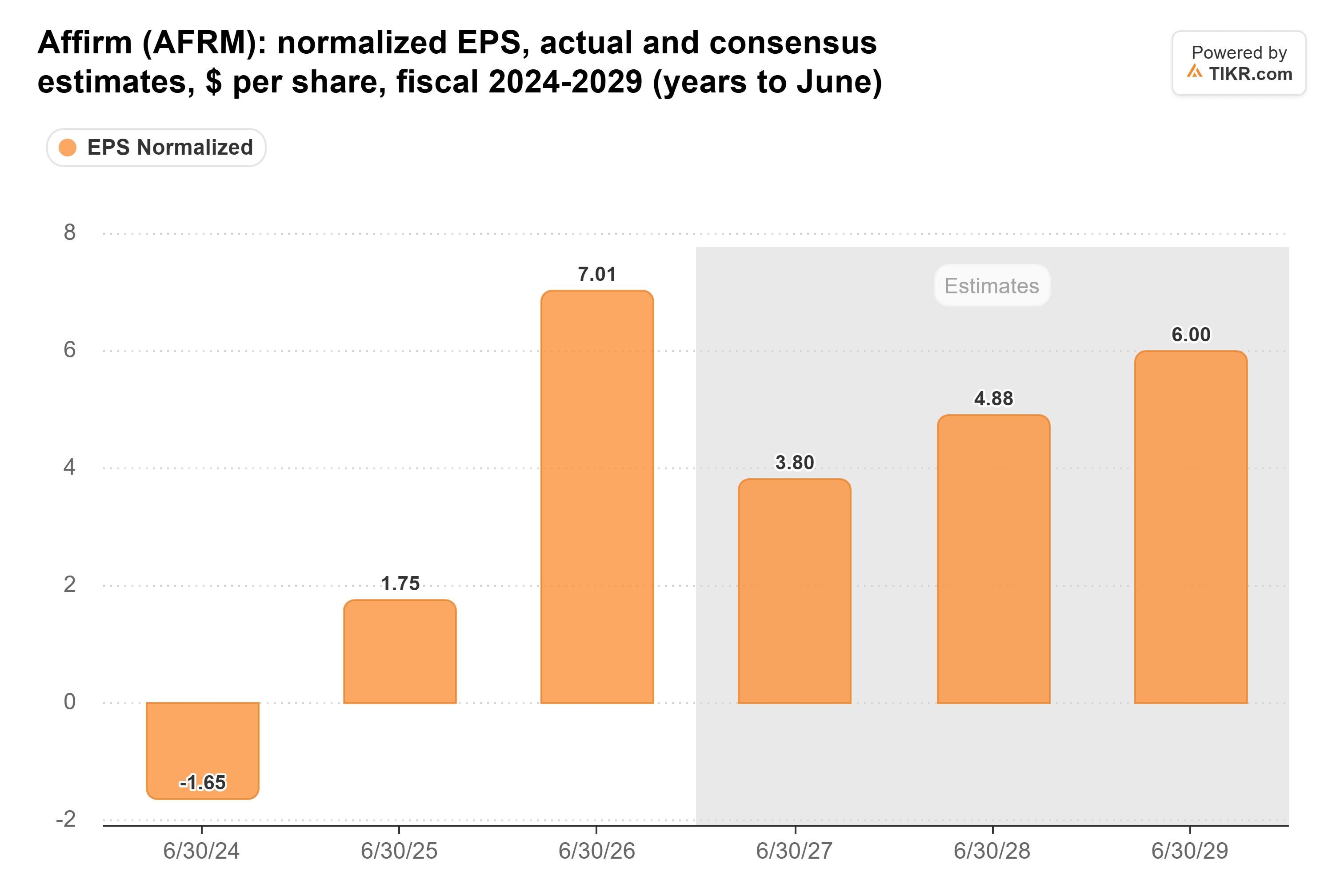
(A one-time, non-cash tax benefit lifts the fiscal 2026 bar.)
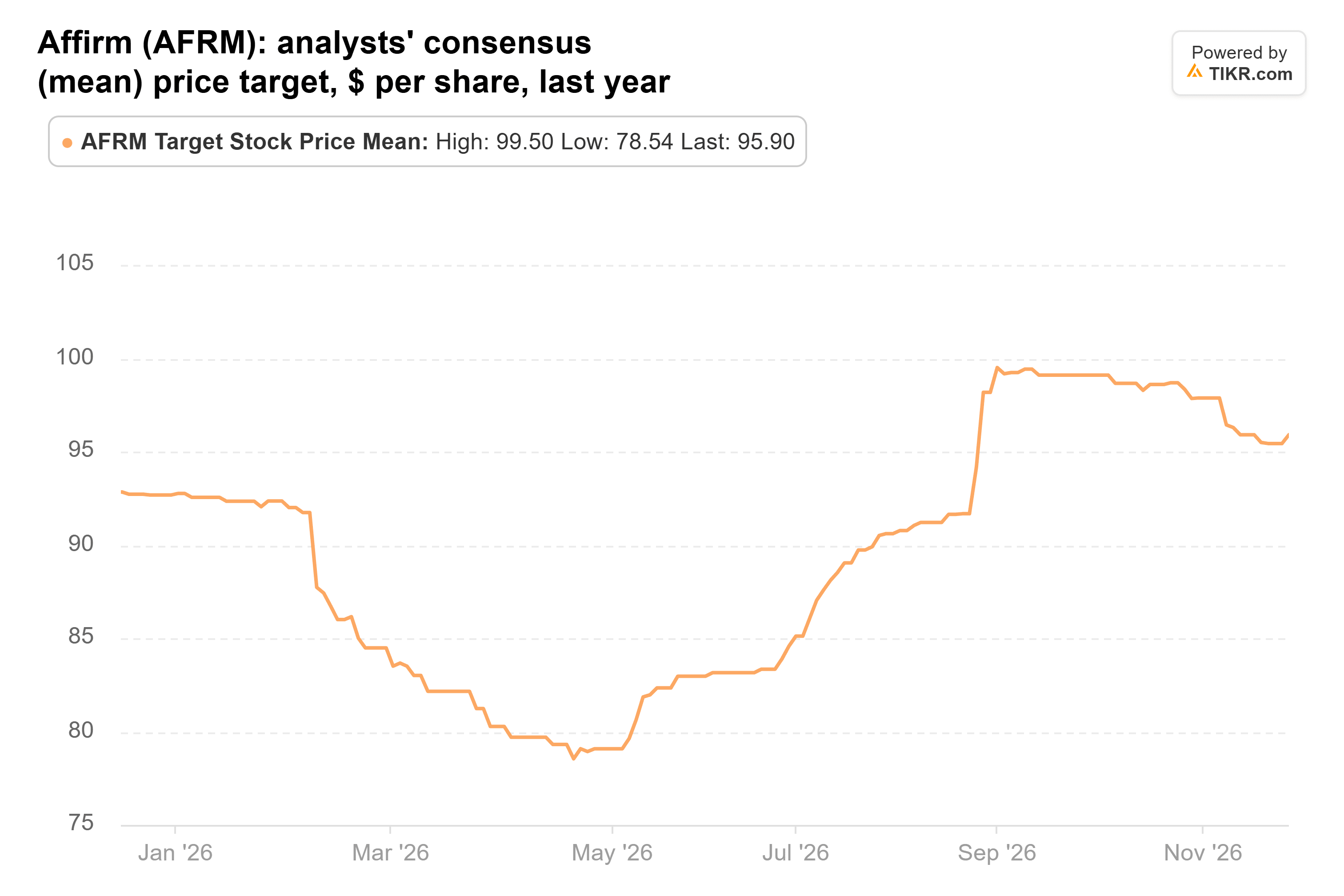
At about 15x forward earnings, the stock trades well below the roughly 28x it has averaged since that multiple turned positive in September 2024. Analysts’ average target, about $96, sits roughly 55% above the last close, though it has slipped from a $99.50 high after the August earnings report:
CFO Rob O’Hare speaks at UBS’s Global Technology and AI Conference on Dec. 1, but the real test is the fiscal second-quarter report, expected in early February. A 30-day delinquency rate at or below 2.9% would say holiday lending held up. Washington gave Affirm a strong week, but a clean holiday quarter would do more for the stock than any cap.
So what is Affirm stock actually worth?
TIKR lets you forecast the future price of any stock in less than a minute. Just enter a few assumptions into TIKR’s valuation model and see what Affirm could be worth. Start from Wall Street consensus estimates, or adjust the inputs to reflect your own view of the business. It’s free to use.
Disclaimer:
Please note that the articles on TIKR are not intended to serve as investment or financial advice from TIKR or our content team, nor are they recommendations to buy or sell any stocks. We create our content based on TIKR Terminal’s investment data and analysts’ estimates. Our analysis might not include recent company news or important updates. TIKR has no position in any of the stocks mentioned. Thank you for reading, and happy investing!