

Key Takeaways
- A hypothetical $500,000 portfolio split evenly across PepsiCo, Nike and Bristol Myers Squibb pays $20,519.20 a year in dividends, or $1,709.93 a month.
- Bristol Myers Squibb’s and PepsiCo’s dividends look safe, using 55% and 75% of free cash flow over the last 12 months.
- Nike’s dividend is stretched at 115% of free cash flow over the last 12 months, and Nike expects revenue to fall high-single digits in fiscal 2027.
- If Nike halved its dividend, the income would drop to $1,424.44 a month, and to $1,138.94 if it stopped paying.
If you’re retired and living off dividends, a 4% yield from three household names sounds pretty comfortable. PepsiCo (PEP), Nike (NKE) and Bristol Myers Squibb (BMY) all yield more than 4% at their current rates.
So let’s take a hypothetical 72-year-old retiree who splits $500,000 evenly across the three. At Monday’s midday prices, that buys enough whole shares to collect $20,519.20 a year, or $1,709.93 a month. That’s a 4.10% yield on the $500,000, with $149.20 of cash left over. Here’s the breakdown:
| Stock | Shares | Cost | Dividends a year | Share of income | Cash dividend payout ratio (TTM) |
|---|---|---|---|---|---|
| PepsiCo (PEP) | 1,167 | $166,530.90 | $6,908.64 | 34% | 75% |
| Nike (NKE) | 4,347 | $166,660.42 | $6,851.92 | 33% | 115% |
| Bristol Myers Squibb (BMY) | 2,661 | $166,659.48 | $6,758.64 | 33% | 55% |
Source: TIKR, prices at 12:45 PM EST on Nov. 9, 2026; current dividend rates from StockAnalysis.
6 safe dividend stocks paying retirees 6%+ yields
There are over 100 stocks paying 6%+ annual dividends today.
But after an extensive investment review leveraging TIKR’s proprietary data, we now believe only six of them are truly safe for retirees.
They’re all yours for free as part of our new investment report, which you can access right here.
PepsiCo’s dividend is covered again
PepsiCo pays $5.92 a share a year, and StockAnalysis counts 54 straight years of raises. Its dividend grew 6.9% a year from fiscal 2020 to fiscal 2025 ($4.02 to $5.62 a share). Over the 12 months to Sept. 16, 2026, the dividend used a comfortable 75% of free cash flow. That’s a big improvement on fiscal 2025, when PepsiCo paid $7.64 billion in dividends against $7.67 billion of free cash flow:
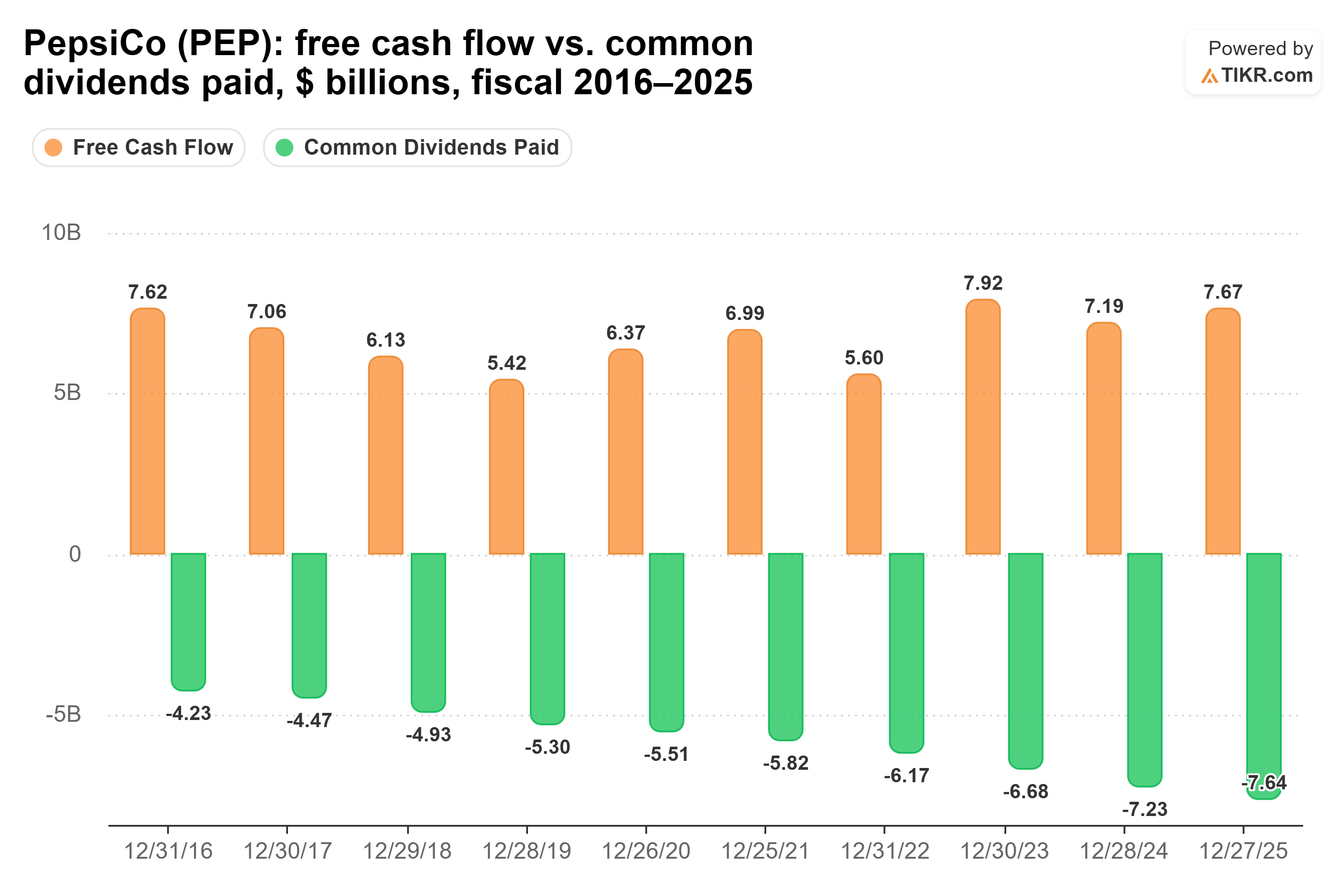
Operating cash flow drove the turnaround. It reached $7.95 billion in the first 36 weeks of fiscal 2026, up from $5.47 billion a year earlier.
Growth is the worry. PepsiCo cut its fiscal 2026 core EPS growth guidance to 2.5%-3.5%, from the low end of 5%-7%, as input costs rise. Then on Oct. 15, KFC said it would move about 3,700 US restaurants to Coca-Cola starting in January 2027.
Nike is paying out more than it brings in
Nike pays $0.41 a share each quarter, or $1.64 a year, and StockAnalysis counts 24 straight years of raises. Its dividend grew 8.8% a year from fiscal 2021 to fiscal 2026 ($1.07 to $1.63 a share). But over the 12 months to Aug. 31, 2026, it paid out a risky 115% of free cash flow. In the year ended May 2026, free cash flow fell to $2.18 billion, from $6.62 billion two years earlier. That left it short of the $2.41 billion Nike paid in dividends:
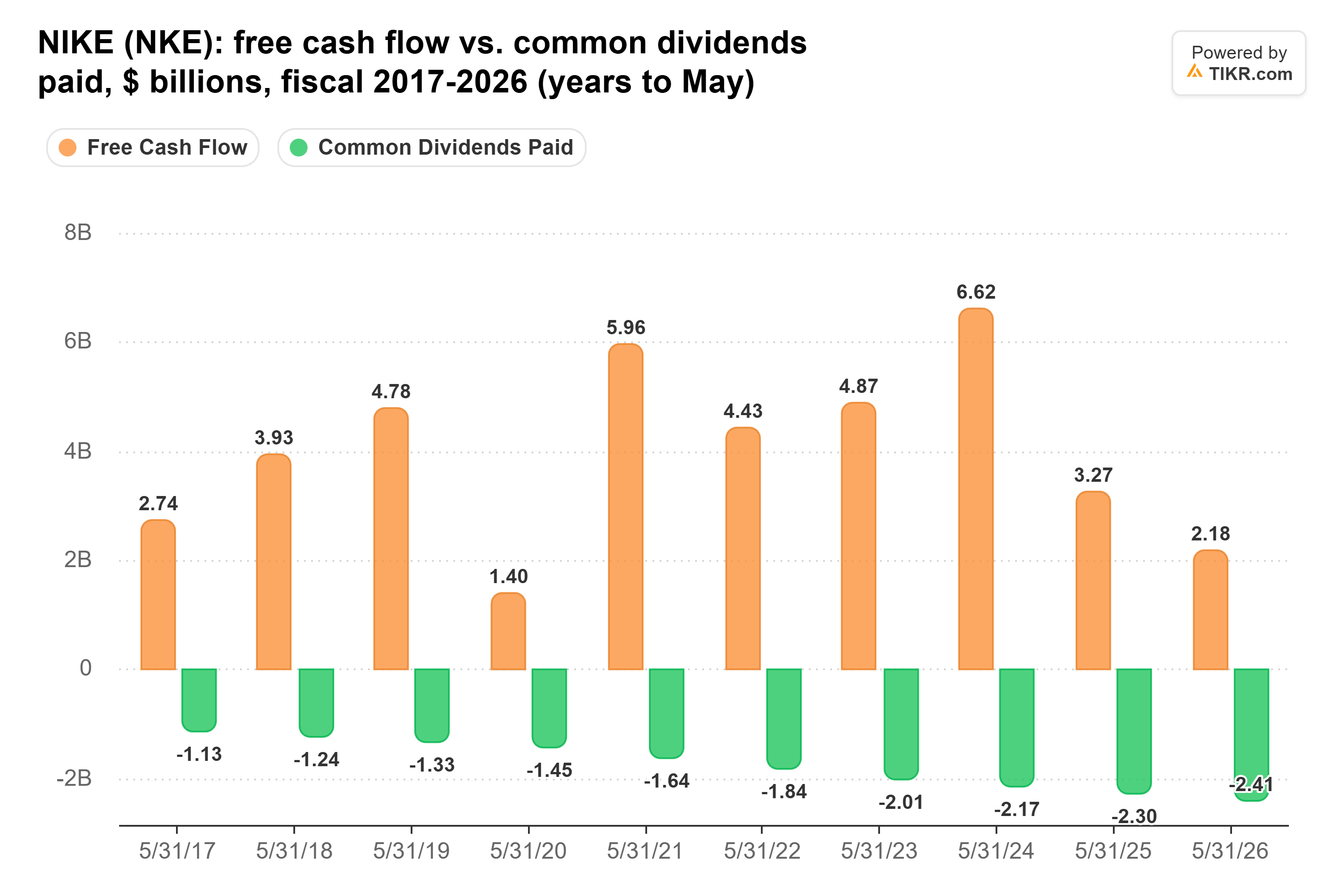
Analysts expect a little relief. Their fiscal 2027 consensus, from 12 analysts, puts the payout ratio at a still-thin 92%, and last year’s consensus landed within 5% of the actual.
The business is still shrinking, though. First-quarter revenue fell 4% from a year earlier to $11.2 billion, and Greater China fell 26%. Nike expects fiscal 2027 revenue to decline high-single digits.
Bristol Myers Squibb has the most room
Bristol Myers Squibb pays $2.52 a share a year, and StockAnalysis counts 19 straight years of raises. Its dividend grew 6.2% a year from fiscal 2020 to fiscal 2025 ($1.84 to $2.49 a share). Over the 12 months to Sept. 30, 2026, it used a well-covered 55% of free cash flow. Free cash flow has also covered the dividend more than twice over in every fiscal year since 2020:
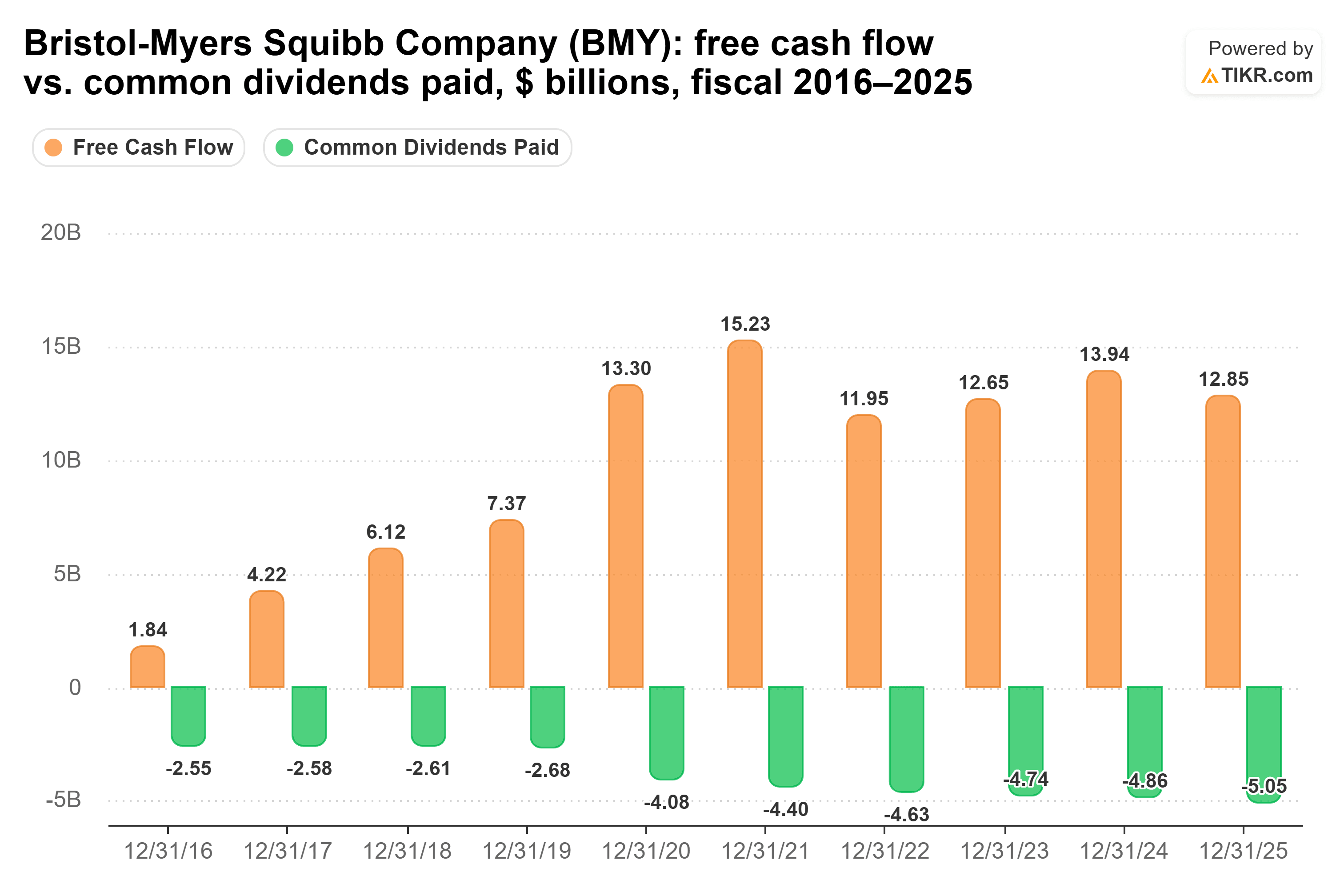
That 55% is up from 39.3% in fiscal 2025, so it’s worth keeping an eye on.
Third-quarter revenue rose 7% from a year earlier to $13.1 billion. Bristol Myers raised its 2026 revenue guidance to $49.75 billion-$50.25 billion. Eliquis is the risk to watch. It grew 26% in the quarter, but its European loss of exclusivity hits this quarter, and management expects a $1.5 billion to $2 billion step-down in Eliquis revenue in 2027.
What happens if Nike cuts?
Nike is the check to watch, since it’s the only one of the three paying out more than its free cash flow. If it halved its dividend, this retiree’s income would fall to $17,093.24 a year, or $1,424.44 a month. If it stopped paying, the income would fall to $13,667.28 a year, or $1,138.94 a month.
CFO David Denton said on the first-quarter call: “Dividend is a very significant priority for us here at NIKE. … And under all scenarios, we have support for maintaining and ultimately growing the dividend over time.” Nike had $8.4 billion of cash and short-term investments at Aug. 31, and its net debt is just 0.46x EBITDA. That’s enough to keep the promise for a while.
Two checks I’d count on, and one I’d watch
Bristol Myers Squibb’s check looks the safest to me. It has the most coverage of the three, and its revenue guidance just went up. PepsiCo’s is safe but slow: it’s covered again, but with earnings growth guided this low, I wouldn’t expect big raises soon. Nike’s is stretched. Its streak and balance sheet buy it time, but this retiree is betting a third of the income on a turnaround.
Nike’s Investor Day on Nov. 16-17 should show whether that changes its plans for cash. And Bristol Myers expects data from its milvexian trial in atrial fibrillation, Eliquis’ market, in the first quarter of 2027.
Forget Bristol Myers Squibb: 6 safe 6%+ dividend yields you can buy right now
Dividends can hold the key to enormous wealth. But only if you buy the right ones.
Picking the right high-yield dividend stock can be the difference between a dream retirement…and scraping by every month, waiting for the next Social Security check to clear.
We’ve identified six stocks yielding 6%+ that we believe every retiree should know about right now. (And Bristol Myers Squibb isn’t one of them.)
Disclaimer:
Please note that the articles on TIKR are not intended to serve as investment or financial advice from TIKR or our content team, nor are they recommendations to buy or sell any stocks. We create our content based on TIKR Terminal’s investment data and analysts’ estimates. Our analysis might not include recent company news or important updates. TIKR has no position in any of the stocks mentioned. Thank you for reading, and happy investing!


