Key Takeaways
- a16z Capital Management, which manages $106.48 billion, added to SpaceX and opened new positions in Braveheart Bio and Freenome in the third quarter, its latest 13F shows.
- SpaceX makes up 92% of the stocks in that 13F, and analysts’ average target sits 86% above its price.
- Braveheart Bio and Freenome are far smaller bets, and both trade well below analysts’ average targets.
- SpaceX is the one the numbers back best, as long as it can fund a buildout analysts expect to burn $150 billion of free cash flow in 2027.
Andreessen Horowitz’s a16z Capital Management filed its 13F for the quarter ended Sept. 30 on Nov. 16, and its three biggest new or added positions were SpaceX (SPCX), Braveheart Bio (BRVE) and Freenome (FRNM). Analysts see a lot of upside in all three, but one of them dwarfs the other two.
SpaceX is almost all of it
a16z held 121.78 million SpaceX shares at Sept. 30, worth $18.37 billion and 63% more shares than it held at June 30. That’s 92.4% of its 13F stocks, which totaled $19.89 billion, so this filing is mostly one big SpaceX bet. There’s plenty in the business to like: revenue from its Super Intelligence segment, home to its AI compute rentals, tripled to $7.56 billion in the third quarter from $2.56 billion in the second, and backlog reached $63.0 billion at Sept. 30. Even so, the stock is down 8% since Sept. 30 and sits 39% below its 52-week high.
TIKR tracks 40 analysts on SpaceX. How many say “Buy”?
See the full breakdown of Buy, Hold, and Sell ratings on SpaceX, along with Wall Street’s revenue and earnings estimates, all in one place. More than 500,000 investors use TIKR to research stocks like this one. See SpaceX’s Analyst Ratings
Analysts keep raising the bar
Since the end of June, analysts have raised their 2027 and 2028 revenue estimates by 146% and 200%, and their average price target has climbed to $257.50 from $63 when SpaceX listed in June:
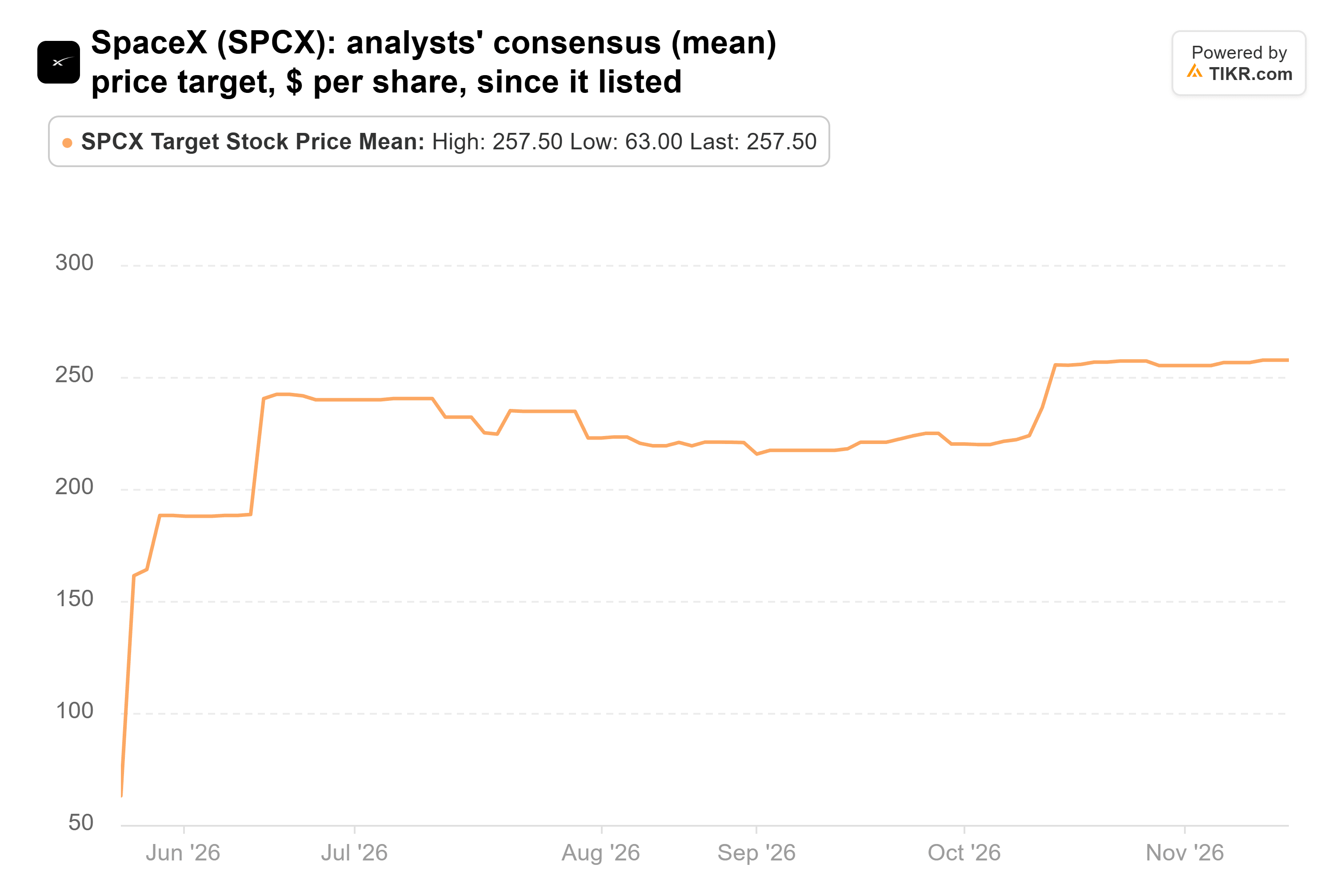
That target is 86% above the last close of $138.43. The stock trades at about 46x forward earnings, with consensus normalized EPS going from a loss of $0.30 this year to $2.50 in 2027 and $5.69 in 2028.
But somebody has to pay for all those data centers. Analysts expect free cash flow of -$57.7 billion this year and -$150 billion in 2027, against $89.9 billion of cash and marketable securities at Sept. 30. And Bloomberg reported that Anthropic supplies about two-thirds of the AI segment’s sales, on a contract either side can leave on 90 days’ notice. Morgan Stanley’s Adam Jonas pins $170 of his $300 target on enterprise AI, so he’s counting heavily on that one renter.
Braveheart Bio is back near its IPO price
Braveheart is new to a16z’s 13F: 10.23 million shares worth $207 million at Sept. 30, 1.0% of its 13F stocks and its No. 3 position. Braveheart and Freenome both listed during the third quarter, so this is the first 13F that could show either one. Braveheart priced an upsized IPO at $18 a share in August, above its $15-$17 range. Its lead drug, BHB-1893 for hypertrophic cardiomyopathy, comes with two Phase 2 datasets from its China partner, Hengrui. Jefferies and Goldman Sachs both initiated coverage with Buy ratings and $48 targets.
Analysts haven’t budged since then, even as the stock has slid to $19.27 from its $29.80 first close. Their average target has gone from $45 at the end of August to $45.50:

That’s 136% above the price, with the five analysts’ targets running from $40 to $49. Braveheart is a clinical-stage company with no revenue, so it’s a bet on trial data. The stock is down 5% since Sept. 30.
Freenome’s big quarter came from one payment
Freenome is the smallest of the three: 5.57 million shares worth $88 million at Sept. 30, or 0.4% of a16z’s 13F stocks. Its third-quarter release looked huge, with revenue of $183.5 million and GAAP net income of $60.1 million. But $180.0 million of that revenue was recognized under its agreement with Exact Sciences after the FDA approved Freenome’s SimpleScreen CRC colorectal cancer blood test in July. Service and other revenue came to just $0.9 million.
The company ended September with $430.0 million of cash, cash equivalents and marketable securities, against a market value of $1.11 billion, and it launched a lung cancer blood test in October. The stock has gone the other way. It’s down 37% since Sept. 30 to $9.93, just below the $10 a share its private placement investors paid when it went public in July. Five analysts’ average target of $18.00 sits 81% above that.
SpaceX is the one I’d follow
If I were following a16z into one of these, it would be SpaceX. Its AI revenue and backlog are growing fast, and analysts have kept raising their estimates and targets even as the stock fell. Braveheart depends on one drug’s trial data, and Freenome’s profitable quarter came from a one-time payment, so neither has the business record to back its target yet.
The risk is that cash gap. If cash flow doesn’t catch up with the spending, SpaceX will have to cover the difference with more debt or new stock. The last of SpaceX’s IPO lock-ups ends Dec. 8, when up to 797.6 million more shares become eligible for sale. After that, fourth-quarter results in early 2027 will show how much cash a $35 billion-$40 billion capex quarter used up. Cash and marketable securities below about $50 billion would be the warning sign.
So what is SpaceX stock actually worth?
TIKR lets you forecast the future price of any stock in less than a minute. Just enter a few assumptions into TIKR’s valuation model and see what SpaceX could be worth. Start from Wall Street consensus estimates, or adjust the inputs to reflect your own view of the business. It’s free to use.
Disclaimer:
Please note that the articles on TIKR are not intended to serve as investment or financial advice from TIKR or our content team, nor are they recommendations to buy or sell any stocks. We create our content based on TIKR Terminal’s investment data and analysts’ estimates. Our analysis might not include recent company news or important updates. TIKR has no position in any of the stocks mentioned. Thank you for reading, and happy investing!