
Key Takeaways
- At the Nov. 20 close, Microsoft traded at about 77x the free cash flow analysts expect for fiscal 2028, and Amazon traded at about 75x.
- Amazon plans to spend about $220 billion on capex this year and more next year, and analysts expect its free cash flow to stay negative until 2028.
- At 30x free cash flow, both would need far more cash than they’ve ever made, and the capex peak that gets them there could slow Arista Networks.
- Microsoft’s contracted backlog makes its bet easier to trust than Amazon’s.
Amazon (AMZN) CEO Andy Jassy has no plans to slow down. Asked on CNBC’s Halftime Report on Nov. 17 about Wall Street’s capex forecasts, he said “we expect to spend around $220 billion this year in CapEx and that we expect to spend meaningfully more next year.”
A lot of that money becomes revenue for suppliers like Arista Networks (ANET).
One investor in r/ValueInvesting argued that Microsoft (MSFT) and Amazon trade at more than 80 times estimated fiscal 2028 free cash flow.
TIKR’s estimates backed that up at the Nov. 18 close. Then two days of tech selling took about 5% off Microsoft and 8% off Amazon. Both now trade below 80x, but still above 70x.
Still More Than 70x
At the Nov. 20 close, Microsoft was worth about $3.60 trillion, or about 77x the $46.8 billion of free cash flow analysts expect in its fiscal 2028. They see free cash flow falling by more than half in fiscal 2027 and then recovering only partway:
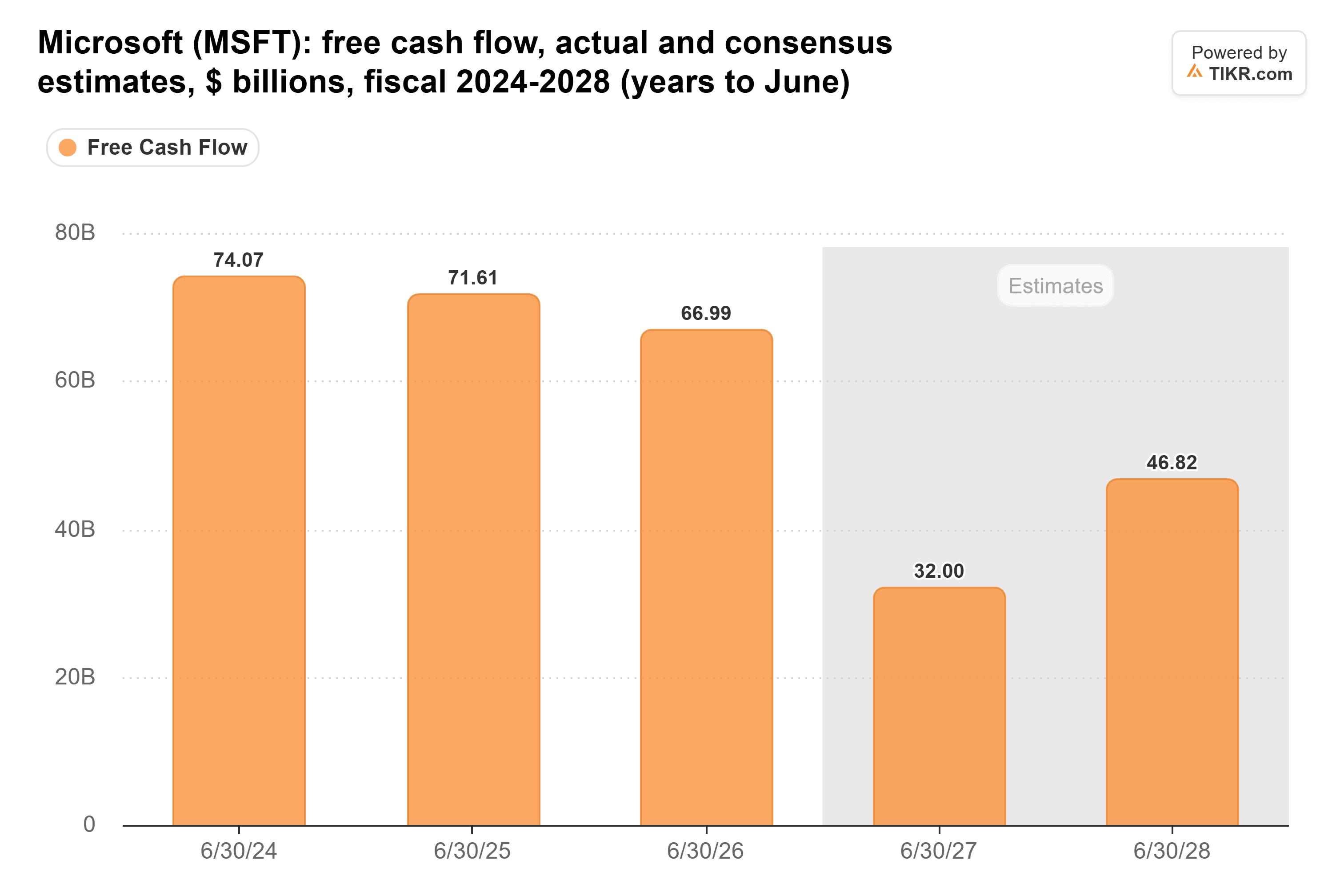
Capex explains the drop. Microsoft’s cash capital spending rose to $115.9 billion in fiscal 2026 from $64.6 billion, and analysts expect $193.7 billion in fiscal 2027.
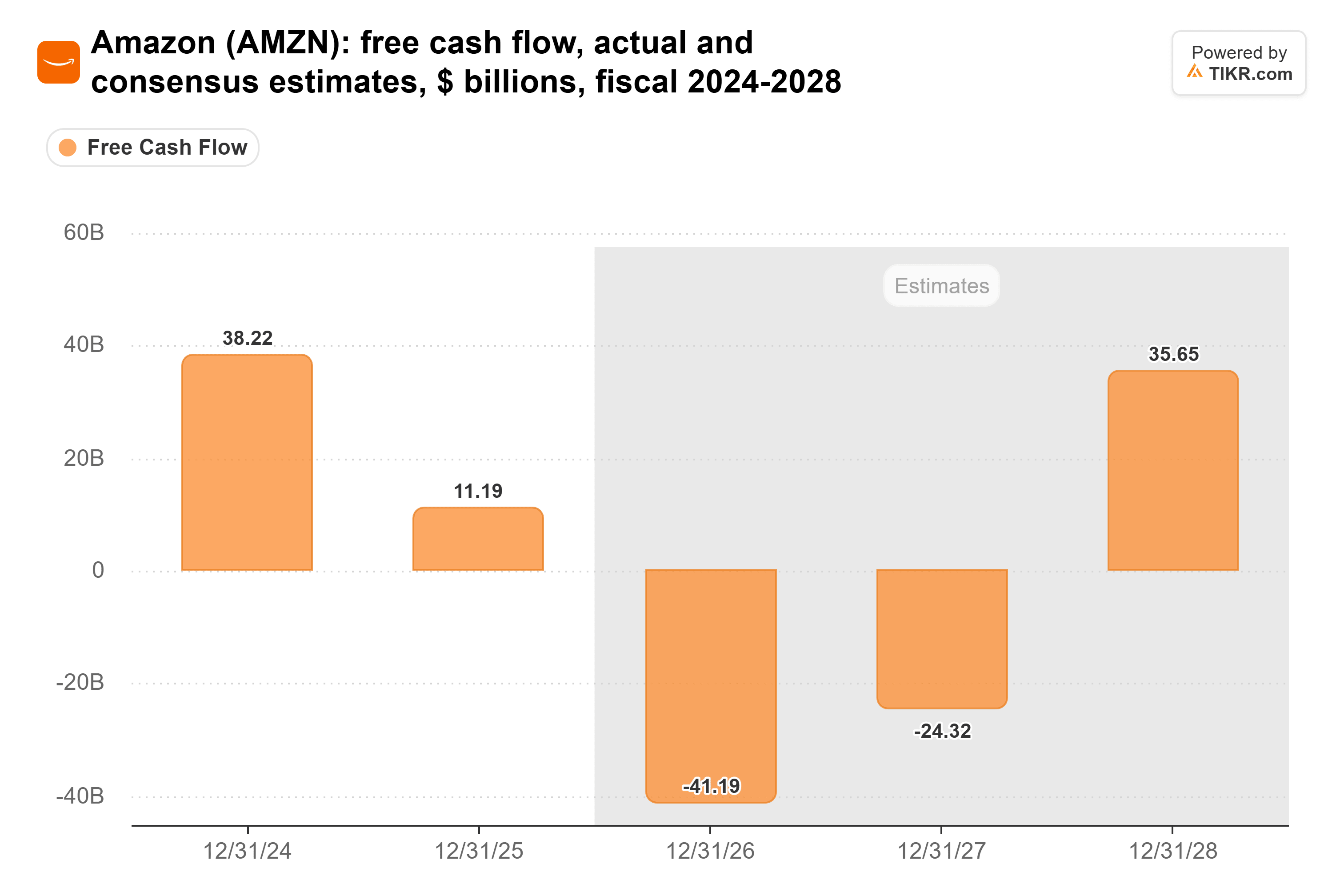
Amazon was worth about $2.67 trillion, or about 75x the $35.7 billion of free cash flow analysts expect in 2028. To get there, it first goes through two years of negative free cash flow:
Its capex rose to $132 billion in 2025 from $52.7 billion in 2023:
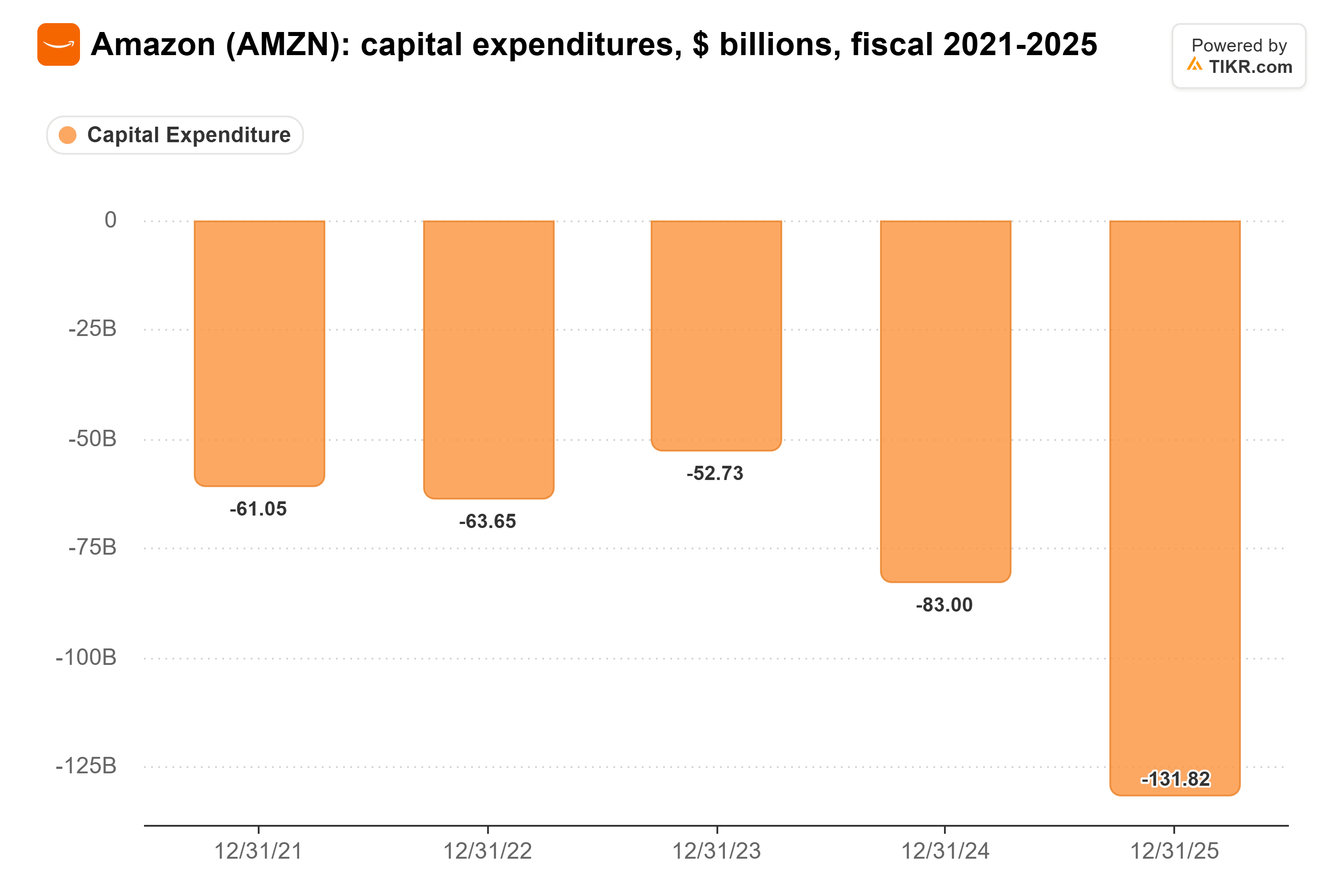
Jassy’s $220 billion for this year is roughly 1.7x that.
TIKR tracks 59 analysts on Microsoft. How many say “Buy”?
See the full breakdown of Buy, Hold, and Sell ratings on Microsoft, along with Wall Street’s revenue and earnings estimates, all in one place. More than 500,000 investors use TIKR to research stocks like this one. See Microsoft’s Analyst Ratings
What the capex has to return
Say you’d pay 30x free cash flow, still a premium price. At Nov. 20 values, Microsoft would need about $120 billion a year, about 1.6x the $74.1 billion it made in fiscal 2024, its best year on the chart. Amazon would need about $89 billion a year, roughly 2.3x its 2024 figure of $38.2 billion. Neither has ever come close.
A 2027 peak has a loser
If capex peaks in 2027, the cash could come back quickly: analysts already expect Microsoft’s free cash flow to rise about 46% from fiscal 2027 to fiscal 2028, and Amazon’s to swing by about $60 billion.
That peak could hit suppliers hard. Arista’s annual report says Microsoft and Meta Platforms bought 42% of its 2025 revenue (26% and 16%). Analysts expect its earnings per share to grow about 38% in 2027 to $6.04. After an 11.6% drop on Nov. 20, the stock trades at about 28x that figure.
Microsoft’s bet is easier to trust
At the end of September, Microsoft had $677 billion of contracted revenue still to be booked, about the same as in June, with a weighted average duration of about 2.3 years. CFO Amy Hood said in January that a lot of the GPUs it’s buying are already contracted for most of their useful life. The risk is that one customer dominates: OpenAI made up about 45% of the backlog at the end of 2025.
Amazon’s backlog is big too, about $578 billion at the end of September. But it stretches over a weighted 6.1 years and includes expanded commitments of $100 billion or more each from OpenAI and Anthropic. That leaves Amazon asking for more faith while analysts expect negative free cash flow through 2027. Jassy said Amazon has “what we consider very strong visibility into the demand.”
Microsoft’s backlog makes its multiple easier to justify, while Amazon still has to show its spending pays off before 75x makes sense. Both companies report again in late January or early February. Microsoft’s report will show whether fiscal 2027 free cash flow is on track for the $32 billion consensus, and Amazon’s should put a number on “meaningfully more.”
So what is Microsoft stock actually worth?
TIKR lets you forecast the future price of any stock in less than a minute. Just enter a few assumptions into TIKR’s valuation model and see what Microsoft could be worth. Start from Wall Street consensus estimates, or adjust the inputs to reflect your own view of the business. It’s free to use.
Disclaimer:
Please note that the articles on TIKR are not intended to serve as investment or financial advice from TIKR or our content team, nor are they recommendations to buy or sell any stocks. We create our content based on TIKR Terminal’s investment data and analysts’ estimates. Our analysis might not include recent company news or important updates. TIKR has no position in any of the stocks mentioned. Thank you for reading, and happy investing!