Key Takeaways
- Of the 460 big funds that have filed 13Fs for the quarter ended Sept. 30, 13 bought Johnson & Johnson and 14 sold it.
- The two biggest sales were each larger than the biggest buy, but both of those sellers still had J&J among their 12 largest holdings at the quarter’s end.
- J&J trades at about 24x forward earnings, well above its five-year average and AbbVie’s multiple but below Eli Lilly’s, while analysts expect its earnings to grow slowly until 2028.
- The numbers favor the sellers, since analysts’ average price target is only 4% above the stock.
Big funds split almost evenly on Johnson & Johnson (JNJ) last quarter. The count covers the 460 big funds that have filed 13Fs for the quarter ended Sept. 30: funds readers know, or ones with $1 billion or more in US stocks, leaving out quant and index funds. Of those, 13 bought J&J, either opening a position or adding 20% or more, and 14 sold out or cut 20% or more. In all, 79 of them held it at the quarter’s end.
They split with J&J at about 24x forward earnings. That’s well above AbbVie (ABBV) at about 18x, and not far below Eli Lilly (LLY) at about 29x, a company whose earnings analysts expect to more than double from 2025 to 2028.
The buyers’ biggest bets were brand new
BSN Capital Partners made the biggest buy. Its 13F, filed Oct. 23, shows a new position of 282,000 shares, worth about $76 million at quarter-end prices. That made J&J its No. 10 holding, at 3.0% of the $2.5 billion of US stocks its 13F holds. Nearwater Capital Markets, whose 13F holds $4.4 billion of US stocks, opened a 200,000-share stake worth about $53 million. Axiom Investors, a firm that manages $28 billion, added 34% to its stake, about $45 million worth, for a total of 660,027 shares at 1.2% of its 13F stocks.
Bill Nygren’s Harris Associates, which runs the Oakmark funds, is the best-known name among the buyers. Its new position is tiny, though: 858 shares, worth about $227,000.
TIKR tracks 23 analysts on Johnson & Johnson. How many say “Buy”?
See the full breakdown of Buy, Hold, and Sell ratings on Johnson & Johnson, along with Wall Street’s revenue and earnings estimates, all in one place. More than 500,000 investors use TIKR to research stocks like this one. See Johnson & Johnson’s Analyst Ratings
The biggest sellers kept most of their shares
In dollars, the sales were bigger. Comgest Global Investors, whose 13F holds $4.3 billion of US stocks, cut its stake 30%, selling about $102 million worth, according to its 13F filed Nov. 9. The Wellcome Trust, with $9.2 billion of US stocks in its 13F, cut 22%, about $93 million worth.
Neither one left, though. On Sept. 30, Comgest still held 904,805 shares worth $240 million, its No. 7 holding at 5.5% of its 13F stocks. Wellcome’s 1.25 million shares, worth $331 million, were its No. 12 at 3.6%.
The deeper cuts came further down the list. Cooke & Bieler, a firm that manages $11 billion, sold 68% of its stake, about $46 million worth, and J&J is now 0.3% of its 13F stocks. Antipodes Partners sold all but 375 of its 91,816 shares. J&J is up about 2% since Sept. 30, so neither side has much to show for it yet.
Does 24x add up?
Analysts expect J&J’s normalized EPS to rise from $10.79 in 2025 to $11.12 this year and $11.61 in 2027, then jump to $13.88 in 2028:
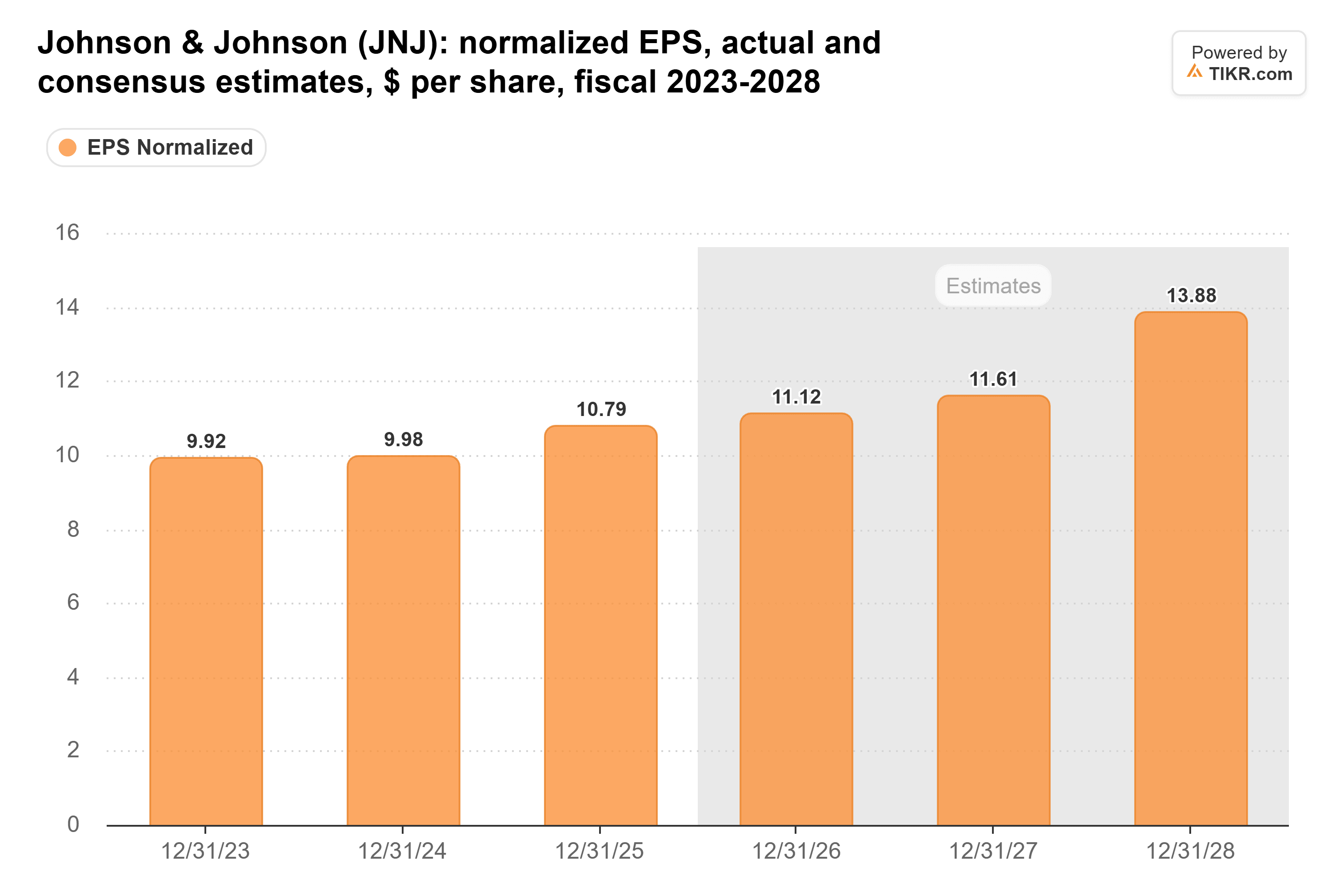
Two deals explain much of that slow stretch. Management said on the third-quarter call that Firefly Bio and Sail cut 2026 adjusted EPS by $0.64 and will cut 2027’s by $1.36. Buyers can also point to the drugs already replacing Stelara: in the first nine months of 2026, Tremfya’s sales grew $2.48 billion, which covered most of Stelara’s $2.74 billion drop, the company’s 10-Q shows.
The problem is the price. J&J trades at 24x forward earnings, close to the 26x five-year high it reached on Nov. 13, the week the stock hit a new high, and far above its 17x average:

Over the past year, analysts’ average target rose from about $202 to $280:
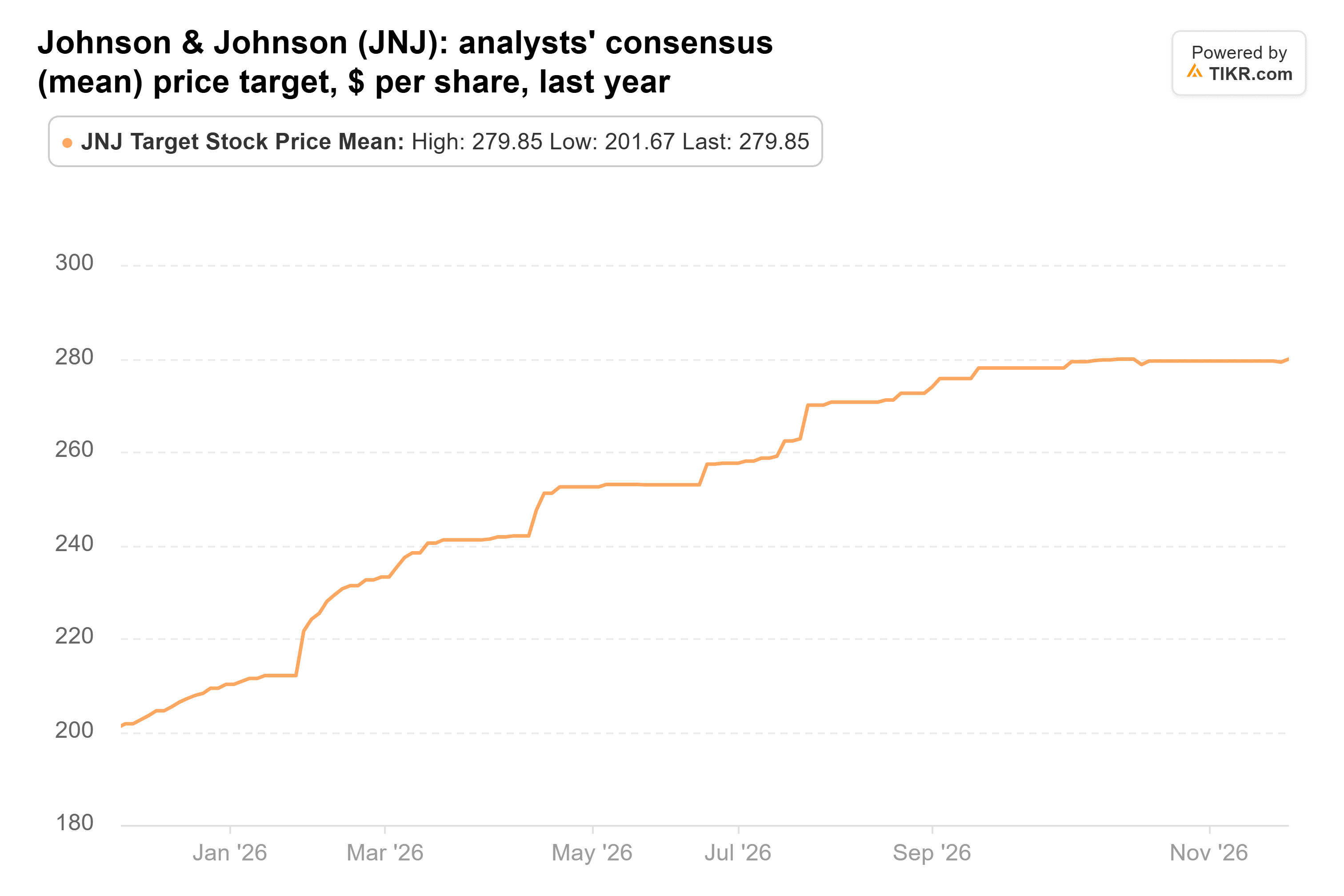
The stock went from $206 to $270 over the same stretch, so the Street has mostly followed it up. On 2028’s estimate, the $280 target works out to about 20x, which is still above J&J’s average. AbbVie’s earnings are expected to grow at least as fast from 2026 to 2028, and it trades at about 18x.
The sellers have the better case
The risk to the sellers is that J&J delivers on its promise of double-digit sales growth by the end of the decade without acquisitions. Analysts’ revenue estimates of 7% to 8% growth for 2028 to 2030 don’t assume that yet. Still, at 24x, with earnings growing slowly until 2028 and the Street’s target barely above the stock, I think too much of that rebound is already in the price.
Bottom line: the numbers favor the sellers. Even so, Comgest and Wellcome kept J&J among their top dozen holdings, which looks like a sensible size for a stock this fully valued.
The next test is J&J’s Enterprise Business Review on Dec. 8, where management will give its 2027 outlook. If guidance comes in at or above the $11.61 analysts expect for 2027, the buyers’ case gets stronger. Anything lower makes 24x hard to defend.
So what is Johnson & Johnson stock actually worth?
TIKR lets you forecast the future price of any stock in less than a minute. Just enter a few assumptions into TIKR’s valuation model and see what Johnson & Johnson could be worth. Start from Wall Street consensus estimates, or adjust the inputs to reflect your own view of the business. It’s free to use.
Value Johnson & Johnson for free
Disclaimer:
Please note that the articles on TIKR are not intended to serve as investment or financial advice from TIKR or our content team, nor are they recommendations to buy or sell any stocks. We create our content based on TIKR Terminal’s investment data and analysts’ estimates. Our analysis might not include recent company news or important updates. TIKR has no position in any of the stocks mentioned. Thank you for reading, and happy investing!