Key Takeaways
- Duke Energy and PPL both yield 3.4% today, so $10,000 in either pays $340 a year.
- Duke has raised its dividend every year for over 20 years, at 2% a year over the last five.
- PPL cut its dividend in 2022 and now targets raises at the low end of 4% to 6% a year, with its payout ratio falling to about 50% by 2030.
- Both dividends are well-covered: Duke paid out 67% of normalized EPS in fiscal 2025 and PPL 60%.
PPL (PPL) raised its long-term earnings growth target to 7% to 9% a year on Nov. 6, up from 6% to 8%. Then on Nov. 20 it declared its regular quarterly dividend of $0.285 a share.
Duke Energy (DUK) narrowed its own 2026 guidance toward the top of its range on Nov. 5. It also has something PPL doesn’t: a dividend raised every year for over 20 years.
Both yield 3.4%, so $10,000 in either pays $340 a year today. If I could hold only one for the next 10 years, which would it be?
| Metric | Duke Energy (DUK) | PPL (PPL) |
|---|---|---|
| Dividend yield | 3.4% | 3.4% |
| Current annual dividend | $4.34 | $1.14 |
| Dividend growth, fiscal 2020-2025 | 2.0% a year | -8.1% a year |
| Payout ratio of normalized EPS, fiscal 2025 | 67% | 60% |
| Payout ratio of normalized EPS, fiscal 2026 consensus | 65% | 58% |
| Net debt / EBITDA | 5.5x | 5.3x |
Source: TIKR and StockAnalysis, at today’s prices.
6 safe dividend stocks paying retirees 6%+ yields
There are over 100 stocks paying 6%+ annual dividends today.
But after an extensive investment review leveraging TIKR’s proprietary data, we now believe only six of them are truly safe for retirees.
They’re all yours as part of our new investment report. Learn more about how to get access right here.
Duke: slow and steady for over 20 years
Duke’s business is growing. Third-quarter adjusted EPS rose to $1.99 from $1.81 a year earlier. Its electric utilities earned $1.82 billion, up from $1.66 billion, on rate increases, higher sales and the build-out to serve data centers. Duke expects 2026 adjusted EPS of $6.70 to $6.80, around the $6.75 analysts expect, and 5% to 7% yearly growth through 2030. On Nov. 16, North Carolina regulators approved rate plans for its two Carolinas utilities at a 9.8% return on equity, though the increases came in smaller than Duke had asked for.
Earnings have grown faster than the dividend for years. Normalized EPS rose from $4.69 in fiscal 2016 to $6.31 in fiscal 2025, while the dividend went from $3.36 to $4.22 a share:
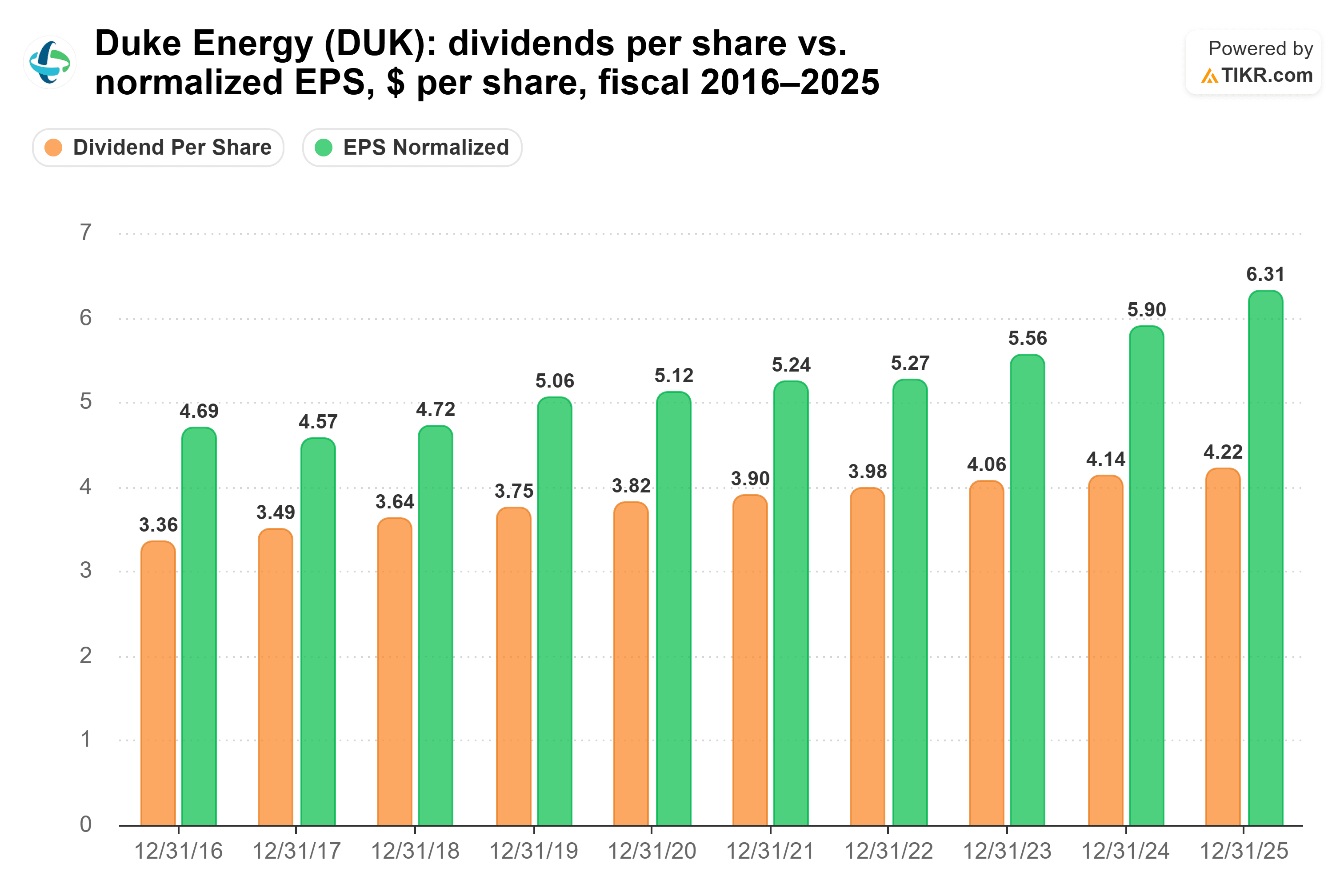
That took the payout ratio from 76.9% in fiscal 2018 to a well-covered 67% in fiscal 2025, and analysts’ 2026 estimates put it at 65%. Management called July’s 2% raise consistent with growth in recent years. With earnings growing faster than that, the cushion should keep building. The cost is debt: net debt sits at 5.5x EBITDA.
PPL: a cut in 2022, and faster raises since
PPL’s record looks very different. In fiscal 2021, normalized EPS fell to $1.05 against a $1.66 dividend, a payout ratio of 158%. The dividend then dropped to $0.88 in fiscal 2022:

It has risen every year since: to $1.09 in fiscal 2025, up 5.8% that year, and to $1.14 a year today. The payout ratio has held near 60% since fiscal 2023, with 58% expected for 2026.
Data centers drive the growth. PPL has 11.4 gigawatts of Pennsylvania data-center demand under signed service agreements. Its $25 billion capital plan for 2027 to 2030 is about $2 billion above its last one. PPL expects 2026 ongoing EPS of $1.92 to $1.96, beside analysts’ $1.95 estimate. Its Invitium Energy joint venture also agreed to terms on about 2 gigawatts of generation for a QTS data center, a letter of intent that PPL keeps out of its base plan.
Management targets dividend growth at the low end of its 4% to 6% range and a payout ratio of about 50% by 2030. That squares with earnings guided to grow 7% to 9% a year. The catch is dilution. PPL plans to sell about $3 billion of new stock through 2030, on top of more than $1.5 billion already sold on a forward basis.
So which dividend wins?
If I could hold only one for the next 10 years, it’d be PPL. Both pay 3.4% today, so what decides it is how fast each check grows. PPL’s is growing faster while it pays out a smaller share of its earnings.
At each dividend’s pace now (fiscal 2025’s raise), $10,000 in PPL would pay about $4,445 over 10 years, against about $3,711 from Duke Energy. (PPL’s -8.1% five-year rate includes the 2022 cut.) Even at the 4% low end of its target, PPL would raise its dividend twice as fast as Duke.
Analysts expect PPL’s normalized EPS to keep climbing through fiscal 2028:

That’s $1.81 in fiscal 2025 rising to $2.30 in fiscal 2028, plenty to fund those raises.
Duke has the better record, and anyone who won’t own a company that has cut before should take it. It has raised every year for over 20 years, and its payout ratio is easing too. It’s just that, at the same yield, I’d rather own the faster-growing check.
Of course, PPL’s plan depends on data-center demand turning into signed contracts, and on selling a lot of new stock without slowing per-share growth. Its next raise will show whether that 4% target holds.
Forget PPL: 6 safe 6%+ dividend yields you can buy right now
Dividends can hold the key to enormous wealth. But only if you buy the right ones.
Picking the right high-yield dividend stock can be the difference between a dream retirement…and scraping by every month, waiting for the next Social Security check to clear.
We’ve identified six stocks yielding 6%+ that we believe every retiree should know about right now. (And PPL isn’t one of them.)
Disclaimer:
Please note that the articles on TIKR are not intended to serve as investment or financial advice from TIKR or our content team, nor are they recommendations to buy or sell any stocks. We create our content based on TIKR Terminal’s investment data and analysts’ estimates. Our analysis might not include recent company news or important updates. TIKR has no position in any of the stocks mentioned. Thank you for reading, and happy investing!