


Starbucks (NASDAQ: SBUX ) operates the world’s largest chain of specialty coffee shops, serving coffee, drinks, and food to millions of customers every day. What started as a single store in Seattle has grown into a global brand that recently trades at about $88 per share and has a market capitalization of about $100 billion.
Once a fast-growing company that defined café culture around the world, Starbucks is now a household name with more than 38,000 stores in 80 markets. While rising costs, declining traffic, and labor issues have weighed on its performance in recent years, Starbucks’ scale, brand loyalty, and premium positioning have given it a stable place in everyday life.
Despite these challenges, Starbucks remains one of the most widely recognized consumer discretionary stocks, driven by steady cash flow and global expansion opportunities. Its shareholder base is dominated by some of the world’s largest asset managers, while hedge funds and active investors are adjusting their positions based on their confidence in the brand’s resilience.
Looking at stock owners and insider trading can help you understand what investors really think about Starbucks right now.
Who are the major shareholders of Starbucks?
Find out if Starbucks ‘ major shareholders are buying or selling today >>>
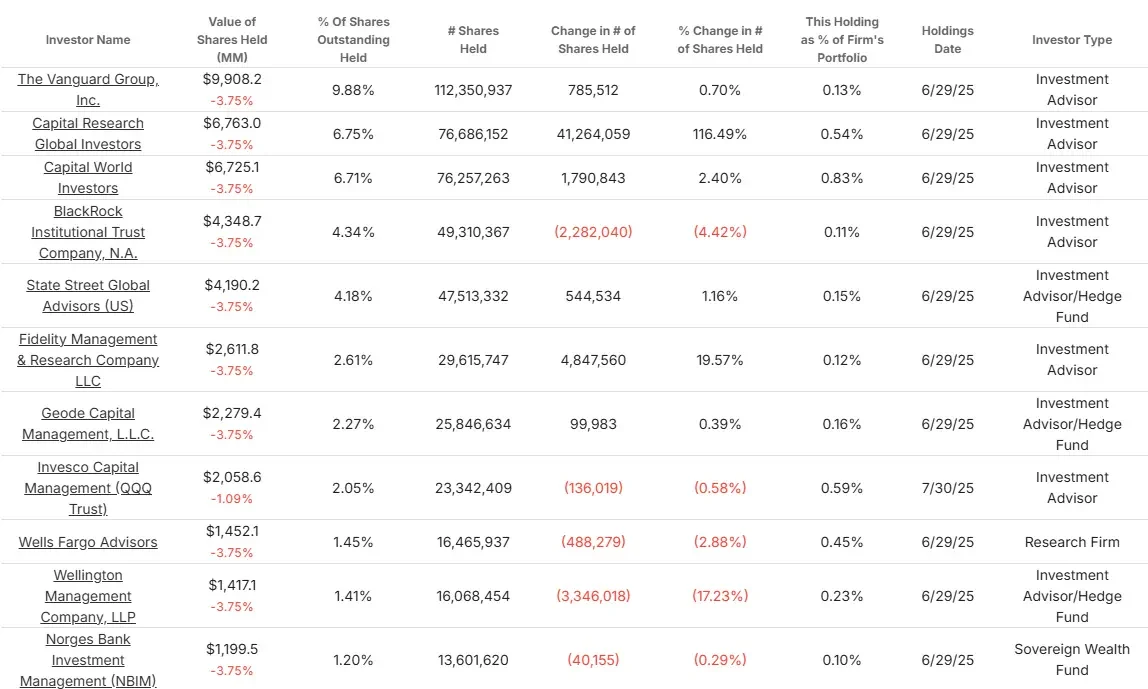
Starbucks operates the world’s largest chain of coffee shops, and its stock is held primarily by some of the world’s largest asset managers.
Alongside these passive funds, some active funds have seen sharp ups and downs, which may reflect a shift in confidence in the company’s prospects.
- Vanguard Group: 112.4 million shares (9.9%), valued at $9.9 billion. Added 785,000 shares (+0.7%).
- Capital Research Global Investors: 76.7 million shares (6.8%), valued at approximately $6.8 billion. Up 41.3 million shares (+116%).
- Capital World Investors: 76.3 million shares (6.7%), valued at $6.7 billion. Added 1.8 million shares (+2.4%).
- BlackRock: 49.3 million shares (4.3%), valued at about $4.3 billion. Down 2.3 million shares (-4.4%).
- State Street Global Advisors: 47.5 million shares (4.2%), about $4.2 billion. Added 545,000 shares (+1.2%).
- Fidelity Management: 29.6 million shares (2.6%), valued at approximately $2.6 billion. Increased holdings by 4.8 million shares (+19.6%).
Citadel Advisors, led by Ken Griffin, increased its stake in Starbucks by more than 17,700% to nearly 577,000 shares, worth $53 million– a bold bet on the coffee chain.
Another significant move came from Millennium Management, led by Israel Englund, who increased their stake by more than 14, 400% to about 325 ,000 shares, valued at about $ 30 million. The increase likely reflects their growing confidence in Starbucks’ resilience.
Jefferies Financial Group, led by Richard Handler, increased its stake by more than 1,800%, buying 65,000 shares valued at nearly $6 million. It’s clear that a financial group of this size is a big supporter of Starbucks.
Capital Research doubled its stake, showing a strong belief in Starbucks’ long-term prospects. Fidelity’s 20% gain suggests a return of confidence, while BlackRock’s drop suggests a degree of near-term cautiousness. Hedge fund activity, meanwhile, shows that selective but aggressive bets are being made.
Follow the leading shareholders of 50,000+ global stocks (free) >>>
Recent insider trading at Starbucks

Insider trading at Starbucks has been fairly low in recent months and appears to be more focused on divestitures. Most of the moves have been small, which could suggest that executives are managing their personal exposure rather than making big statements about the company’s future.
The lack of insider buying is notable because management doesn’t appear to have much confidence in the current stock price.
Some recent insider trades include
- Sarah Kelly (Officer): Sold 308 shares in June for about $93.
- Bradley Lerman (Executive): Sold 975 shares in May for about $87.
- Jorgen Vig Knudstoff (Director): Sold 539 shares in March for $99.
- Rachel Ruggeri (Representative): Sold 1,289 shares in February for about $113.
- Katherine Smith (Officer): Reported to have acquired 45,550 shares in March.
- Marissa Mayer (Director): Reported to have acquired 2,326 shares in June.
These transactions appear to be modest and may reflect business diversification or planned divestitures. The lack of insider buying could mean that management is not interested in driving the stock price higher at this time, and some investors may be cautious about near-term valuations.
View recent insider trading data for 50,000+ global stocks (free) >>>
What data tells us about ownership and insider trading
Starbucks is owned by large passive managers such as Vanguard, BlackRock, and State Street, so it is closely correlated to global index flows. Among active managers, Capital Research and Fidelity increased their positions, which may be a sign of confidence in the long-term strength of the Starbucks brand and the resilience of its cash flows. At the same time, BlackRock’s underweight suggests caution about near-term growth and margins.
Insider activity appears to be more cautious, with small selling by executives and directors and no large buying by insiders, which may indicate that managers are in no rush to increase exposure at current levels.
The signals seem contradictory. While institutions support Starbucks as a long-term investment, insiders seem unwilling to do so.
For investors, it may suggest a degree of confidence in the enduring power of the company’s brand, but it also leaves questions about execution and short-term profitability.
Wall Street analysts are bullish on five undervalued stocks with the potential to outperform the market.
TIKR recently released a new free report on five composite companies that are undervalued, have outperformed the market in the past, and could continue to outperform over the next one to five years based on analyst estimates.
Inside, you’ll find a high-quality, five-company ventilated :
- Strong revenue growth and sustainable competitive advantage
- Attractive valuation based on projected revenue and expected revenue growth
- Long-term upside potential backed by analyst forecasts and TIKR valuation model
It’s a stock that can make you a lot of money over the long term if you buy it, especially when it’s trading at a discount.
Whether you’re a long-term investor or simply looking for companies trading below fair value, this report will help you identify the most interesting opportunities.
Click here to sign up for TIKR and get the full report on 5 undervalued complex companies for free.