
Caterpillar Inc. (NYSE: CAT) is the world’s largest manufacturer of construction and mining equipment, engines, and industrial turbines. The company has long been a cornerstone of the global industry, recently trading near $645 per share with a market cap of approximately $302 billion.
Once best known for its iconic yellow machines on job sites, Caterpillar has grown into a diversified powerhouse spanning energy, transportation, and infrastructure. The stock gained roughly 72% over the past year, driven in part by surging demand for power generation equipment used in data centers. The company recently announced expanded AI collaborations with NVIDIA and unveiled its Cat AI Assistant at CES 2026, positioning itself as an unexpected beneficiary of the AI infrastructure build-out.
With demand linked to global development, mining activity, and infrastructure spending, Caterpillar has become a core holding for many institutional investors. Its broad exposure across industries and long history of operational efficiency make it a stock that shows up in portfolios worldwide.
Taking a closer look at who owns Caterpillar and what insiders are doing can help investors see how confidence in the company is shaping up today.
Who Are Caterpillar’s Top Shareholders?

See whether Caterpillar’s top shareholders are buying or selling today >>>
Caterpillar builds construction and mining equipment, engines, and turbines that power infrastructure worldwide. Its stock is mainly held by the biggest index funds, while some active managers have made sharp moves.
- Vanguard Group: 45.7M shares (9.77%), $29.6B. Trimmed 122K (-0.27%).
- State Street Investment Management: 35.0M shares (7.48%), $22.7B. Cut 946K (-2.63%).
- BlackRock Institutional Trust: 23.4M shares (5.01%), $15.2B. Added 20K (+0.08%).
- State Farm Insurance: 18.6M shares (3.97%), $12.0B. Trimmed 228K (-1.21%).
- Geode Capital Management: 10.5M shares (2.25%), $6.8B. Added 49K (+0.46%).
- Fisher Investments: 9.4M shares (2.02%), $6.1B. Added 21K (+0.22%).
- Bill & Melinda Gates Foundation Trust: 6.4M shares (1.36%), $4.1B. Cut 1.0M (-13.60%).
- T. Rowe Price Associates: 6.1M shares (1.31%), $4.0B. Added 4.9M (+424.14%).
- Norges Bank: 5.6M shares (1.19%), $3.6B. Cut 442K (-7.35%).
- Wellington Management: 5.2M shares (1.12%), $3.4B. Added 5.1M (+3,949.81%).
- BofA Global Research: 4.6M shares (0.99%), $3.0B. Added 391K (+9.26%).
The standout move last quarter came from Wellington Management, which increased its Caterpillar position by nearly 3,950% to 5.2 million shares worth $3.4 billion. The addition of 5.1 million shares represents an aggressive accumulation that dwarfs typical quarterly adjustments.
T. Rowe Price also made a substantial move, raising its stake by 424% to 6.1 million shares valued at $4.0 billion. The addition of 4.9 million shares signals growing conviction in Caterpillar’s cyclical positioning.
BofA Global Research increased its holdings by 9.26%, adding roughly 391,000 shares during the quarter.
On the other side, the Bill & Melinda Gates Foundation Trust reduced its position by 13.60%, selling 1.0 million shares. Norges Bank, Norway’s sovereign wealth fund, trimmed its stake by 7.35%, cutting 442,000 shares.
The passive giants showed mixed but modest activity. Vanguard and State Street both reduced exposure slightly, while BlackRock held relatively steady. The sharp increases from Wellington and T. Rowe Price suggest some active managers see value in Caterpillar’s position within the infrastructure and equipment cycle, while the Gates Foundation’s reduction may reflect portfolio rebalancing or valuation concerns.
Track the top shareholders of over 50,000 global stocks (It’s free) >>>
Caterpillar’s Recent Insider Trades
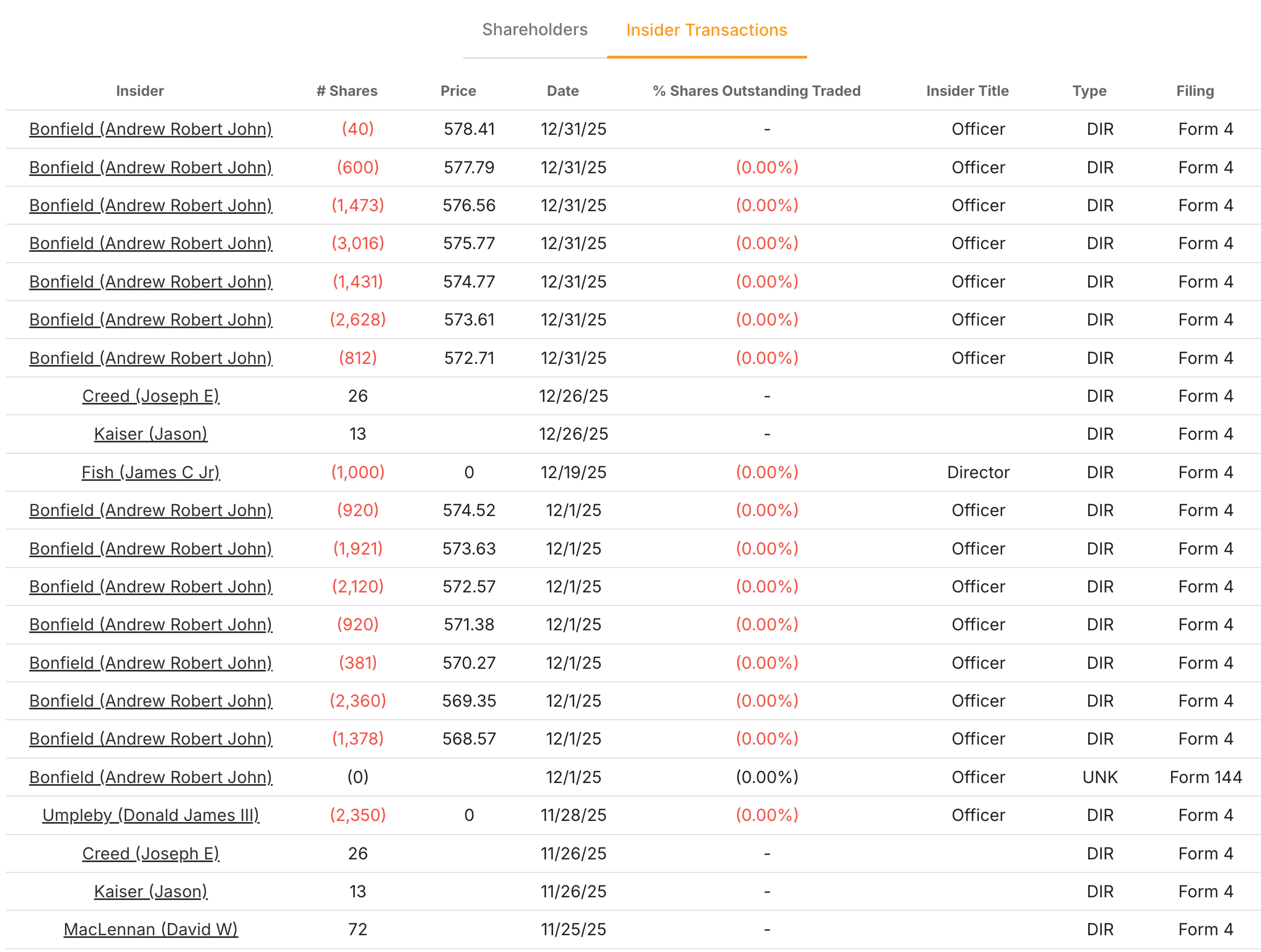
Insider trading activity offers a glimpse into how the people closest to the company may be thinking about its prospects. At Caterpillar, recent filings show mostly selling, with only a handful of small purchases.
Here are recent insider transactions:
- David W. MacLennan (Director): Bought 72 shares on November 25, 2025.
- Joseph E. Creed: Bought 26 shares on both November 26 and December 26, 2025.
- Jason Kaiser: Bought 13 shares on both November 26 and December 26, 2025.
- Andrew Robert John Bonfield (Officer): Sold approximately 10,000 shares in early December 2025 at prices ranging from $568.57 to $574.52. Additional sales in late December included roughly 9,000 shares at prices between $572.71 and $578.41.
- Donald James III Umpleby (Officer): Sold 2,350 shares at zero price on November 28, 2025, likely representing tax withholding on equity compensation.
- James C Jr Fish (Director): Sold 1,000 shares at zero price on December 19, 2025, also likely tied to equity compensation.
The small purchases from MacLennan, Creed, and Kaiser are minimal in size and unlikely to signal strong conviction. Bonfield’s sales, totaling roughly 19,000 shares across December at prices near all-time highs, look like position trimming after strong gains. The zero-price sales from Umpleby and Fish appear to be routine tax withholding rather than open-market activity.
Overall, the insider trend leans cautious. The absence of meaningful open-market buying suggests management may view the stock as fairly valued at current levels.
See recent insider trade data for over 50,000 global stocks (It’s free) >>>
What the Ownership & Insider Trade Data Tell Us
For investors, Caterpillar’s ownership picture looks steady but divided. The big index funds like Vanguard, State Street, and BlackRock provide stability by keeping the stock firmly in global portfolios. Active managers, however, appear split. Fisher and Capital Research are adding, which may point to confidence in Caterpillar’s long-term demand cycle, while Capital World and BofA have cut sharply, suggesting a more cautious outlook.
On the insider side, activity leans more toward selling, with only one small director purchase. This mix of modest buying and larger sales may imply that leadership is comfortable taking profits after the stock’s climb but hesitant to commit more at current prices.
Taken together, Caterpillar remains a widely held core industrial name, but the signals from both institutions and insiders suggest investors are balancing optimism about its strong profitability with caution about valuation and market cycles.
Value Any Stock in Under 60 Seconds with TIKR
With TIKR’s new Valuation Model tool, you can estimate a stock’s potential share price in under a minute.
All it takes is three simple inputs:
- Revenue Growth
- Operating Margins
- Exit P/E Multiple
If you’re not sure what to enter, TIKR automatically fills in each input using analysts’ consensus estimates, giving you a quick, reliable starting point.
From there, TIKR calculates the potential share price and total returns under Bull, Base, and Bear scenarios so you can quickly see whether a stock looks undervalued or overvalued.
Click here to sign up for TIKR and get our full report on 5 undervalued compounders completely free.