Key Takeaways
- On Tuesday, Nov. 17, NVIDIA reports its first quarter since Jensen Huang resigned, and Gene Munster expects the company to pull its guidance.
- Demand into 2027 looks sold out, and Wall Street’s fiscal 2028 revenue estimate is already a little under the roughly 70% growth management guided in August.
- The main risk is that investors read silence as weaker demand. Analysts could then cut earnings estimates that have barely moved since late October.
- At about 14x forward earnings, the lowest in five years, the stock already prices in a lot of bad news. That makes what Kress says about the backlog more important than any range on Tuesday.
NVIDIA (NVDA) reports its third-quarter results on Tuesday, Nov. 17. For the first time in 33 years, Jensen Huang won’t be running the company when it does.
Huang resigned on Nov. 12, days after NVIDIA said it was investigating reports that he’d been the target of a foreign intelligence effort. CFO Colette Kress is now interim CEO too. Usually the CFO is the one who reins in the outlook, and now she’s also the one setting it.
Deepwater Asset Management’s Gene Munster thinks that outlook may not come at all. In a post on X, he wrote: “$NVDA investors, be prepared for them to pull guidance when they report Tuesday night. Near-term negative.”
That would be quite a change for a company that told investors in August to expect revenue growth of about 70% in a fiscal year that hadn’t even started yet.
CNBC’s Jon Fortt sees why Kress would hold back. “I find it hard to imagine that there’s much of an incentive to give an aggressive guide in this situation,” he said on Closing Bell.
Munster still thinks demand for the next year will beat what the Street expects, even with the leadership changes. The numbers back him up, and they suggest the guide matters less than usual this time.
TIKR tracks 62 analysts on Nvidia. How many say “Buy”?
See the full breakdown of Buy, Hold, and Sell ratings on Nvidia, along with Wall Street’s revenue and earnings estimates, all in one place. More than 500,000 investors use TIKR to research stocks like this one. See Nvidia’s Analyst Ratings
Tuesday’s quarter is mostly old news
The quarter NVIDIA reports ended Oct. 25, weeks before Huang resigned. NVIDIA guided it to $108.0 billion of revenue, plus or minus 2%, and it has beaten the top of its range in each of the last three quarters.
One investor on the r/stocks subreddit made the point well: the numbers will probably be fine, and what matters is the guidance and whether any big customer sounds even a little less committed.
The customer question is the one worth listening for, because the demand behind next year looks spoken for. On Bloomberg Tech, Bloomberg’s Ryan Vlastelica said people have pointed out to him that “the company is sold out of chips through 2027.” He added that NVIDIA’s major customers would have a very hard time switching suppliers quickly.
So if Kress skips the number but walks through the backlog and the big buyers, investors may learn more from that than from any range.
Wall Street is already near NVIDIA’s own number
Munster’s call is that the Street is too low on next year, and the estimates leave room for him to be right. Analysts expect revenue of about $412 billion in fiscal 2027, the year ending January 2027, rising to $689 billion in fiscal 2028:
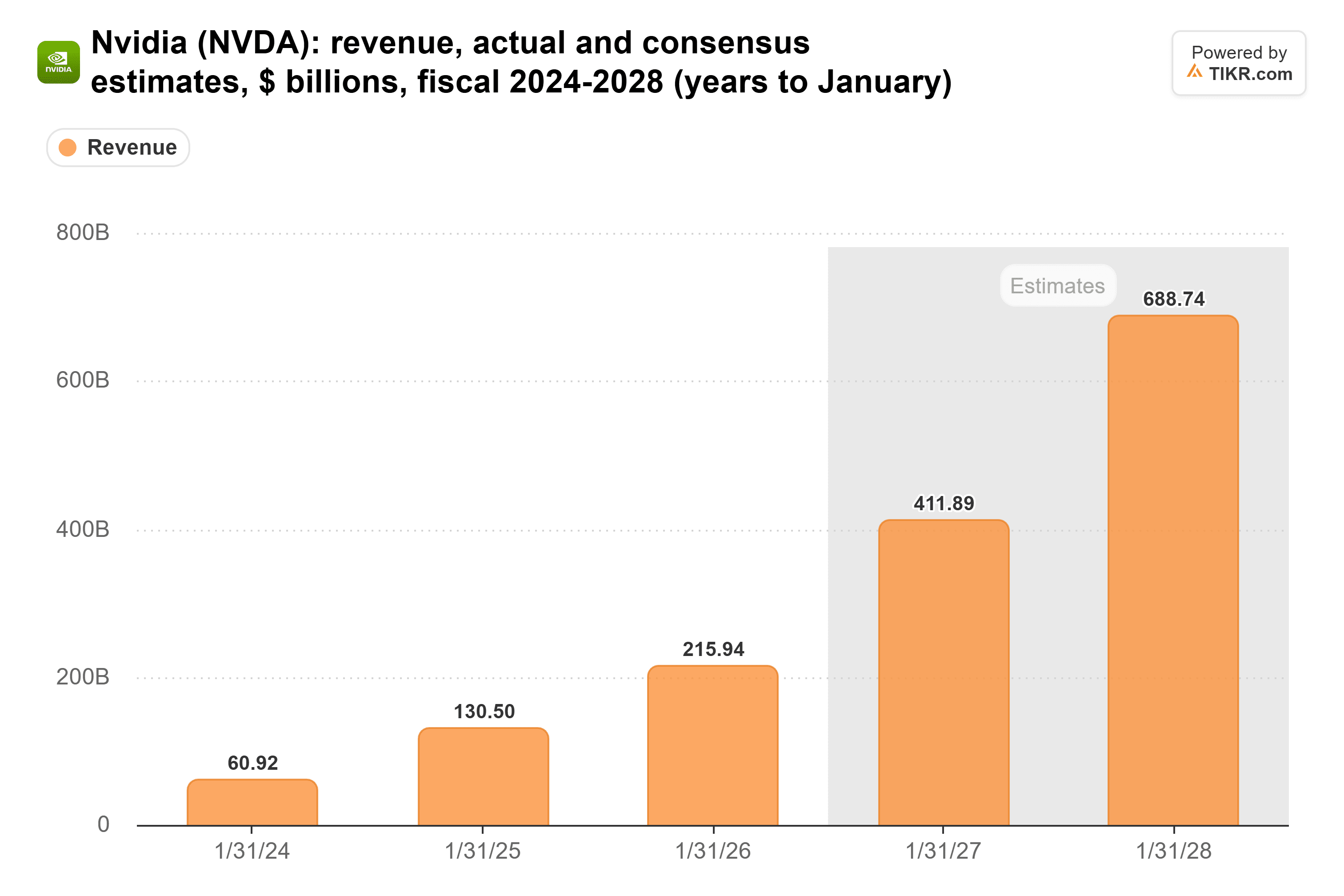
That works out to about 67% growth in fiscal 2028, a little under the roughly 70% management guided in August. Management called that a supply-limited figure and said customers’ own forecasts point to growth doubling. So if NVIDIA can get more supply, today’s consensus could prove too low.
A missing guide could still cost NVIDIA
Pulling guidance could backfire, of course. If a company guides a year out in August and then goes quiet in November, investors will tend to assume demand has weakened, and that’s how estimate cuts start. So far, consensus estimates haven’t flinched, even after Baird cut the stock to Neutral on Nov. 11 and slashed its price target to $200 from $500. Normalized earnings estimates sit at $9.33 a share for fiscal 2027 and $15.85 for fiscal 2028:
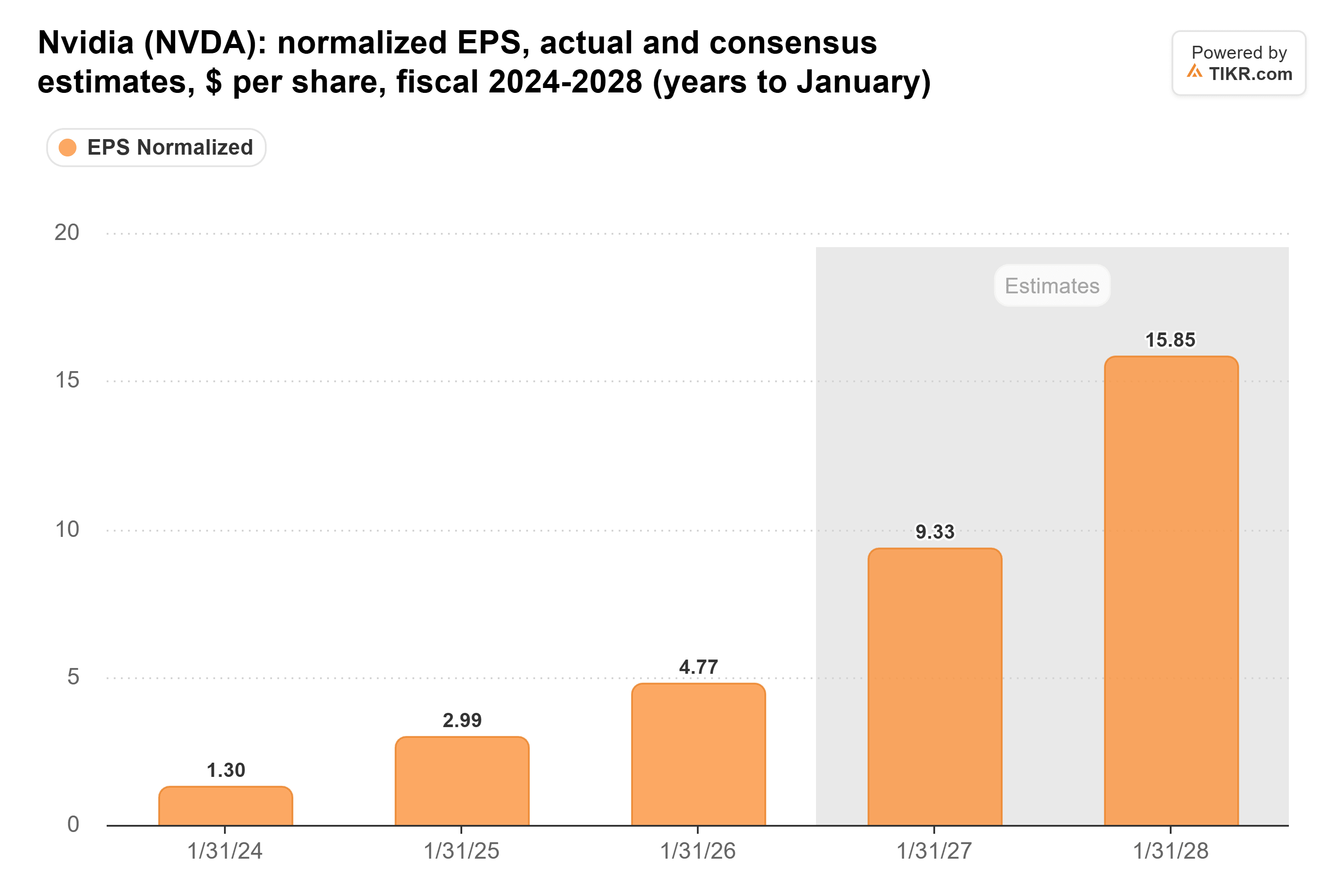
The fiscal 2028 estimate was $15.92 in late October, so a week of turmoil has barely moved it. Watch those numbers in the days after the report: cuts there would mean analysts took the silence as bad news.
Plenty of bad news is already in the price
NVIDIA trades at about 14x forward earnings. That’s the lowest in five years and far below its five-year average of 36x:
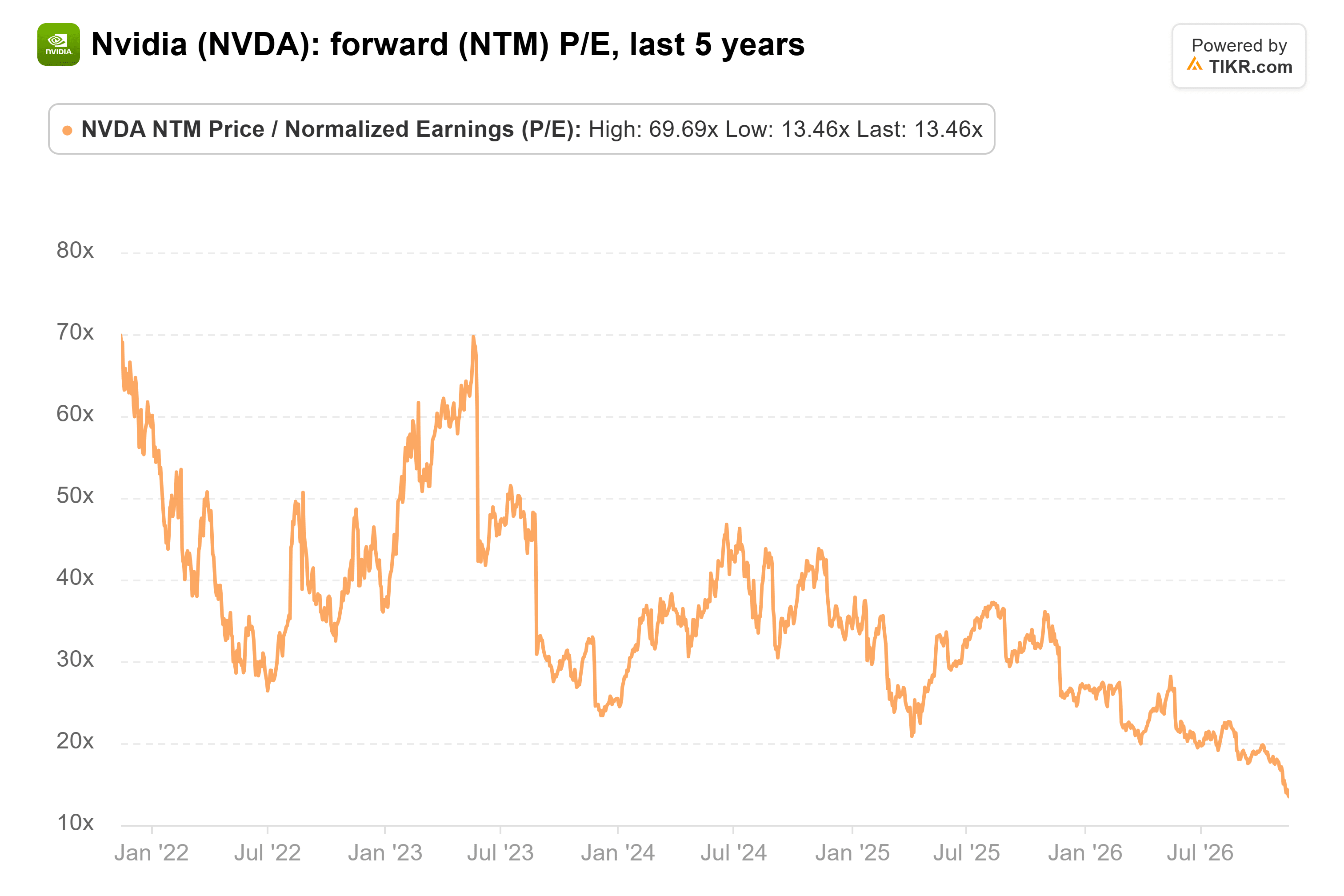
A pulled guide would probably sting for a day or two. But NVIDIA’s next year looks sold out, and at 14x earnings the stock already prices in worse news than Tuesday is likely to bring. If Kress sounds as confident about the backlog and the big customers as NVIDIA did in August, the missing range won’t matter much.
The harder questions sit further out. Analysts already see revenue growth slowing to about 30% in fiscal 2029, and Vlastelica pointed to 2028 and 2029 as the years when the new uncertainty could start to hit. Huang has also agreed to appear before Congress before Thanksgiving, though the details are still being worked out, so the headlines won’t stop Tuesday night.
So what is NVIDIA stock actually worth?
TIKR lets you forecast the future price of any stock in less than a minute. Just enter a few assumptions into TIKR’s valuation model and see what NVIDIA could be worth. Start from Wall Street consensus estimates, or adjust the inputs to reflect your own view of the business. It’s free to use.
Disclaimer:
Please note that the articles on TIKR are not intended to serve as investment or financial advice from TIKR or our content team, nor are they recommendations to buy or sell any stocks. We create our content based on TIKR Terminal’s investment data and analysts’ estimates. Our analysis might not include recent company news or important updates. TIKR has no position in any of the stocks mentioned. Thank you for reading, and happy investing!