
Key Takeaways
- Meta says more than 10 million people set up Muse in about six weeks, but Dan Nathan says that number has to be 20x larger to make an impact.
- Each new Muse user adds compute cost for Meta before it adds revenue, and that cost is revenue for its chip suppliers.
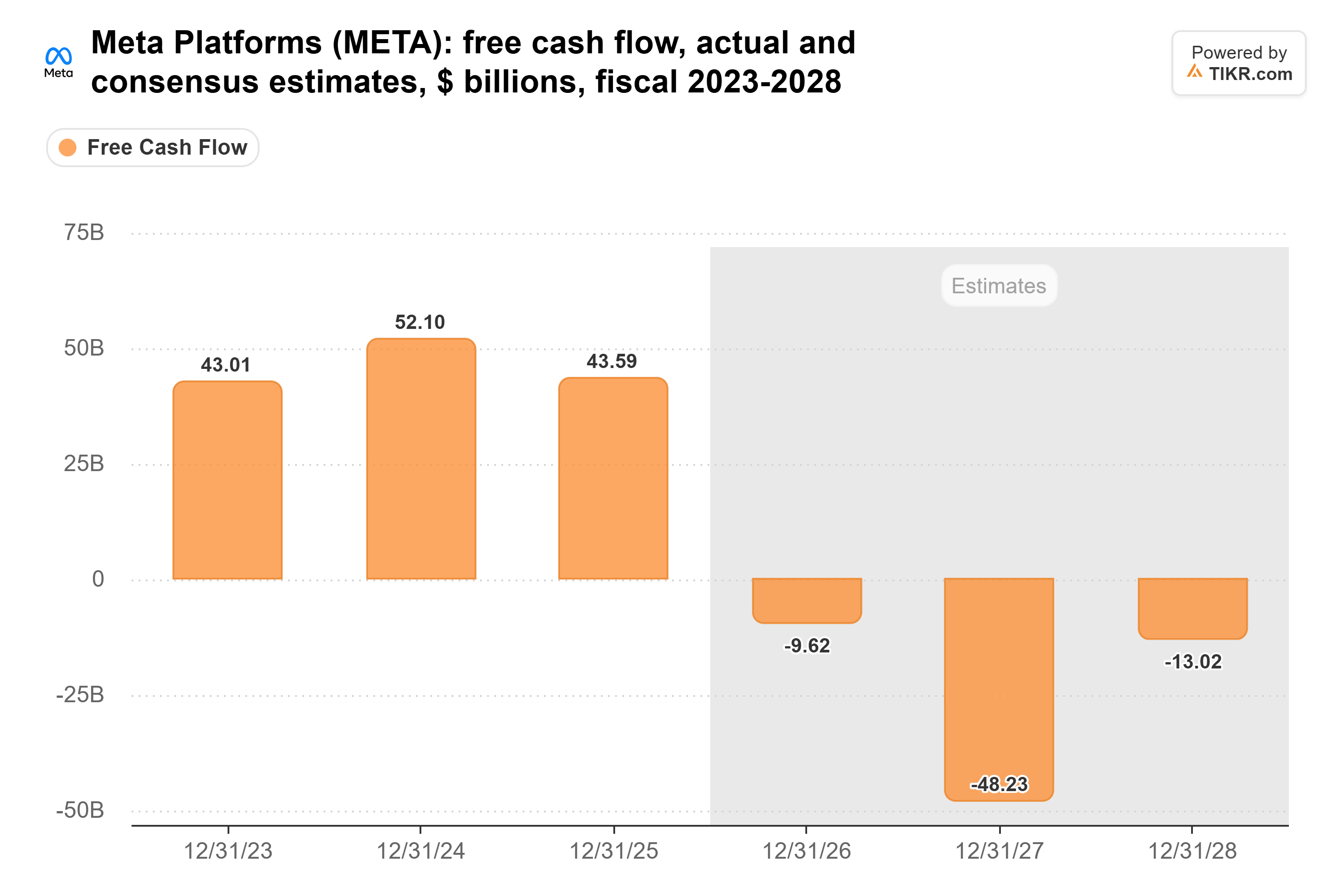
- Analysts expect Meta’s free cash flow to fall to negative $48.2 billion in 2027.
- Muse won’t move Meta’s numbers for years, and the fourth-quarter call in late January is the next test of its costs and its first revenue.
Meta Platforms (META) says more than 10 million people set up Muse, its AI personal agent, in about six weeks. Dan Nathan, co-founder of RiskReversal Media, isn’t impressed. On today’s episode of the RiskReversal Pod, he said “that number has to be 20x what it is right now to make an impact.”
His bigger worry is the cost: “So if they can’t monetize it, the bigger it gets, meaning like the more folks that are using it, it’s the more money they’re going to lose on the thing.” Meta pays chipmakers like Broadcom (AVGO) and AMD (AMD) for the buildout behind that compute, and they get paid whether Muse makes money or not.
Every user costs money first
Management expects Muse’s total serving costs to rise as users grow, and calls the service compute-intensive. Meta pays for that out of free cash flow, which analysts expect to swing from $43.6 billion in 2025 to negative $48.2 billion in 2027:
The reason is capital spending, which nearly doubled to $69.7 billion in 2025:
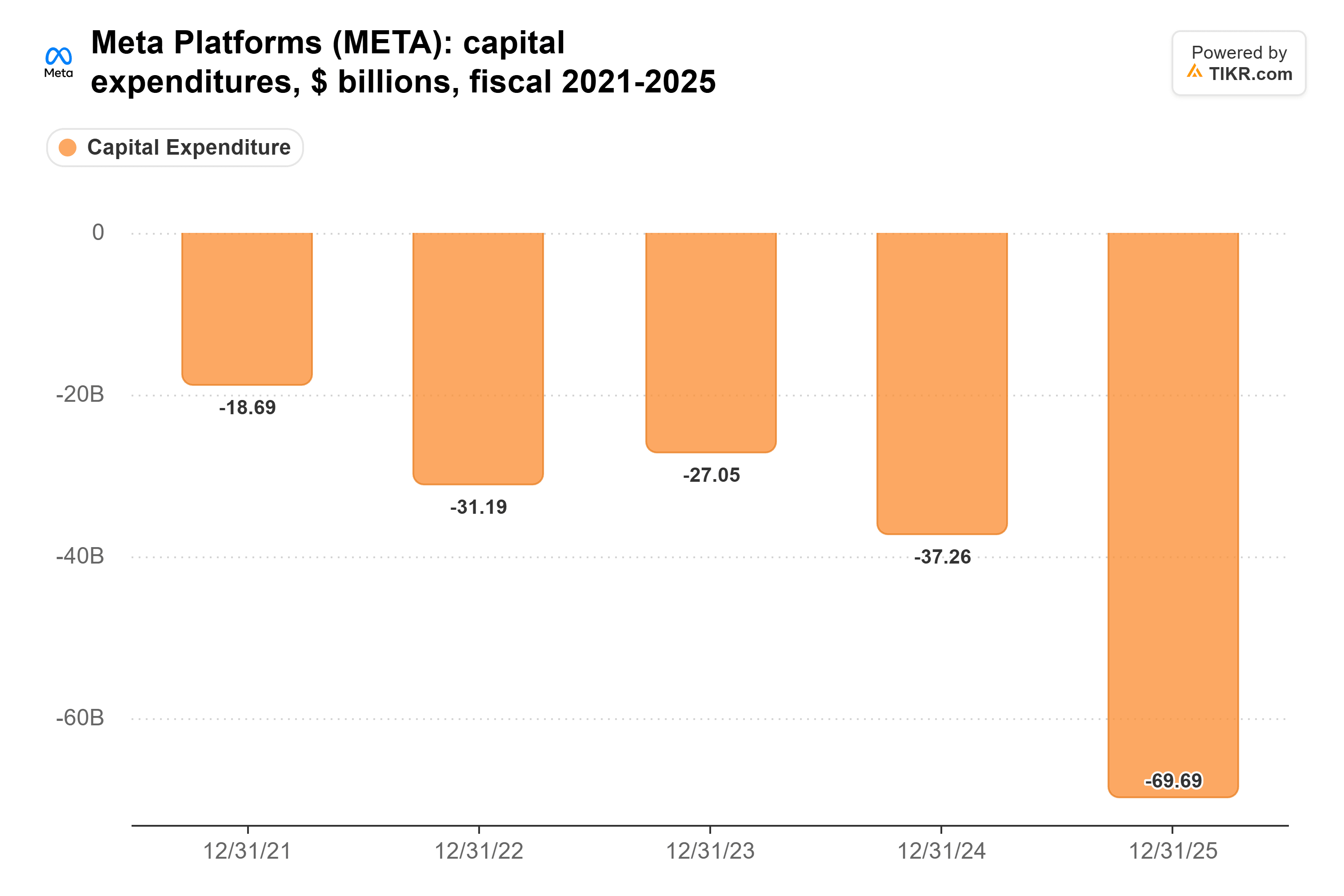
Meta’s 2026 capex guidance is $135 billion to $145 billion, including finance-lease principal, and analysts expect about $210 billion in 2027. Not all of that is Muse, since the same compute runs Meta’s ad-ranking models. But Muse is the part with no revenue line yet.
TIKR tracks 62 analysts on Meta Platforms. How many say “Buy”?
See the full breakdown of Buy, Hold, and Sell ratings on Meta Platforms, along with Wall Street’s revenue and earnings estimates, all in one place. More than 500,000 investors use TIKR to research stocks like this one. See Meta Platforms’ Analyst Ratings
20x is a tall order
Nathan’s 20x would put Muse at 200 million users. Set that against Meta’s revenue, which analysts expect to reach $313 billion in 2027:
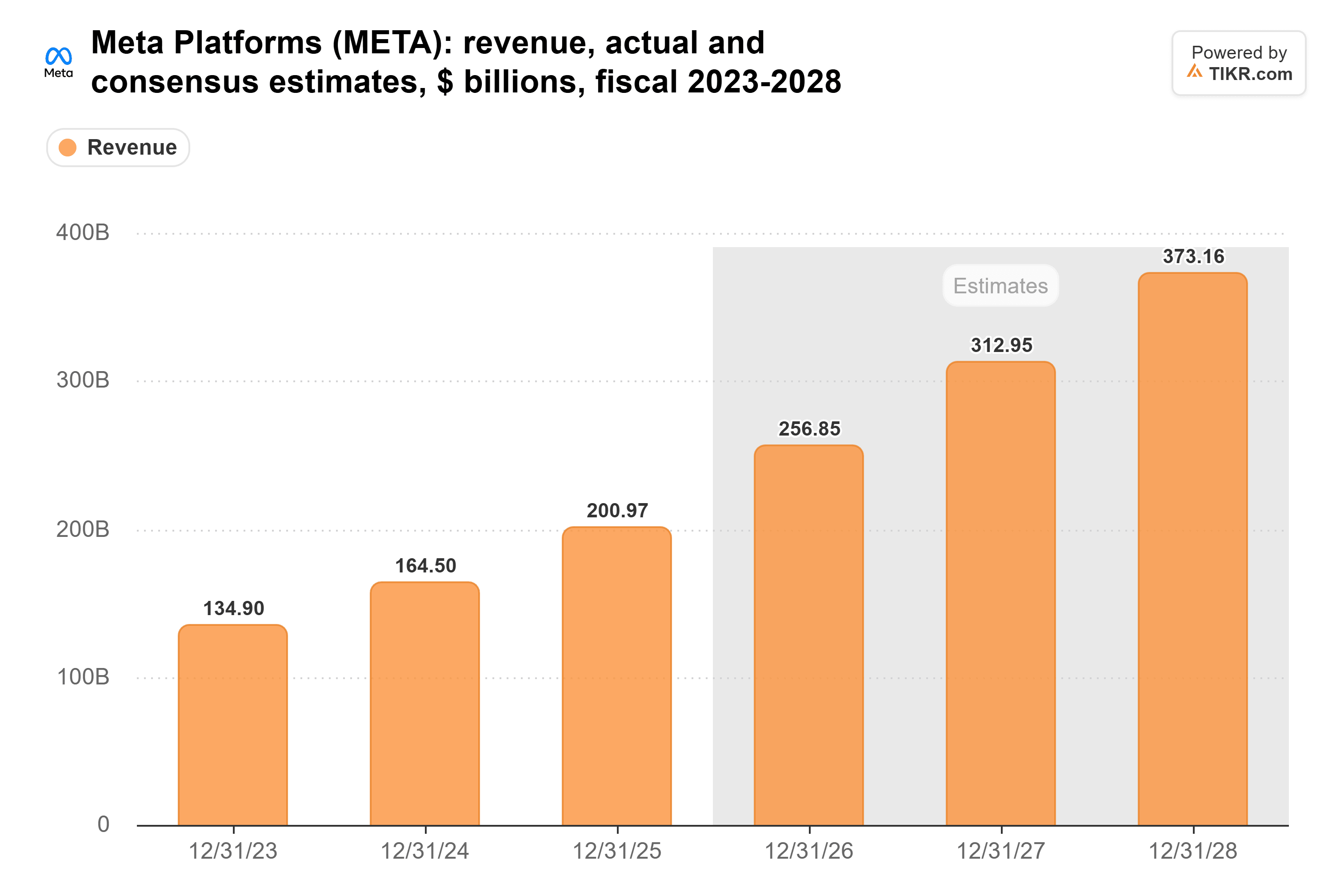
For Muse to bring in just 1% of that, about $3.1 billion, today’s 10 million users would each have to bring in about $313 a year. At 200 million users, it’s about $16 each, roughly a quarter of the $57 Meta made per person across its apps in 2025.
And Muse is only live in the US and Canada, partly because of compute cost, so getting to 200 million probably means taking on more of that cost.
The money has to come from shopping
Alexandr Wang, Meta’s chief AI officer, told Nikkei in October that Meta has no plans for ads inside Muse, which leaves fees and paid tiers to carry it. Shopping is the obvious place to start: management says more than a quarter of Muse users shop with it, with an average purchase above $200. On the cost side, management is aiming to make Muse more than 10x cheaper to run, in compute terms, over the next year. That would ease a lot of Nathan’s worry.
Broadcom and AMD get paid either way
For Meta’s chip suppliers, Muse’s cost is revenue. Meta has said it’s deploying more than a gigawatt of its own MTIA chips built with Broadcom, whose AI semiconductor revenue across all its customers grew 221% to $16.7 billion in its fiscal third quarter. Meta also plans up to 6 gigawatts of AMD GPUs, and AMD’s data center revenue grew 97% to $8.5 billion in the third quarter. The question for both is Meta’s efficiency goal: if each Muse user gets far cheaper to serve, more users won’t mean nearly as many more chips.
Meta shareholders are paying for Muse
Nathan’s math holds up. Frankly, that’s fine while the ad business pays for the build, and revenue rose 26% to $64.6 billion last quarter. But with free cash flow heading negative, Meta shareholders will be paying for Muse until it has revenue of its own.
The next test is Meta’s fourth-quarter call in late January, where management will lay out its 2027 spending plan and could give a first Muse revenue or pricing figure. Capex well above the $210 billion analysts expect, with no Muse revenue alongside it, would make Nathan’s warning look even more right.
So what is Meta stock actually worth?
TIKR lets you forecast the future price of any stock in less than a minute. Just enter a few assumptions into TIKR’s valuation model and see what Meta could be worth. Start from Wall Street consensus estimates, or adjust the inputs to reflect your own view of the business. It’s free to use.
Disclaimer:
Please note that the articles on TIKR are not intended to serve as investment or financial advice from TIKR or our content team, nor are they recommendations to buy or sell any stocks. We create our content based on TIKR Terminal’s investment data and analysts’ estimates. Our analysis might not include recent company news or important updates. TIKR has no position in any of the stocks mentioned. Thank you for reading, and happy investing!