Key Takeaways
- MScience data have Alphabet’s fourth-quarter ad revenue tracking 2.4% below consensus, with Search & other growth slowing to 7.6% from 12% in the third quarter.
- Alphabet’s low multiple may be the market pricing in a real Search slowdown as questions move to AI answers.
- Rollins is losing search leads to AI answers, and Expedia held its consumer marketing flat.
- Alphabet’s fourth-quarter report in early February is the test.
Data that surfaced on Nov. 25 show Alphabet (GOOG) heading for a soft fourth quarter in Search, the business that pays for everything else.
MScience’s latest update, posted on X by @ScroogeCap, has Alphabet’s fourth-quarter ad revenue tracking at $87.73 billion through Nov. 20. That’s 2.4% below the $89.89 billion consensus, or 6.6% growth from a year ago against the 9.2% Wall Street expects.
Advertisers are feeling it too: Rollins (ROL) is getting fewer leads from search as AI answers replace the old page of links, and Expedia Group (EXPE) spent no more on consumer marketing in the third quarter than a year earlier.
Alphabet’s Class C shares closed down 2.02% at $270.98 on Nov. 25, the day the update circulated.
Search is slowing fast
MScience has Search & other revenue tracking at $67.87 billion for the fourth quarter, against $69.50 billion expected, with growth slowing to 7.6% from 12.0% in the third quarter. MScience hasn’t published these figures itself, so they are a secondhand read of alternative data, not a company forecast.
The strange part is that people aren’t searching less: Alphabet said in its third-quarter release that query growth was the highest in five years.
But Search & other revenue growth slowed anyway: from 19% in the first quarter to 17% in the second and 12% in the third. The post’s explanation: “Google is still playing catch-up monetizing queries shifting into AI Mode.” Google’s chief business officer, Philipp Schindler, pointed the same way on the Oct. 28 earnings call, saying strong AI Mode query growth had an impact “because of the lower monetization we were seeing in AI Mode.”
TIKR tracks 60 analysts on Alphabet. How many say “Buy”?
See the full breakdown of Buy, Hold, and Sell ratings on Alphabet, along with Wall Street’s revenue and earnings estimates, all in one place. More than 500,000 investors use TIKR to research stocks like this one. See Alphabet’s Analyst Ratings
Advertisers are rewriting their playbook
On a new We Study Billionaires podcast episode on Rollins, co-host Shawn O’Malley said that at Rollins’ Orkin, “leads are down by double digits this year and management thinks more than half of that drop traces back to AI chatbots as well as AI search.”
Rollins’ answer is to show up on more platforms. As CEO Jerry Gahlhoff put it at a J.P. Morgan conference on Sept. 23: “How do we deal with Gemini? How do we deal with ChatGPT? How do I deal with Claude?” Only Gemini is Google’s, so marketing money Rollins shifts toward the other platforms likely comes out of what used to go to Google’s search ads.
At Expedia, direct selling and marketing in its consumer business held flat at $1.03 billion in the third quarter, even though consumer gross bookings grew 7% to $22.86 billion. That’s good for Expedia’s margins, but it means growth at a major online advertiser didn’t turn into a bigger ad budget.
The low multiple may be right
Search & other brought in 55.7% of Alphabet’s 2025 revenue. Google Services earned $139.4 billion of operating income that year, which is more than Alphabet’s $129.0 billion total. Analysts expect normalized EPS to climb from $10.81 in 2025 to $18.58 by 2028:
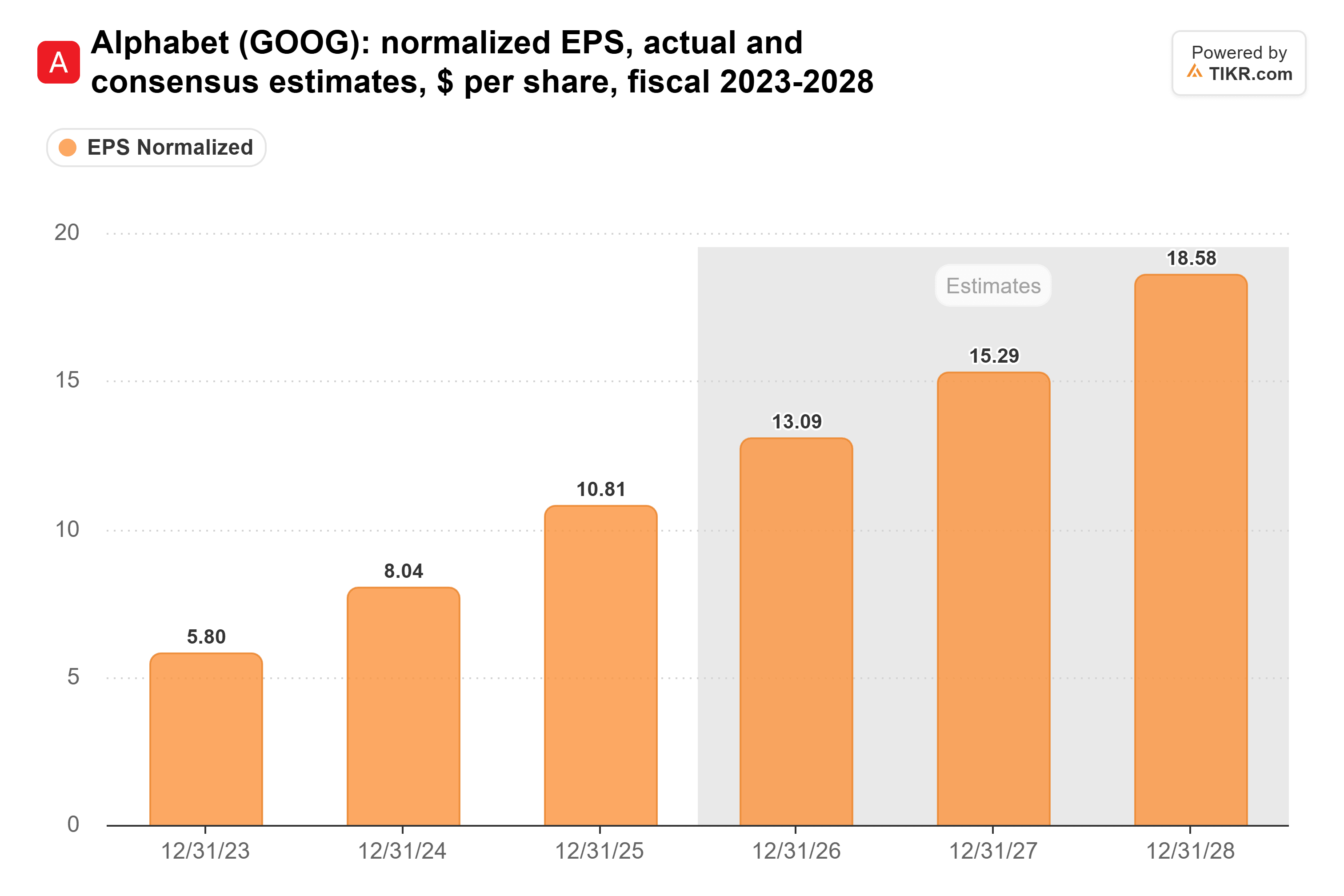
Those estimates came before MScience’s update. On its own, a $2.16 billion ad shortfall in one quarter wouldn’t do much to the year’s earnings. But Search growing at 7.6% into 2027 would make that climb much harder, especially with consensus depreciation reaching $82 billion by 2028.
The market seems to have done that math already. Alphabet trades at 19x forward earnings, well below its 10-year average of 24x:

A TIKR post on Nov. 23 argued that Alphabet looks cheap even after stripping out its SpaceX and Anthropic stakes, which top $200 billion. The discount may have a simpler explanation. Investors may be pricing in a slowdown in Search as questions move to AI answers, and MScience’s numbers suggest they have good reason to.
Watch Search in February
Two things could still close the gap. MScience’s data run only through Nov. 20, leaving the holiday shopping season ahead. And Google is scaling ads inside AI answers: Rollins said on its Oct. 22 call that it is testing early paid placements on ChatGPT and Gemini.
Until Search speeds back up, 19x looks like a fair price for a slowing business, not an obvious bargain. Alphabet’s fourth-quarter report, due in early February, is the test. Search & other growth near the third quarter’s 12% would ease the worry, and growth near 7.6% would confirm it.
So what is Alphabet stock actually worth?
TIKR lets you forecast the future price of any stock in less than a minute. Just enter a few assumptions into TIKR’s valuation model and see what Alphabet could be worth. Start from Wall Street consensus estimates, or adjust the inputs to reflect your own view of the business. It’s free to use.
Disclaimer:
Please note that the articles on TIKR are not intended to serve as investment or financial advice from TIKR or our content team, nor are they recommendations to buy or sell any stocks. We create our content based on TIKR Terminal’s investment data and analysts’ estimates. Our analysis might not include recent company news or important updates. TIKR has no position in any of the stocks mentioned. Thank you for reading, and happy investing!