Key Stats for Walmart Stock
- Current Price: $115.27
- Target Price (Mid): ~$189
- Street Target: ~$138
- Potential Total Return: ~64%
- Annualized IRR: ~6% / year
Now Live: Discover how much upside your favorite stocks could have using TIKR’s new Valuation Model (It’s free) >>>
What Happened?
Walmart (WMT) reports fiscal second-quarter results before the market opens on Thursday, August 20, and for once, the pressure is on a company investors usually treat as a safe harbor. Shares sit near $115, down about 4% for the year, badly lagging a market near record highs. The reason is not a broken business. It is a guidance framework that Walmart set for itself, and now has to hit.
Walmart guided to constant-currency sales growth of 3.5% to 4.5% this fiscal year and adjusted operating income growth of 6% to 8%, a deliberate gap of roughly three points that promises profit will outrun revenue. After the prior quarter left full-year guidance unchanged when investors wanted a raise, the stock has drifted, and the market is no longer giving Walmart the benefit of the doubt. August 20 is when that promised profit leverage either shows up or it doesn’t.
Why the Guidance Gap, Not the Sales Line, Decides the Reaction
Walmart left its full-year sales, operating margin, and earnings guidance unchanged, and with the stock at a premium multiple, a hold read as a disappointment. Revenue of $177.75 billion beat the Street’s $174.84 billion and grew 8.4% year over year, and adjusted EPS of $0.66 met consensus, yet free cash flow swung to negative $1.95 billion as capital spending climbed 34% to $6.68 billion. Strong sales, thinner cash: the profit-leverage story has to carry the stock while capex runs hot.
For the second quarter, the Street expects adjusted EPS of about $0.74, up from $0.68 a year ago, on revenue near $187 billion. Consensus still rates the stock a Strong Buy, with 27 Buys, nine Outperforms, six Holds, and one Sell. The direction is bullish. The question is the guide, and last week the macro made it harder.
On Friday, August 14, the U.S. Census Bureau reported that July retail and food-services sales fell 0.6%, against expectations for a slight gain. The soft headline was driven mostly by autos and a calendar-shifted drop in online spending, with grocery, Walmart’s engine, roughly flat. So the print is not evidence that Walmart’s core has weakened. It is a reminder that the discretionary, general-merchandise categories where Walmart has been gaining share are exactly where a cautious consumer pulls back first, which raises the stakes on margins.

See historical and forward estimates for Walmart stock (It’s free!) >>>
The Higher-Margin Engine Is What Has to Defend the Multiple
Advertising grew more than 35% globally last quarter, and marketplace sales jumped nearly 50%, streams that carry far higher margins than shelves of groceries. That mix is what lets profit compound faster than sales even when tariffs or freight flare.
Seth Dallaire, Walmart’s Chief Growth Officer, explained the logic at the Evercore Consumer and Retail Conference in June. Advertising, he said, has “a different margin profile than the traditional retail business, kind of everyone wins in that respect.” The point matters because these are not bolt-on revenue lines but a structural change in how a retailer earns a dollar. Membership works the same way: once a shopper becomes a paid member, Dallaire noted, “the amount of spend and wallet share that you give to us increases,” and renewal rates climb as members use more benefits. Walmart+ has roughly 30 million members, growing about 12% a year, and members spend around four times what non-members do. Just ahead of the print, Walmart added new Walmart+ perks, a small move in the same playbook that did not move a stock now waiting only on the quarter.
At about 40 times trailing earnings, that premium holds only if the profit engine keeps compounding. The honest yardstick is not a rival’s multiple but Walmart against its own guide: gross margin has held near 25% while the higher-margin streams do the lifting on profit.

See how Walmart performs against its peers in TIKR (It’s free!) >>>
TIKR Advanced Model Analysis
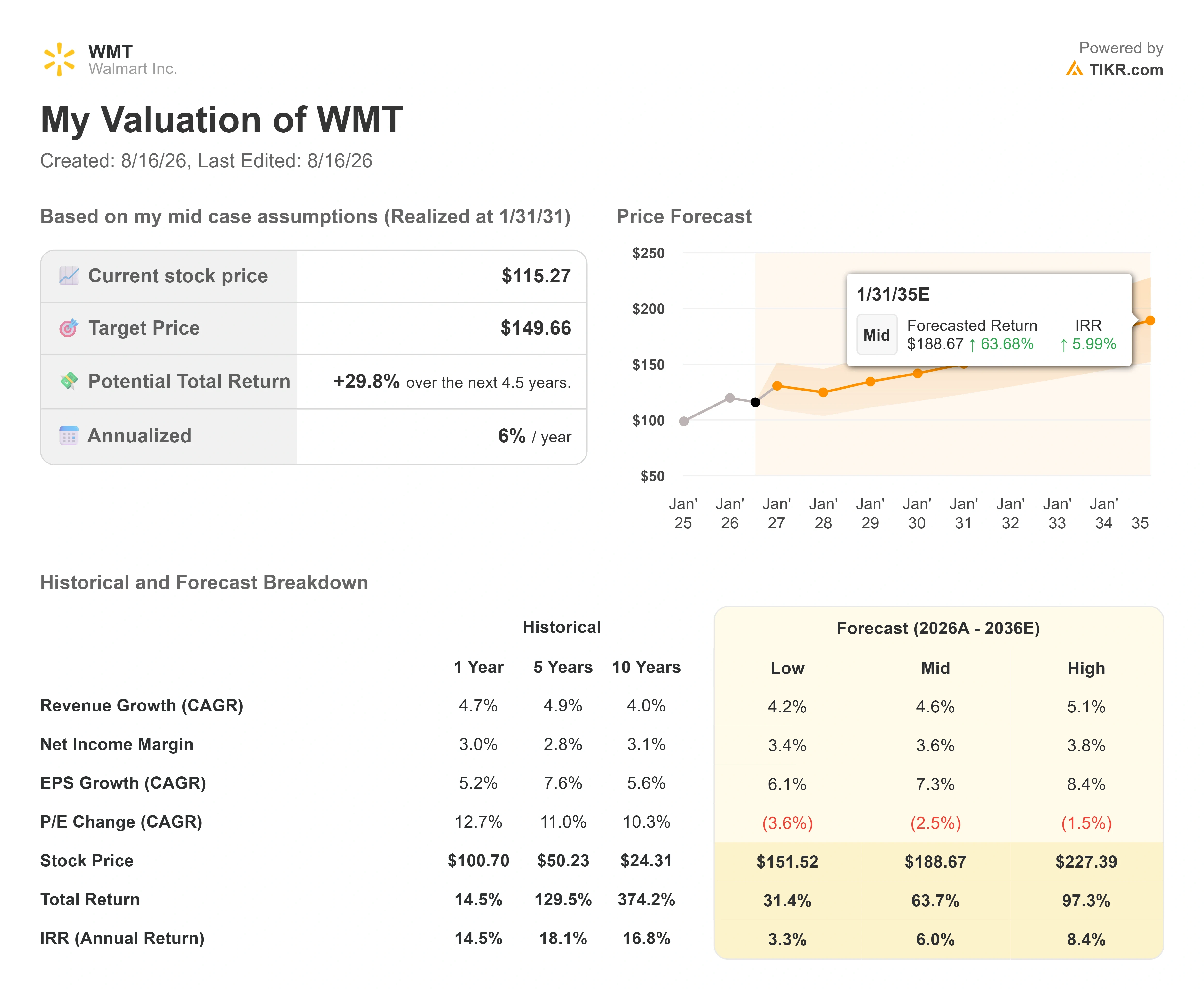
- Current Price: $115.27
- Target Price (Mid): ~$189
- Potential Total Return: ~64%
- Annualized IRR: ~6% / year
See analysts’ growth forecasts and price targets for Walmart stock (It’s free!) >>>
TIKR’s mid-case model values Walmart at around $190 by January 2036, roughly 64% total return from today’s price, or about 6% a year. The two revenue drivers are mid-single-digit consolidated sales growth, a 4.6% revenue CAGR in the mid case, and the faster-growing, higher-margin advertising and membership streams that lift blended profit per dollar of sales. The margin driver is that mix shift, which the model assumes nudges net income margin from roughly 3% toward the mid-3% range. The primary risk is the multiple: the model assumes the P/E compresses modestly, around a 2.5% annual decline, so the return comes from earnings growth, not from the market paying more.
The upside: if the higher-margin streams keep compounding at their recent pace and margins expand faster than modeled, the high case points toward roughly $227, about 97% total return over the period. The downside: if tariffs and a soft consumer squeeze the core while capex stays elevated, the low case lands near $152, still roughly 31% above today’s price but only about 3% a year over the full horizon. All three cases sit above the Street’s mean target of around $138, which reflects a much shorter one-year view, so the model’s longer horizon is why it reads more bullish than the average analyst.
Conclusion
Watch the operating-income line, not the EPS headline. A clean read looks like constant-currency operating income growing near the high end of the 6% to 8% full-year guide with advertising still compounding above 35%, which would validate the premium and likely lift the stock. A worrying read looks like operating income growing only in line with sales, or another guidance hold that denies the raise investors want, which would pressure a stock at about 40 times earnings. The answer comes before the open on August 20, with management’s tone on tariffs and the second-half consumer as the tiebreaker.
See what stocks billionaire investors are buying so you can follow the smart money with TIKR.
Should You Invest in Walmart?
The only way to really know is to look at the numbers yourself. TIKR gives you free access to the same institutional-quality financial data that professional analysts use to answer exactly that question.
Pull up Walmart, and you’ll see years of historical financials, what Wall Street analysts expect for revenue and earnings in the quarters ahead, how valuation multiples have moved over time, and whether price targets are trending up or down.
You can build a free watchlist to track Walmart alongside every other stock on your radar. No credit card required. Just the data you need to decide for yourself.
Analyze Walmart on TIKR Free →
Looking for New Opportunities?
- See what stocks billionaire investors are buying so you can follow the smart money.
- Analyze stocks in as little as 5 minutes with TIKR’s all-in-one, easy-to-use platform.
- The more rocks you overturn… the more opportunities you’ll uncover. Search 100K+ global stocks, global top investor holdings, and more with TIKR.
Disclaimer:
Please note that the articles on TIKR are not intended to serve as investment or financial advice from TIKR or our content team, nor are they recommendations to buy or sell any stocks. We create our content based on TIKR Terminal’s investment data and analysts’ estimates. Our analysis might not include recent company news or important updates. TIKR has no position in any stocks mentioned. Thank you for reading, and happy investing!