Key Takeaways
- Wedbush initiated coverage of Visa with an Outperform rating and a $487 price target, 15% above the current price, after the stock gained 29% in a year.
- Wedbush’s case rests on value-added services, which grew 31% at Visa in the quarter to Sept. 30, against 19% at Mastercard.
- The main risk is client incentives, which rose 21% last quarter, with around a quarter of Visa’s payments volume up for renewal in fiscal 2027.
- On fiscal 2028 earnings estimates, $487 is 28x, about where Visa trades today, so the target looks reachable.
Wedbush analyst Moshe Katri initiated coverage of Visa (V) on Nov. 24 with an Outperform rating and a $487 price target, 15% above the current price. That’s a call for more after a strong run: the stock is up 29% in a year and sits 4% below its 52-week high.
Katri started Mastercard (MA) at Outperform the same day, with a $751 target.
Wedbush is betting on the services
Katri argues the industry’s main driver has changed. The Street used to point to consumers and small businesses moving to electronic payments, he told clients. Now he sees the bigger driver in a shift away from per-transaction fees, which keep getting squeezed, toward services such as fraud, cyber, data, rewards and identity tools.
Visa’s own results back up the services half. On the Oct. 27 call, CEO Ryan McInerney said value-added services revenue grew 30% in constant dollars to $14 billion in fiscal 2026, and he expects “strong VAS growth in the low to mid-20s in 2027.” Mastercard’s value-added services revenue rose 19% in the quarter to Sept. 30, while Visa’s grew 31% in constant dollars over the same three months.
The squeeze is harder to find. Visa’s service revenue grew 14% in its fiscal fourth quarter against 10% growth in the payments volume it’s billed on, which CFO Chris Suh put down mainly to pricing.
TIKR tracks 40 analysts on Visa. How many say “Buy”?
See the full breakdown of Buy, Hold, and Sell ratings on Visa, along with Wall Street’s revenue and earnings estimates, all in one place. More than 500,000 investors use TIKR to research stocks like this one. See Visa’s Analyst Ratings
Does $487 add up?
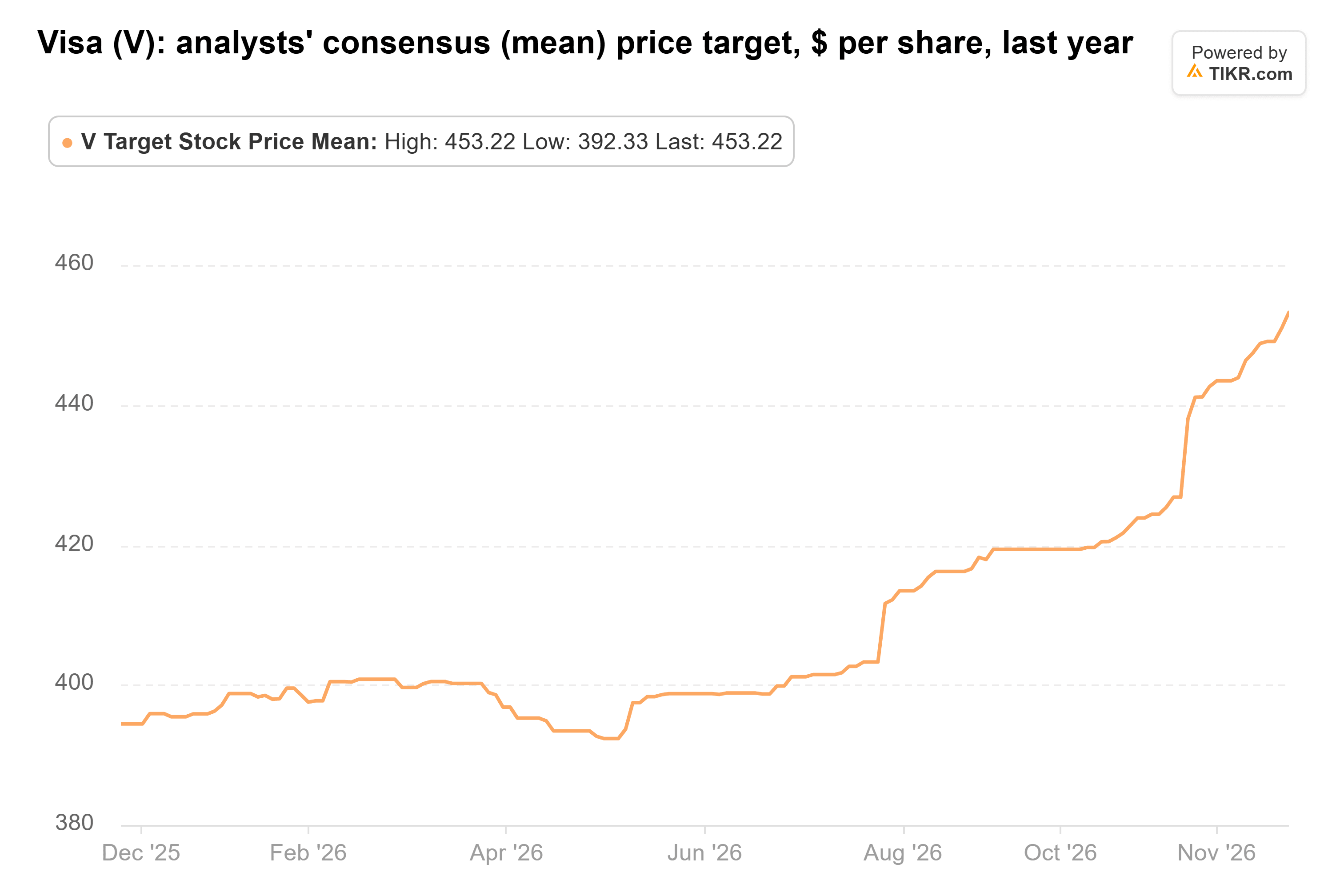
TIKR tracks 40 analysts on Visa, and their average price target has climbed to $453 from $394 a year ago:
Analysts’ normalized EPS estimates have edged up as well, to $15.03 for fiscal 2027 and $17.13 for fiscal 2028, from $15.00 and $17.04 three months ago:

A year from now, the market will be pricing fiscal 2028. On that year’s $17.13, $487 is 28x earnings, right around today’s 28x and a bit above Visa’s five-year average of 27x:

Wedbush hasn’t published its math. On mine, most of the upside comes from earnings growth: 14% from the next twelve months’ EPS to fiscal 2028’s, plus about 3% from a slightly higher multiple.
Incentives are the catch
Visa expects around 25% of its payments volume to come up for renewal in fiscal 2027, and Suh said that “implies a step-up in the year-over-year growth rate” of client incentives, which already rose 21% in the fourth quarter. Freedom Capital Markets cited the same pressure when it cut Visa to Hold on Nov. 4, even as it raised its target to $427 from $410.
Still, Wedbush’s $487 looks reachable to me. It needs only the multiple Visa already trades at, on estimates that keep inching higher. At Visa’s five-year average multiple, fiscal 2028’s estimate gives about $455, right on the Street’s average, so Wedbush’s extra is a bet on Visa keeping its premium.
The fiscal first-quarter report in late January is the first test. If incentive growth runs well above 21% while revenue is guided to grow in the low double digits for the year, $487 gets much harder to reach.
So what is Visa stock actually worth?
TIKR lets you forecast the future price of any stock in less than a minute. Just enter a few assumptions into TIKR’s valuation model and see what Visa could be worth. Start from Wall Street consensus estimates, or adjust the inputs to reflect your own view of the business. It’s free to use.
Disclaimer:
Please note that the articles on TIKR are not intended to serve as investment or financial advice from TIKR or our content team, nor are they recommendations to buy or sell any stocks. We create our content based on TIKR Terminal’s investment data and analysts’ estimates. Our analysis might not include recent company news or important updates. TIKR has no position in any of the stocks mentioned. Thank you for reading, and happy investing!