Key Takeaways
- Verizon yields 6.1% at its current dividend, against 2.0% for Texas Instruments, which raised its dividend 7% in September.
- Texas Instruments grew its dividend 8.1% a year from fiscal 2020 to fiscal 2025, against 1.9% a year for Verizon.
- Verizon’s dividend took 52% of its free cash flow over the twelve months to Sept. 30, 2026, against 71% at Texas Instruments, whose dividend outran its free cash flow from fiscal 2023 to fiscal 2025.
- SpaceX’s push into mobile service is the main risk to watch for Verizon.
Verizon Communications (VZ) had a rough October. Its stock fell 9% on Oct. 9, its worst day since 2002, after SpaceX agreed to buy a nationwide block of low-band spectrum for its Starlink Mobile service.
Texas Instruments (TXN) is having a much better fall. It raised its quarterly dividend 7% to $1.52 a share on Sept. 17, marking what it calls “23 consecutive years of dividend increases,” and reported third-quarter revenue up 28% on Oct. 21.
So income investors have a choice: Verizon’s 6.1% yield, or Texas Instruments’ faster-growing dividend. With $10,000 to invest, which pays you more over the next 10 years?
| Metric | Verizon (VZ) | Texas Instruments (TXN) |
|---|---|---|
| Dividend yield | 6.1% | 2.0% |
| Annual dividend | $2.83 | $6.08 |
| Dividend growth, fiscal 2020-2025 | 1.9% a year | 8.1% a year |
| Cash dividend payout ratio (TTM to Sept. 30, 2026) | 52% | 71% |
| Net debt/EBITDA (LTM) | 3.3x | 0.5x |
| Interest coverage (LTM) | 4.3x | 15.1x |
Source: TIKR and StockAnalysis, Nov. 5, 2026.
6 safe dividend stocks paying retirees 6%+ yields
There are over 100 stocks paying 6%+ annual dividends today.
But after an extensive investment review leveraging TIKR’s proprietary data, we now believe only six of them are truly safe for retirees.
They’re all yours for free as part of our new investment report, which you can access right here.
Verizon’s check comes with room to spare
Verizon’s core business is growing. Mobility and broadband service revenue rose 2.9% to $23.5 billion in the third quarter of 2026, and management expects about 4% growth in the fourth. Wireless equipment revenue fell 9% as Verizon cut back on subsidies, a trade CEO Dan Schulman says is “winning loyal, high-value customers while expanding margins, reducing churn, and generating strong sustained cash flow.”
The cash backs him up. Third-quarter free cash flow rose 12.1% to $7.8 billion, and the dividend took a well-covered 52% of free cash flow over the twelve months to Sept. 30, 2026. Free cash flow has covered the dividend every year since fiscal 2018, even in fiscal 2022, when the dividend took 77%:
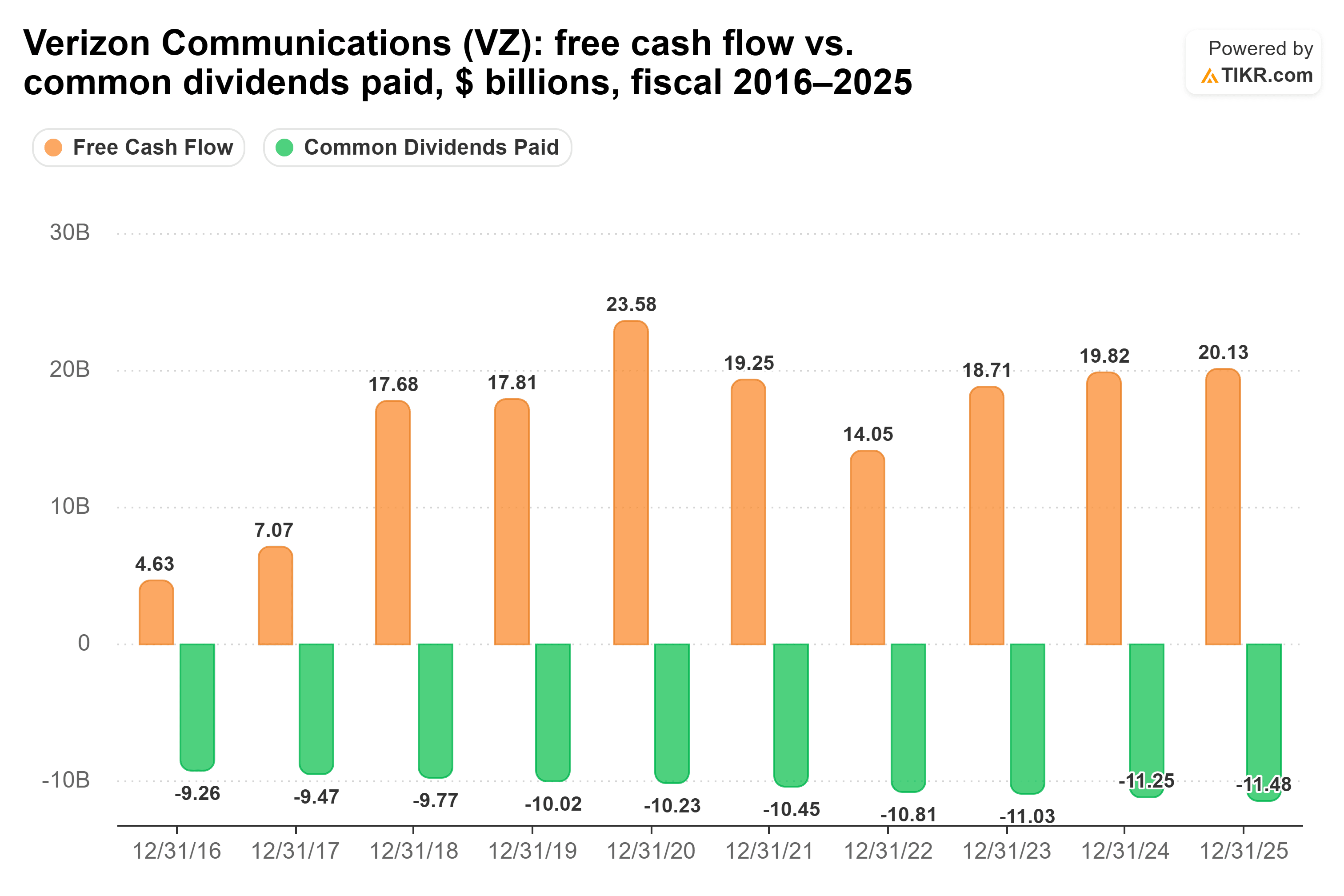
That leaves real room behind management’s pledge, on its third-quarter call, to keep “growing the dividend.”
The risks are debt, at 3.3x net debt to EBITDA, and SpaceX. Bloomberg reported on Oct. 23 that SpaceX is in talks to use at least 80,000 US cell sites, and SpaceX President Gwynne Shotwell said on its Oct. 20 call that it’s aiming for service on its own airwaves in early 2028. (Verizon slipped 1% that day.) None of that dents today’s coverage, but it threatens the wireless cash flow that pays the dividend.
Texas Instruments’ cash is catching up
Texas Instruments’ dividend has had a rougher run on the cash side, even with its business booming. Third-quarter revenue rose 28% to $6.06 billion, with industrial, automotive and data center demand all growing.
Over the twelve months to Sept. 30, 2026, the dividend took 71% of free cash flow, a tighter fit than Verizon’s. Before that, free cash flow dropped from $5.92 billion in fiscal 2022 to $1.35 billion in fiscal 2023, while dividends paid kept rising, to $5 billion in fiscal 2025:
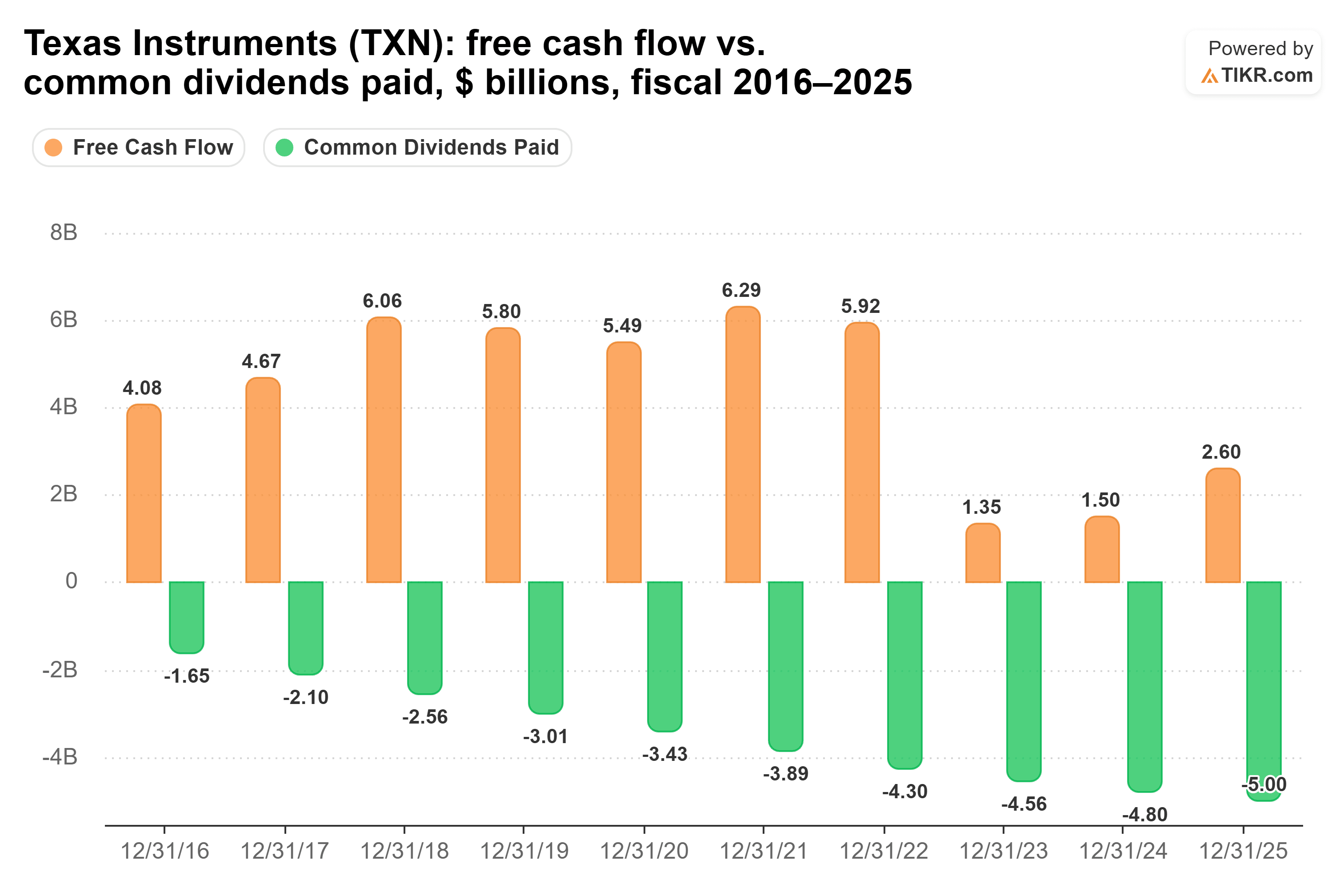
Even in fiscal 2025, the dividend came to a risky 192% of free cash flow.
Texas Instruments says September’s raise reflects its “continued commitment to return all free cash flow to its owners over time.” It returned more than that for three years, but the recovery in free cash flow is what keeps the raises coming. The main risk is the chip cycle: demand from industrial and auto customers can turn. With net debt at just 0.5x EBITDA, it has the balance sheet to ride out a downturn.
So which dividend wins?
Verizon pays you more over the next 10 years, by a wide margin. Put $10,000 in it at its 6.1% yield, and it pays $607 a year today. Growing at its 1.9% five-year rate, that’s about $722 in year 10 and about $6,628 in all. The same $10,000 in Texas Instruments pays $200 today, about $404 in year 10 at its 8.1% rate, and about $2,916 in all.
At the pace each dividend grew in fiscal 2025, 1.5% for Verizon and 4.6% for Texas Instruments, Verizon’s 10-year lead widens to about $4,028. Even at its five-year rate, Texas Instruments’ income wouldn’t pass Verizon’s until about 2045.
Verizon’s rate is also the easier one to keep: 1.9% a year from a dividend taking 52% of free cash flow, with management now expecting free cash flow growth approaching 12% for 2026. Texas Instruments’ 8.1% depends on its free cash flow recovery holding up.
This isn’t to say Texas Instruments is a bad dividend stock. It just raised its payout 7%, it carries little debt, and its business is growing faster. Its year-10 check works out to a 4.0% yield on your original $10,000, and you’d want to count the stock’s growth on top of that. It’s just that over 10 years, I’d rather have the bigger check, covered with more room to spare.
Of course, if Starlink Mobile starts winning Verizon’s wireless customers, that room could shrink fast.
Enjoy your retirement in style with these safe 6%+ dividend yields
Dividends can hold the key to enormous wealth. But only if you buy the right ones.
Picking the right high-yield dividend stock can be the difference between a dream retirement…and scraping by every month, waiting for the next Social Security check to clear.
We’ve identified six stocks yielding 6%+ that we believe every retiree should know about right now.
Disclaimer:
Please note that the articles on TIKR are not intended to serve as investment or financial advice from TIKR or our content team, nor are they recommendations to buy or sell any stocks. We create our content based on TIKR Terminal’s investment data and analysts’ estimates. Our analysis might not include recent company news or important updates. TIKR has no position in any of the stocks mentioned. Thank you for reading, and happy investing!