Key Takeaways
- Upstart fell 14% in a week to a new 52-week low after a hot inflation report sent Treasury yields higher and hit consumer lenders, including SoFi.
- Upstart takes the bigger hit: it relies on outside loan buyers and holds loans that lose value as rates and defaults rise, while SoFi funds itself with deposits.
- Analysts have cut Upstart’s 2026 and 2027 earnings estimates by 18% to 20% since its Nov. 3 outlook cut.
- The stock trades at about 7x forward earnings, but buying can wait until the Upstart Macro Index turns lower.
Upstart Holdings (UPST) stock fell 14% in the week to Nov. 16, closing at a new 52-week low of $19.09, and SoFi Technologies (SOFI) fell 11% over the same days.
Most of the damage came on Nov. 10, when Upstart lost 8.3%. October’s consumer prices rose 0.4%, above the 0.3% forecasters expected, and the hot report knocked consumer lenders lower. The 10-year Treasury yield rose 12 basis points after briefly topping 5%. CEO Paul Gu had already flagged this kind of pressure when Upstart cut its 2026 outlook on Nov. 3: “Macro is putting pressure on our near-term outlook,” he said in the third-quarter release.
Rates Hit Upstart Harder Than SoFi
It comes down to funding. Deposits made up 90% of SoFi’s average liabilities in the third quarter, when it originated a record $16.9 billion of loans and raised its full-year guidance.
Upstart has no deposits yet. It needs banks and investors to buy its loans, and it shares their losses to keep them funding. Its maximum exposure under those deals, a worst case it calls remote, was $1.50 billion at Sept. 30, about 1.7 times its $887.4 million of equity, its 10-Q shows. As rates and expected defaults climb, those stakes and the loans Upstart holds lose value. That’s why it cut its 2026 revenue outlook to about $1.35 billion, from $1.4 billion.
The timing made it worse. On the earnings call, Upstart said the new outlook assumes its Macro Index, its gauge of default risk, stays at or below 1.55 through year-end, with no big change in two-year Treasury yields. The index already sits at 1.53. A week later, the two-year yield jumped 18 basis points in a day, its biggest rise since April 2025.
SoFi got swept up in the group’s selloff. Upstart’s forecast lost one of its two props.
6 Safe Dividend Stocks Paying Retirees 6%+ Yields
There are over 100 stocks paying 6%+ annual dividends today.
But after an extensive investment review leveraging TIKR’s proprietary data, we now believe only six of them are truly safe for retirees.
They’re all yours as part of our new investment report. Learn more about how to get access right here.
Upstart Stock Is Cheap, but I’d Wait for the UMI
Before the report, analysts were looking for normalized EPS of $2.29 in 2026 and $3.58 in 2027. Now it’s $1.84 and $2.94:
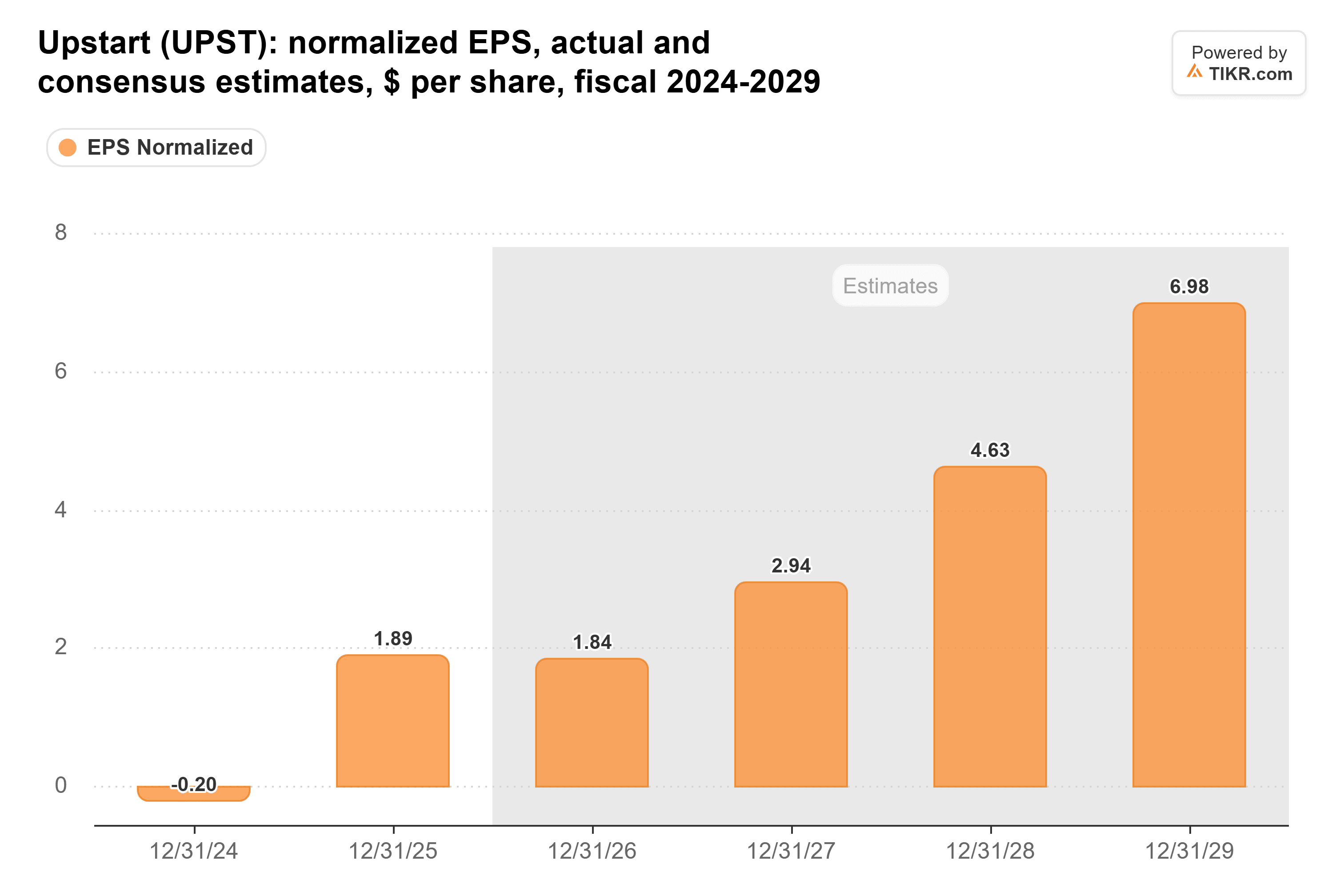
Gu told Citi’s FinTech conference on Nov. 10 that he’s aiming for record results across Upstart’s income statement in 2027, a goal rather than formal guidance. The 2026 estimate is still slipping, though 2027 has held at $2.94 (it was $2.91 on Nov. 11). The 1.55 assumption only covers the 2026 outlook, but an index that keeps climbing would put the 2027 number at risk too.
The stock trades at about 7x forward earnings, roughly half its 14x average over the past year. Wall Street’s average target is $31, down from $68 a year ago, and Citi’s $46 is the highest.
At 7x, selling looks late. But a rising index is what marked down the loans Upstart holds and drove this outlook cut, so I’d wait to buy until it turns lower. November’s originations and a new UMI reading come out in early December, and the fourth-quarter report, due around February, should give a first look at 2027.
6 Safe Dividend Stocks Paying Retirees 6%+ Yields
There are over 100 stocks paying 6%+ annual dividends today.
But after an extensive investment review leveraging TIKR’s proprietary data, we now believe only six of them are truly safe for retirees.
They’re all yours as part of our new investment report. Learn more about how to get access right here.
Disclaimer:
Please note that the articles on TIKR are not intended to serve as investment or financial advice from TIKR or our content team, nor are they recommendations to buy or sell any stocks. We create our content based on TIKR Terminal’s investment data and analysts’ estimates. Our analysis might not include recent company news or important updates. TIKR has no position in any of the stocks mentioned. Thank you for reading, and happy investing!