Key Takeaways
- Nvidia was reportedly TSMC’s largest customer in 2025, at 19% of revenue (NT$727.0 billion), up from 12% in 2024.
- The Wall Street Journal reported that Jensen Huang, whose resignation as Nvidia’s CEO was announced on Nov. 12, worried in August about an “avalanche” of wafer and memory commitments.
- TSMC’s capacity is tight and backed by NT$234.2 billion of customer prepayments, so the risk to its sales over the next year or two looks small.
- The real test is 2028, when TSMC’s record spending becomes new capacity, and analysts expect revenue of NT$9.7 trillion.
Nvidia (NVDA) is sitting on a pile of chips, and The Wall Street Journal says the man who ran it saw the pile coming. Most of those chips started as wafers at Taiwan Semiconductor Manufacturing (TSM), and Nvidia is TSMC’s biggest customer. Nvidia shares closed down 4.34% on Nov. 12, the day Jensen Huang’s resignation as CEO was announced, and TSMC’s U.S.-listed shares fell 1.90%.
According to the Journal’s report late that day, Huang told his top finance executives at an August meeting that the wafers and memory Nvidia had committed to buying were coming at him like an “avalanche.” The report also says Nvidia had been in talks to provide billions of dollars of guarantees to companies that couldn’t afford its chips. Colette Kress, Nvidia’s CFO and now also its interim CEO, questioned that dealmaking and helped cut Nvidia’s proposed commitment to an OpenAI data center project in half.
The memory side of that avalanche lands on SK hynix. The wafer side lands on TSMC.
Better Offline host Ed Zitron put it bluntly on X: “Apparently Jensen Huang was worried that he had overcommitted to TSMC, and that’s why he pushed for the OpenAI data center backstop.” That’s Zitron’s reading, and it narrows the Journal’s account, which covered memory as well as wafers.
If he’s right about the wafer side, TSMC is the company on the other side of those orders.
TIKR tracks 35 analysts on TSMC. How many say “Buy”?
See the full breakdown of Buy, Hold, and Sell ratings on TSMC, along with Wall Street’s revenue and earnings estimates, all in one place. More than 500,000 investors use TIKR to research stocks like this one. See TSMC’s Analyst Ratings
Nvidia is now TSMC’s No. 1 customer
TSMC doesn’t name its customers, but its largest in 2025, widely reported to be Nvidia, made up 19% of revenue. That’s NT$727.0 billion, or roughly $23 billion. It’s up from 12% (NT$352.3 billion) in 2024, so Nvidia’s business with TSMC more than doubled in a year and moved it past Apple at 17%. AI drove it: high-performance computing, which includes AI accelerators, was 68% of TSMC’s third-quarter 2026 revenue, up from 57% a year earlier.
Analysts expect TSMC’s revenue to keep climbing fast through 2028:
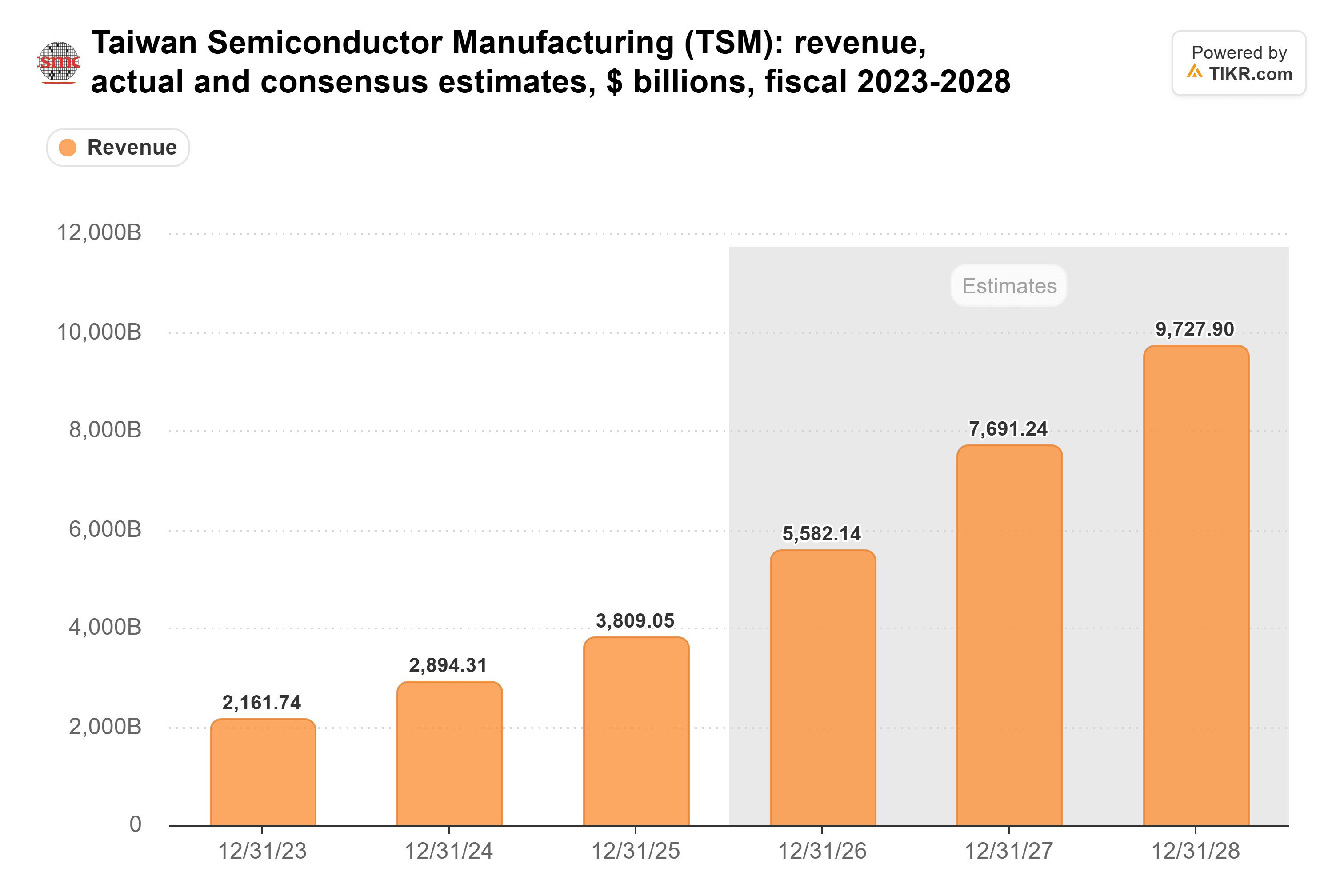
Consensus has revenue rising from NT$2.9 trillion in 2024 to NT$9.7 trillion in 2028, about 35% a year. That’s well ahead of management’s own January framework of growth approaching 25% a year in US dollars from 2024 to 2029. And a big share of that forecast depends on the customer the Journal is writing about.
TSMC is spending for 2028
TSMC’s capital spending hit a record NT$1.27 trillion in 2025, well past its 2022 peak:
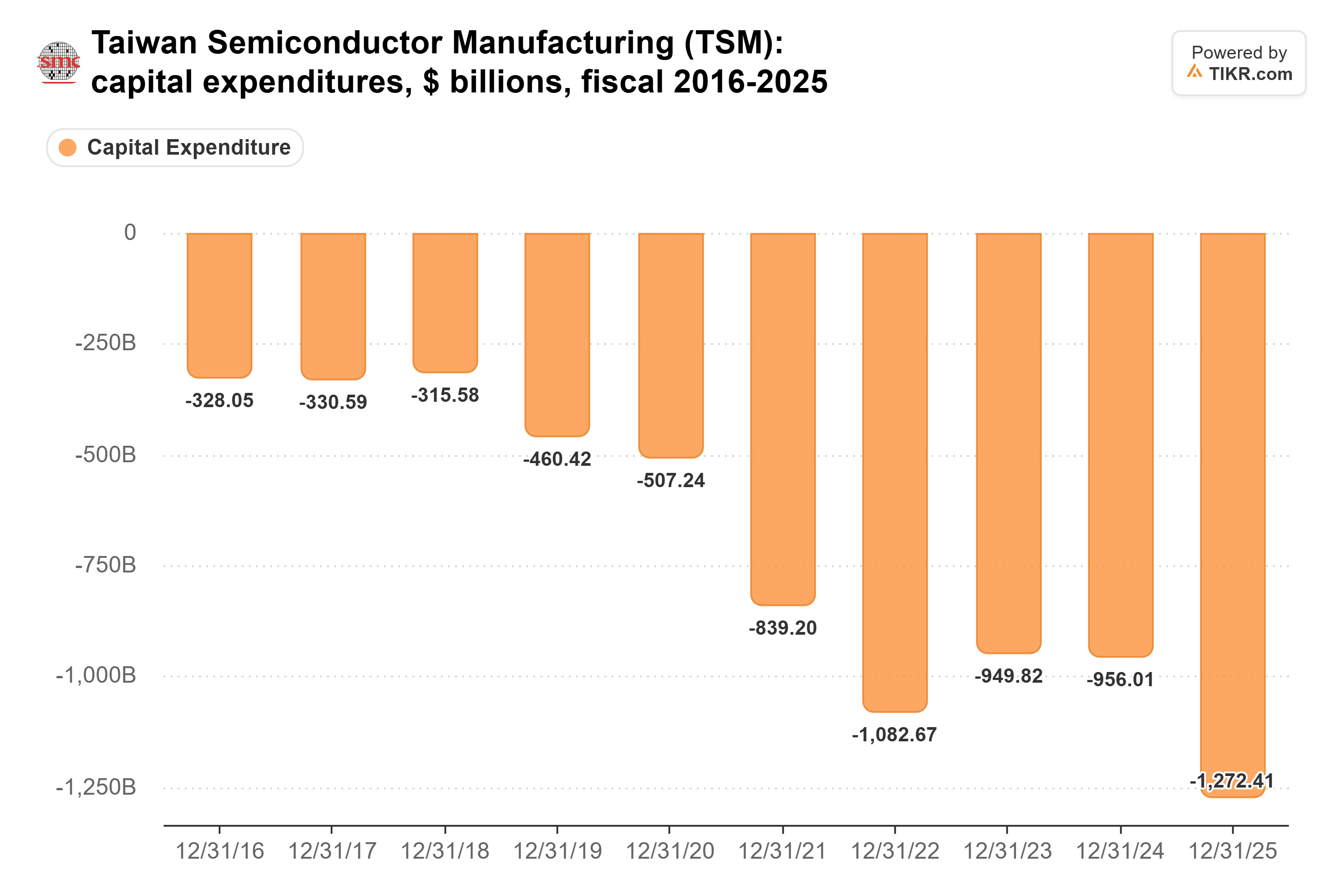
This year will be bigger. Management guides 2026 capex to US$60 billion to US$64 billion, up from US$40.9 billion in 2025. It also expects spending from 2026 to 2028 to be significantly higher than the US$101 billion of the three years before. CEO C.C. Wei says a new fab takes two to three years to build, so most of that money pays for output in 2028 and 2029.
Meanwhile, Nvidia’s inventory has more than quadrupled in under two years:
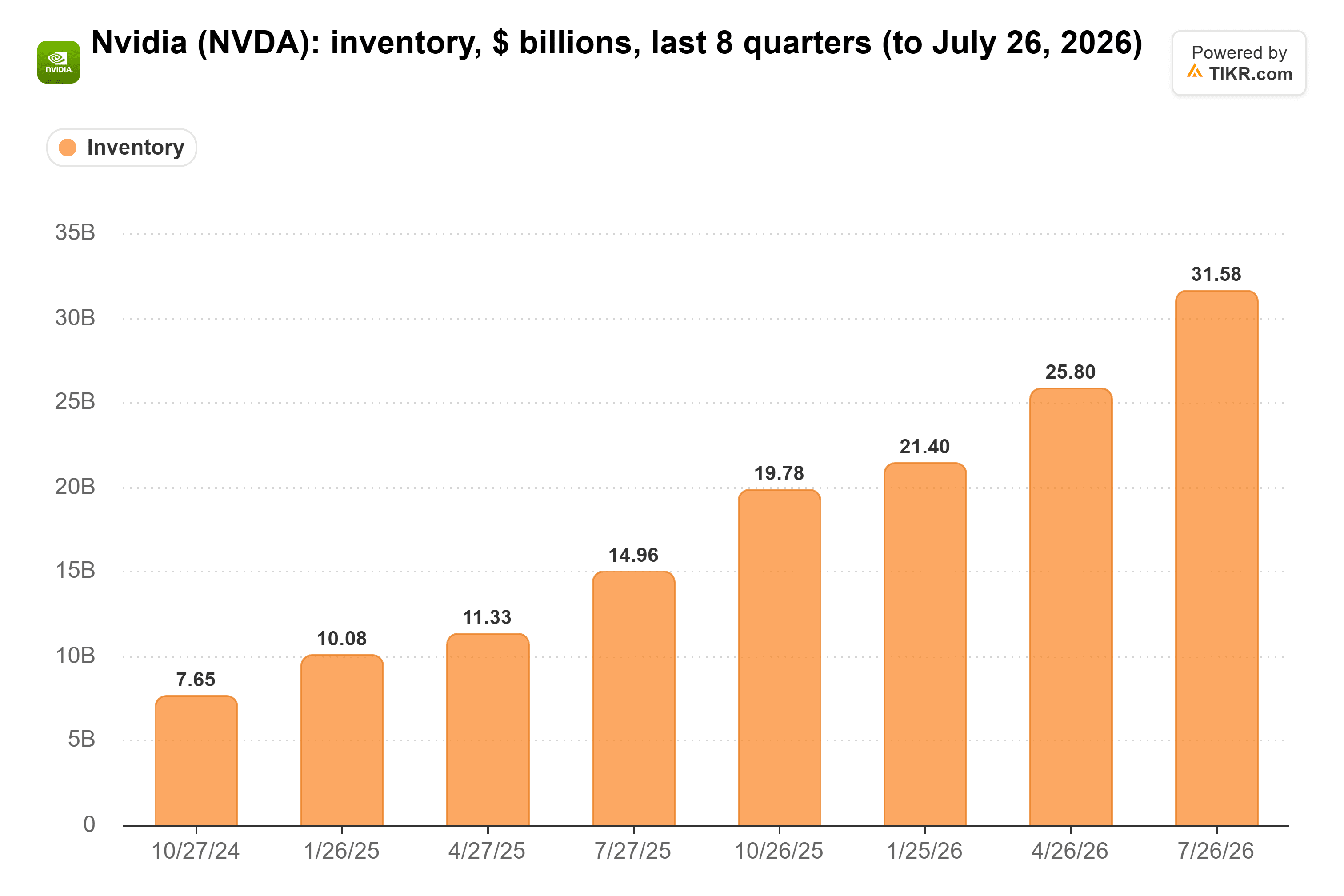
It went from $7.65 billion at the end of the quarter to Oct. 27, 2024, to $31.6 billion at the end of the quarter to July 26, 2026. Some of that is a bigger business carrying more stock. But it’s the same buildup behind the commitments Huang reportedly called an avalanche, and it was still growing as TSMC built for Nvidia’s next orders.
TSMC’s wafers have other buyers today
TSMC isn’t short of customers. At June 30, 2026, customers had prepaid NT$234.2 billion to hold capacity, up from NT$189.9 billion at the end of 2025. The part for capacity more than a year out more than doubled, to NT$92.4 billion from NT$43.3 billion. Demand hasn’t slowed either: TSMC’s October revenue rose 59.7% from a year earlier to NT$586.89 billion, its best month of 2026.
Other chipmakers are lining up for that capacity. Taiwan’s Commercial Times reported on Nov. 10, citing supply-chain sources, that Nvidia may slow its chip orders, and custom-chip suppliers told the paper their customers would take any capacity TSMC frees up, though industry sources said orders were unchanged for now. The same paper reported in late October that TSMC is preparing to raise its advanced-packaging prices by up to 20%, as packaging demand spreads from AI GPUs to server CPUs and custom AI chips. TSMC hasn’t confirmed either report, but both point the same way: if Nvidia orders fewer wafers in 2026 or 2027, other buyers look ready to take them.
2028 is TSMC’s real problem
The fabs TSMC is paying for now are a different story. Wei told shareholders in June 2025 that customers’ combined forecasts for 2026 added up to more than the market could realistically absorb, which leaves TSMC to decide how much to build. The Journal’s report raises the risk that Nvidia’s forecast ran ahead of its own customers: Huang was reportedly worried that major cloud providers were planning to use other chips. TSMC has been here before. After record capex in 2022, its revenue fell 4.5% in 2023, and its EPS fell 14%.
With Kress in charge after questioning those guarantees, Nvidia may finance less of its customers’ buying and order more carefully for 2028.
TSMC can handle an Nvidia pullback over the next year or two, and investors may barely notice it in the results. But the 2028 consensus of NT$9.7 trillion is already ahead of management’s own plan, and it assumes a customer worth 19% of sales keeps ordering at its old pace. That’s the number most at risk.
Nvidia could still keep ordering hard if cloud demand holds up. Kress’s first earnings call as interim CEO is on Nov. 17, and the test is whether Nvidia’s inventory and supply commitments keep climbing. TSMC’s 2027 guidance and capex budget follow in mid-January.
So what is TSMC stock actually worth?
TIKR lets you forecast the future price of any stock in less than a minute. Just enter a few assumptions into TIKR’s valuation model and see what TSMC could be worth. Start from Wall Street consensus estimates, or adjust the inputs to reflect your own view of the business. It’s free to use.
Disclaimer:
Please note that the articles on TIKR are not intended to serve as investment or financial advice from TIKR or our content team, nor are they recommendations to buy or sell any stocks. We create our content based on TIKR Terminal’s investment data and analysts’ estimates. Our analysis might not include recent company news or important updates. TIKR has no position in any of the stocks mentioned. Thank you for reading, and happy investing!